


Latest Comments

Guest - Katrin Sprang Discussion
18 September 2026
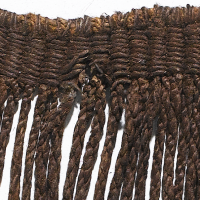
Hi Rachel, I have looked for more photos of you, but that was not very successful. I found a link on...
Guest - Beatrix Sprang Discussion
15 September 2026
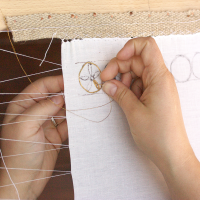
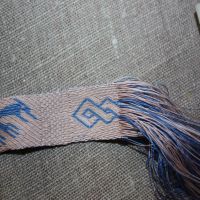
That lozenge pattern element is not a photograph, but a scan. So it should be to scale. But I pinned...
Guest - Katrin Sprang Discussion
15 September 2026
I was not referring to Rachel's reconstruction (is the reconstruction you refer to the one photograp...
Guest - Beatrix Sprang Discussion
14 September 2026
There is something Rachel did not mention. She told me: "Well, I worked with the measurements we too...
Guest - Katrin Sprang Discussion
14 September 2026
Well, this is certainly developing into an interesting discussion. Firstly, going from that lovely l...
JUN
20
0

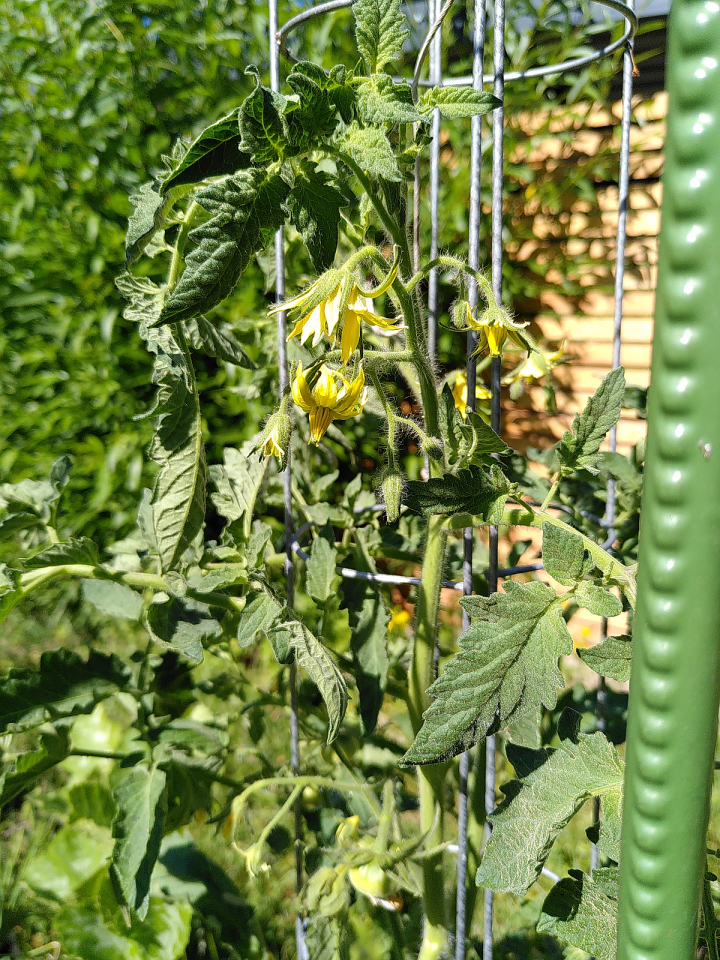
There may be... tomatoes.

It's Monday, and in spite of having had a normal amount of sleep, I'm tired. Go figure. This is slightly annoying, as - of course and as always - there's plenty of work to do. The cat snoozing in the room does not help either, spreading her snooziness molecules.

Probably the heat here is also to blame, at least partly: It's been very hot the past days, and today is no exception. There was something trying to look like a little hint of rain this morning, but it was not even enough to really register, either in our rain meter or on the ground. Which means the important plants still get their daily watering through the can today. 


We have two rainwater collectors, one of them a very large one, so there's water for the thirsty ones. Which are, mostly, tomato plants placed in pots, and a few more placed in the soil in beds. The latter, however, are not as easy or quickly to water. I also have the tendency to think that since they have roots, and practically unlimited freedom, they should be able to stretch their roots until they get to moist soil and take their water from there. In contrast, the plants in the pots don't have that possibility, so they have to get their portion of liquid daily.

So since it's been hot and dry with enough watering activities for most of the plants this year (at least up until now), there are quite a few promising-looking green tomatoes being made already. Now I hope that they will ripen soon-ish and be delicious. It would be really nice to have enough for making some sauce, or diced tomatoes, and can that for use in the winter, but I'm not sure if that will work out...

0
JUN
17
0

Green, green, supergreen.

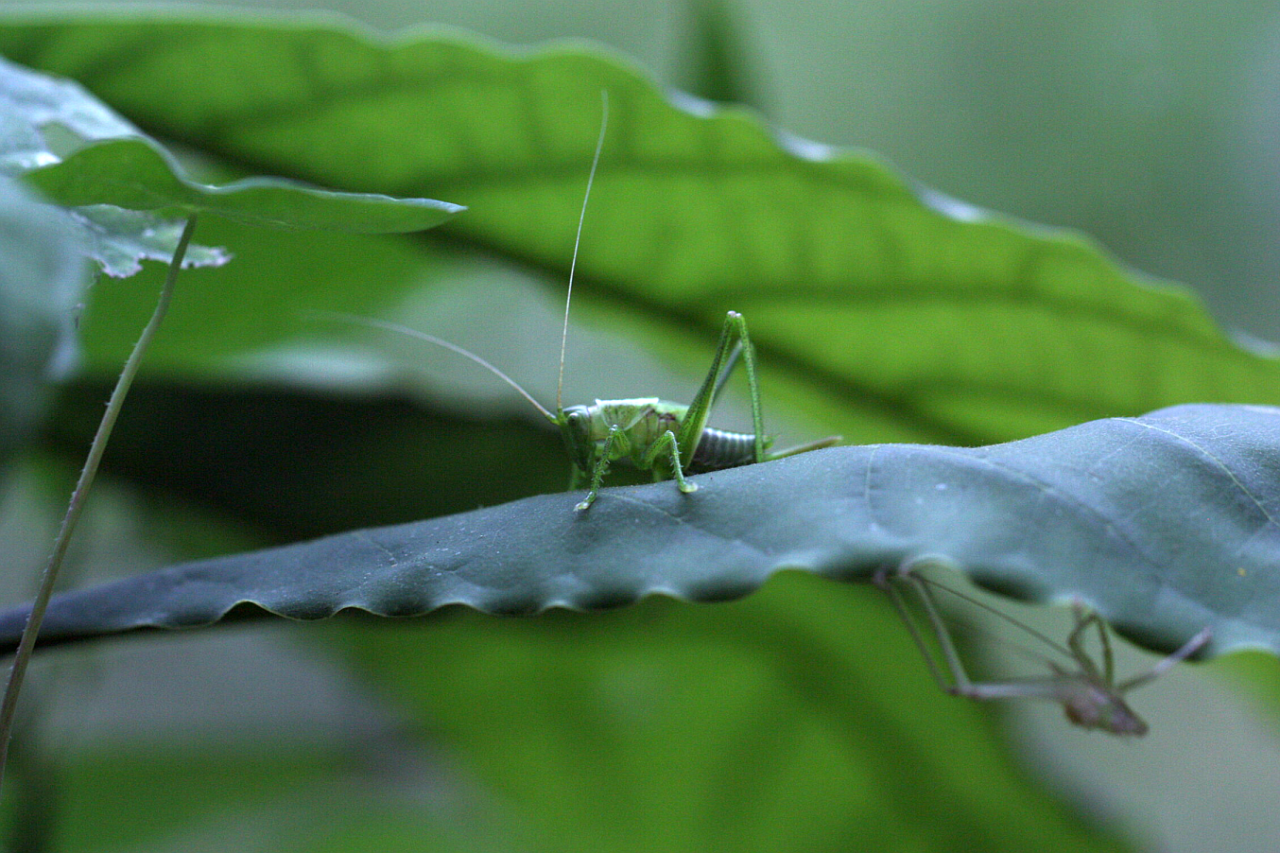
Just like last year, there's a great green bush cricket living in our wintergarden. 

It's a little larger now than it was on this photo taken some days ago - and on the photo, you can see the cast-off skin from its previous larval stage. Not fully grown yet, the green thing.

This species mostly eats other insects, but the specimen here is definitely not opposed to snacking on some green stuff as well - the leaf it is sitting on belongs to an avocado plant, and several of these leaves have a hole, or a piece eaten out of the edge. (And yes, I'm sure that this green lady is to blame for the holes, I've seen her take a few astonishingly big bites out of one leaf edge yesterday morning.)

Last year's guest had an even more exquisite taste - it bit off the tender young stem of a passionfruit seedling, and killed some other seedlings as well. Munching some avocado leaf is, in comparison, very much holding back on the havoc possible. Much appreciated!

0
JUN
16
0

Oh The Colours!

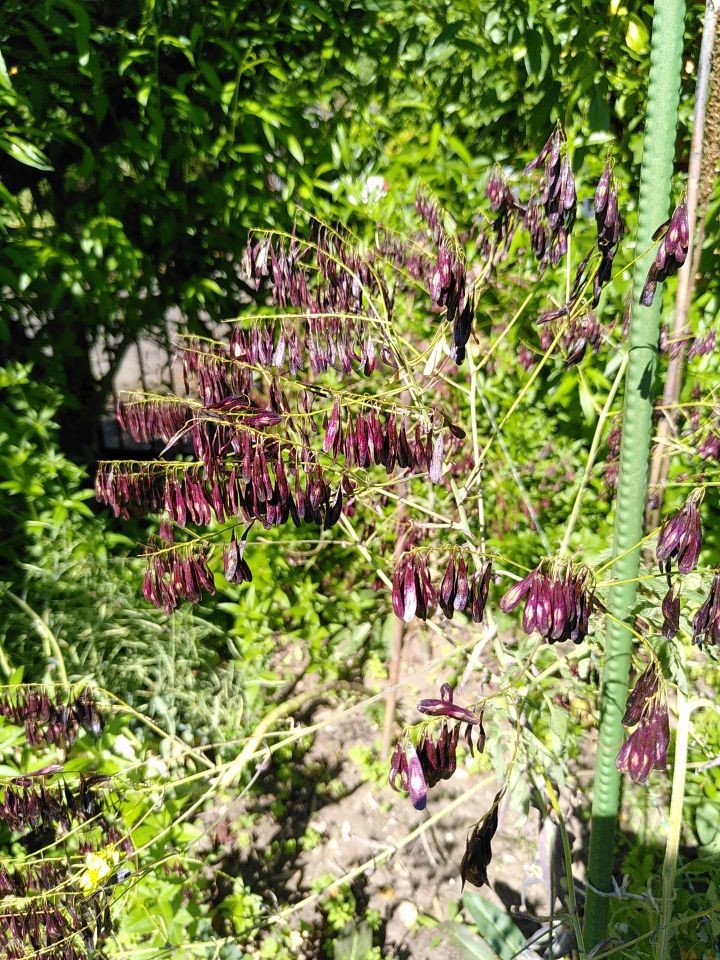
Today's a public holiday here, so instead of a proper post, you're getting this picture of ripening woad seeds: 

I really love the colours of these seeds at that stage - they stay beautiful, but the deep purple changes to something more of a brown or blackish colour as they ripen.  

0
MAR
28
1

Birds!

Today was birds-in-the-wintergarden day... it started off with a pair of black tits in the morning. When it's sunny outside, I open up at least one of the glass doors to the wintergarden, so that a) the plants get some unfiltered sunlight and b) the place does not overheat too badly. Sometimes, that means that a bird gets in and has a bit of a hard time to get out again, because it tries to fly through one of the closed doors, or one of the non-opening glass panels. 

That is not a huge problem unless Madame the Cat is on the premises - then it sometimes ends with a dead bird. Today, though, all the birds got lucky. 

The first of the black tits found its way out again straight away, while the second, smartly, sat down on a high rafter for a while. That was out of sight enough for Madame to lose some of her interest, and I could coax her inside (to visit her food bowl instead of looking for a feathery snack she won't eat anyways). After a while, the bird, now much calmer, went to explore the place in search of a way out, and was successful.

A few hours later, there was fluttering in the wintergarden again, and when I went in to take a look, two robins were trying to bore their way through one of the non-opening panes. Madame was outside on some important cat business at that time; I went and found the two birds to be surprisingly chilled. One was, in fact, so chilled that I could just grab it and carry it outside, where it refused to leave my hand and arm for a few minutes. I tried to transfer it to a nice place to sit on, but it hopped back onto my hand several times, and fluttered off only after it had shat on my arm. I've never had a robin on my finger before, and I can tell you that the grasp of these small, delicate bird feet is surprisingly strong, and that the leg length is astonishing.

I'd have loved to take a photo, but all the photo-taking implements were inside, and I didn't want to take the bird in there... 

Some minutes later, our cat returned from her important business elsewhere. Good timing, I'd say.

0
MAR
21
2

Springtime! Seedling time!

It's springtime for real now, or so it feels - getting warmer, more and more flowers opening up, and I sort of feel the slight pressure to get some of the spring gardening things done, such as planting peas.

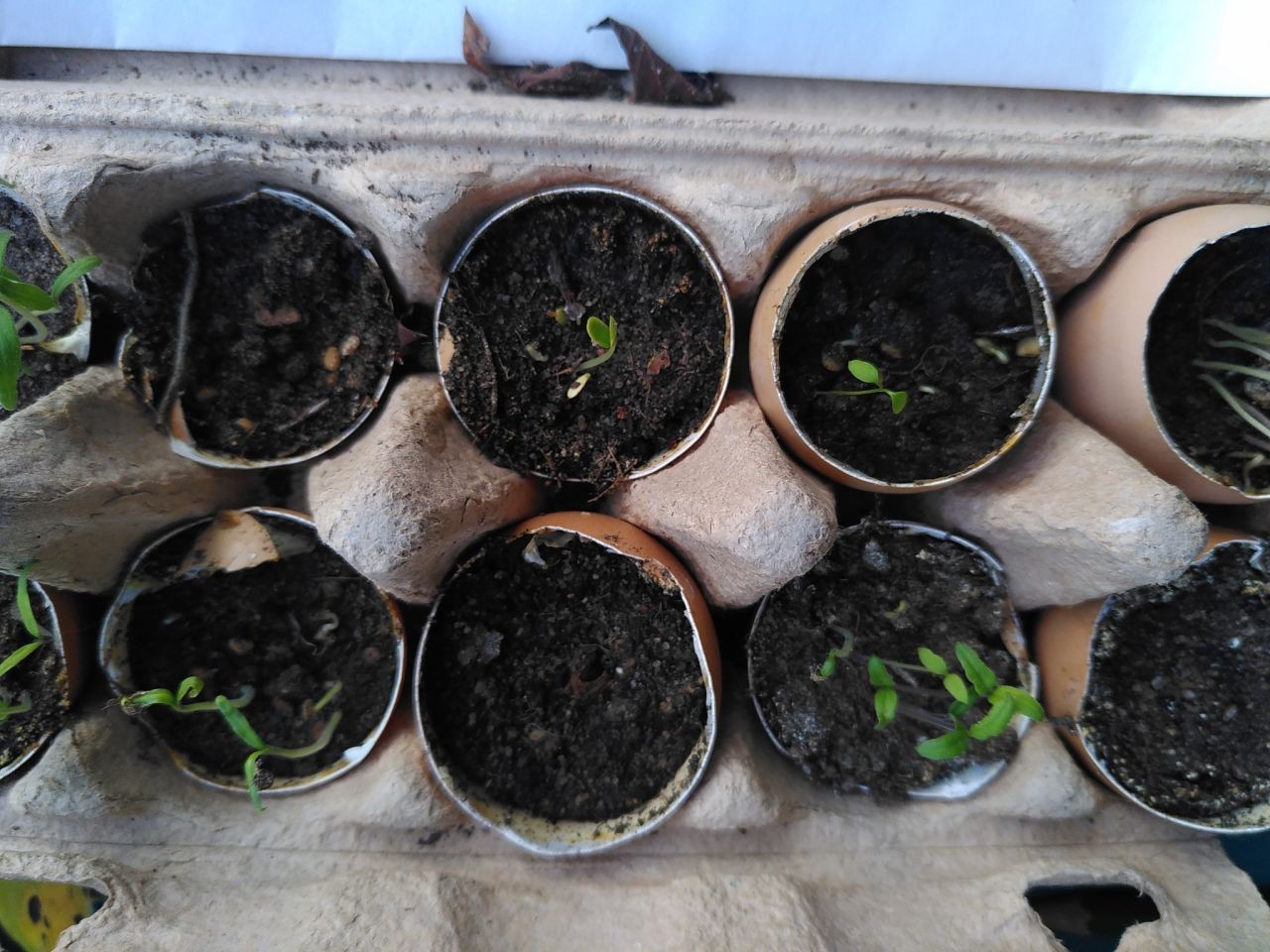
I'm also sorting through the seed stock, as there are a few packets of seeds that are probably too old to be viable anymore. Some of them I've seeded out of curiosity to see if anything will still come of it (though I'm not expecting any luck with 10 year old tomato seeds), some I've scattered in the garden (either they sprout, or get eaten by something, either way it's fine) and some are not sorted into either category yet. There were some tomato seeds that had no year with them, so I've seeded those, too. 

I've also tried something new this year, seedling-wise: 

I've used trays in the past, but they only worked semi-well; this way, I can have an eggshell for each variety and put them somewhere else if necessary (like out into the wintergarden once they have germinated, so they won't grow too tall and lanky for lack of light in too much warmth - which they need to get started). If you're thinking of trying it too, I found that the shells should be a minimum size to work nicely. We usually have L eggs, and the shell should really be split in the middle or above; if it's less than half the egg height, it's a little to shallow for me to feel comfortable. (I always think that it will dry out too quickly then.)

0
FEB
23
0

The Willow Fence.

About every year around the same time, there's pictures of our willow fence, I think.

I've always liked the idea of a living fence - and even though we have a non-living additional fence around our place, the willow one is the higher one, and the more visible one, and the more exciting one.

It's also planted a little bit too close to the actual border of our garden, which, in retrospective, was not the brightest of all ideas. We had thoroughly underestimated how far the new shoots would branch out over the street, and how many of them there would be. We're handling this now by trying to guide everything as straight up as possible with the help of strings; the trick is to tie those in while the new growth is still green and fresh and very malleable.

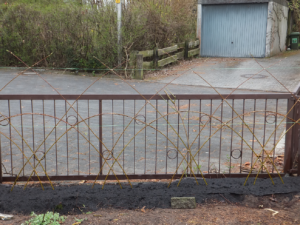
We planted the fence back in April 2012, when it looked like this:


It's a kind of willow suitable for making baskets, which was important to us - after all, if you cut back the new rods every year, it would be sad if they weren't useful in some way.

Now it looks like this:


The fence, over the years, has taught me a few things. Among them, first and foremost: Even if willows are bendy, and even if you try to get the shapes all nice and even and just so, they are living things and they will react differently. Some will grow more, some will grow less, some will die off. Nothing will be just as accurate as planned, and planted. And in some places, you'll just have to live with something looking different because of a missing bit.

There's limits to what the trees will accept, and the more horizontal you try to make something grow, the closer you get to this limit. Parts of the tree may go up and die suddenly. The low arches are an issue every year, with plenty of them growing only to about the thirdway point, and then the tree puts everything into the new rods and we end up with a dead part beyond.


Another funny thing is when two trees meld together at their contact point. (That was what I had, in my youthful optimism, planned for all of them to do, by the way.) Sometimes, nothing extraordinary happens. Sometimes, though, the new united tree then decides some part of it is not necessary anymore... and there's another bit of dead wood for us to prune off.

What is really fascinating, though, is the difference between the "before" and the "after" harvesting the rods, and how much biomass this fence puts out every year.

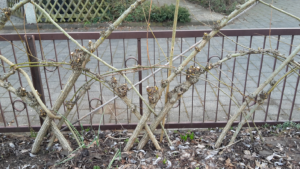
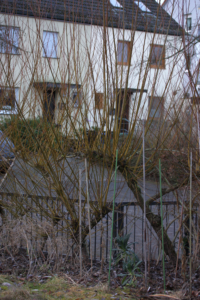
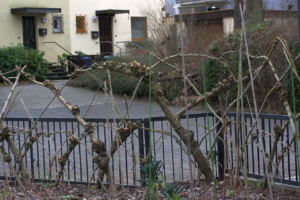
Here's the before look:


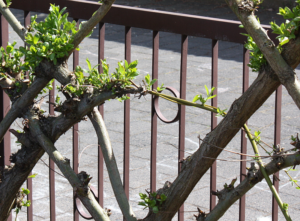
And here the after, of approximately the same bit:


Every. Single. Year. Amazing, isn't it?

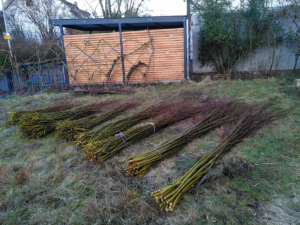
Here's this year's yield, all bundled up. Want to guess how many kilograms of willow?

0
FEB
17
0

It's Not Friday Yet.

It's still not Friday. Am I relieved, or am I disappointed? A bit of both, I guess - there's a stack of things left to do this week, and I feel like I'm way behind on many of them.

There is progress, though. Actual progress on all fronts - spinning for the Egtved blouse fabric and getting the new website version ready for a relaunch. There's also the February newsletter in the works, due out today or tomorrow. (Probably tomorrow.)

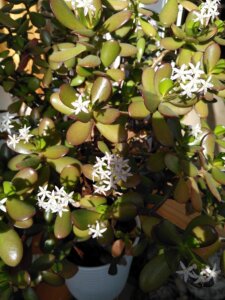
[caption id="attachment_6991" align="alignnone" width="225"] Flowers in the wintergarden! I'm still amazed that this plant can flower. My mum's specimens never did. Maybe it's due to the fertiliser provided at my place? Or more light in the wintergarden? Who knows...


There's also some garden work progress... it's the time of the year when our willow fence needs pruning and some care. We're more than halfway through with it, but the last part still has to be cut - and now, after the stormy winds have calmed down, it is time to work on this some more. With the side benefit of having some fresh air to clear the brain for a bit more work later on.
0

By accepting you will be accessing a service provided by a third-party external to https://pallia.net/

Contact