

Latest Comments

Guest - Katrin Sprang Discussion
18 September 2026
Hi Rachel, I have looked for more photos of you, but that was not very successful. I found a link on...
Guest - Beatrix Sprang Discussion
15 September 2026
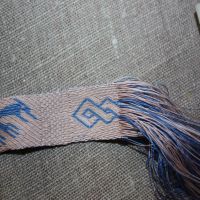
That lozenge pattern element is not a photograph, but a scan. So it should be to scale. But I pinned...
Guest - Katrin Sprang Discussion
15 September 2026
I was not referring to Rachel's reconstruction (is the reconstruction you refer to the one photograp...
Guest - Beatrix Sprang Discussion
14 September 2026
There is something Rachel did not mention. She told me: "Well, I worked with the measurements we too...
Guest - Katrin Sprang Discussion
14 September 2026
Well, this is certainly developing into an interesting discussion. Firstly, going from that lovely l...
MAR
10
0

Skjoldehamn Find Pics.

The Skjoldehamn find is a set of clothes (two pieces for the upper body, usually referred to as shirt and tunic, and a pair of trousers, plus some bands and a hood) dated to the 11th century. There's been quite a bit of debate about this find, as it's probably from the Sami culture, and oh, modern politics came into who might or might not research this. It's also apparently not clear whether it was a man's or a woman's clothing.

No matter who these pieces belonged to, however, it's an absolutely fascinating find in a quite good condition, with even some of the colour still visible.

Dan Halvard Løvlid, who has studied the Skjoldehamn textile find and has written his Master's thesis about it, has a website with photos and some newer articles about that find. The articles include a reconstruction of the starting border of the blanket and of the warp setup of the ankle bands. The photos were taken by Dan, and he has put them online in full resolution. Go and enjoy some old textile porn - and thank you, Dan, for putting this online!

0
MAR
09
0

CfP, CTR events, free access to literature

It's time for something like a link roundup again - textile conference related, this time.

The CTR has their programme online for 2022, and there's a number of meetings and lectures that everybody can attend. Every second wednesday there is a meeting from 14:00 to 15:00 followed by a presentation with discussion starting at around 15:00. The next one is on March 16, about modeling public buyer behaviour towards circular textile products and services. Learn more about the lectures on the CTR page (click the lectures link to download the current pdf programme).

EuroWeb has a Call for Papers out for a seminar which will take place in Portugal, June 29 to July 1st. The seminar is titled "What's in a name? Toponyms and loan words as textile labels across time.". The CfP is open until April 15, and you can learn more about the seminar and find out how to take part here.

Springer is granting free access to some of their programme until March 31st - including some archaeology things. Find out more here.

0
FEB
25
0

Open Library from the Internet Archive

I like online resources for research - who doesn't? And occasionally, I stumble across a new one, which is always a nice thing.

My most recent discovery happened because a colleague was searching for a specific article, published as part of a book, that I thought sounded interesting. So I checked my own library database, but of course it was not in there. Then I did a bit of a search on the 'net, and there was a link to the Internet Archive (which you might know through the WayBackMachine, which I can totally recommend if you want to look at websites that once were but are no more today) and, more specifically, to their lending library thing OpenLibrary.org - where you can virtually borrow digital copies of books. Quite a lot of books, actually, including the one in question that my colleague was looking for.

Borrowing works if you have a free log-in for the Internet Archive, and then you can read for one hour in the book in question, with automatic extension as long as nobody else wants to read it. Some things can also be borrowed to your e-reader for a 14-day period.

So in case you're running out of things to read... you might find something there. I hope you have fun!
0
JAN
19
1

Some more links...

French shepherds in a particular region used to walk on stilts - and apparently, if you learn how to do it at an early age, you can be really good with stilt-walking.

Alex Makin has made a video about the stitches in the Bayeux tapestry:


And finally, in case you've missed it (I think I posted that before somewhere) - you can download Karina Grömer's book about prehistoric textiles "Prähistorische Textilkunst in Mitteleuropa" for free from this e-library. The English version is also available behind the link. Enjoy!
0
JAN
18
0

ATR 63 is out!

Archaeological Textiles Review Issue 63 has come out a bit ago, and - as usual - you can download the pdf version for free from the ATR website.

The issue has articles about Nubian textile fragments, Greek clothing terminology, Viking Age textiles and tapestries, and tablet weaving from Hallstatt, among other things. If you're interested in archaeological textiles, it's definitely worth checking out!
0
DEC
16
0

Bamberger Kaisergewänder - digital exhibition

The imperial garments from Bamberg, topic of the special exhibition that started last year, are now featured in an online exhibition! So for all of you who were not able to go there in person to see these, you can now go and visit Bavarikon to view some very nice photos of the garments. These include a few close-ups that will bring you closer to seeing the individual stitches than would be possible in front of the real thing, as lights in the exhibition aren't too bright, and there's always a glass between you and the things.

In theory, the language can be switched from German to English, but there seems to be only German available - you can still enjoy the images, though.
0
NOV
29
0

Like an Arrow!

There's a quite interesting article online about arrow wounds found on human remains in a site in Exeter - where, due to the fracture patterns and spalling it was even possible to see the probable turn direction of the arrow causing one wound.

Arrows usually spin, due to the slight curve of the feathers used as fletching; that stabilises the arrow while it's flying through the air. Depending on the curve of the feathers used, it will either turn clockwise or counterclockwise, and the curve of the feathers in turn depends on whether it was a left or a right wing feather.

It would be very interesting to know if one arrow-maker would prefer to do all arrows fletched in the same direction... or not. Or if they used tools or gadgets to get the fletching as consistent, and as accurate, as possible (like modern people do, when shooting with bow and arrow has become a sport, and precision is important) or if they just did it by eye. Back when I was having a bit of a go at shooting with bow and arrow, I tried both - my latest set of arrows had one feather taken from a bird of prey and two goose feathers each. They were rather soft, and made a quite distinct noise when flying through the air, and they were not stuck on in the precise 120° angle that more modern fletching is done in, and they were a little irregular anyways - but my shooting precision was never on a level where I'd feel that the irregularity made any difference. (Read: I had a lot of fun, but was quite bad at it.)

Modern feather fletching, by the way, is made from turkey feathers, and you can get them in all kinds of colours and patterns, pre-cut with a die so they are all exactly alike... and that makes the arrows look very different from ones done with less standardised, more natural fletching. They will all fly, though. And they will all make quite a bit of an impact!
0

By accepting you will be accessing a service provided by a third-party external to https://pallia.net/

Contact