

Latest Comments

Guest - Katrin Sprang Discussion
18 September 2026
Hi Rachel, I have looked for more photos of you, but that was not very successful. I found a link on...
Guest - Beatrix Sprang Discussion
15 September 2026
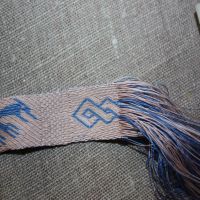
That lozenge pattern element is not a photograph, but a scan. So it should be to scale. But I pinned...
Guest - Katrin Sprang Discussion
15 September 2026
I was not referring to Rachel's reconstruction (is the reconstruction you refer to the one photograp...
Guest - Beatrix Sprang Discussion
14 September 2026
There is something Rachel did not mention. She told me: "Well, I worked with the measurements we too...
Guest - Katrin Sprang Discussion
14 September 2026
Well, this is certainly developing into an interesting discussion. Firstly, going from that lovely l...
JUL
30
3

Link Post.

Status of things here: The cat is lounging on my arms (and half on the keyboard) again, and if I have not cuddled her for too long, I get admonished that her ear needs kneading, or her belly needs rubbing, or that she generally needs some more attention. There's a package waiting to be packed and brought to the post office together with the already-packed one (which will happen very soon), the usual stack of emails to be answered and taken care of, and there are way too many tabs open in my browser. Which, as you well know, means:

Time for a link post!

If you like to look at weird design choices for... stuff, check out the Instagram account "uglydesign". It's curated by two designers who are trying to find the ugliest thing there is (just like the name hints) - but obviously, beauty and ugliness are in the eye of the beholder, and I find some of the things not predominantly ugly, but more "cool in a weird way". (Some are utterly horrible to my personal aesthetic sense, though.)

EXARC has a new section about textiles, with a collection of interesting articles that will be extended with new ones as they come up. I especially appreciate that someone else also writes about the "it depends" thing, something that has come up again and again in my personal research and crafting, and that I think is very important when discussing time needed to do something (which, in turn, is a frequent topic both in Experimental Archaeology and in explaining aspects of medieval or historical craft to the wider public).

Now some bits in German:
Here's an interesting article about how much food gets thrown away in Germany, and how much of that would be avoidable. Especially bread, one of the staples, and considered a Very German Thing Indeed, gets binned in a horribly high percentage. Altogether, a third of the food produced ends up in the trash. A THIRD!!!
We've recently had some more trouble than usual with bread getting mouldy, reasons as yet unknown (different types of bread, or the weather, or contamination of our bread box, or a mix of things, or something else, possibly), and it always makes me really sad to have to throw it away. I have a general tendency of seeing food going bad as a personal failure, and I consider throwing away still-edible things as a kind of disrespect towards all the people who have worked on making this food.
This is a combination that you might call... interesting. On the down side, it leads to much chagrin for every bit I have to bin because it's really not edible anymore, which includes those where there was no way of avoiding the outcome (such as fruit that was damaged during transport and instantly changes from "unripe" to "covered with greenish fur"). It also includes me eating dodgy stuff, or things I don't really enjoy anymore because they have to be used, on occasion. On the up side, it means that relatively few food gets thrown away here, and that I have a good amount of creative approaches to leftover foods and their use.

On to something more positive: A medieval shipwreck was found in a German river, the Lippe. The wreck was found by chance by a hobby diver, and now gets checked out by archaeologists. It's about ten metres long and probably about 1000 years old; whether and how it will be excavated is still being evaluated.

And a last German link - there's an Interessengemeinschaft Zugpferde! I didn't know that until a while ago, when I stumbled across it via an article about sustainability in field- and forestwork. For small fields and in some circumstances, it makes more sense to invest in draft animals instead of trying to go "all western, all modern" and get a tractor, or other machinery. The IG Zugpferde tries to keep the draught horse and draught cattle use alive and offers all kinds of stuff around this - from competitions to workshops and courses to learn how to care for and use draught animals. I'm utterly delighted - and I hope there will be more draught animals in use in the future!
0
JUL
16
2

Open Access?

If you're reading research papers now and then (or frequently, of course), you will probably have stumbled across The Paywall more often than you'd like. Murphy's rules for reading scholarly work definitely includes one that says "The article that sounds most interesting will be inaccessible due to some reason, preferably a paywall."

So. You'd like to read something, but the publisher would like to have half an arm, or maybe quarter of a leg for access to the volume, issue, or article? There's a few ways to get the article of interest without paying yourself. If you have a library card for a Uni library (you usually can get those without much fuss for the country you live in), and the library is within reach and has online access to the journal (which you can usually find out via their database) - there you go, you can access and download the article from a library computer. Bring your own USB stick, or mail it to yourself.

If that's not the case, there's networks like academia.edu and researchgate.net. Both are free to join, and they offer the possibility to network with researchers, follow them (so you get to see if they add something new) and read their papers. Authors upload pdf copies of their work; it's still legal, as the copies are not freely available, but within a closed group. You can also request a paper if it's not uploaded yet, and hope the person in question isn't as slow as I am with adding new things.

What I most recently discovered is unpaywall.org, which is a database with free versions of paywalled articles. There are several ways to use the database for your research, such as integration in Zotero, but the easiest one I have found is to use Chrome with the unpaywall extension. When you are on a page with a doi, you can then hopefully see a green open padlock on the right side of your screen - click that, and you are taken to the place where the free version of the article lives. (I actually installed Chrome to try this out...)

Enjoy, and may you find and get all your desired articles this way!
0
JUL
07
9

If I could have a Superpower...

There's this thing about superheroes: They have superpowers. Each, usually, their own, and they range from superstrength (Hulk smash! Superman! And don't forget Pippi Longstocking) to mind-reading to throwing fireballs to flying to freezing things and whatnot else.

Well. Flying and smashing and being superstrong might all be cool... but if I'd get to choose a superpower, it would be Universal Incredible Language Skills - as in speak, read, and understand any language like a talented native speaker. toBecause that would make things so much easier. Archaeologists still publish their research in their home language, usually, so if you are looking for things outside your own country or language area, you need to at least know about some basic terms in your goal language to have a chance of finding stuff.

On a side note - there's pros and cons for publishing in your home language as well, of course. If you publish in English, you might have colleagues in your own area who don't find the research; if you publish in your language, it won't be as visible from outside your language area. Unless, of course, your home language is English. Then you're lucky - though you might then be one of the people who, when young, never got far with learning a foreign language because you could always get by with your own...)

Anyways, I was able to find a lot of non-German and non-English articles and books and publications when I was working on my thesis, and had to brush up my language reading skills considerably to be able to handle them. For some of the very exotic things, I had help from friends and family (my Dad was able to help with the Czech articles, and I had friends and fellow students help with Polish, and Icelandic; plus people to ask about the finer points of Middle High German. I also had some help for the not-so-exotic-but-still-hard-for-me Italian.

I was a lucky lady to find all that help. It didn't hurt either that I quite like languages, and that I had lessons in English, French, and Latin in school (though I was so bad at Latin that it doesn't really count), and learned a bit of Dutch, Spanish, and Swedish while at Uni. In most of the languages I can read, my passive understanding skills are way, way, WAY better than my active skills - which is to say I can read simple everyday things in newspapers and more or less understand the gist of them; I can read archaelogical papers and understand them (better than the news in most cases, funnily); but I will have a hard time understanding spoken language and will probably not be able to speak beyond very limited, very simple short sentences. I also have a sort of mashed-up language slurry in my brain for some groups; for instance, I read "Generic Scandinavian" and it will take me a while and some thinking to be able to tell Danish or Norwegian apart. Telling those apart from Swedish is easier, but I will still have to take a second look. My Spanish is so bad that it once took an Italian guy about 15 minutes of me talking at him to realise it was Spanish, not Italian. (It was a fun conversation nevertheless.)

So. Superpower of choice - Universal Language Skills.

In case you should happen to have them, or in case you happen to read Finnish, you can find the original documentation of excavations, plus a lot of other resources, at Kulttuuriympäristön Palveluikkuna. Have fun!
0
JUL
02
0

Procrastinating. Helpfully.

I have to do tax stuff. Which, as you probably know, is not my favourite task of them all... so I've been procrastinating this morning.

At least I've been procrastinating in a productive way - finding a slightly better way to get bibliographical data attached to the many .pdf articles that I have in storage (but not yet in the bib database I use), and doing some cleanup and maintenance work on said database. That includes correcting special characters that have not transferred correctly. A pain in the neck, especially if they are not the simple, regular ones that can be typed easily on my standard German keyboard.

I used to have a specialised keyboard when I was writing my thesis, adapted to include Danish, Polish, and Czech special characters, but that has not survived the changes of computer hardware and operating system that happened inbetween, and I haven't gotten around to setting that up again. For the moment, I've found a handy character list on the 'net to copy and paste the single individual characters; it's here, and includes HTML and ASCII codes, if you find those handy.

I've also looked into some other database stuff, though not quite as successfully yet. There's a few things I would like to organise better, so that I can use and access the information I have more easily, but haven't found a really good solution yet. The optimum would be something that also allows cooperation with colleagues via the 'net, while easy to use, linking things both online and in local storage together, and searchable. I might have a lead on something that sounds promising, but haven't looked into it much yet... and I shouldn't, today, since - see above - someone has to do my tax work... and the cat, while purring helpfully and being very cuddly as she currently lies on my arm (the left one, for a change, very unusual) refuses to do that.
0
MAY
07
0

Lots of Things to Read!

If you're looking for things to read and learn about something, you might find something at the Springer homepage - there's a package of textbooks available that is currently free of charge. The books are mostly introductory books (there's a lot of "principles of" in the titles), and they cover a huge variety of topics. There's little archaeological stuff among them (I found one book about zooarchaeology), but if you always wanted to know things about quantum mechanics, data analysis, programming, machine learning, biomechanics, or social marketing - you might find what you were looking for there.

The books are downloadable both in pdf- and in epup-format. Enjoy!
0
APR
09
0

Curiosities.

Here are some curious videos to entertain you! First of all: Headwear, inspired by kitchen stuff:

Slightly more modern, and owing to the current situation - while in Germany, police patrols the streets and tells people to move on (you're allowed to do sports outside, or take a walk, but not to sit on benches or on the lawn), there's a much more intimidating kind of patrol happening in Britain:


Like so many other museums, the Städel Museum is offering its collections in digital form, so you can visit and have a look at art via the 'Net. Their motto for this? #STAYDELATHOME. I have laughed my ass off about that. (Proof, again, that I am easily amused...) Do go check out their collections, they have a number of wonderful medieval artworks as well as a lot of more modern ones.
0
MAR
23
0

This and that.

I'm a little random-brained today, so you're getting random links.

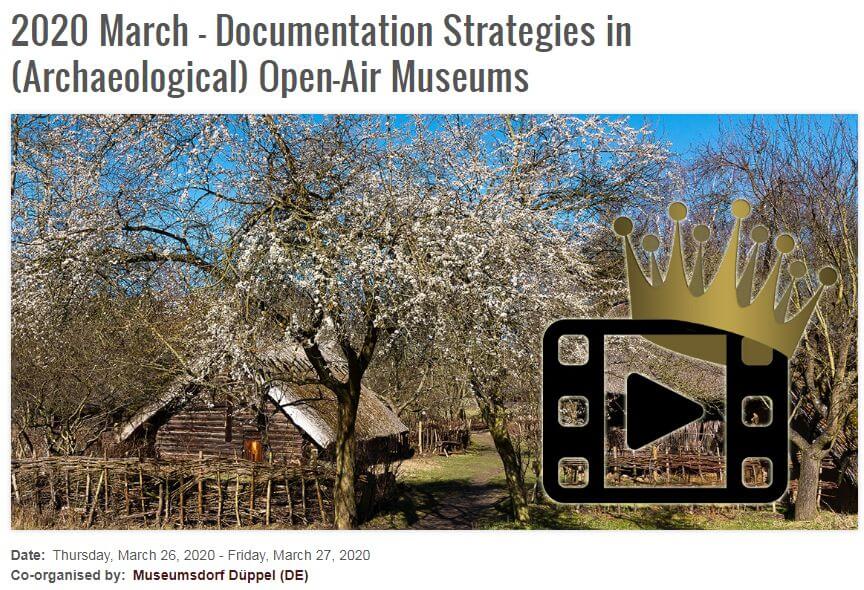
First of all, amid all the cancelled conferences, EXARC will be holding theirs as a digital conference, live-streamed and later on available as well.

[caption id="attachment_5136" align="alignnone" width="864"] Note the genius symbol thingie in the bottom right corner. I take off my hat to whoever made this.


Tune in on their official website to learn about Documentation Strategies in Open-Air museums, free of charge, on March 26 and 27. (There will even be a Discord pub get-together, because there's no archaeology conference without a drink and a chat with the colleagues!)

The open-air laboratory Lauresham (where the European Textile Forum took place last year) has started a youtube channel where they plan to show clips of various places and activities taking place. Text is in German, but you can enjoy a view of that beautiful place no matter your language:


If you're looking for something else to do, you could try yourself in folding proteins - basically playing games for science. Relevant games, too, because there are puzzles related to the proteins in the Corona virus. You can download the programme on the official website (no phone apps available yet) and get going right away.

And that's it for today... different stuff tomorrow!
0

By accepting you will be accessing a service provided by a third-party external to https://pallia.net/

Contact