Latest Comments

Guest - Katrin Sprang Discussion
18 September 2026
Hi Rachel, I have looked for more photos of you, but that was not very successful. I found a link on...
Guest - Beatrix Sprang Discussion
15 September 2026
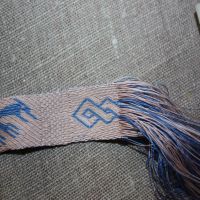
That lozenge pattern element is not a photograph, but a scan. So it should be to scale. But I pinned...
Guest - Katrin Sprang Discussion
15 September 2026
I was not referring to Rachel's reconstruction (is the reconstruction you refer to the one photograp...
Guest - Beatrix Sprang Discussion
14 September 2026
There is something Rachel did not mention. She told me: "Well, I worked with the measurements we too...
Guest - Katrin Sprang Discussion
14 September 2026
Well, this is certainly developing into an interesting discussion. Firstly, going from that lovely l...
FEB
01
1

"Togs" was Word of the Day!

A few days ago, Merriam Webster had "togs" as word of the day, and I got sent the link. Word of the Day is quite fun to read, and if you are looking to improve your English vocabulary, it might not be a bad thing to just take a look at it now and then (or daily, even).

If you would like to read the "togs"-WotD, go here. But be warned: There's word games and stuff on that site, it can act as a time sink...
0
JAN
31
4

Archaeology of York free publications!

York Archaeological Trust has made several of its out-of-print volumes available for free download, including the volumes 17/14, Finds from Anglo-Scandinavian York, and 17/15, Finds from Medieval York. Hooray!

You can download the files from this Resources page of the York Archaeological Trust website. Enjoy!
0
JAN
12
1

It's Linky Time again!

It's been a while (I think) since the last links-to-other-pages blog, so it is time for me to do it again, and I hope that you can find something interesting in this list...

Through my blog reading of other blogs, I stumbled across this one: My Textile Notes. It's the blog of an Indian textile engineer, giving a totally fascinating mix of modern industry-related and traditional crafts-oriented information to the reader. I will definitely keep this blog on my list!

Another interesting textile blog is The Textile Blog, a blog with an emphasis on textile design. It's not only medieval (though you can do a tag search for medieval stuff), but I find it nice to have a look at 19th and 20th century design now and then as well.

Just in case you are knitting colourwork and have problems with it and are not yet reading the Yarn Harlot's blog, hop over there for instructions for "Slightly Less Crappy Knitting". I really like this lady's style of putting things, and I especially appreciate her approach to knitting: Do whatever you (feel) like, there is no Knitting Police.

And if you ever wondered about depictions of the Seven Arts in medieval artwork, especially Grammar, you might want to take a look at this article from Marginalia.
0
JAN
11
2

Illness in the Icelandic Saga?

Via an link at medievalist.net, I stumbled across this really interesting article in the Scientific American. It's a look at the Icelandic saga of Egil, a man of heroic stature and singular ugliness. There are quite a lot of descriptions of this man, including poems he supposedly wrote himself with complaints about body conditions, that according to this article all hint on him having an illness called Paget's Disease, a disease causing abnormal growth of bone.

I found this article fascinating due to two reasons. Firstly, it (again) shows that it is a good thing to look at a given historical source from all different kinds of angles and perspectives, not only literary or historical. And secondly, it shows in a very impressive way that the oral tradition that served to hand down the saga material from its start to it being written down at least a century later must have been very accurate in passing from one "carrier" to the next one, preserving all the details and hints that led to this diagnosis in 1995. I totally recommend reading this article!
0
DEC
17
2

Medical history meets fashion.

When doing my daily bit of aimless link-clicking yesterday, I stumbled across a very, very interesting article via medievalists.net, titled "The codpiece: Social fashion or medical need?" The short version of the article: The development of the prominent codpiece might be closely connected to a strain of Syphilis running rampant at that time, with symptoms including swelling of the genitals and treatment involving local bandages that, in addition to the swollen private parts, have to go somewhere.

This, to me, is another proof that clothes and what we call today the "development of fashion" are connected closely to a lot of other areas of daily life, even to things like illnesses. Availability (or scarcity) of certain materials and colours, climate changes, influences by marriages in the upper crust, availability or scarcity of food, work or travel requirements and social signaling, age and wealth as well as fads in the smaller social groups one is involved in and, of course, personal taste all blended (and still blend) together to a complex influence on the wardrobe of each person in history.

This blend is so complex that we will never be able to pinpoint all its ingredients for a person that lived in history - it would probably not even be possible to correctly analyse the blend for a person currently living, I suppose, since a lot of the elements are probably not things said person reflects upon. However, that makes this article about a connection between illness and fashion even more delightful to me: There is another factor that can actually be traced by an interdisciplinary approach, adding more knowledge about the mix. And at the same time, this proves that a) looking beyond one's own discipline is a really, really good thing and b) that we can never be too open-minded when we are looking at the history of garment development.

By the way, if you don't know medievalists.net yet, make sure to take a look around - it's a very interesting page!
0
DEC
09
1

Blogiversary!

Well, actually, the blogiversary was yesterday. Which I had written in my calendar to make sure that this year I would not again forget when the blogiversary was, and write a post on the actual day.

And then I remembered after posting the blog entry.

So... as of yesterday, this little blog of mine is two years old, and has grown very dear to me in that time. Blogging in the morning has become a daily little ritual (not so little on the days that I find inspiration, though, and write a longer bit), and I actually look forward to blogging again when I've been off-blog for a while.

But a blog is never only about writing - it's only a proper blog if it does get read and enjoyed as well. And blogiversary is, of course, a wonderful opportunity to ask you readers: If you could wish for something on this blog, what would it be? A topic that should be covered more often? Something that has come up too frequently for your taste? Anything else? (Of course I give no guarantees that I will actually fulfil these wishes, but hey, worth a try, isn't it?)
0
DEC
07
0

Middle High German on the Internet

Just like all youngsters in my generation, I had to learn a tiny bit of Middle High German when I went to school. But unlike most of my classmates, that old German language somehow fascinated me immensely, and I really enjoyed learning the old-style words of that little poem we had to know by heart (and then recite).

I don't really remember when I immersed myself deeper into that old language, but I picked up enough of it during my time at the Uni to be able to read most texts fluently (with occasional help of a dictionary) and translate the texts into modern German. And that is an immense help, of course, when hunting for garment descriptions and clothes in context, a part of research that I also like very much. Those texts, with their garment descriptions and focus on beauty and fashion in some of them are really invaluable to get an idea of how clothes were supposed to look and what was important for them to fit correctly and give the right picture to the contemporaries; and when I'm looking for text passages about special items, I always turn to the MHDBDB. In case that doesn't ring a bell for you (yet): That's the Middle High German Conceptual Database where you can search for a term and get it with a bit of context from a large number of texts.

And sometimes I want to read a bit more of that text, to see if I have the context correctly or to know a bit more about the scene including my term-in-context, and for that, there's an internet solution as well: Middle High German texts on the Net. So in case you feel a need to read some of them, here's my link list:

Digitales Mittelhochdeutsches Textarchiv
Mediaevum.de
Anthology of Medieval German Literature
Biblioteca Augustana
Erlanger Liste (scroll way down)

Enjoy! (There's a bit of English info in the Anthology, plus translations into modern German, if that is of help for you.)
0

By accepting you will be accessing a service provided by a third-party external to https://pallia.net/

Contact