
Latest Comments

Guest - Katrin Sprang Discussion
18 September 2026
Hi Rachel, I have looked for more photos of you, but that was not very successful. I found a link on...
Guest - Beatrix Sprang Discussion
15 September 2026
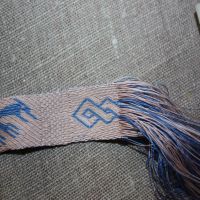
That lozenge pattern element is not a photograph, but a scan. So it should be to scale. But I pinned...
Guest - Katrin Sprang Discussion
15 September 2026
I was not referring to Rachel's reconstruction (is the reconstruction you refer to the one photograp...
Guest - Beatrix Sprang Discussion
14 September 2026
There is something Rachel did not mention. She told me: "Well, I worked with the measurements we too...
Guest - Katrin Sprang Discussion
14 September 2026
Well, this is certainly developing into an interesting discussion. Firstly, going from that lovely l...
NOV
16
0

Links and things.

I stumbled over a batch of nice links recently, and I'm finally sharing them with you:

The Anjou Bible is fully digitalised and online - you can see it here. The Book Viewer is in Dutch, but the icons' functions are very, very obvious, so you should have no problem looking at the pictures.

I also stumbled across a site called Decameron Web with an article about sexual positions in the Middle Ages. There's also a lot of other resources and information about the Decameron there, including an Italian and English version of the text.


And finally, there's an interesting non-medieval project going on: An artist called Christopher Salmon is on the quest for money to make a short film from Neil Gaiman's short story "The Price". The text will be read by Neil Gaiman himself, and there's stunning artwork in graphic-novel-style going with it.


If you like the teaser and want to support it, you can pledge money (starting from 10 Dollars) to the project. The money will only be deducted from your account if enough supporters can be found - the film is budgeted at 150.000 USD, and there's yet a ways to go until that amount is reached.
0
NOV
11
3

Wow.

We now interrupt our regular programme for a completely unscheduled and unexpected "Hooray!"

Yesterday, I received an e-mail telling me this little blog here has made it to a Top-50-List which you can find here - it's called  50 best blogs for Medieval History Geeks. And I was totally stunned and amazed to be in one list with the Great Ones of Medieval blogging, like the Medieval Material Culture Blog, Got Medieval, Unlocked Wordhoard and many more.

If you don't know the other blogs on the list, do go check them out (that's time well spent) while I am here, feeling totally cool because I've actually been listed in a Best-Of-List. Hooray!
0
NOV
09
0

Searchable Textiles Database

The Internet holds many surprises, and one of them is a searchable database associated with the book "Cloth and Clothing in Early Anglo-Saxon England, AD 450-700" (2007) by Penelope Walton
Rogers: http://ads.ahds.ac.uk/catalogue/archive/clothing_eh_2007/index.cfm

This covers the period AD 450-700 and includes 3802 records of textiles from 162 Anglo-Saxon cemeteries, searchable by using drop-down menus. I have only taken a very short look at it, and it will probably be most useful if you own the book the database goes with, but it might come in handy anyways...
0
SEP
24
6

There. A Bleg.

The Book has been out for about half a year now, and it's doing very well - and I have not forgotten all those comments and questions that I receive about an English version. So I've done some planning and scheming and thinking and prep work, and now it's time to find either an agent willing to peddle the book on the Europe/US market or a publishing house, preferably with distribution on both sides of the Big Pond.

And here I sit, now, with my not-so-great knowledge of English-language-based publishing houses and agents. So I'll do what probably every blogger does sooner or later: I write a bleg.

I am looking for a possibility to bring my book to the English language market. It's a book geared to please both the scientists (art historians, archaeologists, textile conservators) and the Living History activists, offering the first general overview of still extant medieval garments plus all the background knowledge needed to re-create garments using a reconstructed historical tailoring technique. The German version is doing very well and has been getting rave reviews from scientists and Living History folks alike.
If you know an agent or publishing house that might be interested in this book, please give me a hint - I'd be delighted to have a few more leads than I have at the moment!
0
JUN
21
2

Oh those pesky sources.

This weekend, an e-mail with a research-related question fluttered into my inbox:
Some months ago, I was doing websearch on nalbinding and ran across a blog entry about ancient scrivner tools that actually may have been misidentified nalbinding needles.

Unfortunately, the author of the mail can't find it anymore and thus asked if it might have been on my blog. Where it is not (or at least I can't remember writing it at all, which usually means I never did write it). But the Internet is large and full of knowledge - any of you know this article and maybe even where it is?

And while I'm blegging: Recently, historical spools and bobbins for thread have come up again and again as a topic, and I remember that I had already taken one foray into the library to look for some more examples - but these little buggers seem to be hard to find. The one that is cited (and reproduced) most often is the spool from London, and I know that there are some thread spools, including simple reed cutoffs, in the finds from Kempten. But apart from that? There's only little mention of "possible bobbins" or so in most of the publications that readily come to mind. Have I missed the compendium of thread spools and bobbins? Or is there really so little of these small helpful things out there?
0
JUN
02
0

The stuff you can find on the 'Net - amazing...

I find it amazing again and again - the things that can happen if you hop around on the internet.

Yesterday night, we laughed about a pun involving the Krebs Cycle (citric acid cycle). Then - by looking that one up in Wikipedia - we stumbled over a page that lists biochemistry songs. Folks! Biochemistry songs! With lyrics detailing how the Krebs cycle goes, or the respiratory cycle, or whatever! Can it get geekier than that? I wrote a few filks in my life, but I never thought of doing a science-y songtext.

Needless to say, we went to bed far later than intended. Go waste your time too: Here's the site we found yesterday, and here's a link page to lots of other science songs.
And while I'm at it, if you are planning to write a murder mystery book, here's a hint from author Parnell Hall, also wrapped in a song. With gruesome pics.
0
MAY
31
0

Monday Monday...

Somehow those weekends are just swooooshing these times - I can't believe it is already Monday again!

At least my energy level feels quite a bit higher than it was on Friday, so I'll see how much I can get done today. And in case you are actually looking for a little textile content while I am busily pottering away at boring office stuff and doing some proofreading and preparing some stuff for markets, take a look at the instructions behind this link, which goes to Hsifengs livejournal and where she describes how to get at most of the presentations given at the "Costume Colloquium: A Tribute To Janet Arnold" in 2008 in Florence, Italy.

Now that's a wonderful idea, I think!
0

By accepting you will be accessing a service provided by a third-party external to https://pallia.net/

Contact