
Latest Comments

Guest - Katrin Sprang Discussion
18 September 2026
Hi Rachel, I have looked for more photos of you, but that was not very successful. I found a link on...
Guest - Beatrix Sprang Discussion
15 September 2026
That lozenge pattern element is not a photograph, but a scan. So it should be to scale. But I pinned...
Guest - Katrin Sprang Discussion
15 September 2026
I was not referring to Rachel's reconstruction (is the reconstruction you refer to the one photograp...
Guest - Beatrix Sprang Discussion
14 September 2026
There is something Rachel did not mention. She told me: "Well, I worked with the measurements we too...
Guest - Katrin Sprang Discussion
14 September 2026
Well, this is certainly developing into an interesting discussion. Firstly, going from that lovely l...
JUN
16
2

The Return of the Evebø Dog.

The Evebø band... oh, source of joy and questions. For me, at least.

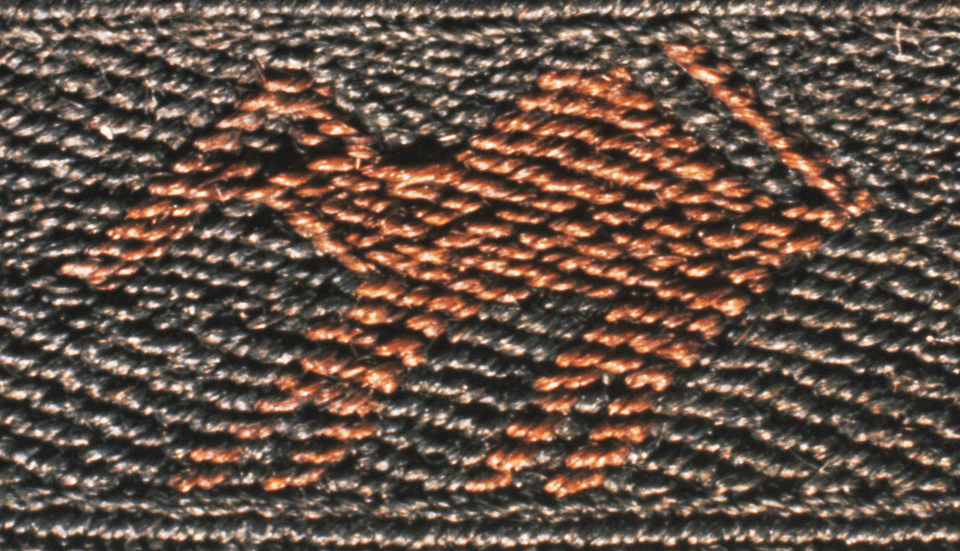
The Evebø band is a find from Norway and dated to the 6th century; it's a tablet-woven band with twill technique patterning, and very good, very detailed pictures of the band can be found at the Fotoportalen Unimus. Including, to my great joy and delight, photos of the back of the band... because, as simple as the band might look at first glance, there are some strange things happening with the animal that might be a dog (though the Most Patient Husband of Them All says it looks more like an ant-eater to him, and I sort of agree).

[caption id="attachment_5364" align="alignnone" width="368"] Photo from UNIMUS.no


The original band happens to have a 20 tablet pattern zone, which coincidentally is the width of one of my playbands... so of course, at some point, I had to weave the Evebø ant-eater doggie. And as we all know, dogs are pack animals.

So. Let me introduce you to my Evebø dog collection:
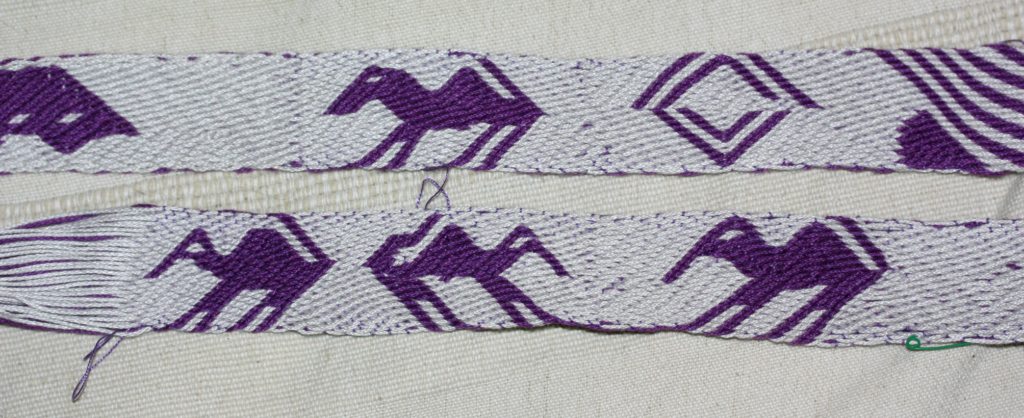


The first one, in the upper band part on the image, was woven starting from the nose, after just a sketch of the original animal. Though I was sort of aiming to reproduce it, I wasn't going for the "have to match it exactly" approach, but more for the general direction. As you can see, it has a wider nose than the original, a much thicker neck, and a baboon butt.

The rest followed a considerable amount of time later - they grow younger from right to left. First (rightmost) was woven from the tail onwards; then, because the first one had been so long ago and that made it hard to compare what the differences were, I did another one starting from the nose (you can easily tell that by the baboon butt). Finally, I did a third one, trying to a) weave less mistakes than in the first ass-starter, and b) matching it as closely as possible to the original. Which was... well... not completely successful in both cases. As you can see mostly in the chin and nose area. Sigh.

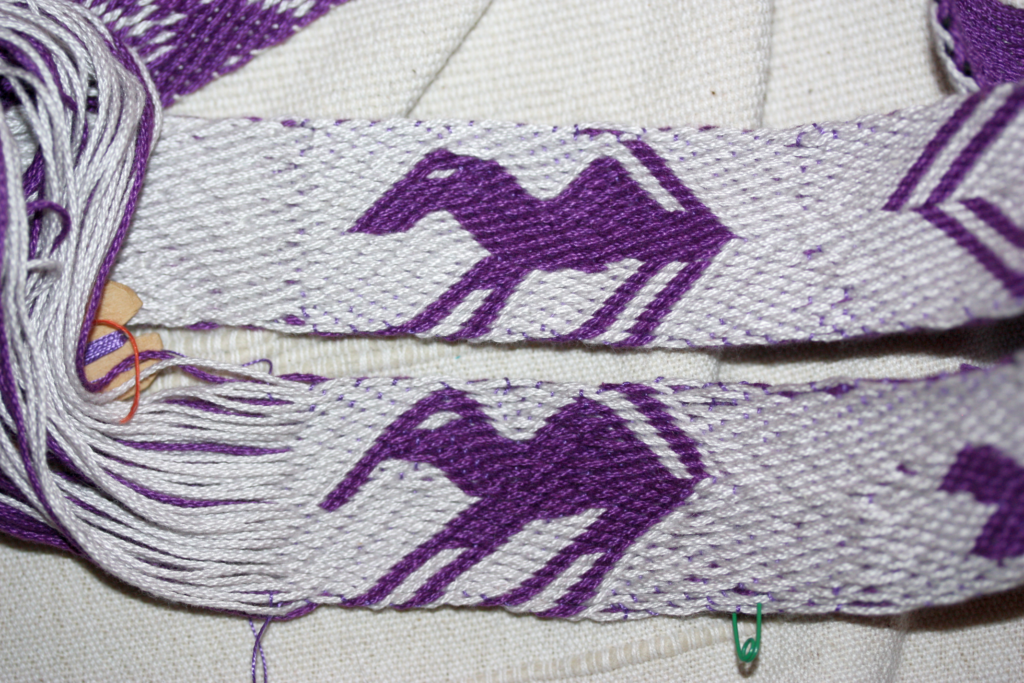
If you compare my versions with the original, you can find quite a few differences (even disregarding the baboon butt versions, and just looking at the ass-first doggies). A small thing is the forelegs not having the split further down than the hind legs in one case - though that is just a question of me not paying enough attention to where the split was supposed to come, and not a technical issue.

The really interesting differences, though, are in the neck, eye, and nose area... can you spot them?
0
JUN
11
0

Holiday!

It's a public holiday in Germany today, and I'll use that as an excuse for a long weekend. I will leave you with these two versions of the Evebø dog:


See you on Monday! (Or on Sunday, if you're joining for the Lauresham tablet-weaving presentation...)
0
JUN
10
3

About done.

If you looked in vain for a blogpost yesterday, you've probably guessed that it got gobbled up by the current project - which, as other publications tend to do, has eaten up all available time and then some. However, it's about done now (I'm keeping my fingers crossed that there will be no hiccup during the final file export), and hopefully everyone watching it will enjoy the thing on Sunday late afternoon.

If you're interested, you can find more info here on the page. Info text is in German, but there will be an English version of the presentation (where you will see that I didn't even try at all to match the voice-over to my German speaking face action...). I'm assuming there will be a link to the presentation posted on the site on Sunday at around 17:00 German time, but you might want to register for the Discord thing as well and hang around there in the EXARC channel - and join the discussion afterwards!
0
JUN
04
2

Mariengürtel - a few pictures.

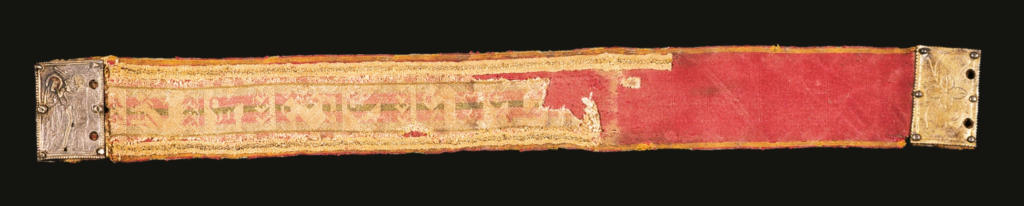
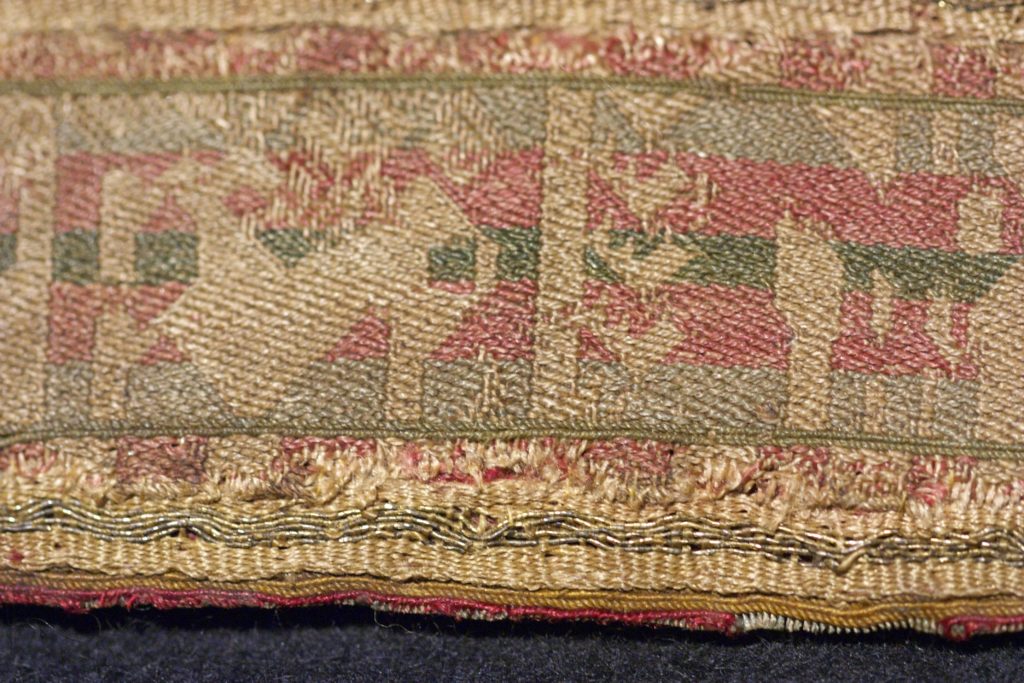
I wrote a while ago about the Albecunde belt, which is one of the tablet-woven bands in the museum St. Afra in Augsburg. It has survived in two parts, a longer and a shorter one. Onto the smaller part of the Albecunde belt, another smaller piece of tablet-woven band is sewn. Its date is not clear, but it has been revered as the belt of St. Mary for a long while - and thus is called Mariengürtel.

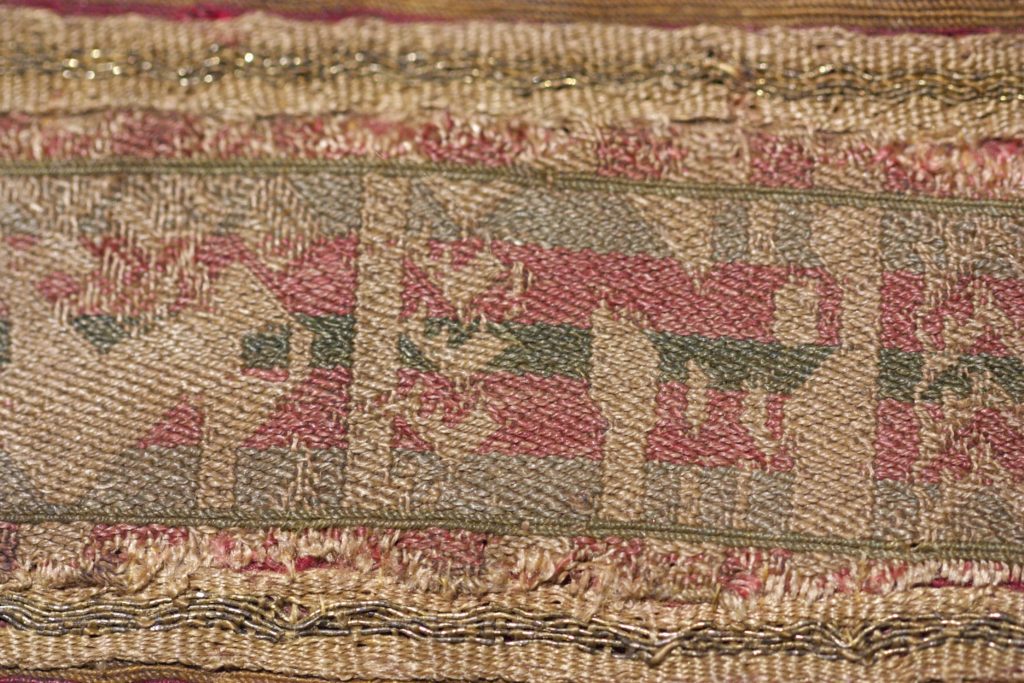
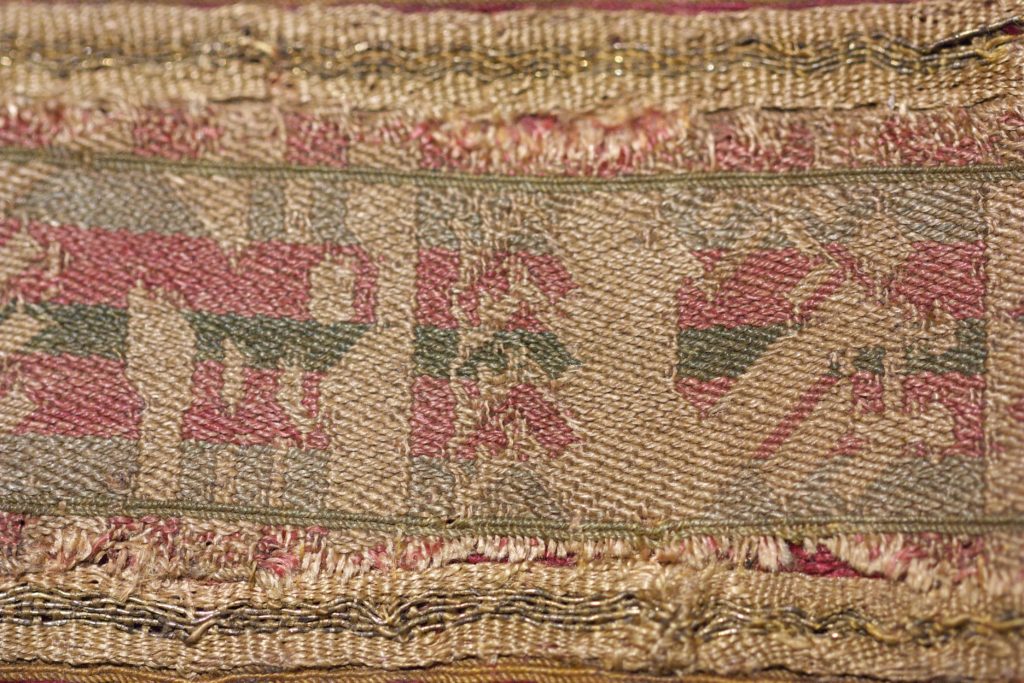
It's a twill weave, with animal patterns in colour on an off-white background or in off-white on coloured background; and said background is green, red, and light bluegreen.

This is the overview picture from the museum:


...and here are some detailed pictures that I took, with kind permission from the museum.


It's a beautiful piece, and I am definitely itching to try and weave some of these little animals. According to my count, it's 2+41+2 tablets, so I can try them on my 42 tablet playground band. Once I have the current things done and finished, that is...

 
0
JUN
03
1

Weaving!

I've spent the day weaving, and preparing things for my little presentation about tablet-weaving due on June 14 - as part of the digital event at Lauresham:


Preparing for this meant I finally got around to do a few things that I've been planning to do or try out for a while - among them brocading over diagonals (as it was done on the Ulrichsmanipel) and warping a new explanation-/demo-band that's not as narrow, ratty, and worn out als my old four-tablet one was.

Tomorrow will be more video-taking for this, and then I will get to do some cutting, and editing, and things like that. Exciting work, and I have finally found an editing programme that I seem to be able to work with... which is a very, very good thing indeed.

 
0
JUN
02
5

Disappearing Patterns.

Addition to clarify things, June 4 2020:

Silvia very correctly points out in the comments that she knows of no tablet-woven bands that appear in just one colour, but have a twist direction turn pattern that points to an original patterning. This is true - I don't know of any either (though my overview is not as good, or current, as Silvia's).
Knowing a little bit about how many textile finds are not published, and how decisions are made on what to publish with the very limited time and resources available... my suspicion is that at least a few bands exist that lie somewhere in an archive or a freezer, which would carry a hint of original patterning in form of twist direction changes. Or none at all, if the pattern was formed while only turning the tablets in one direction. They are, however, too unspectacular to be looked at in detail, or published. The same is probably true for bands that still do have a visible (maybe just faintly visible) simple pattern. Since tablet-woven patterns come out best when contrast is high, the chance of the pattern staying visible even in discoloured bands is relatively high.
So - I am not trying to say that there are lots of simple bands published who originally had a colour pattern, which has disappeared now. I'm trying to point out that there is a possibility of simple patterned bands discolouring in a way that would make it harder or impossible to see what the original pattern was. How likely that is, exactly, and how many of these might be in archives or storage boxes, is another very interesting question, but unfortunately not one I'm able to answer. I just think it's something worth to be aware of.

End of addition.

 
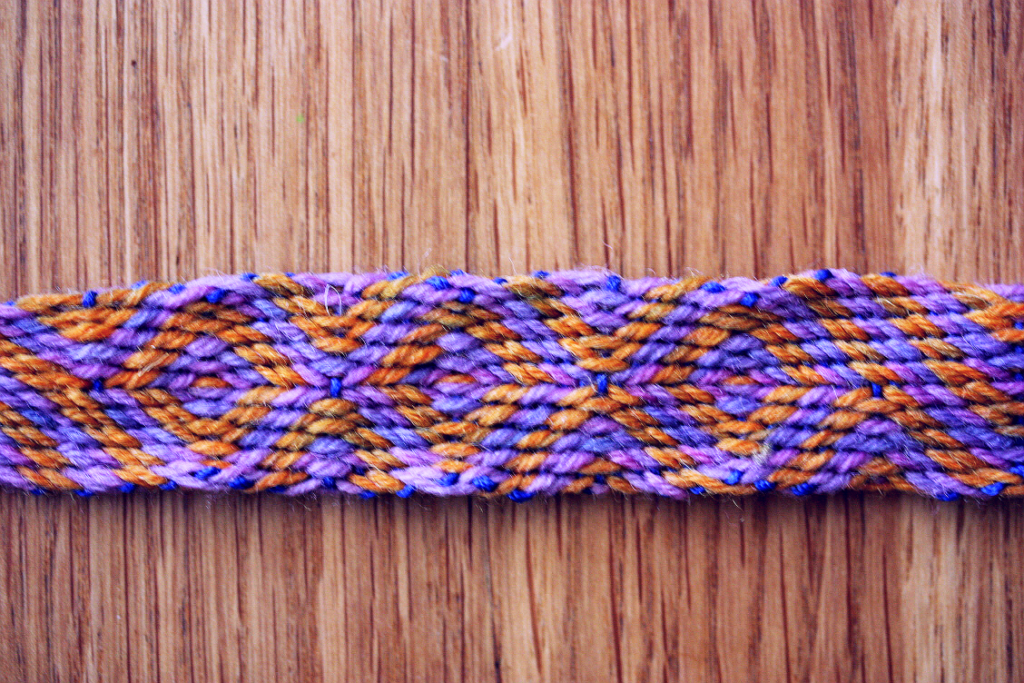
A while ago, I botched when setting up a warp for a tablet weaving demo band - I took two colours I liked, held the balls of yarn next to each other, went "yeah, that looks good", and warped the band in a setup for diagonals or twill.

Just to find, a few wefts in, that the contrast wasn't as good as I had thought it to be. A quick check, and yes - the grey value of the two colours is identical. So while the pattern is visible in normal lighting, the contrast isn't high enough to use this as a demo band for showing how to weave twill.

It is, however, perfect to show something else: What can happen to a tablet-woven band when it's buried in the soil for a few hundred years and turns all brown all over. Because then, all you might be able to see is that there must have been a pattern of some kind.

Case in point?
Let's take one of the most simple patterns you can weave with a diagonals setup: diamonds. It looks like this on my band:


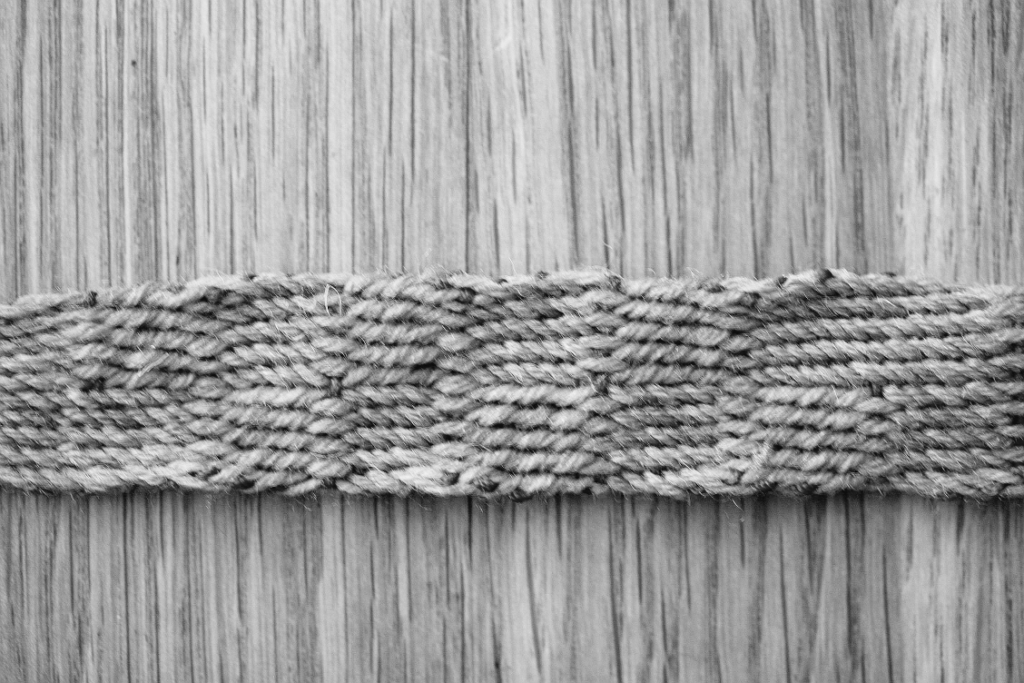
Now let's put it into virtual soil to turn all brown - or, in this case, convert the picture to greyscale.


You can see the turning points across the whole band, coming in at more or less regular intervals - so you can assume that some pattern must have been happening here. You won't be able to tell which one, though.

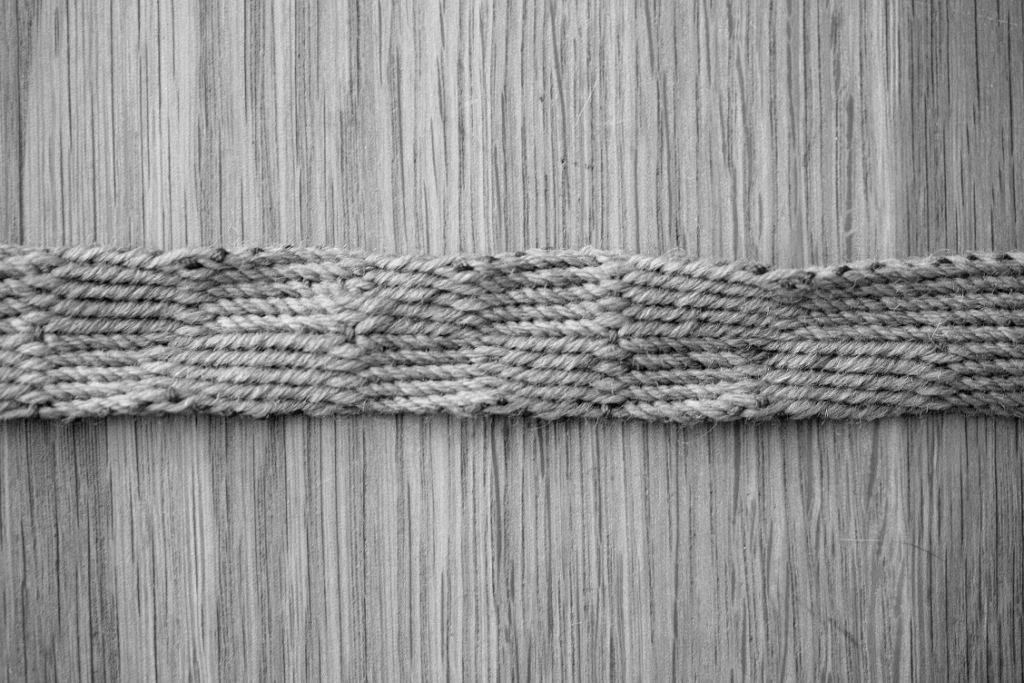
Let's spice it up a bit. Imagine you're the archaeologist and find this:

[caption id="attachment_5317" align="alignnone" width="640"] Click on this link to find out.


Are you able to guess what it looks like in colour? Click on the link to find out.

So there we are. A band like this would probably not get published prominently - and I think that we might have found many more simple patterned bands in the Middle Ages than our finds show today. No metal (as in the brocaded bands) will mean worse chances at surviving in the soil, and small bits and pieces of uniformly coloured bands will give scant hints at the patterns that might once have been visible...
0
MAY
06
0

Twist matters.

Things I learned in the past days:
  1. Filming a video presentation of something makes me extra-super-duper nervous. Part of this is the thought in the back of my mind that every "erm..." and every silly facial expression and every little imperfection in speech will be recorded and thus preserved FOREVER, and thus I should be absolutely perfect, and that is hard to do.
  2. Writing subtitles in English underneath a German spoken text is hard, not only because I can (duh) talk much faster than I can type. There's also the temptation to deviate (too) much from the things I actually say, to make it more clearer to the reader, or to cram more info into the text... which I as a viewer would find confusing, and not ideal.
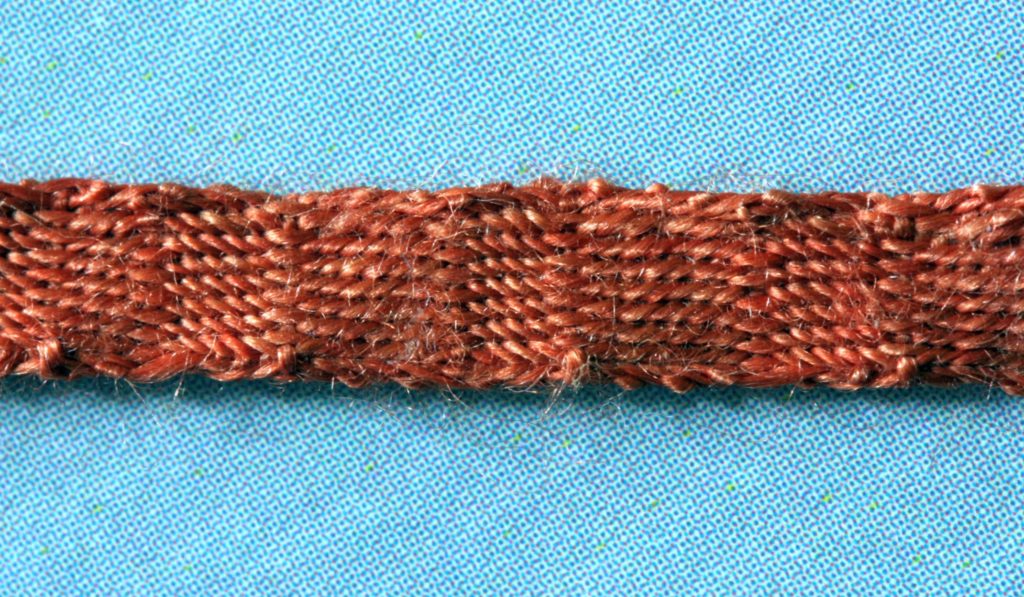
  3. There was very, very, very little twist in the threads used to weave the Albecunde belt. My tests done with my (only very slightly twisted) embroidery silk look like this:


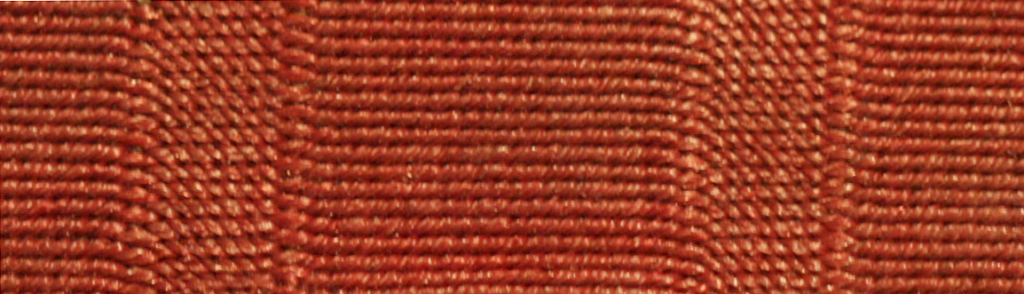
While the original belt looks like this:


You cannot see the pattern as clearly on my test piece as you can on the original - it looks very pronouncedly diagonally structured in one twist direction, but more like a mushy solid surface in the other. On the original, there's a diagonal structure visible in both directions, and it's only a very little more pronounced in one compared to the other.

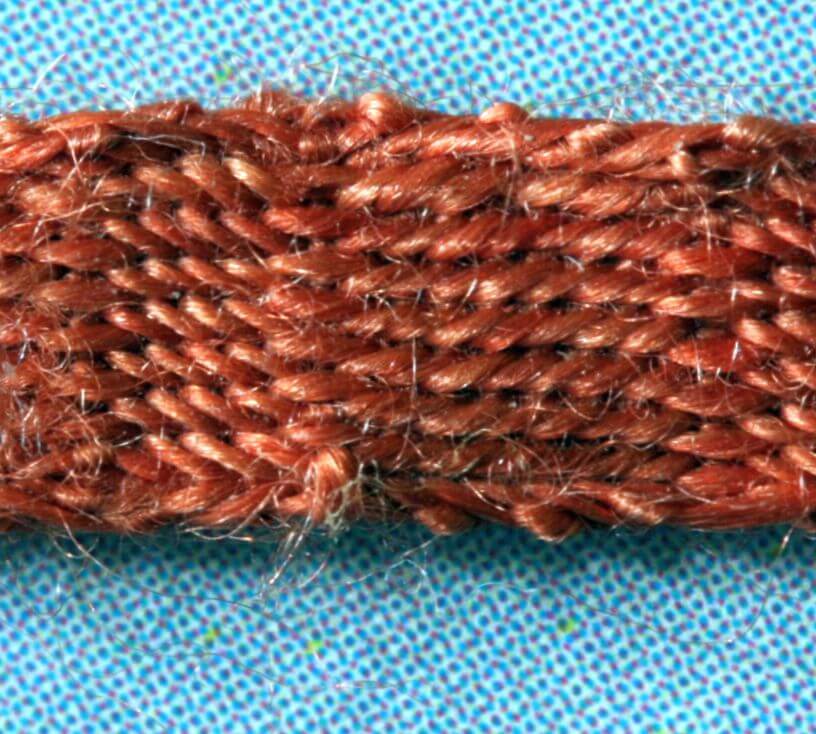
Here's closeups to make things even more clear:


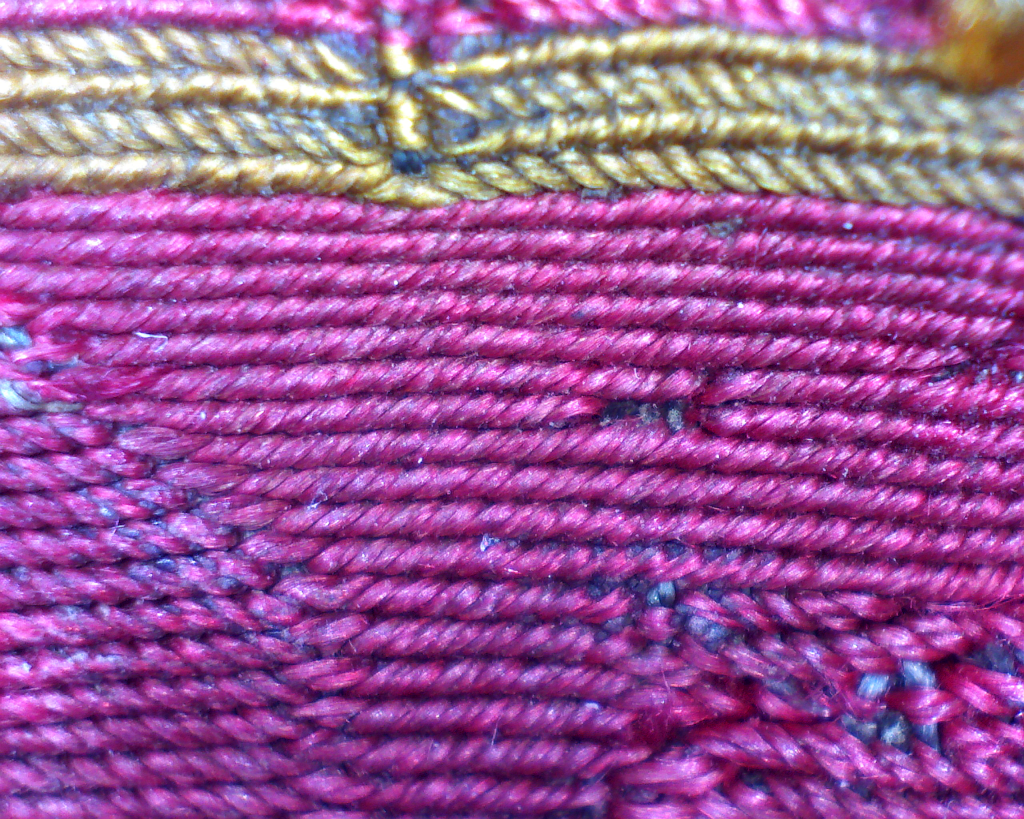
You can see that the diagonals with an S-slant are much more defined than those with a Z-slant. That's because my thread is slightly s-twisted. It's not much, but enough to make quite a visible difference in the outcome; enough of the z-twist the tablets introduce is levelled out by the yarn twist to show. The twist is visible, if you look closely, in the areas where I changed tablet twist direction.


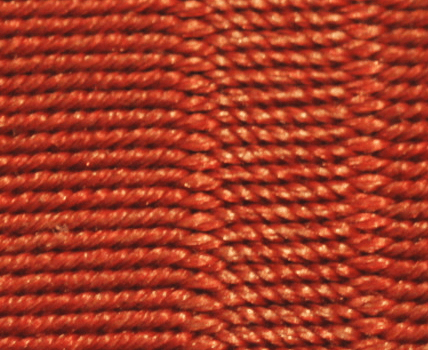
This is a detail, closeup, of the original. Here, too, you can observe the individual thread twist in the places where tablet turn direction changes - but it is so slight that it's almost impossible to detect. The best indication of it being a hint of an s-twist is that the S-cords in the tablet weave are a little bit more defined than the Z-cords.

Here's a microscope picture, going even closer to the threads:


This shows how important even a little bit more or less of twist can be when you are weaving a pattern that relies, for its effect, exclusively on the shine and the light refraction of the silk used - and how much knowledge and skill went into this band.

You can hear more about the Albecunde band on Sunday in the presentation at Virtual Lauresham (and see my video thingie...)!

Thank you to the Diözesanmuseum Augsburg for letting us study the belt in detail for our reconstruction project!
0

By accepting you will be accessing a service provided by a third-party external to https://pallia.net/

Contact