
Latest Comments

Guest - Katrin Sprang Discussion
18 September 2026
Hi Rachel, I have looked for more photos of you, but that was not very successful. I found a link on...
Guest - Beatrix Sprang Discussion
15 September 2026
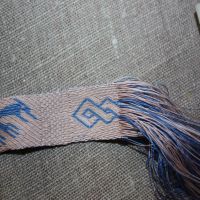
That lozenge pattern element is not a photograph, but a scan. So it should be to scale. But I pinned...
Guest - Katrin Sprang Discussion
15 September 2026
I was not referring to Rachel's reconstruction (is the reconstruction you refer to the one photograp...
Guest - Beatrix Sprang Discussion
14 September 2026
There is something Rachel did not mention. She told me: "Well, I worked with the measurements we too...
Guest - Katrin Sprang Discussion
14 September 2026
Well, this is certainly developing into an interesting discussion. Firstly, going from that lovely l...
NOV
15
3

Once upon a time...

Once upon a time, sheep's wool was a valuable resource, prized and traded across all of Europe. Once upon a time, sheep's wool was so valuable that a lot of effort went into breeding sheep to get good, well-spinnable crops of wool. Woolen cloth was used to make clothes, blankets, even sails and tents. Garments were tailored from woolen cloth that was so sturdy it would stand decades of wear. Good wool was highly prized.

Today, sheep are bred that will not give a crop of wool, because getting the sheep shorn will cost more - much more - than the normal market price will yield for the wool. Sheep are shorn with no regard to shearing quality, and the fleece taken off is not sorted, but just stuffed into sacks and put away. The only wool that will still get a slightly higher price (which is still in no relation to the worth of good wool as a material) is standard white merino wool, which will then be washed, straightened, and carded to death, resulting in the standard top that you can buy everywhere. Thread spun from that will not be very sturdy in comparison to wool that has not been treated to death.

And for all those of us who would like to work with wool different from this? We now have a problem, Houston. Because worth of the wool has gone down so far that wool will be thrown away (that can cost money in Germany, by the way, because it is "special refuse"), it is often given away for free - and that is further lowering the perceived value of wool. If we let this go on for another decade, who knows if it will be possible at all to get wool suitable for historical crafts anymore?

Which brings me to a question directly related to this. Would you, gentle readers, buy wool prepared in accordance to historical treatment/preparation of wool - that is, not washed (only rinsed, or not been in touch with water at all) and then combed so that you spin in the grease and then wash the yarn? Would you be willing to pay a fair price for wool like this, meaning that this wool would be much pricier than normal, factory-prepared wool? Or are you content with what is offered from the factories nowadays?
0
JUN
29
0

Light and Darkness on Historical Markets

I was asked recently about my electricity needs for my market stall - for lighting in the evening hours. My electricity needs are described in a single word: None.

I have a very easy policy for late-night market hours. Evening or even night market hours are a phenomenon that seems to become quite common these days on events, especially on events connected to a town anniversary festival.
My policy is that when dusk comes upon the market area, I am slowly packing up the small stuff, and when dusk is fully come, I close my shop. Nobody is going to see anything in my market stall anyways in the dark hours, except if I install a floodlight contraption (which will not fit into my tiny little TGV and aside from this is not really historical). There's just no sense to shop for plant-dyed threads in the darkness, and there's no way anyone will be able to appreciate the gossamer-fine hairnets and the delicately manufactured needles and needle-cases in the evening hours.

And my shop is not the only one thus affected - which is why evening- and night-hour markets are one of my (albeit lighter) pet peeves. Would you shop for something at night? When you can't discern its details, or properly search for flaws? I cannot believe that back in the Middle Ages somebody would have shopped for something in the evening hours unless driven by dire need. And in all the years that I visited markets, I have never bought anything after dusk (except food or drink, of course). I have looked around and chatted with people, and I have said things like "oh, that's where his/her stall is, I'll have to come back tomorrow and have a look".

I can just see no reason at all to shop at night, and I think that it doesn't fit in with a "historical market" scheme. A few oil-lamps or lanterns are nice and add to the atmosphere, but will never give off enough light to properly shop by.  With lighting by oil lamps or lanterns also come the problems with fuel spills and other, flame-related, hazards. Thus, a lot of the late-hour stalls have electrical light installed. That is more or less hidden and more or less made to look like lantern light, but it is still electrical lighting and thus out of place in an otherwise historical stall. I refuse to buy something under electrical lighting in both cases: When it looks like lantern-light (because then it's too dark for my taste to see and properly appreciate the wares) and when it looks like a floodlight installation gone astray (because this just glaringly stands out of the historical setting so much it hurts).

I'm fine with food and drinks stalls, I like to sit somewhere and see people walk by, or perform something, or listen to some musician on the square and have a little chat with friends. And I can understand if incense or lanterns are sold after dark. But all the rest? Even if it is a merchant or craftsperson I know and trust, I want to see the things I'm about to buy in daylight to fully appreciate them. So why do we need to transfer our modern late shopping hours to a historical market anyway? Is it our modern taste for convenience? Is there anybody really shopping at night, spending money enough to make it worth opening shop for so long? Or do the merchants just stand around and look decoratively with their stalls open and lit?
0
MAR
23
0

Gold! Gold!

The long-time readers here will maybe remember that a good while ago, I posted about finding somebody who could make a gold thread like it was used in the 12th century, and trying to guess the market for that.

I think I never really gave you an update on all that. Well, I did decide to take the plunge and put in an order for the gold thread, and meanwhile it has been all produced and should be on its way here shortly - just in time to make a few nice little goldwork packets for Freienfels.

The company who makes the gold thread is one of the last few left of that kind, and they have an impressive workshop, as you can see in this little documentary film (in French) that ran on TF1, a french "journal" tv show. If you don't understand French, watch it anyways, you're in for a treat if you like old(ish) weaving looms and textile machines!
0
MAR
15
0

Tent Stuff

Sorry for the belated blogging - the Firefox update somehow slowed me down a lot.

While Sunday was a nice day for relaxing and taking a walk in one of the neighboring towns, I spent most of Saturday very diligently working on the tent fabric. Waterproofing tests are still running, though a favourite seems to be emerging by now (oil cloth, by the way, really stinks).

The main constructive element is sewn, and I am now working on the next bits - the anchor points that will keep the wooden structure for the back of the stall in place on the fabric. And after that, it will be time to provisorially put up the tent and see where the rest of the anchor points will go...

And tomorrow, I will hopefully have some pictures of the tent construction details already finished.
0
MAR
11
0

I'm working on it.

If you want to know what "it" is today, it's both the Call for Papers/Call for Workshops for this year's Textile Forum as well as the tent for the market stall.

Writing the call for takes so long because, well, there are quite a few changes in comparison to last year, and we don't want to give a wrong impression by hastily written information.

And making the tent... well, everybody who has ever planned the construction of a tent/stall and then sewn that tent by hand knows how long that can take. Add to this the additional problems and challenges popping up - like the waterproofing issue - and it's no wonder that progress is slow. But it is there. After taking a nice, hot bath


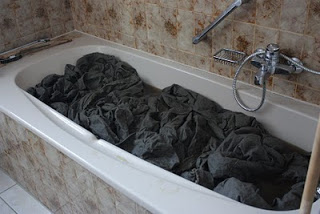
the tent fabric is now completely dry again, and today it's time to test the construction basics by putting up the "framework". Most of the connections for putting up the wooden part will be temporary and provisional, since the tent structure has no stand-alone, rigid framework, but relies on combining wood and fabric. But I need to get a proper, hands-on evaluation of how large the inner space will feel in the completed tent, and I also need to mark where to put diverse bits and pieces for the construction on the fabric. So up it must go.
0
JAN
28
4

It's not spectacular... or is it?

After all the paperweight is off my back for a while ( it will be time for taxes soon - more paperwork), here are some things that are not really spectacular, but give me a nice feeling of something actually moving forwards.

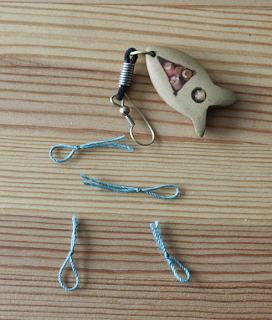
First of all, these dropped-off stitch markers


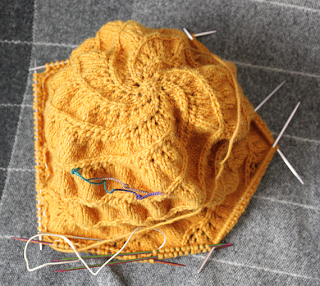
  - and yes, I use bits of knotted silk thread and an old, single earring - these dropped-off markers mean that I have progressed on my second slouchy hat (with better maths for the hem this time),


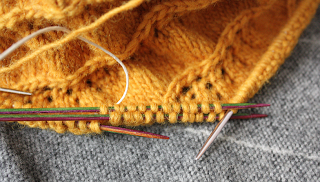
and am now almost into the first round of ribbing. This means slipping half the stitches to a holder and knitting the other half. Just what happens here:


Then, there's that other idea that I have had. And now I am swatching - not spectacularly either:


But other things have happened, too. Non-knitting things. Like this:


This is where the seam on the tent is today. Which is almost one metre from where it was yesterday in the early evening, and that means actually almost two metres of stitching done, half by me and half by the most patient man that lives on Earth (I'm sure he must be the most patient man on earth, after all, he lives with me). Only a few metres to go on that first bit! And it looks as if there would be sewing time tonight as well. And tomorrow.

And finally... something spectacularly unspectacular.


They have been fired for a while and are now finally in my workspace. "They" are the ceramic disks that are supposed to go on an equally unspectacular stick and there to serve as a spinning whorl.
For those of you who are not recognising these whorls, originally they were made as the reference whorl of the Textilforum Experiment, and they got a lot of praise for running extremely well. However, the experiment whorls were not intended to be sold, and they were purely functional, including all rough edges and unsmoothed surfaces. These are made for actual use - with smooth edges and smooth surfaces. The whorls are made from modern clay, and with a modern technique - I'm using a specially-made little cookie-cutter-like implement. But that modern procedure is what makes them exactly alike and as close as humanly possible to the weight and MI of the original 12th century whorl, which is what we needed for the experiment. I will weigh them today to make sure they are all on a par, and then they are going into the Marketstall tomorrow.
0
NOV
20
0

More of the splendour!

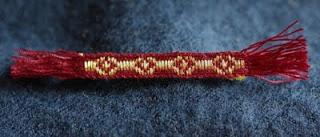
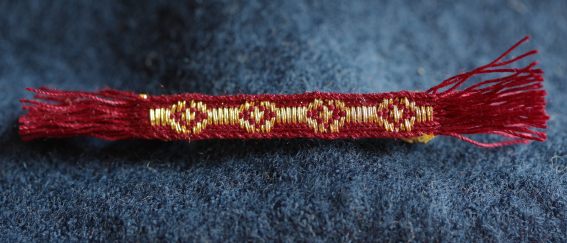
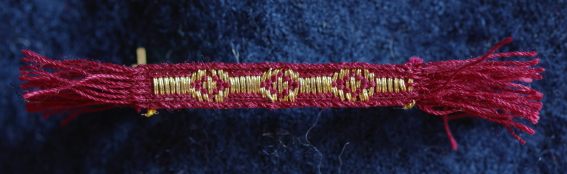
After fiddling around a little and experimenting with different settings on the camera (thank goodness for one you can go "all manual" on), I have now managed to take some much better pictures of the gold brocade brooches. (By the way, the German term for brooch is "Brosche", and for brocading "broschieren", so I've been making "Broschierte Broschen" or "Broschurbroschen" with this.)

Here are some pics - clickable. If you look at the large pictures, please keep in mind that these brooches are only a little more than 3 centimetres in length!


0

By accepting you will be accessing a service provided by a third-party external to https://pallia.net/

Contact