
Latest Comments

Guest - Katrin Sprang Discussion
18 September 2026
Hi Rachel, I have looked for more photos of you, but that was not very successful. I found a link on...
Guest - Beatrix Sprang Discussion
15 September 2026
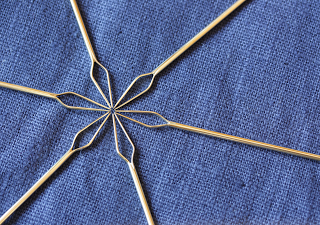
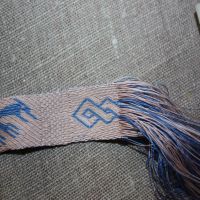
That lozenge pattern element is not a photograph, but a scan. So it should be to scale. But I pinned...
Guest - Katrin Sprang Discussion
15 September 2026
I was not referring to Rachel's reconstruction (is the reconstruction you refer to the one photograp...
Guest - Beatrix Sprang Discussion
14 September 2026
There is something Rachel did not mention. She told me: "Well, I worked with the measurements we too...
Guest - Katrin Sprang Discussion
14 September 2026
Well, this is certainly developing into an interesting discussion. Firstly, going from that lovely l...
JUL
22
8

Guessing the Market

There's sort of good news: Finally, I might have found an artisan who is capable and willing to reproduce medieval gold thread for me. Real, no-compromise gold thread, as it was found in the excavations at Villach-Judendorf in Austria: Gilt silver wound around a natural-coloured silk "soul", 0,2 mm thick and used for weaving (brocade) as well as for embroidery. (You can use several threads at once when doing couch work - I have a nice photo somewhere showing just that. After all, medieval people had their lazy streak too!)

"Normal" gilt or gold threads are imitation gold, wound around a core of cellulose or other material, but not around silk. And getting gilt-silver threads (not the japanese version, where a strip of paper is gilded or silvered) is really hard already, even if it's "just" gilt, not pure gold. Those threads are usually much thicker, too.

The downside? There's a hefty minimum order, and gold thread is not cheap. Quite the opposite, actually: Real gold or gilt thread was exquisitely expensive in the Middle Ages and it's still exquisitely expensive today. I'm very, very tempted to order the thread, but it's an investment that should not go too wrong.

So now it's time for me to play my most beloved game of them all (well, not really): "Guess The Market". And this time, I'm shamelessly using this blog to get some input from you, because I've been told time and again that I'm no normal textile stuff customer (though you probably aren't).

Do you feel the strong desire to buy authentic-to-the-soul gold thread? Modeled after a find? Even if it is really thin and really pricey? Would you use it for weaving, for embroidery, or for both? How much need do you have? And how much would you be willing to pay for, say, 10 metres? Or do you prefer to buy the cheaper imitation gold thread?
0
JUL
21
11

More additions to the Stall

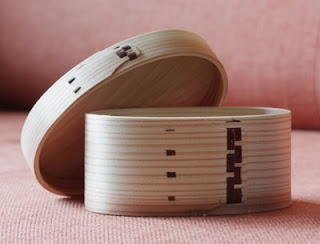
When some time ago I asked for suggestions for the market stall, Kruliczyca (she has a blog, too, in Polish with English summaries) mentioned bentwood boxes for storage of needlework goods.

I have now come up with some of them - smallish, oval boxes made from fragrant wood. They are small enough to slip into a sewing cabinet or box that is already quite crowded, plain but pleasing the eye so they will look nicely on a table with work in progress, and a good possibility to store a needlebox, small shears, or your favourite sewing threads in them. Or hide some unauthentic thread rolls or other needlework trinkets that are not for everybody to see.


I quite like them and will probably use a few of these boxes for displaying wares. At the moment, they make an impressive stack in my warehousing cupboard!
0
JUL
14
2

Can't be too thin, really!

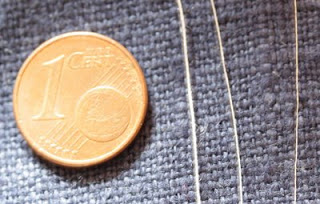
I've been sewing for ages now with Gütermann Silk thread (the thread on the blue plastic spool) whenever I needed sewing silk. Why? Because it's available in almost every second sewing shop around here. But a few things did irk me about it. First of all, it's on a blue plastic spool - that makes it easy to tell the silk thread from the cotton and polyester variations coming on the same spool type, but not so easy to use the thread on medieval events. Then it is - of course - coloured chemically. And then it's just so thick and bulky! Fine for tablet weaves, but for sewing really fine silk? Nah. And for authentic hairnets, too, it's just too thick.

So a while ago, I found out about YLI silks - the sort they call "Silk 100", to be precise. It comes on plastic spools (white and quite short-and-thick, this time) and is much lankier than Gütermann. So I was happier for a while - but the plastic spool problem still applies (and I was not about to re-wind 200 metres of fine silk thread from a plastic spool to a wooden one, I'm one of those rather hiding their spools). And while YLI says it's the finest silk thread on the market, it is still a little thick for making hairnets. And while we're at it, I'd like a finer thread for the really fine stitching on thin silks (think Pongé 05 quality here) and for couching works or sewing something on "invisible". So now YLI is not the thinnest thread on the market anymore, at least not on the medieval markets!


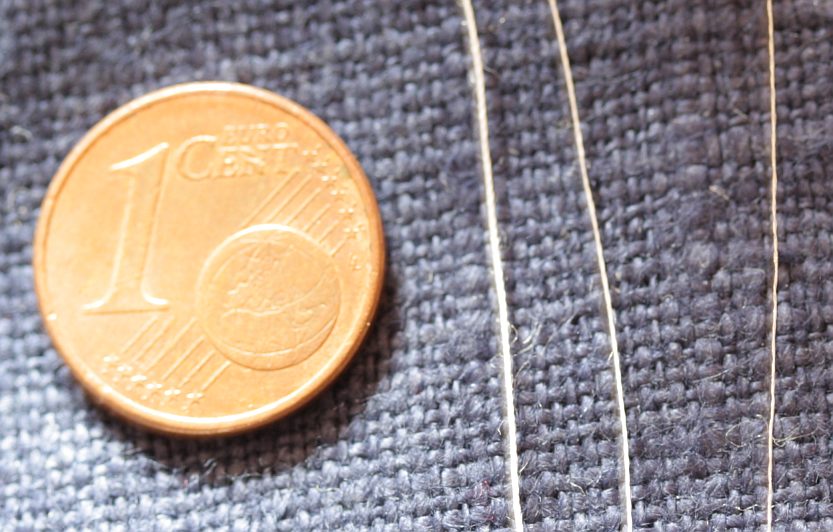
Here you see from left to right: All the money I will have left after investing in this market stall, Gütermann sewing-quality white silk thread, YLI Silk 100 in white, and my extra-thin silk.

It will come wound in portions on paper cores, so while it is not properly medieval, it's at least not plastic. The thread is fine for making hairnets, attaching small embroideries to a garment, for using as weft thread in tablet weaving with thicker silks if you would like your motifs a little less lengthened, or for stitching really fine silks or - of course - couching work. The only thing left to decide for me now is how much of the thread to use for one portion: one hundred metres? two hundred metres? More or less?
0
JUL
08
2

More Sewing Necessities

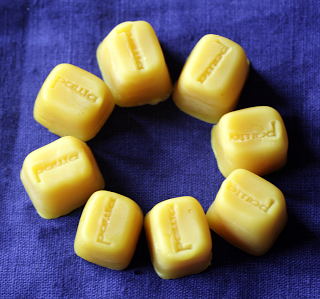
Today's choice for the blog presentation: Beeswax. Everybody needs beeswax! Each sewing bag, pouch, chest or other sewing-goods-container needs a piece of beeswax! And because carrying a candle for that is not the most practical of things, and because there are not so many nice chunks of good-quality beeswax on the market, these are the latest addition to my product line:


In case you don't know why beeswax is a sewing tool: It is invaluable to wax threads for sewing, especially linen threads. It makes them much more durable, they are less prone to fraying where they rub against the needle's eye, and the thread will not kink itself into knots as easily. Plus it smells heavenly! Just draw the thread across the chunk of wax once, and you are all set. Use of beeswax in textile work is documented for medieval times through different accounts, and once you are used to lightly waxing threads, you won't want to be without it anymore.

You can also use beeswax to neaten the edges of fine cloth - though that does take quite a bit of practice, and of course that will eat up your chunk of beeswax much faster than drawing threads through them.
0
JUL
06
6

The Alternative to Playing Cards

When I learned tablet-weaving, I used either beer mats or butchered playing cards. For my small hands, beer mats are definitely too large, so I went over to playing cards cut up and punched with holes for good. They are slim, lightweight, quite sturdy and cheap - the only problem is that you have to cut them to squares and punch holes. And as I'm a bit demanding about my hole placement, wanting them all in the same place, this did always take some time; time spent to prepare weaving equipment that was obviously so not historical. So I've been looking for alternatives for a long time now.

I tried to weave with small (really small) bone tablets one time - they are nice, smooth and good-looking, but they are also tiny with their side length of 2,4 cm, and I did not manage to get a smooth weaving sequence with the tiny things in a band with more than just 5 or so tablets. I also got wooden tablets made as a present once - again, carefully cut, bored and sanded for smoothness, and just the right size to weave. However, wooden tablets add a huge amount of bulk to the tablet-stack and are quite heavy.

So despite all these tries to use more medieval materials for the tablets, I always returned to my trusty playing-cards for weaving work. Since I don't weave for show on medieval events, it was never a problem. But there's a difference between not needing and not wanting... and I wanted.

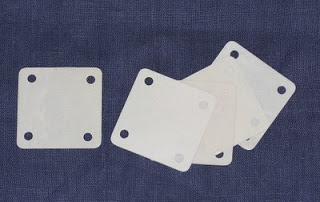
And now I have - and I have to spare, so they are on offer at the market stall. I present to you the museum-compatible, slim alternative to cardboard and playing-card tablets: Weaving tablets made of parchment.


These tablets measure 6 x 6 cm, a convenient size when weaving and large enough that you can handle them well and even weave with the tablets standing on the corners, for tubular or other special weaving actions. The parchment is prepared by hand, in one of the last traditional parchment manufactury. In this case, it is calf parchment. Rounded corners for smooth turning, large holes for ease of setting up the warp.

The tablets, being parchment, can be marked, coloured, scribbled on - whatever you desire. With a thickness of about 0,6 mm for most of them, they are slim enough so that handling a larger stack is easily possible - but stiff and wide enough to grasp them easily. So... no more excuses about not having acceptable weaving tablets to work with!
0
JUL
02
10

Hand-made needles

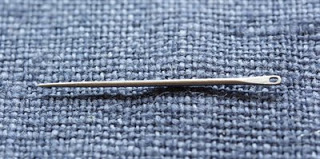
A few days ago, the postie brought me a small, unspectacular-looking packet. But the contents are really, really spectacular, and another addition to my product range in the stall: Steel needles, completely hand-made!


I had to hunt quite a while to find those beauties, and I'm really happy to have them in hand now. The steel is not stainless, so it needs a little loving care inbetween stitching sessions, but a drop of oil or a scrap of wool still containing lanolin (or a scrap of cloth with some lanolin rubbed on) will take care of them nicely. They are also shorter than I'm normally used to, but this, on the other hand, makes it possible to use more of the thread than with a longer needle.

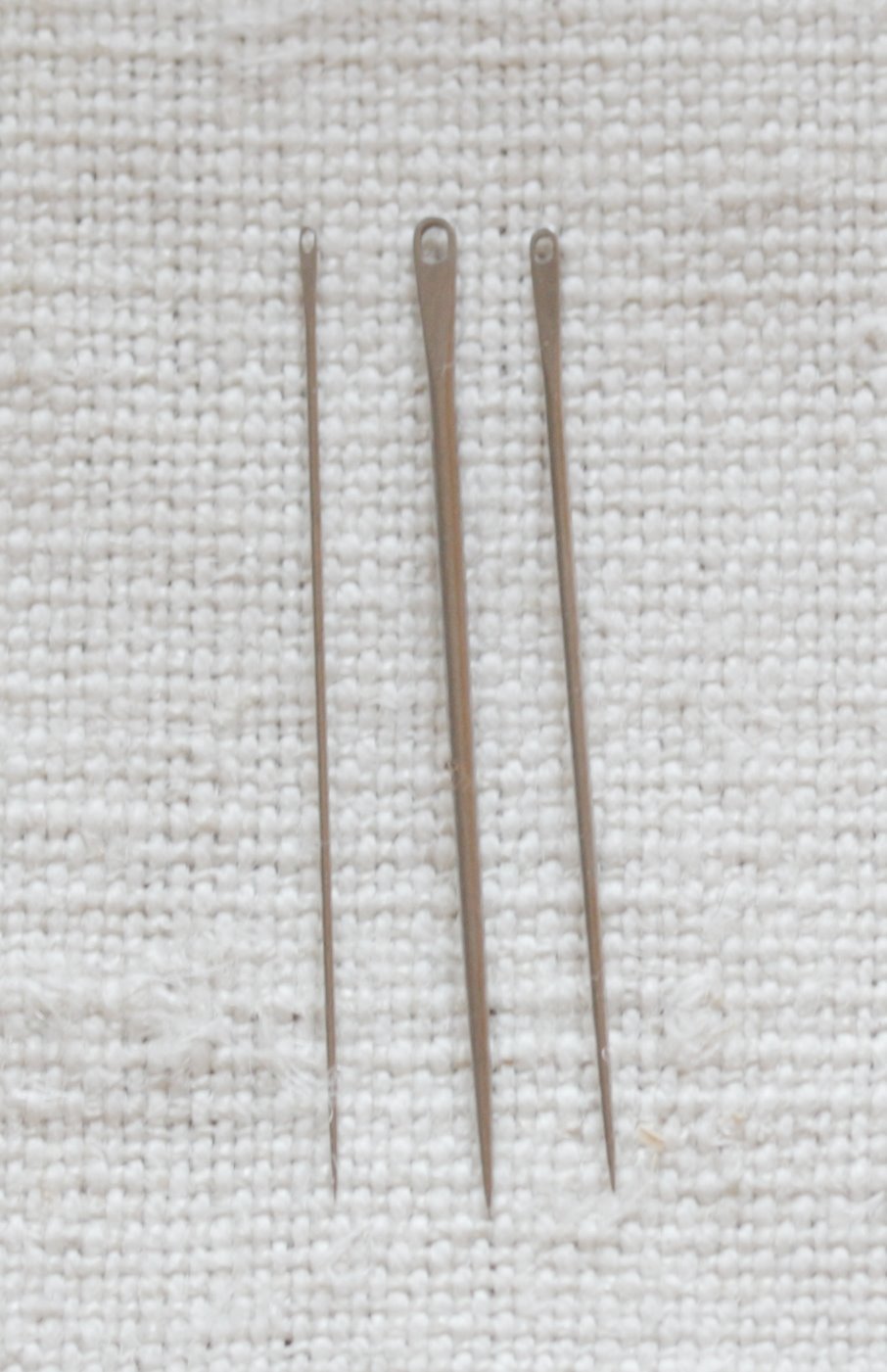
They have relatively large eyes in a flattened head, designed to take the thread through the fabric without rubbing it and are thus perfect for embroidery with delicate silk or gold threads. I can now offer three sizes for sale, a quite thick and sturdy needle with large eye, a medium-thick one and an extremely fine one. It's awesome to look at them knowing they are all made by hand - I had problems only photographing them!

In this picture, you see the three sizes side by side: extra-thin, thick and medium. I'm really looking forward to working with handmade needles in the future and stash the modern needles out of sight, whipped out only when needed in an "emergency".


And just because I can, I made a closeup photograph of the needle heads and eyes. Isn't that amazing?

0
JUN
29
0

Monday, Fun day!

I had a really nice weekend, including a wonderfully productive and fulfilling Friday and Saturday. Much of Friday was spent chatting and plotting things with two fellow archaeologists - one of them in personal union the goldsmith making my netting needles. So on that afternoon, a few more ideas developed for the range of goods for me to carry. The stall is developing into something catering to textile workers and enthusiasts of all textile disciplines current in the middle ages: Tailoring and sewing, narrow wares, netting, embroidery, and some more odds and ends. I won't carry fibres (since there are enough people for that, and most textile folks already have one or more sources for fibre), but odds, ends, and things connected to stitching and textile crafts.

Since the visit on Friday, I now have six more netting needles, as tools when holding workshops or for sale. They are just as beautiful and just as polished as my own one, and here's proof:


And just because of that incredible net from St.-Truiden, I had also ordered a really small netting needle. Really really small. And here it is, made from copper wire, with a shank diameter of a gigantic full millimetre! I'm really delighted with it, and I will try it out with my new, extra-fine silk thread - another thing that will be offered for sale.


I talked about a really productive weekend, didn't I? Saturday morning gave me a head start on something nice and special for the embroidery fraction, though that idea is still under development and therefore still top secret. The wood for the netting gauges is standing in the living room, waiting to be cut into pieces and sanded down. The concept for the stall is also developing - but more about all those things in another post...
0

By accepting you will be accessing a service provided by a third-party external to https://pallia.net/

Contact