

Latest Comments

Guest - Katrin Sprang Discussion
18 September 2026
Hi Rachel, I have looked for more photos of you, but that was not very successful. I found a link on...
Guest - Beatrix Sprang Discussion
15 September 2026
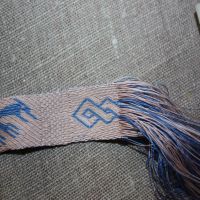
That lozenge pattern element is not a photograph, but a scan. So it should be to scale. But I pinned...
Guest - Katrin Sprang Discussion
15 September 2026
I was not referring to Rachel's reconstruction (is the reconstruction you refer to the one photograp...
Guest - Beatrix Sprang Discussion
14 September 2026
There is something Rachel did not mention. She told me: "Well, I worked with the measurements we too...
Guest - Katrin Sprang Discussion
14 September 2026
Well, this is certainly developing into an interesting discussion. Firstly, going from that lovely l...

Cording...

The Egtved Skirt is surprisingly short, with only about 40 cm overall length. Subtract about 2 cm for the waistband, and another c 2 cm for the felted rings on the bottom, and you end up with approximately 36 cm of cords for the actual skirt part.

That does not sound like a lot, right? Well, it quickly adds up, however - after all, there's about 350 or so cords in the complete skirt. These cords are very hard twisted, and one way to make this type of cord is to use the twist-and-cross method that was also employed for making bast proto-fabrics, like the mat Ötzi had with him.

Twist-and-cross means you twist each of your elements in one direction, then cross it over the other in the opposite direction. This gives you very good control and enables you to make a very hard cord with lots of twist and countertwist. Accordingly, the ply angle can be very high. The downside is that it takes a rather long time...

You can see how I do the twist-and-cross on one cord of my skirt in this video:


I've come a bit further than when I filmed this, but there's still about one metre to go... with the cords. That is a lot of twisting left to do!
0
Cording Again.
More Weaving.
 

Comments 2

Harma on Wednesday, 03 November 2021 16:50

I love your commitment to doing it in the original style, and it reminds me of a great week in Süd Tirol, but wouldn't a fringe twister with crocodile clamps be much more efficient? After a few tests it is easy to determine how many turns are needed and you can twist a cord in one tenth of the time without any visible differences.
Mine is home-made and looks like the Ashford twister. I twist a number of times in one direction and 2/3 times with both end held together, in de other.

I love your commitment to doing it in the original style, and it reminds me of a great week in Süd Tirol, but wouldn't a fringe twister with crocodile clamps be much more efficient? After a few tests it is easy to determine how many turns are needed and you can twist a cord in one tenth of the time without any visible differences. Mine is home-made and looks like the Ashford twister. I twist a number of times in one direction and 2/3 times with both end held together, in de other.
Beatrix on Wednesday, 03 November 2021 17:41

I did this with the twist and cross method by hand too. But much faster.
Like this: one cord in the right hand, one in the left. You twist both cords simultaneously with your thumbs and index fingers (both in the same direction off course to get a higher twist). Then you change your cords from one hand to the other (so left to right and right to left) in the other direction. With a bit of practice you´ll be much faster.

I did this with the twist and cross method by hand too. But much faster. Like this: one cord in the right hand, one in the left. You twist both cords simultaneously with your thumbs and index fingers (both in the same direction off course to get a higher twist). Then you change your cords from one hand to the other (so left to right and right to left) in the other direction. With a bit of practice you´ll be much faster.
Already Registered? Login Here
Monday, 21 September 2026

Related Posts

By accepting you will be accessing a service provided by a third-party external to https://pallia.net/

Contact