


Search the Blog
Latest Comments
Guest - Aislinn
Dyestuff Citizen Science.
09 October 2026
This is a great project. I look forward to the results. Thanks for letting us know.
Guest - Aislinn
Time for...
09 October 2026
Looks delicious!
Guest - Katrin
Sprang Discussion
18 September 2026
Hi Rachel, I have looked for more photos of you, but that was not very successful. I found a link on...
Guest - Beatrix
Sprang Discussion
15 September 2026
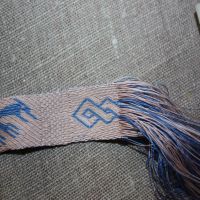
That lozenge pattern element is not a photograph, but a scan. So it should be to scale. But I pinned...
Guest - Katrin
Sprang Discussion
15 September 2026
I was not referring to Rachel's reconstruction (is the reconstruction you refer to the one photograp...
Experiment, more of the (almost) same
Since yesterday afternoon, fourty plywood discs in two different sizes and thicknesses are peacefully lying on a heap together, completing my selection of experimental spindle whorls. Thank goodness for the invention of power tools and "circle cutters"! Though even with that multi-watt support, it took me a while of fiddling with the large plywood sheets, the cutting gadget (a very cheap tool and accordingly fiddly to use) and the drill in its stand before I found out how to best cut the discs. But in the end, the archaeologist prevailed!
Now all the hard bits of the preparation are finally finished, and the whorls have turned out not to be perfect, but at least very good, and absolutely sufficient for the experimental purposes. So whew! The power of trial runs and solid calculations (with a huge lot of help from André Verhecken) is proven again.
A lot of the wool is already portioned and packaged, and today I'll take care of the rest of packaging before finishing the plywood with a light sanding around the edges and then... glueing the spindle whorls and spindles together.
This is something I would never do under ordinary circumstances. Who would want a spindle that can't be equipped with a different whorl, after all? "Those folks" back in the middle ages certainly didn't need glue to keep their spindle whorls on the spindle, the double-conical form was enough.
But since I am using chopsticks as spindle sticks (totally non-medieval, just like the plywood and the modern glue for assembling these), and since the plywood needs some glue to keep on the stick, and because I just want to make sure that none of the whorls slips off during the experiment, glue it is.
After the spindles are assembled, there's not much left to do for the experiment - preparing the documentation, writing down my notes for the "prep talk" before we start and packing all the things needed for transport to Eindhoven, no more. And well that this is so, since the experiment will start on Tuesday morning next week.
Now all the hard bits of the preparation are finally finished, and the whorls have turned out not to be perfect, but at least very good, and absolutely sufficient for the experimental purposes. So whew! The power of trial runs and solid calculations (with a huge lot of help from André Verhecken) is proven again.
A lot of the wool is already portioned and packaged, and today I'll take care of the rest of packaging before finishing the plywood with a light sanding around the edges and then... glueing the spindle whorls and spindles together.
This is something I would never do under ordinary circumstances. Who would want a spindle that can't be equipped with a different whorl, after all? "Those folks" back in the middle ages certainly didn't need glue to keep their spindle whorls on the spindle, the double-conical form was enough.
But since I am using chopsticks as spindle sticks (totally non-medieval, just like the plywood and the modern glue for assembling these), and since the plywood needs some glue to keep on the stick, and because I just want to make sure that none of the whorls slips off during the experiment, glue it is.
After the spindles are assembled, there's not much left to do for the experiment - preparing the documentation, writing down my notes for the "prep talk" before we start and packing all the things needed for transport to Eindhoven, no more. And well that this is so, since the experiment will start on Tuesday morning next week.
Comments
No comments made yet. Be the first to submit a comment
By accepting you will be accessing a service provided by a third-party external to https://pallia.net/