Latest Comments

Guest - Aislinn Dyestuff Citizen Science.
09 October 2026
This is a great project. I look forward to the results. Thanks for letting us know.
Guest - Aislinn Time for...
09 October 2026
Looks delicious!
Guest - Katrin Sprang Discussion
18 September 2026
Hi Rachel, I have looked for more photos of you, but that was not very successful. I found a link on...
Guest - Beatrix Sprang Discussion
15 September 2026
That lozenge pattern element is not a photograph, but a scan. So it should be to scale. But I pinned...
Guest - Katrin Sprang Discussion
15 September 2026
I was not referring to Rachel's reconstruction (is the reconstruction you refer to the one photograp...

Fibre Thickness Measurements.

I've been trying to practice using my digital microscope - by doing some fibre thickness measurements. Like so many things, this takes a bit of getting used to, and is not quite as easy or straightforward as one might expect... starting from getting things focused properly, to taking a good measurement of the rather fine fibres. It would help to have a greater magnification to have less margin for error (one pixel in or out does already make a difference), but then it's even harder to get a proper focus, and there's fewer fibres per image...

Anyway, here's a picture for you so you can see how that looks:
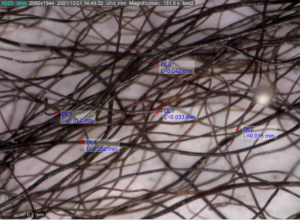


This is the fibre I'm using for the corded skirt, the cord part. I suspect that the measurements I took are a little bit high, because I have another kind of fibre where I know the micron count, and my measurements were consistently higher than the count that was listed... so, well, probably needs some more practice, and some calibrating of my own eye, and possibly I need to move that one pixel inside instead of outside.

Also... taking these measurements is quite time-consuming! Especially regarding the fact that you need to take measurements from about 100 fibres, randomly selected, to get something like a proper histogram of the fleece (or fleece part) that you are looking at. I only took a random sample of some few fibres, and I probably won't go for the 100 for now. There's other things to do that are more important right now (and I know already that the fibre profile of the stuff I can get does not match the Bronze Age sheep...)
0
Egtved Progress.
The End. Of the Belt.
 

Comments 2

Kareina (website) on Friday, 22 October 2021 09:19

I can't help but wonder how much you can automate the process? Geologists regularly let software automatically identify mineral grains, determine the locations of borders between different minerals , and the report the percentage of each mineral in a microscopic image. It needs checking to be certain that one correctly defined the visual parameters of each mineral, but checking is way faster than circling each mineral grain by hand and then calculating their area.

I guess to get the thickness of the fiber you'd need a program that chooses a random location, determines if it is fiber (dark) or background (light), then, if fiber, checks all of the adjecent pixels to see if they are still fiber, and then progress outwards from the starting point in all directions till it encounters pixels in the background colour. Once the boundaries of that fiber are thus determined then it can measure the shortest distance between one edge and another to determine the thickness of that point. Repeat 100 times. Or 1000. The computer doesn't mind doing repetitive tasks.

I can't help but wonder how much you can automate the process? Geologists regularly let software automatically identify mineral grains, determine the locations of borders between different minerals , and the report the percentage of each mineral in a microscopic image. It needs checking to be certain that one correctly defined the visual parameters of each mineral, but checking is way faster than circling each mineral grain by hand and then calculating their area. I guess to get the thickness of the fiber you'd need a program that chooses a random location, determines if it is fiber (dark) or background (light), then, if fiber, checks all of the adjecent pixels to see if they are still fiber, and then progress outwards from the starting point in all directions till it encounters pixels in the background colour. Once the boundaries of that fiber are thus determined then it can measure the shortest distance between one edge and another to determine the thickness of that point. Repeat 100 times. Or 1000. The computer doesn't mind doing repetitive tasks.
Katrin on Friday, 22 October 2021 14:58

That sounds like it would be a wonderful solution to the task! Can you recommend a software that would be able to do this?

That sounds like it would be a wonderful solution to the task! Can you recommend a software that would be able to do this?
Already Registered? Login Here
Friday, 16 October 2026

Related Posts

By accepting you will be accessing a service provided by a third-party external to https://pallia.net/

Contact