


Search the Blog
Latest Comments
Guest - Aislinn
Dyestuff Citizen Science.
09 October 2026
This is a great project. I look forward to the results. Thanks for letting us know.
Guest - Aislinn
Time for...
09 October 2026
Looks delicious!
Guest - Katrin
Sprang Discussion
18 September 2026
Hi Rachel, I have looked for more photos of you, but that was not very successful. I found a link on...
Guest - Beatrix
Sprang Discussion
15 September 2026
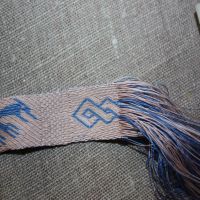
That lozenge pattern element is not a photograph, but a scan. So it should be to scale. But I pinned...
Guest - Katrin
Sprang Discussion
15 September 2026
I was not referring to Rachel's reconstruction (is the reconstruction you refer to the one photograp...
Like an Arrow!
There's a quite interesting article online about arrow wounds found on human remains in a site in Exeter - where, due to the fracture patterns and spalling it was even possible to see the probable turn direction of the arrow causing one wound.
Arrows usually spin, due to the slight curve of the feathers used as fletching; that stabilises the arrow while it's flying through the air. Depending on the curve of the feathers used, it will either turn clockwise or counterclockwise, and the curve of the feathers in turn depends on whether it was a left or a right wing feather.
It would be very interesting to know if one arrow-maker would prefer to do all arrows fletched in the same direction... or not. Or if they used tools or gadgets to get the fletching as consistent, and as accurate, as possible (like modern people do, when shooting with bow and arrow has become a sport, and precision is important) or if they just did it by eye. Back when I was having a bit of a go at shooting with bow and arrow, I tried both - my latest set of arrows had one feather taken from a bird of prey and two goose feathers each. They were rather soft, and made a quite distinct noise when flying through the air, and they were not stuck on in the precise 120° angle that more modern fletching is done in, and they were a little irregular anyways - but my shooting precision was never on a level where I'd feel that the irregularity made any difference. (Read: I had a lot of fun, but was quite bad at it.)
Modern feather fletching, by the way, is made from turkey feathers, and you can get them in all kinds of colours and patterns, pre-cut with a die so they are all exactly alike... and that makes the arrows look very different from ones done with less standardised, more natural fletching. They will all fly, though. And they will all make quite a bit of an impact!
Arrows usually spin, due to the slight curve of the feathers used as fletching; that stabilises the arrow while it's flying through the air. Depending on the curve of the feathers used, it will either turn clockwise or counterclockwise, and the curve of the feathers in turn depends on whether it was a left or a right wing feather.
It would be very interesting to know if one arrow-maker would prefer to do all arrows fletched in the same direction... or not. Or if they used tools or gadgets to get the fletching as consistent, and as accurate, as possible (like modern people do, when shooting with bow and arrow has become a sport, and precision is important) or if they just did it by eye. Back when I was having a bit of a go at shooting with bow and arrow, I tried both - my latest set of arrows had one feather taken from a bird of prey and two goose feathers each. They were rather soft, and made a quite distinct noise when flying through the air, and they were not stuck on in the precise 120° angle that more modern fletching is done in, and they were a little irregular anyways - but my shooting precision was never on a level where I'd feel that the irregularity made any difference. (Read: I had a lot of fun, but was quite bad at it.)
Modern feather fletching, by the way, is made from turkey feathers, and you can get them in all kinds of colours and patterns, pre-cut with a die so they are all exactly alike... and that makes the arrows look very different from ones done with less standardised, more natural fletching. They will all fly, though. And they will all make quite a bit of an impact!
Comments
No comments made yet. Be the first to submit a comment
By accepting you will be accessing a service provided by a third-party external to https://pallia.net/