Latest Comments

Guest - Harma Too Many Images Error.
27 November 2026
There have been weeks in November in which I would talke about 800 pictures. Proof of very interesti...
Guest - Max Mustermann The True Cost of Driving a Car.
06 November 2026
Great breakdown — the non-fuel costs are exactly the bit most people forget when they compare cars. ...
Guest - Harma Phew. Now it gets involved!
21 October 2026
Have fun at these events.
Guest - Aislinn Dyestuff Citizen Science.
09 October 2026
This is a great project. I look forward to the results. Thanks for letting us know.
Guest - Aislinn Time for...
09 October 2026
Looks delicious!
APR
03
0

Lightfastness Tests - with pictures!


For those of you interested in the lightfastness tests, here are pictures!


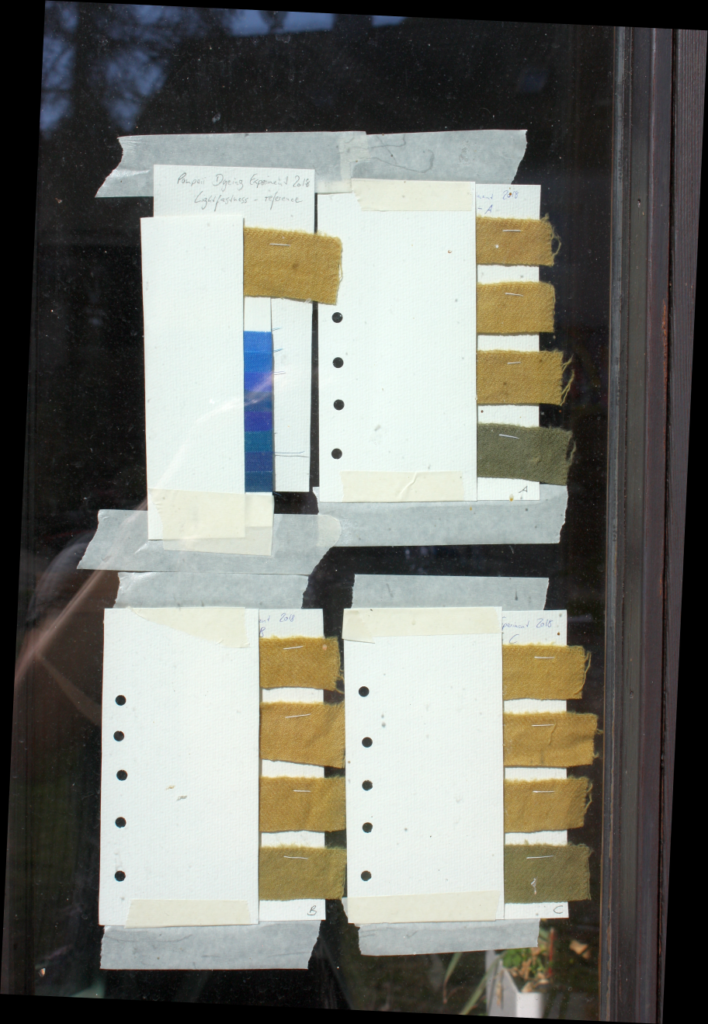
This was how the setup looked at the start...


I covered the parts to be protected with cardboard and stuck the whole shebang into the window of our wintergarden, facing south. After 7 days, I took it all down and checked the fading.


On the blue wool scale, each reference strip takes about two to three times longer to begin fading as the next lower strip in the scale. As the Material Technologies Limited website states:


Under normal solar testing conditions, reference 1, the least permanent, will begin to fade in 3 hours to 3 days, depending on geographic location, season, cloud cover and humidity; reference 3 will fade in 5 days to 2 weeks; reference 6 in 6 to 16 weeks; and reference 8, the most permanent, in 6 to 15 months.) These scales are used for paint lightfastness testing under international standard ISO 105-B, and are also used by gallery curators to measure the accumulated amount of light received by museum displays of paintings, textiles or photographic prints. 


This fits in fairly well with the speed of fading that I had, with reference strip 3 already noticeably faded after the 7 days that I took it down for the check. And this is how the birch looked:
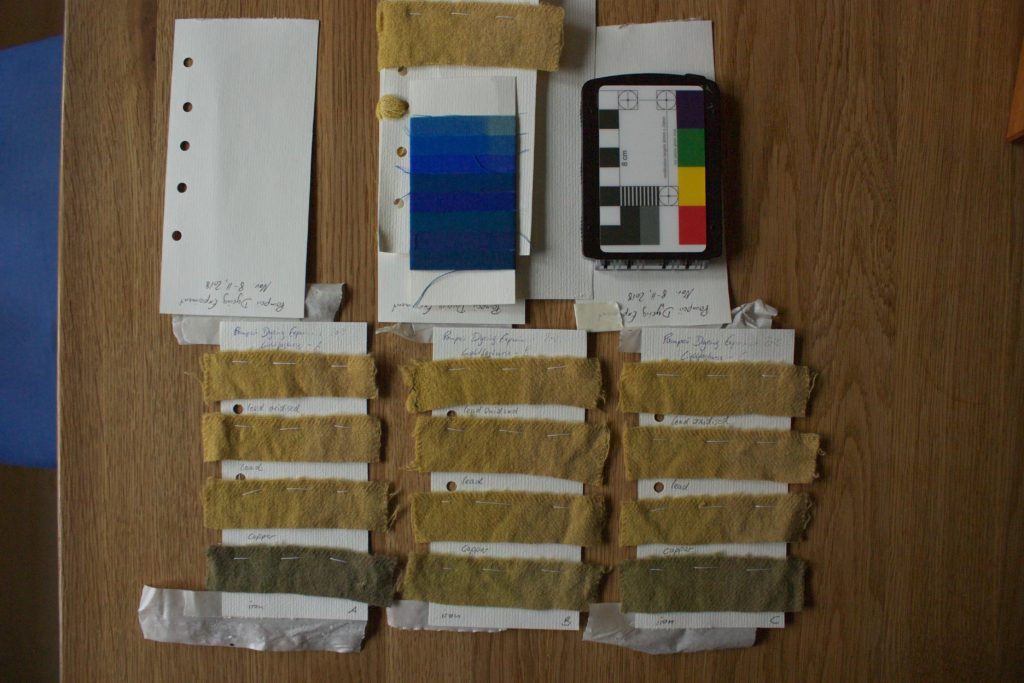


As you can hopefully see, there's distinct fading on the first blue strip, and there also is fading on the second and third one. It is not so easy to see on the photograph, but in actual natural daylight, there also is a little fading visible on the birch-dyed cloths. That would place the colour fastness regarding light of these strips somewhere between strip 3 or 4 - not too bad, seeing that modern recommendation for clothing dyes is to have 4 or better.


This, by the way, is another example of it being rather difficult to document nicely and clearly - not everything is easy, or even possible, to show on a photo.


After taking these pictures, the strips were covered again and went back into the window. I'll take them down once more soon, and see how things look then.

0
APR
02
1

Links again.

Roman Britain had a multi-cultural population - including people with African and Middle East origins. This can, yay science! be proven by bioarchaeology - read more about it here.


While we're on the topic of Britain, there's a petition going on to remain in the EU, and it's being signed at quite a rate. You can have a look at the live update info site here (and marvel at the number of areas that are still voting "leave", too!).


The NYT has an article about Gucci making shoes that look a lot like Keen sandals, and Keen's reaction to this.
For those of you reading German, here is an article about a rare breed of pigs, the Schwarzes Alpenschwein (black alp pig). (If you don't read German but like piglet photos, it's also worth a click.)

And that's it for now - with proper links, as the blog is working for a change. Let's see how long that holds up...
0
APR
01
0

Links - Art-Related


Here are, for a change,
some art-related links for your (hopefully) delectation.


First of all, an article about reconstructed sounds of Ancient Greek Music - with, of course, sound snippets in a video!


And here's a piece from the British Library site about female actors taking part in Shakespeare's plays - from the first woman to play a (female) role in Britain to modern gender-bending interpretations.


I found both of them very interesting - it's always fascinating to me to see how art changes with the times, and with the changes in society. Back when I was in school, I was in the drama group, and it was perfectly normal for women to act, including some male roles - sometimes because it was a classical "Hosenrolle", that is a role now traditionally played by a female though portraying a male character; sometimes because there were not enough men in the group; sometimes because of our interpretation; sometimes because one of the women was better suited to do a specific character than one of the men. So yes, even in our society there's still a lot of bulshitty gender-related stuff around... but a huge lot of it has also died off over time, and that is a really, really nice thing.

0
MAR
29
0

Still technical troubles.

The blog has still troubles - it seems I can post with a little workaround, though, which unfortunately does not allow links or images. So you're getting text only for the moment.

Things going on here? The car is emptied out and everything is back in place; there are only a few bits of after-fair-homework left to do.

I've also taken down the lightfastness test yesterday for a first look. After only about 7 days, there is a surprising amount of fading already! Which does mean that dyes classed as "very fugitive" are very fugitive indeed. Admittedly, our wintergarden glass seems to let a lot, if not all, UV through from how fast things faded, and there was quite sunny weather in the last days, but I'm still surprised at how fast this went. Pictures have been taken, of course, and they will get posted soon in the "result summaries" section of the Textile Forum homepage.
The birch-leaf-dyed wool strips, by the way, are fading a little already, which puts them into lightfastness class 3 to almost 4 (fading is less than on strip 3, but more than on strip 4). The recommendation for modern clothing dyes is class 4 - so they're actually not doing too bad for a dye that is generally deemed to be "not so very lightfast" among the professional plant dyers that I hang out with...
0
MAR
28
0

Technical Troubles in the Blog

I've done a software update recently, and there's some technical issues with the blog since then - which I hope will be solved soon. Technical issues of the kind where sometimes it works and sometimes it doesn't, and the search for the reason is still going on (which was, by the way, the reason for the spam posts yesterday).

So if there's sudden blog silence, you know what is behind it!

0
MAR
27
6

Wenn einer eine Reise tut...


There's a German saying which goes "Wenn einer eine Reise tut, so kann er was verzählen" (if someone goes on a journey, he has stories to tell). Well, that's definitely true for the trip I had to Oberstdorf...


On about halfway to the fair, I made a stop to re-fuel the car and have a potty break... but when I wanted to drive away from the fuel pump, my trusty (not-so-)little car refused to do it. The engine started almost normally, but died again at once... so I finally got to use the breakdown cover that we got back when we got the car.


Which was when I stuck the little card into my wallet. Which was not yesterday - and accordingly, the number was not working anymore. So a little bit of internet searching and phoning later (thank goodness for having a smartphone), I was able to tell a friendly young man what had happened, where I had planned to go, and a little bit later, I got told that a pickup would be coming to get me and my car to the next associated car workshop, where I'd get a rental car to continue my trip.


And that is exactly what happened. So I got to handle all my stock and fair booth stuff once more, after loading it into the car early in the morning, now cramming it into the rental car (which was quite a bit smaller than mine). After that was finally done, off I went - to arrive in Oberstdorf a few minutes before the hall was due for closing. Margit had in the meantime set up her own part of our booth, and prepared as much as possible for me - figured out where to place the workshop table and benches, where we would place my tables, and gotten my paperwork and parking permit sorted out.


Then we spent about twenty extra-exhausting minutes running to the car and transporting my stuff inside as fast as possible, so we'd have it in there to finish setup in the morning. We just managed to get it done before the hall closed... and I got to enjoy speed-booth-setup in the next morning.


It all got done in time, if only just, and I remained a little confused as to what of my things was where throughout the fair, as I had had to re-pack (and consequently re-order) things when changing cars. Nothing crucial had been left behind, though.


Needless to say, I was extra tired in the evenings... what a good thing that I could fall into bed nice and early. Apart from the car calamity, though, we had a really good time - nice weather, nice customers, and nice colleagues. I actually managed to catch up with two of them - Renate from Wollstube Wollin (who stood opposite us, and who is to blame for my going home with more yarn to knit), and the lovely Solveig from Alice im Wunderladen, who spent her break with Margit and me.


Meanwhile, I am back home, the car has been repaired and is also back home, and all that remains is - as usual - to re-fill things that have become low in stock and to do the fair homework... and then the next fair will be the Nadelwelt in Karlsruhe. I'm looking forward to that, and hopefully to a smooth trip there and back!

0
MAR
26
0

News from the Dark Side.

The ink, according to the recipe I was using, is finished - and the result is a very dark liquid with a blueish tinge, much darker than I'd expected. That might be due to my making a very small amount (which would increase the surface to volume ratio, and thus oxidisation) or it might be due to the longer time of the ink standing around, or it might be due to the ingredients.

Whatever the reason, I have learned several things.

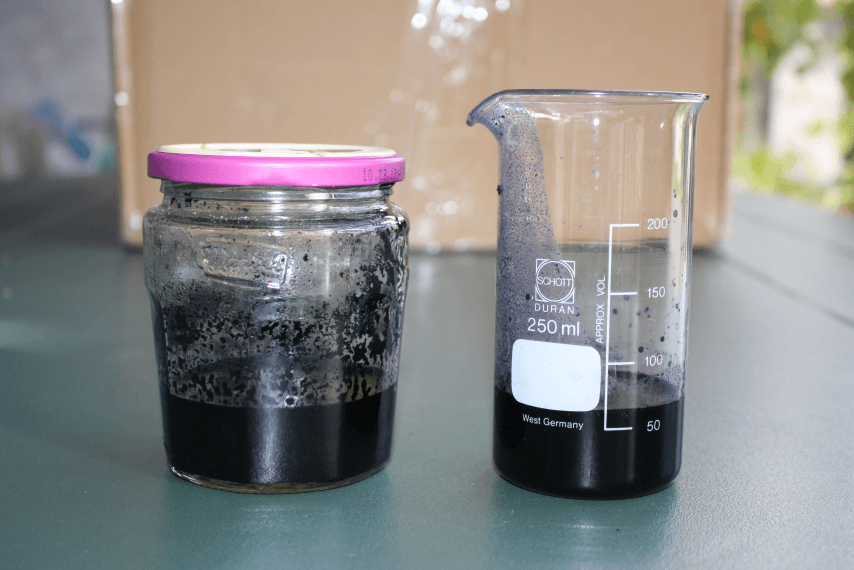
One: There is quite a lot of sludge left (which the recipe says can be used for a second batch of ink), reducing the yield of actual liquid to write with quite a bit... to about half, actually, in my case.

[caption id="attachment_4377" align="alignnone" width="854"] Sludge left, ink right...


Two: It's a fairly viscous ink. That is a nice thing as it makes using the ink on fabric a bit easier than when it's more liquid - though with a bit of practice, that is also no problem.

[caption id="attachment_4378" align="alignnone" width="640"] The ink test on fabric...


So that would make this ink nicely suitable for use as embroidery pre-drawing... if there were not number

Three: It's too oxidised, and that means there are too many free-floating ink particles in the liquid. Which means that though it will not wash out, it will bleed - and this, in turn, means I will look for (and try) a different recipe, and see if that works better.


The ink I have now is still a nice ink, though not for pre-drawing. It does give a lovely black on paper or parchment, though, and that usually does not get washed... so if someone needs some writing ink, let me know!
0

By accepting you will be accessing a service provided by a third-party external to https://pallia.net/

Contact