Latest Comments

Guest - Harma Too Many Images Error.
27 November 2026
There have been weeks in November in which I would talke about 800 pictures. Proof of very interesti...
Guest - Max Mustermann The True Cost of Driving a Car.
06 November 2026
Great breakdown — the non-fuel costs are exactly the bit most people forget when they compare cars. ...
Guest - Harma Phew. Now it gets involved!
21 October 2026
Have fun at these events.
Guest - Aislinn Dyestuff Citizen Science.
09 October 2026
This is a great project. I look forward to the results. Thanks for letting us know.
Guest - Aislinn Time for...
09 October 2026
Looks delicious!
JUL
18
0

Cat Shenanigans.

The cat, kind soul that she is, wanted to let me know she thinks my keyboard could use a bit of a cleaning. As she is perfectly and clearly understandable when she meows and purrs, but her human personnel are a bit slow on the uptake, she had to use drastic measures to demonstrate the cleaning necessity.

Which was achieved by hooking a claw underneath the Alt-Gr key and pulling. This, of course, was at first misinterpreted by her desk-sitting, cat-petting human as a mere coincidence, as she likes to knead when she's hanging out on the desk. The human was soon aware, though, that there was an astounding amount of dust and cat hair under that key... so obviously, there must have been a reason for the cat to do this. Right?

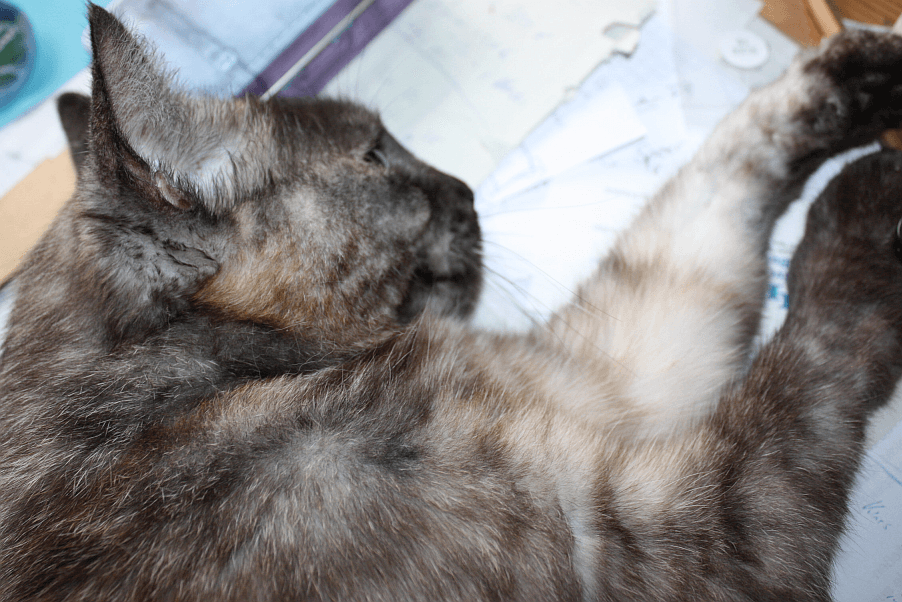
[caption id="attachment_3236" align="alignnone" width="902"]The culprit, erm, the graciously observant cat right after the deed, acting like nothing has happened. The culprit, erm, the graciously observant cat right after the deed, acting like nothing has happened.


So I did take the hint, and subsequently the small vacuum cleaner with a little brush (after Madame had left the desk, of course, as she is not fond of vacuum cleaner noises), and removed more astounding amounts of cat hair and dust from underneath the other keys.

Then came the fun task of figuring out how the three bits of plastic are supposed to fit together... and after two or so false starts, I managed to get them into correct order and position again.

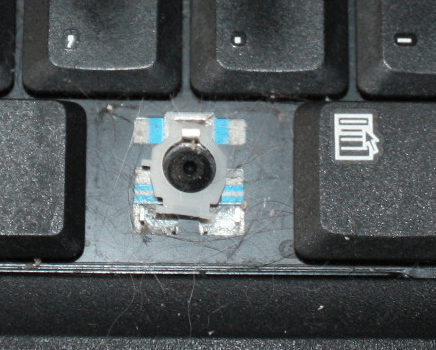
[caption id="attachment_3238" align="alignnone" width="436"]One of the plastic bits. And cat hair. One of the plastic bits. And cat hair.


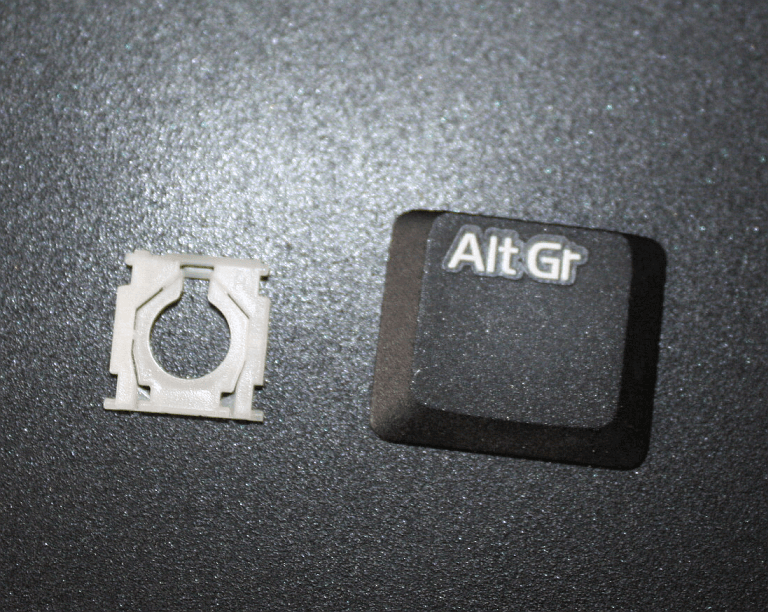
Placing the two white parts together again required bending the smaller one to get the little axles into their sockets again; for the rest, it was the combination of sliding something into one holder, then pressing the other end down until it clicked into place - once to fasten the white bits to the key plate, once to secure the whole setup to the keyboard again.

[caption id="attachment_3237" align="alignnone" width="768"]The two white bits, reunited, waiting to be set back into place underneath the key plate. The two white bits, reunited, waiting to be set back into place underneath the key plate.


Actually, that was fun, if a bit scary when doing the bending-to-set-into-place-bit (especially as I had to do it twice, not getting the stacking order correctly at the first go. Not something I'd have chosen to do this morning without the cat prompt, but I do find it interesting to see how things like that work - and putting torn-apart bits together is an excellent way to figure that out.

Now, though, I hope the cat will abstain from pulling out more keys - I do have actual work to do...
0
JUL
17
0

Link Roundup!

It's time for a link roundup again - here you go:

Following in the Jane Austen track, here's a post about shoes in her time.

SFF Audio has the complete unabridged audiobook "Herland" by Charlotte Perkins Gilman for you.

Here's an interview about microscopy on Early Modern textiles with Cristina Balloffet Carr.

Finally, a comic about blogging from Unshelved (which is a strip about a library, and the accompanying librarians).
0
JUL
14
0

Caterpillar.

We went off to harvest some cherries a while ago, and together with loads of them, we accidentally brought back this guy:

schlehenbuerstenspinner
Which, the Internet helpfully tells me, is the caterpillar of Orgyia antiqua, the rusty tussock moth, or, in German, Schlehenbürstenspinner (it seems to go for unwieldy names in both languages). I've never seen one of these caterpillars before, but they seem not to be so rare.

When searching for what this might online, I found a nice site with quite a lot of caterpillar pictures to help identify their species: Schmetterlinge Westerwald. There's 152 different caterpillars there, and the photos alone are worth a look to wonder about the variety of shapes and colours that these tiny critters have!

The one in the picture, by the way, got set outside onto our own morello cherry tree - where it will hopefully be okay...
0
JUL
13
0

Those Romans...

Romans are quite fascinating, with their mass-produced goods and their incredible logistical shenanigans like aquaeducts and streets. They are also... weird. In a way, at least - they'd probably consider us modern people at least as weird as we see them, if not more so.

But on to the Roman links showing both their ingenuity and their weirdness: Roman concrete, especially that for under-water use, has long been a thing to wonder about, as it just stays strong and strong, not corroding or decaying in conditions where modern concrete would have long given up. Now, it seems, the question why this is possible has been solved. It actually is corroding - but in a way that makes it stronger. Here's an article from the Guardian giving you details.

In the atlasobscura, you can read about clay instead of concrete. Specially shaped clay - the Romans had pottery jars just for the purpose of fattening dormice, which they would then eat as a delicacy.

Well. Probably not weirder than drinking coffee that has been shat out by civets. Or eating putterfish.
0
JUL
12
0

More Bouldering Stuff.

Just in case yesterday's post made you curious about bouldering, I have some videos for you. First of all one that is showing you an introduction to our usual haunt:

Then there's a recent boulder we did that we ended up with very different solutions. First, the Most Patient Husband climbs it like it was probably intended to be done:

For me, this didn't work. The black volume at the bottom is too far away and too flat for me - I don't get enough pressure on that foot, so it slips. I also have a hard time reaching the next hold from the start hold, so I had to think of something to help me get there. Good thing I have legs, and feet, and a bit of flexibility. Oh, and it only takes me two and a a half time as long... but see for yourself. (Fun, though.)

0
JUL
11
2

Interesting Differences.

Last year in April, a friend of ours introduced us to one of her favourite sports, and we've stuck with it since - bouldering. Bouldering is basically climbing, but only to a height where you can still (relatively) safely jump down - and consequently, you're not using a rope or other safety gear. In a bouldering gym, you have thick mats under the walls, so you get a (relatively, again) soft landing when you fall; and then there's different routes screwed onto the walls, usually colour-coded to show how easy or hard they approximately are.

It's a very interesting sport, because it's not only physical. Yes, having a lot of strength and power and endurance does help a lot, as does having a good sense of balance and body tension. But you can substitute quite a bit of sheer strength with good, efficient technique.

And it's also a puzzle to find out how to climb those problems. A puzzle whose solution is, or can be, extremely dependant on the body size, shape, and type of the climber. We have a climbing buddy who is taller than both the Most Patient Husband of Them All, and I'm on the short end of our group. We also have different proportions in our limbs, and different amounts of strength and flexibility.

A lot of the easier, more straightforward problems are the same for all three of us. One doesn't have to reach as far as the other, but basically handholds and footholds and technique are very similar. There are other problems, though, where sometimes we end up with three different solutions, and in a few cases, everyone could do all three versions, but one just feels best. In some cases, the other methods just won't cut it at all - the foot won't go to the hold, or the arms are not long enough, or there's not enough strength for a specific move, or the hold won't accommodate both hands.

So sometimes, you can see the three of us hang out in front of one of the boulder problems, trying to think of all the possible moves one could do, trying to find a sequence that works for the one of us who has problems with a part of that boulder. (Unsurprisingly, quite often, that is me, being the smallest - followed by our buddy, who is sometimes too tall to make our solutions work for him. As much as I might complain about being way too short sometimes, being tall is not always the best thing for bouldering either...)

Recognising the differences in these moves also made me think about the differences in crafts procedures. There, too, is a standard method, with standard tools and movements, that will usually get the job done. However, different people might have different problems with these moves, and in some cases, it will turn out to be inefficient, and there needs to be a different approach. When it concerns methods, like, for instance, in tablet weaving, the same applies to brains. Not everybody is comfortable with the same system - I've met people who prefer flipping the tablets instead of reversing direction, people who turn them individually, people who turn them in several packs. There's quite a few different methods of writing down patterns, too - and obviously they all work, if not for everybody. So in some cases, it's a question of finding the method (or the teacher teaching the method) that will work for you. That is sometimes easier said than done, and there's always the possibility that a technique, even if you get it taught in a way and for a method that does work for you, will just not become your favourite - and that's fine. But if you are just starting out learning something, and get the feeling that you just don't get it, my recommendations are: persevere and try some more, but also go and see if you can get input or a lesson from somebody else than your first teacher, or at least watch other people doing whatever you are trying to learn. It might just click suddenly for you.
0
JUL
10
1

Birka Literature.

Birka is a rather well-known find place for quite a few textiles, including tablet-woven bands, and a frequently cited resource. The publications are not the newest, and in this case, it's in our favour - they are old enough to be offered as pdf files, for free, on the site of Historiska.se, the Swedish history museum.

You can find the Birka publications here, and if you have a bit of time, also check out their English homepage - which even features a test where you can find out which character from the Norse mythology you might be. (It tells me I'm Skadi... and something about me not minding deadlines, because I'm already done when they approach. Ah, if only.)
0

By accepting you will be accessing a service provided by a third-party external to https://pallia.net/

Contact