Latest Comments

Guest - Max Mustermann The True Cost of Driving a Car.
06 November 2026
Great breakdown — the non-fuel costs are exactly the bit most people forget when they compare cars. ...
Guest - Harma Phew. Now it gets involved!
21 October 2026
Have fun at these events.
Guest - Aislinn Dyestuff Citizen Science.
09 October 2026
This is a great project. I look forward to the results. Thanks for letting us know.
Guest - Aislinn Time for...
09 October 2026
Looks delicious!
Guest - Katrin Sprang Discussion
18 September 2026
Hi Rachel, I have looked for more photos of you, but that was not very successful. I found a link on...
JUL
12
2

Early Modern Mummy Heap.

There's been a sensational find done in Italy: A church burial place where an entire community of people was buried in a church crypt - and a lot of them mummyfied. Which means that they are still fully dressed in their burial garments - practical, no-nonsense clothes.

You can read and see pictures about this find from the Italian mountain church here. Go have a look - the pics are spectacular!
0
JUL
11
0

Even more conferences.

Either I'm getting told about more of them, or this year is especially conference-heavy... no matter which of this is the case, here's another conference call blog entry for you.

Aarhus University of Denmark celebrates 40 years of Medieval Archaeology with a conference 26 to 28 October 2011, and you can find info and the conference programme on their conference website here. The conference will be in English, so no need to speak or understand Danish really well.

Another conference in October is the annual EXAR conference, this year taking place in Schleswig, northern Germany. You can find information on the exar.org webpage; the conference is from 13th to 16th of October, and it includes an optional excursion to Nydam (to see the Nydam ship). Deadline for registration is the 15th of July - still a few days left! -, and if you are interested in giving a paper, there seem to be still a few paper opportunities left. If you are not speaking or understanding German, please be aware that though the official languages of the conference are both English and German, the years when I attended the conference consisted mostly of German-language presentations.
0
JUL
08
1

Not all done yet - sorry!

For those of you who are waiting for the pallia online shop to finally pop into life, here's a current account of how it stands:

I have finished listing most of the wares - all the often-requested ones are in the shop - and they "only" need their photographs taken to get things going. So there's a photo session in my near future.

I have also made good progress on the legalese part of the thing; the necessary legal texts are all written and linked into the shop surface, and I'm full with knowledge about a few legalese details and how to solve them once the shop really starts rolling. There's one issue left to solve, but that is for a special still very secret extra of the shop... and won't delay the rest of it from going online.

What is going to delay the online release (apart from me being in Leeds next week, for example) is that I still need to do some testing and, before that, a good amount of template-jogging for it to look remotely like it should. While I have done a very little work with .css before (see the new, re-vamped pallia.net website), I am still finding my feet with Joomla!, the basic structure for the shop module that I now have. I did spend my evening yesterday working on baby simple things like adding a second menu and removing unwanted information - things that just eat up a lot of time until one has learned how things roll and what the logic behind the structure is.

This is the curse of doing all things single-handedly: You have to do it yourself. All of it. Yes, there's technically the possibility for me to have somebody else set up the shop and do all the prelim stuff, but since I will have to work with it later on, I have to know stuff about the backend and use of the shop scripts and underlying scripts anyway... so I might as well learn it right now.

That's how I am currently doing with the online shop - just to keep you up to date and from wondering what ever has happened to that project. I'll give you another update once I'm in the testing stage, and I might need some testing help then. If you cannot or do not want to wait anymore, though, please just e-mail or phone me to order things. I can still handle orders - luckily, my shop frontend is not me!
0
JUL
07
1

Leeds blogger meetup.

As my departure to Leeds IMC is creeping closer and closer, I checked back on Jonathan Jarrett's blog about the Blogger meetup. And true to his word, he and Magistra from the magistraetmater blog have decided on a time and place: It will be Tuesday evening, 18 to 20 o'clock, at the Stables pub.

Here's the full article on Jonathan's blog, where you can find a picture of him for identification. I'll be there, too - so maybe we meet at Leeds?
0
JUL
06
0

Exploded Sheep.

At the moment, the winter garden is feeling quite sheepy - with Rhönschaf sheep fleeces hanging out to air, dry out completely and be sorted (and probably partly combed).

Rhönschaf is a sturdy, rather large sheep with white, longish wool that has a nicely defined, wavy crimp. I have four fleeces; one of them will be put on hold for a workshop on historical wool preparation and spinning, and the rest of them...

Closeup of one of the fleeces
The fleeces are very good quality, with little to very little dirt in them; most of that falls out when combing the fibres. The sheep come from a good, sheep-friendly home and spent most of their time outside. The wool is not felted and very easy to comb, even without prior teasing or beating to loosen up the fibres; there's a pleasant amount of lanolin in it, but not too much.

The wool, when combed in the grease, has a chamois or light eggshell colour; it washes up into a clean white with water and maybe a smidgen of soap.
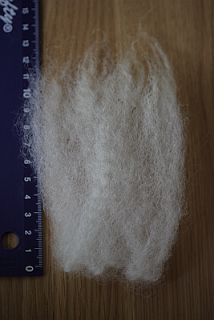
One lock after rinsing.

If you now feel the strong need to get your hands on some of that wool, you have several possibilities: I will sell you wool prepared into these lovely nests of hand-combed top:

Hand-combed top, in the grease, for spinning worsted yarn.


... which is ideal for worsted yarn - smooth, thin, strong yarns for your weaving or sewing needs.

If you have never worked with hand-combed top before, let me tell you: It will be much more expensive than industrial preparations, because we're talking about serious time investment here* - but it's also vastly different from industrial preparations. The short fibres are removed, there's still all the lanolin in,  there are no felted bits due to washing, and since I started working with those historical preparations, I don't like to touch the modern industrial stuff anymore.


If you prefer to do your prepping yourself, you can either get raw wool from me to use your own equipment. Or come to my stall at Tannenberg, where I will have a nice combing station, and you can use my combs to prepare wool for yourself.

* and you all know how I feel about fair pricing in crafts, right?
0
JUL
05
3

I almost forgot.

A while ago, I wrote a teaser post about a plying technique that I wanted to write about - and then I almost forgot I promised you a follow-up post. ZM15

While most of the ladies on medieval images have a long distaff that clearly holds fibres, like this:


Psalter of Fecamp. Ca. 1180. From Petzold, Andreas. Romanische Kunst, art in context. Köln: Dumont, 1995, p. 97.

and some fewer ones have a short distaff that also clearly holds fibres, like this:

Detail from Giotto: Annunciation to St. Anna. Scrovegni-Chapel, Padua. 1300-1320. From Flores d'Arcais, Francesca. Giotto. New York: Abbeville, 1995, p. 150.

something about this picture has always sort of tickled the back of my brain.

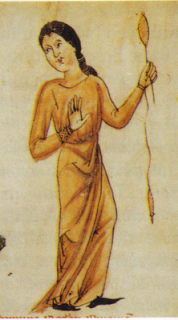
Young woman, Pseudo-Apuleius, 13th century. Vienna, Österreichische Nationalbibliothek, Cod. Vind. 93. From Kotzur, Hans-Jürgen. Hildegard von Bingen 1098-1179. Mainz: Verlag Philipp von Zabern, 1998, p. 336.

It's not the usual what she's holding; it's clearly a shorter distaff than usual, and the form of the stuff on the distaff is very clearly defined, very spindle-shaped and not fibery-looking at all.

Let's jump to another topic: the problem of plying. I don't know how well you manage to spin the same amount of length on two spindles or spools - I don't manage so very well; there's always some of the yarn left on one side when the other side has already run out. There's a theoretically very easy way to avoid this, though: To fold the yarn spun in half (from one single spindle, spool, or cop) and ply it with itself. When there isn't a foulup, you end up with a neat two-ply with no singles left.

There are different instructions on the 'Net on how to ply from a center-pull ball, and there's also the Andean Plying Bracelet which both are means to achieve the desired end-result: a skein of single folded in half and plied up. Both involve re-winding the spun yarn from the bobbin of a spinning wheel (where it's an absolute necessity) or from a spindle.

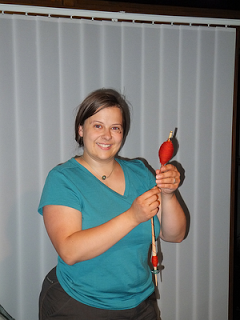
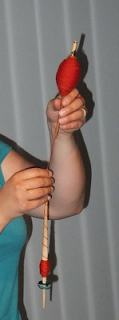
Me, I'm lazy. I like to be lazy. I promote winding spindles in a special way so that I can, after spinning, just slide that cop of yarn off the spindle onto a slim bit or stick of wood or so for storage. (Chopsticks, by the way, work fine.) And the way that I wind my yarn results in a stable, spindle-shaped cop of yarn that is essentially something not too unlike a center-pull ball. So I tested plying directly from the  cop (transferred to a slim stick) onto the spindle... and it works, and very very well too.

There's me doing it...

... and a close-up with a slightly different hand position that occurs quite frequently during the process.


So... here's a method that is efficient, easy to use, will result in no waste of yarn singles, and does not require extra tools (you can use a spindle stick to ply from). And I'm hooked on this new technique.
0
JUL
04
0

Back from the weekend.

I spent Saturday and Sunday in Stuttgart at the "Medieval Times" event of the Junges Schloß Stuttgart. "Junges Schloß" is a museum concept especially for children - every object in easy view of children, things to touch, experience, try yourself and garments to dress up with. I had the opportunity for a quick walk through the exhibition on Sunday morning, and I was so bummed that I'm already older than ten years.

No, really. It is a wonderful museum for children (and me and the two grown-up colleagues also had a heap of fun sitting on the thrones and on the knight's horse), and if you are in the area with a child, or if you are interested in museum concepts for children, or if you are plain curious - do go there. I was really blown away by the exhibition.

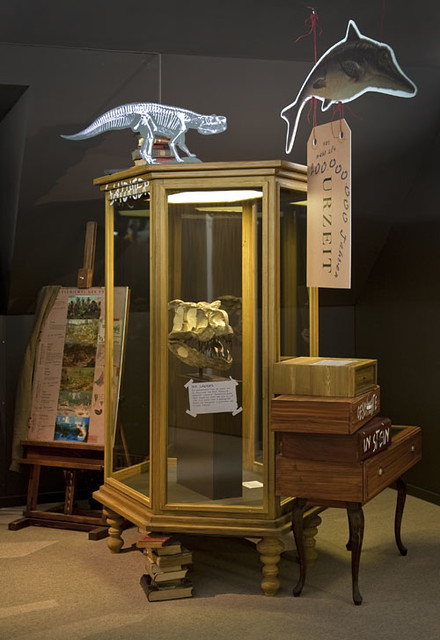
If you are too far away (or if you want a look before), here's a picture of the main room, a renaissance "cabinet of curiosities" showing treasures from throughout time.

Wunderkammer Urzeit
(Picture from a photostream made by the museum that you can find here.)

And those glass cases can all be opened by the staff in the museum so that the young visitors can touch the original objects in there. Awesome, isn't it?

I had hoped to sneak off and catch another few minutes in the exhibition room, but the medieval event was so well received and so well visited that there was absolutely no time for it. I spent all Saturday and Sunday spinning, explaining about worsted and woolen, combing wool and spinning even more. And letting people try themselves. Oh, and threatening my neighbour with my distaff, because that's a very medieval thing to do (and always good for a laugh).

So go visit the museum, everybody who is able - I'm sure you will enjoy it!
0

By accepting you will be accessing a service provided by a third-party external to https://pallia.net/

Contact