

Latest Comments

Guest - Katrin Sprang Discussion
18 September 2026
Hi Rachel, I have looked for more photos of you, but that was not very successful. I found a link on...
Guest - Beatrix Sprang Discussion
15 September 2026
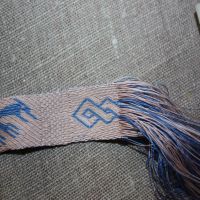
That lozenge pattern element is not a photograph, but a scan. So it should be to scale. But I pinned...
Guest - Katrin Sprang Discussion
15 September 2026
I was not referring to Rachel's reconstruction (is the reconstruction you refer to the one photograp...
Guest - Beatrix Sprang Discussion
14 September 2026
There is something Rachel did not mention. She told me: "Well, I worked with the measurements we too...
Guest - Katrin Sprang Discussion
14 September 2026
Well, this is certainly developing into an interesting discussion. Firstly, going from that lovely l...
APR
09
0

Trouser Ponderings.

I've been wondering in the back of my brain for most of the night, since looking at the Alpirsbach pattern yesterday: How would it have been constructed?

You see, the pattern, as published in Fingerlin, I., 2001. Textil- und Lederfunde, in: Landesdenkmalamt Baden-Württemberg (Ed.), Alpirsbach. Zur Geschichte von Kloster und Stadt, Theiss, Stuttgart, pp. 715-818 on p. 737 looks like this:

The whole thing is placed at an angle onto the fabric, as indicated by the little arrows - so you can use the elasticity on the bias to make everything work better.

So far, so good. But... we're in the late 15th, early 16th century here. There's definitely no Burda-style patterns made from paper, and the thing is not lined, so you can't use the lining for construction. Which leads me to the question, as always when looking at garments from medieval times: How do you construct this? Which measurements do you take, and how do you transfer them to the fabric to cut out your thing, especially since there's bits not cut in one piece due to the fabric width?

Of course you can construct one leg first and then use that as template for the other one. But in this case, which one do you do first, the one with the bits of the front and the back strip cut extra, or the one with the solid bit of the ass part cut extra? 

Questions over questions. First step for trying to solve them is printing out the thing and marking it up with all the known bits - which pieces are definitely the same length, which bit correlates to a known body measurement, how are the warp and weft aligned in the extra bits. Which is exactly what I am going to do today, in a bout of slightly brain-bending fun!

0
APR
07
0

Exciting things...

Easter has not only brought some time with family and plenty of eggs (both the coloured-shell chicken version and the chocolate version), but also some more prep for the exciting trouser project to come.

The trouser find from Alpirsbach, most probably dating to the late 15th or very early 16th century, is rather well-known for being, well, one of a kind. The fabric was a linen 2/1 twill, which is unusual by itself. The cut though very nicely corresponds to trousers shown on artwork from the same period. You can see an image of the find here (on a German page).

I'm currently working on a request of a museum to have a reconstruction of the piece, with the feet parts on. First problem was to research the fabric and figure out if there's someone who can weave it, and I'm very happy that Marie Ekstedt Bjersing is now going to take on that challenge, as the fabric is quite unique as well - not only because of the binding, but also having a thin warp and a comparatively very thick weft.

My task will be to make the fabric into a garment, and as I'm writing this, some modern, machine-made fabric is hanging outside to dry so I can do a test run in order to understand the pattern correctly before I'm cutting into the good stuff.

So. Exciting things. 

0

By accepting you will be accessing a service provided by a third-party external to https://pallia.net/

Contact