Latest Comments

Guest - Katrin Sprang Discussion
18 September 2026
Hi Rachel, I have looked for more photos of you, but that was not very successful. I found a link on...
Guest - Beatrix Sprang Discussion
15 September 2026
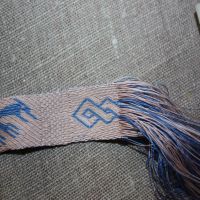
That lozenge pattern element is not a photograph, but a scan. So it should be to scale. But I pinned...
Guest - Katrin Sprang Discussion
15 September 2026
I was not referring to Rachel's reconstruction (is the reconstruction you refer to the one photograp...
Guest - Beatrix Sprang Discussion
14 September 2026
There is something Rachel did not mention. She told me: "Well, I worked with the measurements we too...
Guest - Katrin Sprang Discussion
14 September 2026
Well, this is certainly developing into an interesting discussion. Firstly, going from that lovely l...
MAY
06
0

A Look Inside.

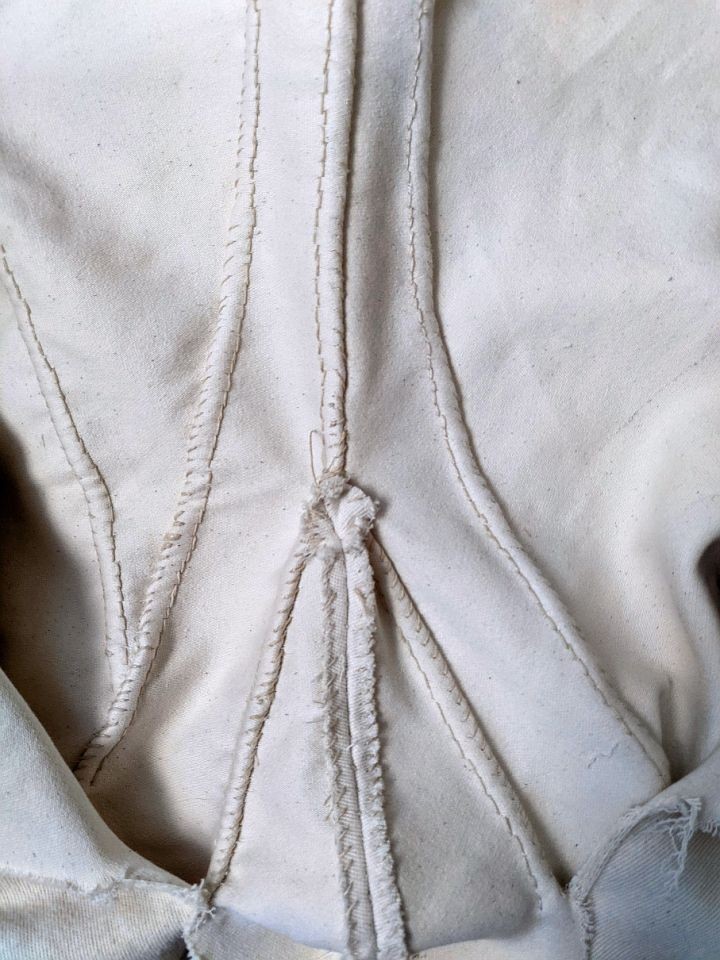
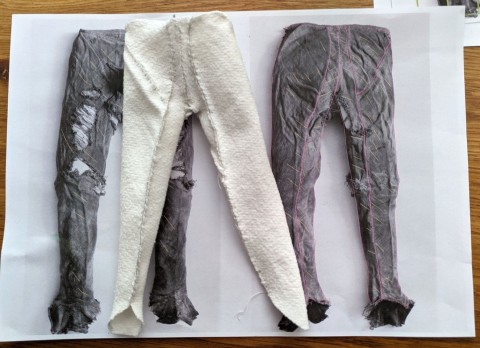
There's some progress, and you are getting a look inside... the butt part. It currently looks like this: 

Since there's no really clear indication of a felled seam on the codpiece, I've made it as flat as possible. The rest are felled same direction as in the Alpirsbach original.

Fitting is still to be done - and the thing also lacks the feet, which means the legs have a tendency to twist out of alignment. But that will be done next try-on session! 

0
MAY
05
0

More Alpirsbach.

About everybody who has done reconstruction work on late medieval legwear and used the Alpirsbach pattern as one of the sources has mentioned (if they have written about it, obviously) that the crotch as drawn on the pattern will not work.

I can confirm. It's too pointy, so that you will have the full length for the crotch drawn in on the pattern, but it is not usable in its full length - the little pointy point will be pointless, you could say. So why did I go for the pattern style anyways? Well, because a) I wanted to see how it did not work, and b) I didn't want to make something up before having an idea of what to make up.

I have now changed it to a sort of narrow U-shape for the second leg, and it looks much better. 

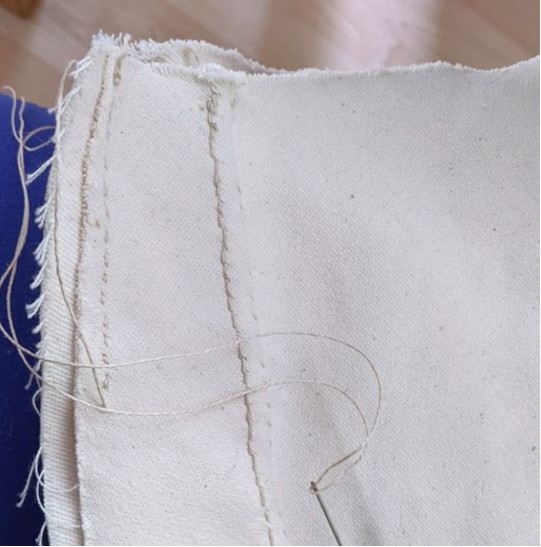
I have also mapped all the long and short seam allowances so I can do the felled seam in the right direction. And I have cursed (frequently) my choice of test fabric, which is rather heavy and stiff and needs some wrangling to work with the relatively narrow seam allowances.

Yes, this will be just enough to fell. No, it's not enough to be nice and easy... but the original seams were relatively narrow, too.

One leg is sewn (though not hemmed) all the way down, the other halfway, and the butt seam is in (that's the one being done in the picture). They have a tendency to twist around the wearer's legs, which is a little weird and may be a) normal and totally okay or b) something that will turn out to be not so good, and will need an adapted pattern making process in future iterations. But it might also be one of the reason why these hose were footed: So that the seam stays where it's supposed to stay. 

Now the only step left (apart from the feet, and finishing the long seams) is to figure out the final version of the codpiece, and cut, sew, and install that. It will also be very interesting to see if the thing really stands nicely on its own or whether it needs to be filled with something.

All very interesting : )  

0
APR
30
1

Long Weekend Ahead.

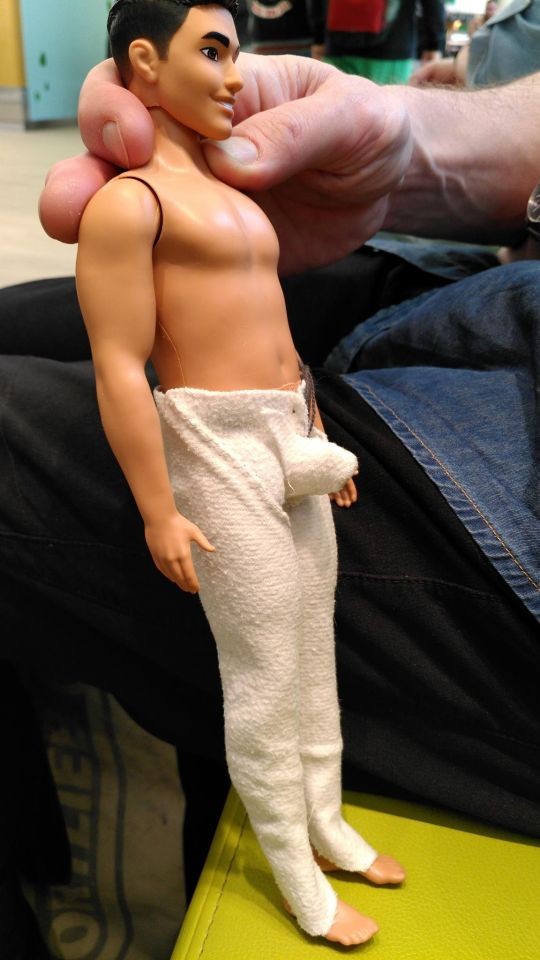
And while I am happily getting ready for the long weekend, here is an image of Barbie doll Ken (with, as they call it, the "broad body type" who is kindly modeling my small model of the Alpirsbach hose: 

It's still lacking the feet and the waistband, but otherwise, well! And you can guess that I was very happy about this happy chance fit! 

0
APR
23
0

Teeny legs!

I'm not a huge fan of sized-down models for  testing garment patterns, but sometimes, well, sometimes it is not the worst idea. So it happened today - and the result is, I'd say, not that bad:

I have managed to invert sides (or would need to turn it inside out now), but overall, there's been a few insights, especially regarding the braguette. So... once all the other questions are solved, I might have a better idea of how to attach it!

(Still to crack: The "how to place it on fabric and so on" riddle.) 

0
APR
22
0

Stuff that's happening.

I got a new battery for my trusty laptop today, as the old one is, well, trying to turn itself into a soft hillside. Not good. 

Still working on the Alpirsbach riddle, where lots of the grain directions on the actual photo don't match very well with the grain directions on the pattern drawing, and where the two legs were consequently probably designed/drafted individually and slightly differently in approach. Gnah.

One single white tulip is blooming.

There is a part of the Swedish Historical Museum website that has all the documentation drawings of the Birka excavations, and you can search the list and look at the individual graves all you want. Why do I know this? Because I had to find out today, when working on a translation from German to English, whether the thing with textiles attached in grave 901 was scissors or shears. (German can do a distinction if you write Bügelschere instead of Schere, but the latter can mean both, so unless there's an explicit Bügelschere, you never know. It was shears in the grave, by the way.) This translation issue reminded me of a friend's explanation why so many of the automatic translation programmes have issues with genders: Because it's much easier to have just one dataset for each language that goes to English and back, and to translate from, say, Finnish to Suaheli, you'd go Finnish - English - Suaheli. Which gets you odd effects if you are translating from a language with a certain distinction between things to English where this is lacking and back to another language that would in theory mirror the original distinction, but now it won't because the information got lost in the intermediate step. 

0
APR
20
5

Surprisingly (well, not really) complex...

So. There's still pondering taking place regarding the Alpirsbach trousers  legwear... because, well, my way of thinking.

The task is to make a reproduction of the trousers for an exhibition, which technically means that I could take the pattern published after the examination of the trousers garment, read the description, enlarge the pattern and then cut exactly that. But that, to me, would be sort of... cheating. I would much prefer to understand how the pattern was constructed originally, then re-do that construction process, and make the trousers with that re-done pattern.

Which, in turn, means that I have to understand the pattern. Not just which body measurement is found where in the thing, or where which part goes to sit on the body, or which bits to measure, or how much seam allowances to add to a given part, but also how to place the thing onto the fabric.

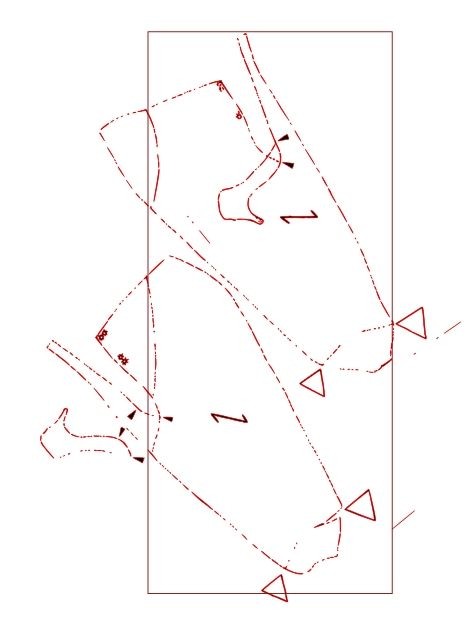
You see, in the original there's two main parts, and they look quite similar but they have different bits tacked on due to the fabric width not being enough to cut everything in one piece. My current hypothesis is that one leg was constructed first, cut out, flipped over, placed on the fabric and traced to make the second leg. For this, the (to me) logical choice would be to cut the right leg first, as this has only a small bit on the butt added in, and all the relevant long measurements are fully on the fabric.

It would look like this, laid out:

Pattern after Ilse Fingerlin.

Some of the bits are very clear (there's a crotch middle spot, and the butt strip, and the foot part, and the thigh circumference), but the exact shape of the crotch cutout is a lot smaller and more pointed than a lot of the re-creation patterns of joined hose that I have found in other places.  So... is this correct? Will this work? How to reliably construct it?

Questions over questions. It does remain interesting, I can say!

0
APR
13
0

Weekend Over.

Is it really Monday already? 

But on the other hand, the weekend saw some nice hanging out, some bouldering, making a new batch of cat food so the furry lady can munch on something different, and some painting of miniatures. Which (the minis) will be seeing the gameboard this evening, if all goes according to plan!

The weekend also included some more puzzling over the Alpirsbach thing making, and I did get some helpful hints from Beatrix Nutz. Including the hint that they should not be called "trousers" but "hose" or, even better, "joined hose".

Eh. Terminology. I do like to complain about textile terminology and its many, many pitfalls and dark corners and its general horrible unreliableness, so it's good to see that at least there's reasons for my complaining! (In Middle High German, "hosen" would be the hose, too, but in modern German they are called "Beinling" and the full garment with everything covered and everything sewn together would be "Hose", in the singular, so of course I was assuming that English would handle it the same way and "trousers" are the full thing while "hose" are the Beinling equivalent. There you go.) 

0

By accepting you will be accessing a service provided by a third-party external to https://pallia.net/

Contact