

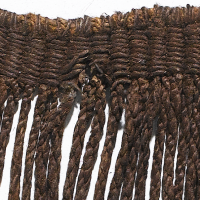
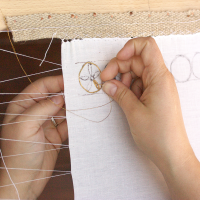
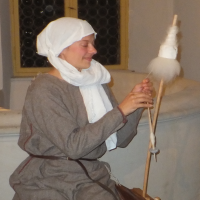
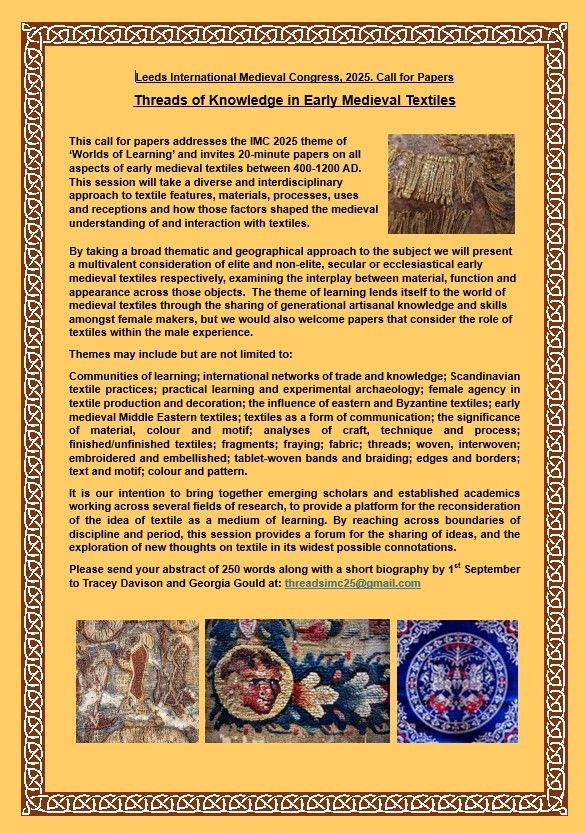
Leeds International Medieval Congress is having its CfPs running, and one of the sessions will be "Threads of Knowledge":

Enter your text here ...

Leeds International Medieval Congress is having its CfPs running, and one of the sessions will be "Threads of Knowledge":
Enter your text here ...

I'm off on the "Neu verflechten" conference, where I will be presenting (together with Tracy Niepold) once more about the Shiny Dead Cow Guts, also known as membrane thread project. This time, the title is so long that it almost feels like it's half a presentation by itself:

I'm always vaguely amused when titles (or subtitles) end up rather long. I don't mind them at all, since it's usually quite descriptive and so you know what awaits you - but it seems to be a thing especially in archaeology context. When I was studying, we had to fill out forms to get our "Schein" for attending something, and you'd usually run out of space because stuff was so wordy. It started already with trying to fit "Archäologie des Mittelalters und der frühen Neuzeit" on the rather short line for what you are studying, and went on to cramming "Very long and rather descriptive title with mention of the timespan in words or if it's in numbers then something else making it really long" into the part of the form that wanted you to state the name of the course. Good times! (And no wonder we'd internally all write "AMANZ".)
As I'll be on the conference for the next two days, too, there will be no blogging until next week!

The Early Textiles Study Group conference this year is taking place in Cambridge, Britain - or you can join in virtually online. Registrations for both kinds of attendance is now open, and you can have a look at the preliminary programme on their website, too.

Edges are definitely a very interesting topic!
I'm currently working on translating (and shortening...) our NESAT presentation for an upcoming conference in German, and this, together with some other things, has made me ponder how presentations at NESAT, but also other conferences, have changed during the past years. Or maybe I should really say decades, but that makes me feel old.
Back when I started out in Uni, standard was still having slides, and one of the guidelines that a tutoring archaeologist gave us was two slides (shown in parallel) per minute when you are planning your presentation.
Then came the advent of PowerPoint, and the utter freedom to have as much text, and as many pictures, as you wanted. In as quick a sequence as you wished to, because you're doing the clicking yourself and don't have to say "weiter" (or knock) so your helper puts in the next slide.
At the last NESAT, we had one old-style paper presentation (with powerpoint, but the rest of how it was designed was really more like back when slides were the usual thing), and the rest of them were all "modern style". The big difference, for me, was that the old-style presentation was slow enough in both text and images that you had enough time to jot down the key points and you could even have made a quick sketch of the key parts of the images. With the modern style presentations, you stand no chance. Information density and slide speed is so high that you cannot write fast enough for all the key points, let alone try and sketch something. Very few exceptions apply, but for me, the way to get the most out of the papers in modern style is to write down the things I find important or interesting that the speaker says, but that are not written as bullet points on the corresponding slide - and I make a photo of the slide in addition to that.
Thinking back, this has changed over the past years too, I remember being able to write down more of the content that was presented. I don't think I have gotten that much slower in writing; my impression really is that the papers have become more densely packed with information all the time. (I do confess guilty of trying to fit as much into my presentations as possible, so I have definitely played my part in this development. Case in point - our NESAT presentation had 47 slides in total, for a run time of max 20 minutes. That's about 25.5 seconds per slide if you distribute the time equally.)
Looking at it like this, it's a small wonder we were all so tired after the conference days! It also seems to be quite different in other disciplines... which I also find very interesting. Maybe I should venture out to more neighbouring discipline conferences in the near future, to compare.
I'm already looking forward to NESAT - this conference is always a highlight of the three-year-period that NESAT takes place. This time, it will be in Warsaw, Poland. I've been to Poland once already, many years ago, for an excavation, and I have a lot of good memories of these weeks, so it will be really nice to re-visit some of the local delicacies. And, of course, meet with the friends and colleagues from all over Europe.
The conference programme looks quite stuffed with interesting things - you can find it on the website, in case you are interested.
This June, there will be a German conservator conference, called "Neu verflechten", which will even be hybrid - so if you're interested, here is some more info:
27. bis 29. Juni 2024
Neu verflechten!
Textile Netzwerke und Perspektiven im musealen und archäologischen Kontext
Die Fachgruppe Textil und die Studienrichtung Textilien und Archäologische Fasern des Instituts für Restaurierungs- und Konservierungswissenschaft (CICS) der TH Köln laden zu einer gemeinsamen Fachtagung unter dem Titel "Neu verflechten"! Textile Netzwerke und Perspektiven im musealen und archäologischen Kontext" vom 27. bis 29. Juni 2024 an der TH Köln ein.
Die Tagung setzt sich mit den aktuellen Herausforderungen im Umgang mit musealen und archäologischen Textilien auseinander und soll dazu dienen, neue kollegiale Netzwerke zu bilden – zu verflechten. Das Tagungsthema ist bewusst offen gestaltet, um allen aktuellen Themen der Textilrestaurierung Raum zu geben.
Viele der Präsentationen und Poster sind interdisziplinär. Themenschwerpunkte sind vor allem die Textilrestaurierung in der Archäologie, aber auch in der modernen Textilkunst, sowie die Anwendung von Methoden und Materialien anderer Fachgebiete. Begleitend zur Tagung wird eine Ausstellung mit Vernissage (Textiles & Beyond. Positionen zeitgenössischer textilverarbeitender KünstlerInnen. Ausstellung am CICS, Raum 11, 17. bis 29. Juni 2024) angeboten. Bei einem gemeinsamen Abend mit Aperitivo haben wir die Möglichkeit für den Austausch und ein gemütliches Zusammensitzen. Am Ende der drei Veranstaltungstage bieten wir außerdem Führungen durch die Fachbereiche des CICS an.
Wir bieten unsere Tagung in diesem Jahr erstmals hybrid an, sodass auch eine kostengünstigere Online-Teilnahme möglich ist.
Mehr Informationen zur Tagung (Programm und Link zur Anmeldemöglichkeit) hier auf der VDR-Seite.
I will also be there, presenting our membrane thread project - and I'm already looking forward to this a lot!
It seems to be the season for CfPs - so here's some more:
The European Association of Archaeologists have extended their Call for the 30th Annual Meeting in Rome, Italy. The conference will run August 28-31, and the new deadline is February 12. You can find out more about the conference and also the submission portal via their website.
There will surely be quite a few textile sessions there again, and one of them is Session #733, Interdisciplinary Approaches to the Archaeology of Roman Textiles.
By accepting you will be accessing a service provided by a third-party external to https://pallia.net/