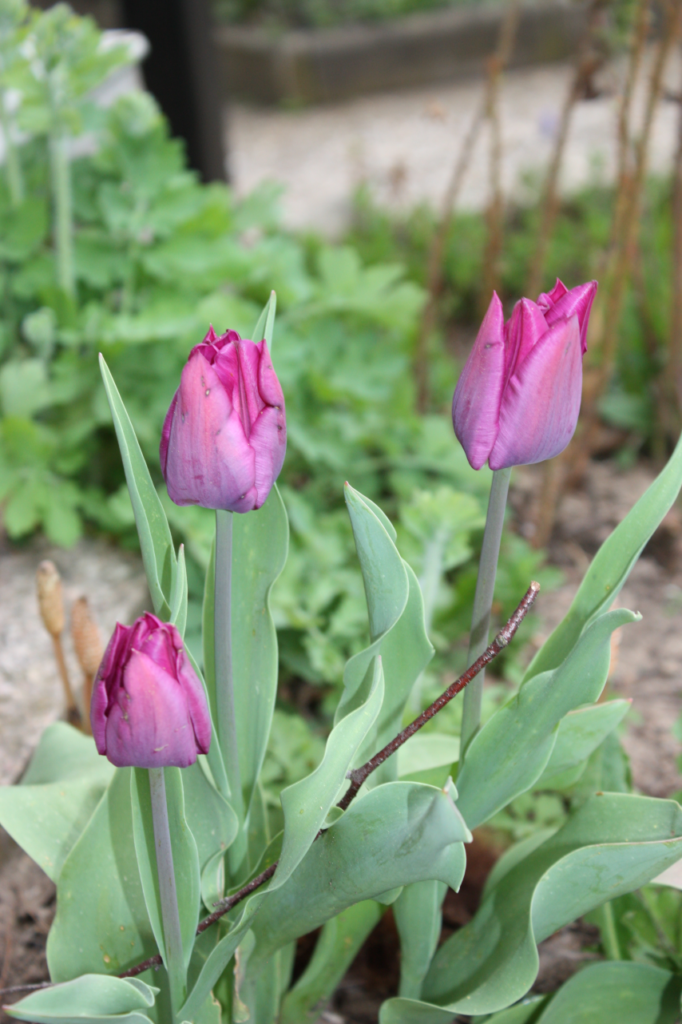
Actually, this title is half a lie, because only one picture is an actual garden pic - this one:

It's a surprise gladiolus that one day just turned up here, and now it's blooming brightly red and standing tall. Well, with a little help - the flower stalk actually had grown so tall that a heavy rain flattened it down to the ground, and it needed a support to keep it upright after that.
The other one is of a plant that resides in our wintergarden - sea kale.

This is a plant grown from seeds that I took from actual wild sea kale on one of our trips to Britain (so it's a pre-Brexit-Britain-exiter!). Sea kale doesn't grow easily from seeds, and it took about 20 of them to get me one single plant, which I then tried to coddle and coax into growing.
It was... rather uncooperative, languishing with only two or three small leaves... not very promising at all. So I kept it in the protective wintergarden environment, and then it got its very own nice large pot with water reservoir, and still... nothing.
I did know that sea kale is a
halophyte, but as I also knew that it had been grown inland in former times, I had not added salt to its diet straight away. (The
German wikipedia article about halophytes is much more elaborate than the English one, by the way, so if you read German, it's the better choice.) Then, finally, I started watering it with the water we had boiled our pasta in. Salty water. With lovely sea salt. And slowly, this little plant started to grow a few more leaves, and to get a little larger. It's still not very large - especially not compared to the huge, huge sea kale plants growing on the British Coast - but it might just need more salt, and I'm sort of afraid to overdo it, so I'm upping the dosage only slowly and slightly.
Moral of the story: there are plants that can tolerate salt, and plants that actually need salt, and the latter will not do well without it, even though they might survive (if barely) in normal soil. Salting the earth, in that case, is actually helpful!
Oh, and bonus proof it is a cabbage species:

The little yellow dots are cabbage white butterfly eggs.