Latest Comments

Guest - Katrin Sprang Discussion
18 September 2026
Hi Rachel, I have looked for more photos of you, but that was not very successful. I found a link on...
Guest - Beatrix Sprang Discussion
15 September 2026
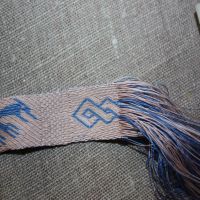
That lozenge pattern element is not a photograph, but a scan. So it should be to scale. But I pinned...
Guest - Katrin Sprang Discussion
15 September 2026
I was not referring to Rachel's reconstruction (is the reconstruction you refer to the one photograp...
Guest - Beatrix Sprang Discussion
14 September 2026
There is something Rachel did not mention. She told me: "Well, I worked with the measurements we too...
Guest - Katrin Sprang Discussion
14 September 2026
Well, this is certainly developing into an interesting discussion. Firstly, going from that lovely l...
AUG
10
1

Socks... or not... or yes.

A while ago, I started knitting the Semki socks -  and recently, I gave up on this project, and frogged them.

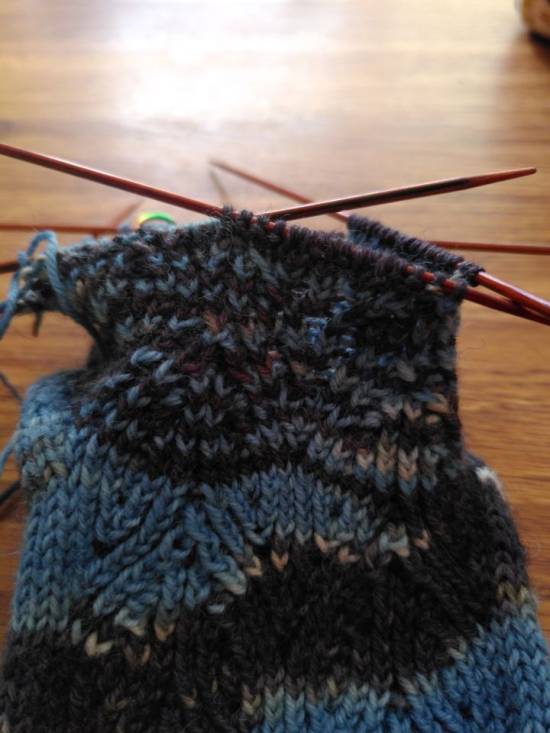
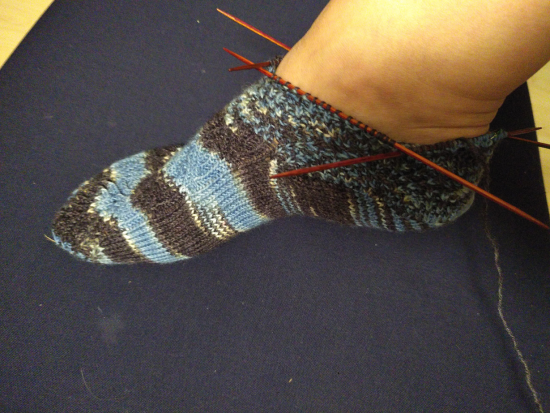
I had gotten a good bit up the shaft already, and then tried to try them on, just to realise that my heel won't fit through the very narrow leg part, and that my instep is way too high for the sock. So I ripped back to where the decreases start and adjusted, doing some kind of make-it-up-as-you-go-along changes to the pattern.

That was fun, and it sort of worked, and I ended up with a sock that would fit... but unfortunately, the variegated yarn and the pattern didn't go back to playing well together. I did like the wide stripes in the foot part, and had it turned back to this look after a bit of shenanigans for the transition between foot and leg, I'd have been fine. But this? 

Nah. Not really.

So I frogged the sock, and have since started the next try of sock-knitting - this time the "Basketcase Sock".  The last time I've done entrelac knitting was ages ago (and a project that I also frogged), but I really like the idea, and it was time to work on my backwards knitting skills too...

0
APR
14
0

Teaching Thoughts.

I've been thinking about teaching again recently - because of teaching some more again, in different settings, and because of an upcoming conference where I will do and give a short presentation about the topic.

Teaching is fun, and fascinating, and has its own special challenges and rewards. There are some things that are easier to teach and some that are harder. Personally, I find that the hardest technique to teach from the many textile techniques that I have on offer is filet netting. The knot, once you have it in your muscle memory, is not hard to do. It's a nice, fluid set of motions resulting in a nice tight knot that has the correct size every time.

However... there is no good way to split up that set of motions, at least I have not found any way to do that yet. To form the knot, you have to do all the motions and all the passes over and under the different threads, and you have to do all of them correctly. So learning that knot requires you to memorise the whole sequence in one go, which, according to my experience teaching this, is a significant challenge.

I remember learning how to do that knot myself; I used the instructions provided by Therèse de Dillmont in her book, the Encyclopaedia of Needlework, and I read them bit by bit following the sequence for many, many times until the whole process had settled in my brain. 

So - teaching long, complex (sort of) sequences that have to be done in one block is definitely a challenge - but it is something that can be taught. Other things just cannot be taught (as in directly giving instructions or passing on sequences of movements) at all. In some cases, the difference between individual bodies means that every body needs an appropriate solution for a given problem; one may work for many or most of them, but not for all. In these cases, you can only assist. 

My favourite example for this is tensioning the yarn when knitting Continental style. For most knitters (according to my own anecdotal evidence of looking on hands), wrapping the yarn around the left forefinger works very well. Many knitters wrap twice, some once, some even three times, and the number of wraps may also depend on the yarn. So this is the way how to tension yarn that most people get shown and taught when they start out knitting. 

However... for some people, it does not work. That includes me - if I wrap the yarn around my forefinger, it just won't slide at all, and I get higher tension all the time, or if I jerk more of the thread loose, uneven tension. For me, it works wonderfully to just weave the working yarn through the fingers of my left hand: over the ring finger, under the middle finger, and over the forefinger. When I was learning how to knit, finding my personal way for tensioning the working yarn was actually one of the biggest challenges, because nobody showed me that method; I stumbled across it when trying out different possibilities.

So as a teacher, you can be aware of the possibility that a given method or process might not work for everybody because of physical reasons - and then you can, if you know of alternatives and options, tell about the other possibilities that the student could try. But of course you cannot slip into their skin and try out the options yourself to see which one feels best, and you might not be able to demonstrate the other options well as they might not work well, or at all, for you. In the end, they will have to find their own solution by trying out things. 

Have you come across similar things - in learning a skill, or in teaching? I'd love to know!

0
FEB
17
1

Something for the knitters - centered 3-to-2 decrease

A good while ago, I stumbled across a rather unusual centered decrease in Ravelry, dubbed "bunny-ears decrease". It's a centered decrease that reduces three to two knit stitches. The decrease is not hard to work, is perfectly symmetrical, and not very obvious in the finished piece. So it did become one of the tools in my knitting skillset, and I've put it to good use whenever something unobtrusive was needed as a decrease. Slants as in k2tog or ssk are nice, but only if you want a slanty decrease that is rather more than less visible, especially if you have technical reasons that will stack your decreases, or have them placed in a way that will look weird if they slant.

If that sounds interesting for you, I point you to the site of Naomi Parkhurst, String Geekery. You can find her detailed blog post with photos, drawings, and different instructions on how to work this lovely decrease here.  

0
JAN
24
0

The Eternal Ink...

My eternal ink is finished, finally! I blame a number of things for it taking so long - among them, yes, the pandemic, as that seriously cut down on our opportunities to sit in a café and knit while enjoying some coffee. Travel times also were reduced greatly, though that was not as much of an influence, since the cardi is knit in one piece, and I have this rule about not taking along any projects that will not fit into my project bag. Which is rather small, because, you know, travel.

(I tend to lug along a plethora of things anyways, and usually way more than I will use or need, so it does make a lot of sense for me to limit myself.)

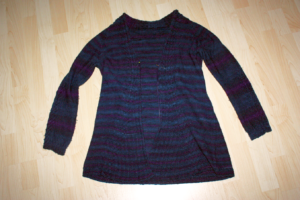
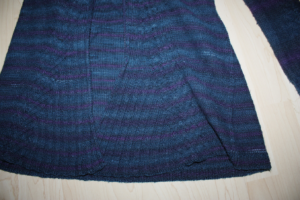
So here is some picture proof of the finished thing:


I'm very happy with it - the only thing left to do now is to sew in the zip so I can close it. The original pattern intends for it to stay open, and I've worn it a few times already now without a closure... but I like to have the option of wearing it closed, too. In case I end up not liking it with the zip, well, I can always take it out again.

The wool is very, very soft and nice to wear, and I also really like the colours. The stripes are not too blatant, but I think they add some interest, and the cables are also rather subtle but nice.


Also - I managed to tweak the pattern a bit while I was knitting so it fits me really, really well. Which is also a nice thing!
0
NOV
16
0

Early Knitted Gloves Database

If you're interested in historic knitting (which has its start in the Middle Ages, but its heyday in the Early Modern times), I hope you've already heard of the KEME database.

If not, let me fix this for you. The KEME database is a collection of knitted items, and the acronym stands for "Knitting in Early Modern Europe". Using the database is free, but you need to register for a login with password due to copyright restrictions. The database started with caps, which were one of the main pieces produced in Early Modern knitting, and there is a lot of them to find in there. It has recently been extended and now includes nearly 100 examples of knitted liturgical gloves - plus there are plans to add stockings in the future as well.

You can also subscribe to the KEME newsletter on that page. For the caps, there already have been Citizen Science projects as well, including a still-running one for the search of wool which will result in a cap texture and surface like that of the originals. Other projects might come up for stockings and gloves. Just in case you are a knitter with a love for history, and are looking for things to knit...
0
DEC
16
0

"Bake" Mosaic Knitting Pattern

Naomi Parkhurst is making knitting stitch patterns (which sometimes include mosaic patterns) out of words, using a special encoding technique. Fittingly for this time of year, she's encoded the word "bake", and I think it looks really pretty. You can take a look at it here.

Speaking of baking - we're done with all the "necessary" seasonal baking. Though there's some egg white left that needs to be taken care of, and I'm intrigued by a Finnish seasonal thing called Joulutorttu. So there might be something in the near future still!
0
APR
24
0

Knitting!

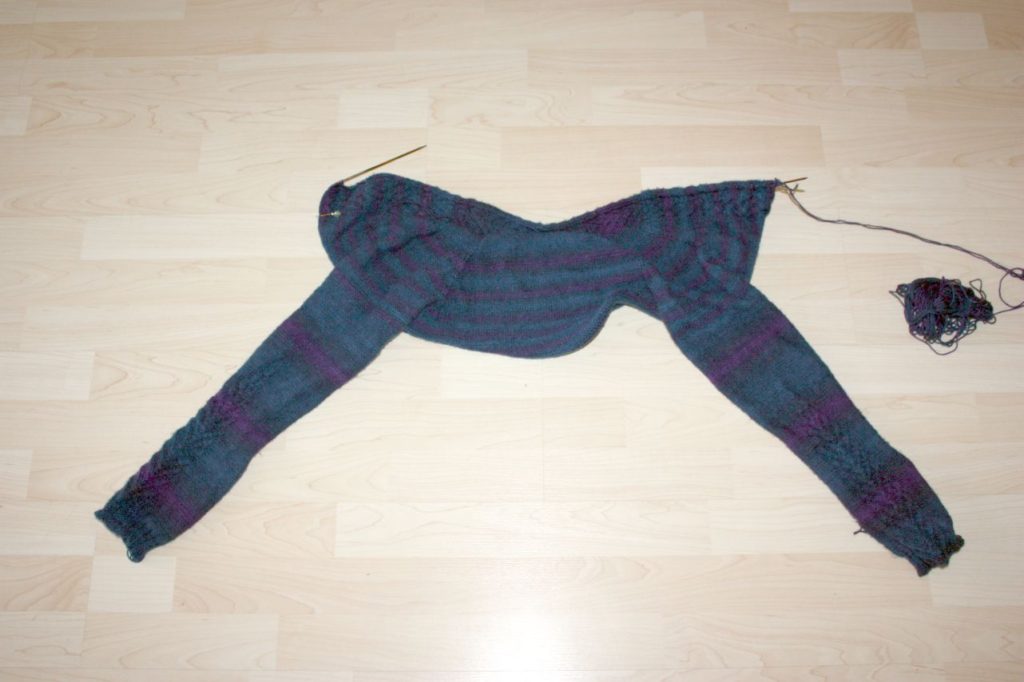
There's been surprisingly little knitting time happening here - too many other things have been done instead, predominantly gardening stuff. There's also been some mask sewing this week, as it will be compulsory to cover mouth and nose in shops and public transport from Monday on. I can report a bit of progress, though: The sleeves on my Ink cardi are finally finished, and I'm back to working on the body.


The yarn is very soft and very nice, and I also like the cable pattern, which is surprisingly hard to photograph. I still have a good long way to knit, though, before it will be finished...

Speaking of knitting, if you are looking for some inspiration, there's a nice and varied bundle of knitting patterns, called Spring Knits, available for 9.95 USD upwards from PatternChest. That's a new website, a spinoff from the Bundle of Holding, which sells bundles of roleplaying games.

You can pay the base price and get the basic bundle, or pay more than the threshold price (which gets adjusted on the basis of what people pay on average), and receive the basic bundle plus the bonus pack. Five percent of the price paid will get donated to a charity supporting healthcare workers, the rest of the payment is split up between the organisers and the designers.
0

By accepting you will be accessing a service provided by a third-party external to https://pallia.net/

Contact