
Latest Comments

Guest - Katrin Sprang Discussion
18 September 2026
Hi Rachel, I have looked for more photos of you, but that was not very successful. I found a link on...
Guest - Beatrix Sprang Discussion
15 September 2026
That lozenge pattern element is not a photograph, but a scan. So it should be to scale. But I pinned...
Guest - Katrin Sprang Discussion
15 September 2026
I was not referring to Rachel's reconstruction (is the reconstruction you refer to the one photograp...
Guest - Beatrix Sprang Discussion
14 September 2026
There is something Rachel did not mention. She told me: "Well, I worked with the measurements we too...
Guest - Katrin Sprang Discussion
14 September 2026
Well, this is certainly developing into an interesting discussion. Firstly, going from that lovely l...
NOV
12
0

"Jogless Jogs" and true spirals

Now that I'm slightly over the half-way mark with my "learn how to knit" project, I've already fallen in love with something to make after that.

It is a pair of socks, with free pattern on the Internet. But no ordinary socks - no, they are Alice-in-Wonderland-Illusion-Socks (pattern and pics in pdf). And of course there are questions... like "can I use the wool from my stash* for socks, even if it's a bit thick, if I use really thin knitting needles?" and "how can I eliminate that jog?"

Now I already hate jogging as in "run to get somewhere faster" - my knees and me, we're just not made for that. And jogging in knits? Not so grand as well. So I was looking around a bit the Internet on how to eliminate the jog, and there's a method called "jogless jog" - which helps. Basically, jogless jogging means gently mangling or mushing the stitches around the jog to conceal it. But there's still a jog, and there's still fiddling with the colour change and carrying up of threads. (Nice explanations of jogless jogging can be found at TechKnitter's blog.) And the structure of circular knitting does allow for truly jogless stripes - with only a slight colour-coming-in-jog at the start and the end.

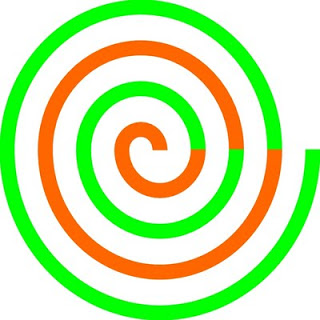
Now, technically, knitting in-the-round is knitting a spiral. For normal colour changes as for stripes, you are breaking the spiral to change from colour A to colour B. Imagine knitting in the round with a lot of increases so your round turns out flat, and it will look like this:


In sock knitting, this would be one round orange, jog, one round green, jog, ... and so on. You are trying to knit rounds of colour in a true spiral, breaking the spiral. Rounds of colour can be done easily, and jog-lessly, on a rounds-based technique like netting, but not on a spirals-based technique like knitting or nalbinding (and not in netting if you mush your meshes at the beginning so you can net spirals).
Breaking the spiral will always result in a jog. For thick, solid stripes, that isn't too bad. But for one-line or two-line stripes, that means the jog is all or half the stripe thickness if it's not eliminated.

But why break the spiral at all? Why not just insert another spiral? That would look like this:

In sock knitting, this would look like one round orange-one round green-one round orange and so on. No jogs - because you are not breaking the spiral.
You just add another spiral for each coloured row - so for illusion knitting, that would mean four spirals (two of colour A, two of colour B) each coming from one ball of yarn. Which is more or less the limiting factor of this technique: one ball for each spiral, making it a ballsy technique, so to say.

Of course I had to try it out (and that's why this blog post is so late today):


You can see the very sloppy join of the cast-on (the bump), and you should be able to see where the additional three spirals come in at different places at the bottom of the tiny tube. You cast on, knit to the end of your solid part, and then you just knit in the other colours/spirals.

Let's say you are knitting in the round with five needles (four in the knitting, one working needle) and want to have two-row spirals. This means you stop at where you want the colours to come in, with your current working thread (colour A) at the end of one needle (and the fifth needle free). Now usually, you would turn your work clockwise and continue on the next needle. Instead, turn counter-clockwise and knit in the second thread of colour A, right across the needle, turn clockwise and knit across the next needle. You now have both colour A threads stacked on top of each other. Now turn your work 180° counter-clockwise and knit in the first ball of colour B - across that needle, across the needle where you brought in the second colour A, across the third needle where you already stacked up both colour A threads, making your stack even higher. Now you can turn clockwise again, and on this needle you knit in your second colour B thread. You can knit this all around until you reach the huge stack - and from now on, whenever you find yourself on top of that stack, just take the bottommost working thread and work one round, switch thread, and so on and so on. That's it. The last stitch you are knitting into (on top of that stack) will be quite loose, but the tension adjusts itself when you take up each of the threads to work with them. And the little stack of current spiral ends also makes for a wonderful rounds marker.

To end spiraling, just stop knitting the spirals one by one, preferably at the place where you started it, to make the complete thing approximately the same length all over. Putting in a short-row heel when starting the sock at the toe shouldn't pose too large a problem as well (I'll figure that out after I've found out whether I can use my stash yarn or not). And then - Illusion Socks in Ballsy Spirals method!


* Yes, I already have a significant yarn stash. Yes, that shouldn't happen if you are not a knitter. However, I started buying those wonderful, naturally-dyed yarns ages ago when I would still think of using them for tablet weaving, and I sort of got hooked on the colours and just needed my regular yarn fix afterwards.
0
NOV
11
5

Knitting history

Ah, I should have known that a single post about knitting will draw more people out of the woodwork and get comments than all the other techniques. And actually, I wonder why - is it because more people can relate to knitting stuff, doing the technique themselves?

Comments yesterday made clear that there is huge interest in the history of knitting. When I was writing my thesis, of course knitting was one of the textile techniques to be mentioned, so I did some reading on that topic. And found (again) that knitting is a very, very hard technique to trace - about as nigh impossible as felting, if for different reasons.

Felting has no regular internal structure and thus is prone to fall apart into single hairs in adverse conditions - and adverse conditions for felt even include those that are generally good for organic material. With knitting, the problem lies elsewhere. Knitting can be unraveled so easily - and partly or completely "frogging" the work, if modern knitting blogs are any indication, is quite usual for things not living up to expectance. (Please tell me, do you frog knitted things that you don't wear anymore as well? Or only new stuff that doesn't fit or please well enough?)

If we assume that yarn was a valuable thing, and especially fine, colourful silk yarns, I can very well imagine that the yarns were unraveled and stored for another use - which would greatly reduce the number of knitted finds. Recycling and re-using (or remaking) of standard, sewn-from-fabric garments can be frequently seen in the archaeological evidence: Small, cut-off bits with seams in them, obviously the bits that could not be salvaged and used in a re-make because they were too crooked, too small or too oddly formed, or bits that were too worn. Now imagine somebody frogging a piece of knitting to re-knit. All that will be left might be a snippet of yarn - which, unfortunately, doesn't carry a sign telling the textile researcher "hey, I was part of knitting once!". And this makes knitting research a huge problem.

From what I could find in sources that were recent enough to already factor in the discussion of nalbinding against sprang, there was no evidence for true knitting before the start of the 12th century. There's a little more in the 13th, and more and more in the late middle ages and early modern age, but nothing earlier. The early datings usually come from the "coptic socks", and those I will consider as all nalbinding until somebody can prove the opposite by re-evaluation of the actual finds.

To round this off, for those of you hungry for references: Here's my list of things about knitting, taken from my bib database. I have not read all of those, so I can't guarantee that they will be good or insightful - if you know any of them, comments are very welcome!

CARDON, DOMINIQUE: Fils renoués. Trésors textiles du Moyen Âge en Languedoc-Rousillon. Carcassonne 1993.

GREINER, SYLVIA: Kulturphänomen Stricken. Grunbach 2002.

KJELLBERG, ANNE: "Knitting and the use of knitted goods in Norway before 1700. From archaeological finds to documentary evidence." In NOCKERT, MARGARETA und ESTHAM, INGER (Hrsg.), Opera Textilia Variorum Temporum. To honour Agnes Geijer on her ninetieth birthday 26th October 1988. Stockholm 1988. 145-152.

TURNAU, IRENA: "The Diffusion of Knitting in Mediaeval Europe." In HARTE, N.B. und PONTING, K.G (Hrsg.), Cloth and Clothing in Mediaeval Europe. Essays in Memory of Professor E. M. Carus-Wilson. London 1983. 368-389.

WYSS, ROBERT L.: "Die Handarbeiten der Maria. Eine ikonographische Studie unter Berücksichtigung der textilen Technik." In STETTLER, MICHAEL und LEMBERG, MECHTHILD (Hrsg.), Artes Minores. Dank an Werner Abegg. Bern 1973. 113-188.
0
NOV
10
0

Speed Knitting!

So what is the fascination of knitting for me?

First of all, you can make useful things with this - like socks. (Did I mention I like knit socks?) And if you have a penchant for making your life more difficult, then you can take very fine needles and very fine yarn and make a myriad of tiny stitches for some early modern stockings. Or go and buy a "tsock kit" from the Tsarina of Tsocks, who makes artwork kits disguised as sock kits. (And I will definitely need some of these crazy socks some time in the future.)

Then, knitting still is all over the place - thousands of people do it, and probably everybody alive knows at least one knitter. And it is easy to learn even if you are on your own, because there are so many websites and, even better, so many videos that show you how to cast on, work in the round, knit and purl, English, Continental or Oriental style. Just search youtube (or generally search) for "knitting tutorial", and there's enough to keep you occupied for hours.

But for me, there's another fascinating thing to knitting: The possibility of speed. A good while ago, I wrote a Google Penance for the search term "tricks to faster hand sewing", with the bottom line that with sewing as with most other craft processes, there's a limit to how fast you can go - and it just won't get faster. Knitting sort of has an exceptional position here, because knitting can be sped up oh, so much.

To give you a taste of what is possible in the extreme, here's a video of Miriam Tegels knitting - she's the holder of the Guinness World Record in speed knitting, with 118 stitches in one minute.


Isn't that really incredibly fast? And doesn't that make me think of the knit stockings in early modern age and wondering how long it took a professional knitter to make one?
0
NOV
09
11

Knitting, anyone?

For years now, I have successfully been a non-knitter. I just never did it. I had not learned in school how to knit (they only taught us crocheting), and I had only made one short and unsuccessful try to learn it back years ago, when I was still caught in puberty. The technique somehow never appealed to me enough to fiddle my way through it, and I could remember from my one try that it was really difficult to catch those pesky loops of the stitches and that I didn't know what to do when one of them slipped.

And then, when I started out in the textile archaeology field, knitting was said not to come up before the later middle ages, and not properly before early modern ages, when it somehow becomes all the rage and Knitter's Guilds form and those guildmembers knit amazing things. So I had a perfect excuse for not knitting: a, there are more than enough people around who know how to knit and do it (and teach it), so there's no danger of the technique dying out; and b, I had more than enough other techniques that were less modern and less well known already. And c, I didn't want to do things in techniques that can fall apart so easily just by pulling on the working thread (yes, you have to take out all the needles before that too, I know).

But. But. Knitting has actually been found dating back to the 13th century (in a German well, of all places). Knitting is a problem for the textile archaeologist because it can be unraveled so easily. The wherefrom and why of the development of knitting is still not known to historians. I like a good scientific unknown - it always reeks of challenge for me. And then there are the socks, which I admit I love. Hand-knitted, nicely patterned, woolen socks... aah.

And then there was the Textile Forum, where a lot of truly awesome knitting went on inbetween all the other things. Fine woolen yarns! Intricate patterning! Really really thin "knitting needles" that were sold to the knitter as "a bit of copper alloy wire"! This all smelled like a challenge and a fascinating opportunity for some full-scale madness much too much for me to resist.

So I have finally given in and learned how to knit. And I have discovered some of the fascination of knitting for myself...
0

By accepting you will be accessing a service provided by a third-party external to https://pallia.net/

Contact