
Latest Comments

Guest - Katrin Sprang Discussion
18 September 2026
Hi Rachel, I have looked for more photos of you, but that was not very successful. I found a link on...
Guest - Beatrix Sprang Discussion
15 September 2026
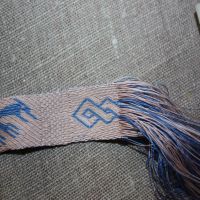
That lozenge pattern element is not a photograph, but a scan. So it should be to scale. But I pinned...
Guest - Katrin Sprang Discussion
15 September 2026
I was not referring to Rachel's reconstruction (is the reconstruction you refer to the one photograp...
Guest - Beatrix Sprang Discussion
14 September 2026
There is something Rachel did not mention. She told me: "Well, I worked with the measurements we too...
Guest - Katrin Sprang Discussion
14 September 2026
Well, this is certainly developing into an interesting discussion. Firstly, going from that lovely l...
MAR
17
1

Oh really? Well. If you say so.

During our last crafty evening, there was some need for craft knowledge input - the kind that you'd expect to find in the Encyclopaedia of Needlework. So we turned to that book, the necessary input was more or less gained, and the book stayed on the table for a while.

And a bit later, the most patient husband of them all picked it up and looked into the section on knitting. He read me the very beginning of it... the section starts out telling you that there is nothing more to be developed or invented in knitting, as it's all been done already and we know everything.

(That's the German version - the English just states that it "would be difficult to invent new stitches or patterns", not impossible. Unless "difficult" in the 1880s meant "impossible" in the same way that "selten" in middle high german epics meant "never", though technically it's only "rarely".)

Seeing that my current creative outlet is the invention of such a thing, this was hilarious. And now, having found that the English text is less sure of the impossibility to invent new stitches, I do wonder in which language Ms de Dillmont originally wrote her book.

Also, if you are a sock knitter, check out the different heels and toes she describes for all your sock-knitting needs. There's forms that I have not seen yet - she does not give the shortrow heel, though, or the sweet tomato heel. (But, as you well know, there's nothing new in knitting. No no.)

For the moment, though, I will not turn to socks (especially not cuff-down ones, I prefer the no-maths toe-up approach) but stay with my hat and shawl...
0
MAR
10
0

Spring is coming! Lace knitting time!

We've had the nicest weather during the weekend, perfect for sitting in the sun and drinking coffee and knitting. Also perfect, and the right time of the year, for pulling out all the seed packets and getting started on sowing - there shall be tomatoes again this summer, and mini-cucumbers, and chili plants, and also some pumpkins and zucchini.

I've also been hit by a creative bug during the weekend - it all started with the comment of a friend that knitted lace has a tendency to be quite feminine in look. Well. Well... I have worked a bit on the most un-feminine lace I have yet managed to see. It's not quite finished its development, but I'm close, oh so close. (I'm itching to show you pics, but I think I should keep it mum for a little while longer...)

The pattern is begging to be incorporated into a hat pattern that will probably end up slightly weird, due to topological reasons. I hope to have it done and finished in time for LonCon - it would fit in nicely there, and probably delight a few geeky knitters no end.

So hopefully I will be searching for a few adventurous test knitters soon... for now, though, I shall go back to finishing my computer work before the morning runs out.
0
MAR
03
0

Spring, and knitting.

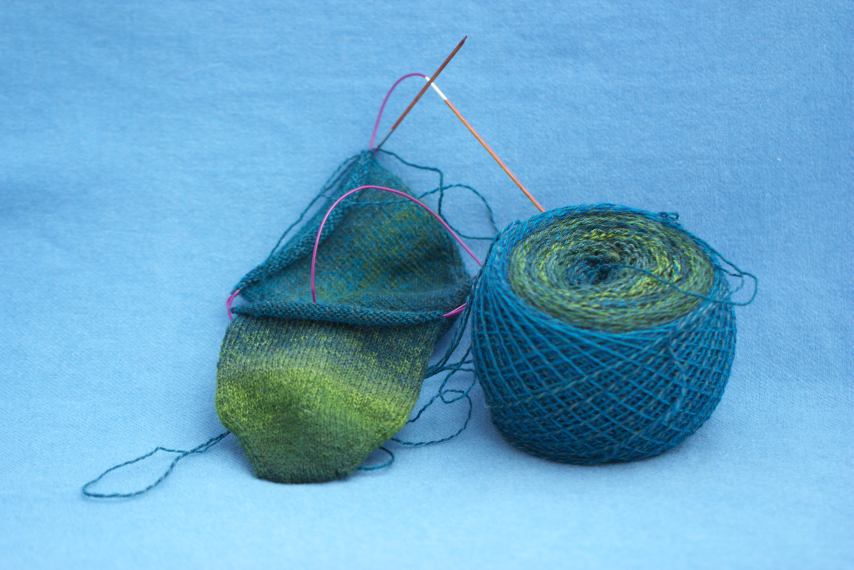
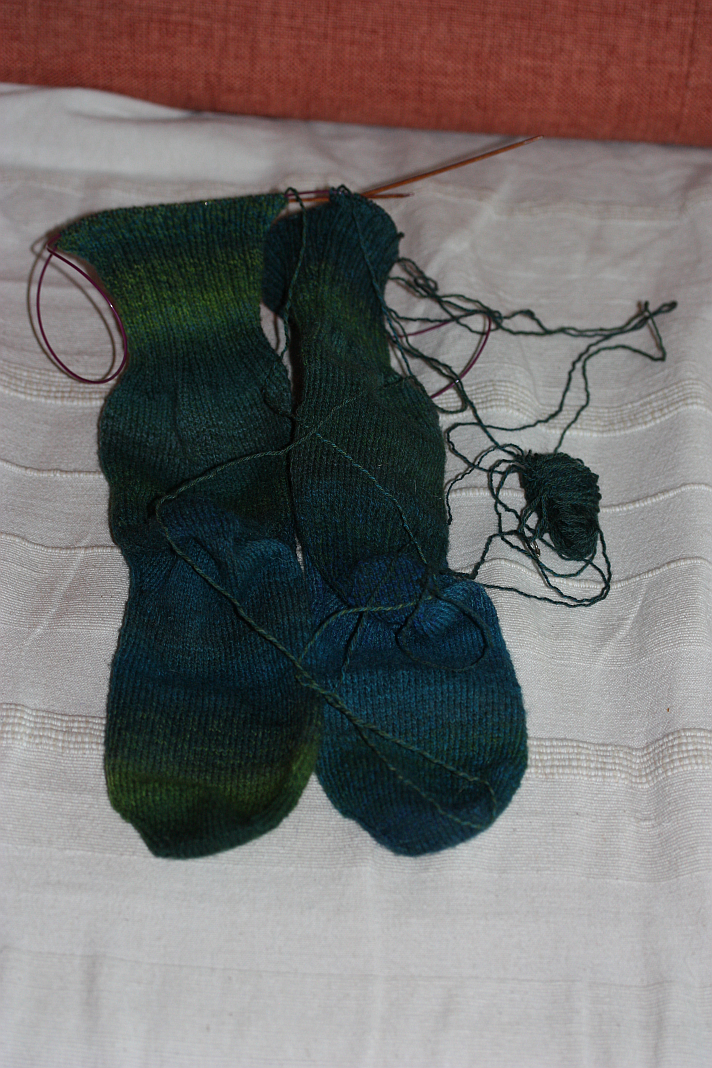
The many hours of sewing, it seems, make me want to increase my knitting time as well... and there's two just-for-fun projects on needles, currently: The socks that I sort of blogged about a while ago are almost finished (just a few more rounds before bind-off):


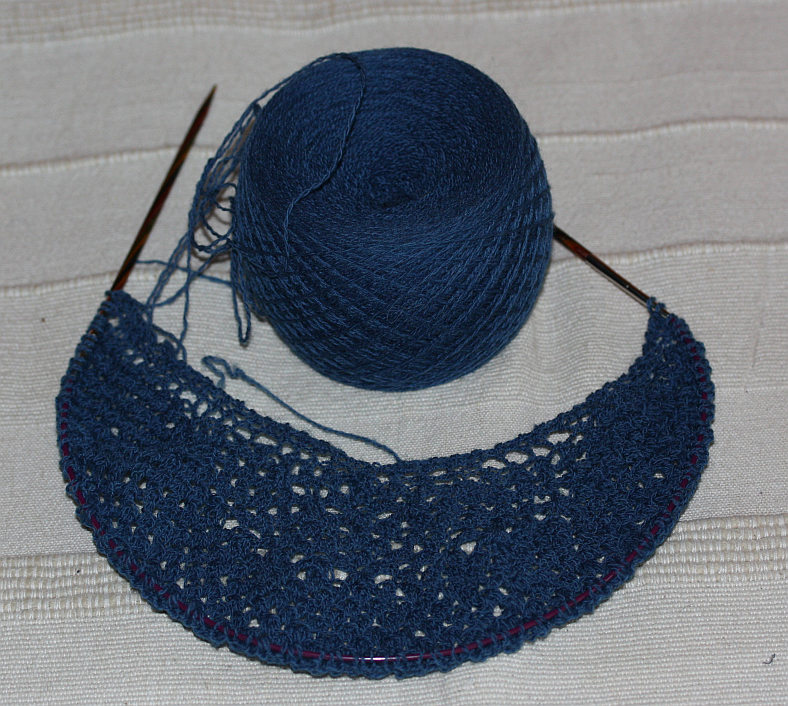
Also, I have started knitting my very first lace scarf... because of the yarn I spun, oh, back in 2011. It had a run-in with an indigo dye vat last Textile Forum, resulting in blue yarn. 595 m (or 571 m, the second time I measured) and weighing 64.9 grams. What do you do with that? I can tell you what I did: I scoured Ravelry's pattern database until I found a shawl pattern that I liked and that uses about this amount of yarn.

I got that pattern as a present for my birthday, and yesterday I couldn't resist any longer (I had planned to wait until the socks were finished) and cast on.


It's the Renaissance Shawl (here's its ravelry page). The designer, smart woman, is giving percentages of yarn left throughout the pattern, so you can see whether your gauge is fine for the amount of yarn you have.

Speaking of Ravelry and patterns and socks, by the way, there are a bunch of really cool socks designed by General Hogbuffer. If you like socks that are not just plain vanilla, check out his design page!

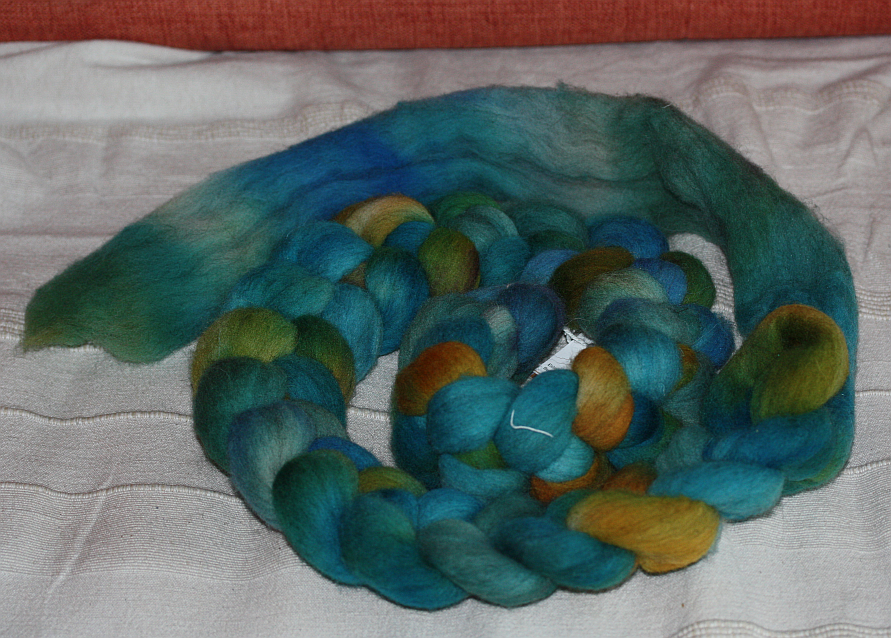
Finally... since the sock yarn I spun gave me so much pleasure, I have this:


which, one day in the medium-far off future, will spend some quality time with my spinning wheel.

So as you can see, there's a lot lined up as fun knitting for the evenings and my breaks!
0
FEB
28
0

Things going on here.

Sewing project update: The first buttons are attached to the sleeve of the red dress. I tried to snap a photo this morning, but found that I need either much more light or a tripod and was too lazy to get the latter. It's beautiful, though - the red is an incredibly lovely colour.

There's also a next project lining up for when the current one is finished - including an altar linen, something that is weirdly exciting to do. It's no spectacular work, just a very simple cloth, hemmed and pieced together in the middle, with no embroidery or other special effects, but the altar vestments are such an important part of religious life and thus of medieval culture that it is super-exciting for me to do.

We're also working on finishing up the paper about our dyeing experiments of the last two Textile Forums - one of them is a little late, but I'm (or we) are trying to make up for that with the second one.

For those of you who read German, there's a very interesting article on Archaeologik about how the public (especially that part going on treasure hunts with metal detectors) sees archaeologists. Not nice to read - but important to keep in mind: Sensational stories about treasures shift the impression of the public towards the find, not towards research.

Also in German: the guy behind Tribur is working on reconstructing the carolingian sword-belt-thingie.

Not in German, not medieval, but really cool: Geek Knitting Links and more of the same.
0
JAN
23
2

Gratuitous Yarn Pics.

A while ago, I went to a monthly spinning meet-up for the first time. That was fun.

A month later, I went there again... and fell in love with some fibre. It's not that I do not own enough fibre for spinning. (Seeing that I have fibre to sell, that would be sort of weird.) It's also not that I don't have enough spinning projects already, or things and techniques I should (or want to) try out, or improve in. And I also own more than enough sock wool for the next few years worth' of sock knitting, seeing how slowly I knit. (Intermittently, and that is probably mostly to blame. Even if your actual knitting speed is not snail-like but only on the low end of mediocre, leaving a knitting project in a bag for a few months because there just is no leisure for it means that making a pair of socks will take ages.)

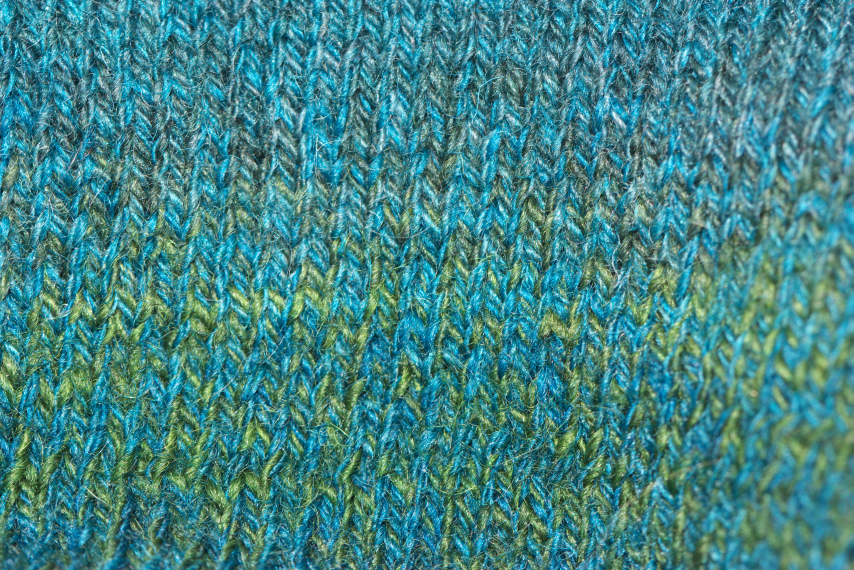
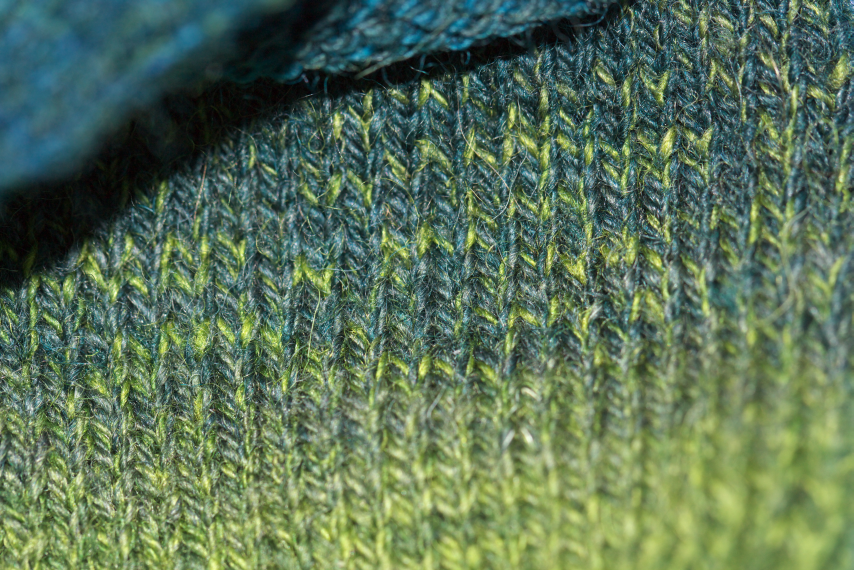
That fibre... it sang to me. It was dyed, modern-style, in blues and greens with a dash of teal and a dollop of grey in it, and it looked too, too lovely. Long story short, after a while of considering and getting a snippet of the fibre to test-spin, I caved. I bought the fibre and took it with me to spin it during our post-Christmas time with friends. (They know me. Neither of them did blink an eye when I turned up with my spinning wheel in tow.)

I divided the dyed top into three parts, length-wise, and spun each part in my normal thickness and my normal amount of twist (and that's lots). I plied it up three-ply, feeling very generous with my time and very modern, and came out with almost sock-yarn thickness. (It's about as thick as normal sock yarn if you stretch the normal yarn a little.)

When I was finished, I knit up a little sample... which I then tossed into the washing machine, the normal cycle that we use for our clothes. Twice. It came out a little softer than it had come in, but unchanged in size.

And then I started knitting socks from it.


I am insanely happy with this yarn (even though I could have added more plying twist in a few places, and even though the colours from the three plies don't exactly match up).


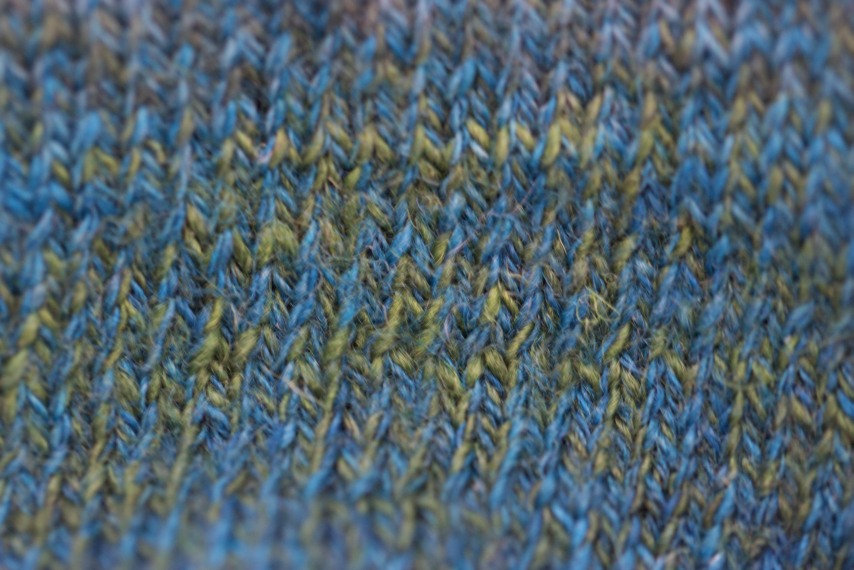
The different colours and the mixing of them, however, make for interesting patterning.


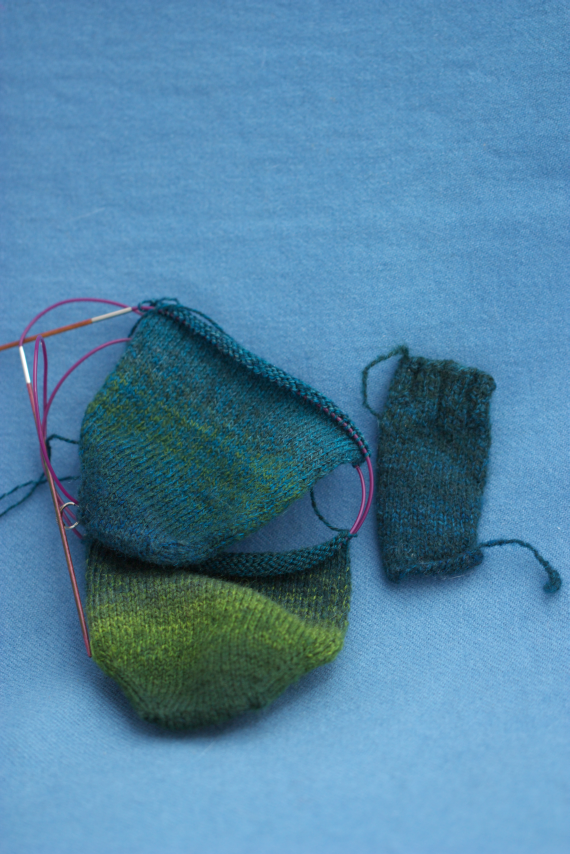
And I'm looking forward to the time when both socks will show a share of green and blue...


because at the moment, it looks a bit as if I were knitting one sock each from two different wools.


I don't really mind, though. I am very happy watching my hand-spun wool knit up, and looking forward to having new socks at an unspecified time in the future.
0
SEP
26
3

Reading the correct version of instructions... helps.

There are a few never-ending things in my life. The Neverending Spinning Experiment, for instance. Or the Neverending Quest for a Publisher for the English Version of my thesis (though there is some movement on that front recently, I have not given up!)

Now, I'm thinking of adding one more item to the list: the Neverending Skew Socks. Skew is a pattern that was published in Knitty back, oh, about four years ago.

It clicked with me straight away. Now, I'm not a big knitter, and I'm not fast, but I like socks. So I ventured out to knit me a pair of Skew socks... and found, quite quickly, that they do not fit my foot. At all. My instep is way too high for them as written.

However - I wanted those socks. Really badly. So I ripped back and fiddled and thought and measured and math-ed some and then some more, and at last I came up with a method that worked. I knit a pair of socks and placed the instructions to the side - for later use.

Time passed, our vacation came up, and I wanted to take some knitting - something small, half-mindless, and nice. I typed off the pattern and took a ball of sock yarn. I knit and knit... and there was that bit in the pattern where I wondered, huh, that looks a bit weird... but I knit on.

Back home, I found that I had skipped into the wrong line when typing the hand-written pattern into the computer. So I ripped back... both socks (two-at-a-time magic loop). Quite a bit. And I knit that part again... correctly, this time. And progressed into the part that I had had almost finished before.

Then I proceeded into the heel part. I knit a bit, and then some more, and then some more... but not much more before I realised that something was decidedly wrong. I was missing stitches. Not only 6 stitches (as before) - this time, it was twenty of them. Now, 20 stitches at sock gauge... that's a lot. A freaking lot.

I went to look for the missing stitches. Had I skipped a section when copying the pattern? Nope. After a goodly while of checking, I found it... I had written a sequence of pattern lines into my hand-written notes, marked them and smeared something like "This!" at their side... but not crossed out or corrected the old version. The old version that had, you guessed it, 20 fewer stitches. And when copying the notes, I had not looked beyond the valid-looking set of instructions...

So the next step in my Skew journey: Correct my digitised instructions, print them out again, and rip back both socks (again, gah!) to where the mini-gusset increase starts. Sigh. The Neverending Skew Socks. If only they weren't so funny...
0
NOV
14
0

This, and that, and do I have enough wool?

I'm still feeling a little swamped by work, though pleasantly so - things are coming up that might mean really interesting projects in the future, there's some progress on the writing front (though there's never, ever as much as I'd like) and I may have figured out a way to find out whether the yarn I have is enough for a knitting project.


A good while ago, a relative gifted me with her old knitting stuff - an assortment of yarns, and among that three packages that were once intended for a sweater, pullover, cardigan or whatever you might name it. Now due to a lot of different reasons (most of them related to shape - my shape), I am not going to knit a given sweater pattern as written. I prefer a zipper to a button band (I'm just not a button person), I am probably going to shorten the whole piece so the hem falls where I want it, I am also probably going to shorten the arms, and I might fiddle with other elements. And the size - I normally fall between sizes.

With all these alterations, though, and yarn that is not available anymore (and not listed in Ravelry), how am I going to figure out whether it is enough yarn for the project? There's lots of guidelines on how much one needs, but somehow I don't trust them.

So here's a different possibility (that I hope will work out well):
Knit a swatch. (You wanted to anyways, right?) This should be at least the typical swatch size, as in at least 12 x 12 cm (or 5 x 5 inch) to let you measure the gauge correctly (since that may be necessary knowledge for altering the pattern). Do whatever you plan to do with the finished piece - wash it, feed it to the dog, ... you know the drill. (At least theoretically, I'm sure you know it.)

Then you calculate the area in cm² that your swatch has. You might want to leave out the very edges to be on the safe side - so 11.5 x 11.5 cm on a swatch that actually measures 12 on each side. Then you put it onto a good kitchen scale - diet scale will be a good idea, probably. You now have two numbers.

Next, you can roughly calculate the area in cm² that your finished piece will have. A sweater will typically consist of one body (roughly a tube) and two sleeves (also roughly a tube). For these calculations, I just took the widest width of the body part and the total length to calculate the body surface area and the upper arm width and desired sleeve length to calculate the sleeve surface area. (Don't forget that you will need two sleeves!)

Now you can divide the complete sweater surface area by the swatch surface area. This tells you how many swatches would be equivalent to your sweater. Now you multiply the swatch weight by this number, and you get an approximate finished weight for the sweater. (Approximate because shaping, armholes and neckline are not considered.) Compare that to the weight of your available yarn... and if your yarn weight is greater or equal, you should be good to go.
0

By accepting you will be accessing a service provided by a third-party external to https://pallia.net/

Contact