Latest Comments

Guest - Katrin Sprang Discussion
18 September 2026
Hi Rachel, I have looked for more photos of you, but that was not very successful. I found a link on...
Guest - Beatrix Sprang Discussion
15 September 2026
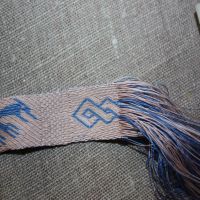
That lozenge pattern element is not a photograph, but a scan. So it should be to scale. But I pinned...
Guest - Katrin Sprang Discussion
15 September 2026
I was not referring to Rachel's reconstruction (is the reconstruction you refer to the one photograp...
Guest - Beatrix Sprang Discussion
14 September 2026
There is something Rachel did not mention. She told me: "Well, I worked with the measurements we too...
Guest - Katrin Sprang Discussion
14 September 2026
Well, this is certainly developing into an interesting discussion. Firstly, going from that lovely l...
NOV
05
0

Knitting time.

Somehow it seems as if winter (or at least the colder months) are my main knitting time - though judging from the output, you would not suspect that.

On my (small, but existent) pile of unfinished objects lies a pair of socks with shadow-knit cats and an almost finished pinwheel sweater. The socks are millimetering towards being done (inching would be too fast, you see?), but the sweater has been huddled into a heap, abandoned, for oh-so-long now.

I'm still in love with the concept of the pinwheel sweater (you take a round blanket, stick two sleeves in, and wear it), but even though I tried on a friend's version of it, I'm not at all happy with mine. It's knit in bulky yarn which may have been a bad choice, since that makes it really heavy; and in this version, it just does not fall right for me. It doesn't.

So I have decided to frog it. And now I've stumbled across a very nice how-to-fit-a-sweater tutorial that helps with choosing flattering projects. So I'll look for another thing, better suited to my shape and figure, to knit... some of these days, this means, I will sit down and cast on something. (And if I'm good, I will finish the socks first.)
0
OCT
29
1

Knitting Link.

For those of you who would like to insert zippers into your knitting but do not want to sew them in, I can recommend going to Techknitter's blog and taking a look at her solution... nifty.

Speaking of knitting: My pair of Alice's illusion socks is actually nearing their point of completion. I am planning very, very much on finishing them before New Year (or I will have been dragging them around for more than one year).
Somehow, this shows how little knitting I have managed to do this year. I hope next year will be a bit better, or one day I'll run out of socks...

0
AUG
20
1

The Manly Art.

A friend pointed me to the existence of a small book called "The Manly Art of Knitting", written by Dave Fougner. It seems to be available used only, and that to a steep price - 90+ USD from the Big River Store, at least.

However, for those of you just curious about the contents, like me, with no actual need to buy it, there's a very nice review on the Historic crafts blog. (They have since moved to a new location, here on blogspot, and it looks like a nice blog, but unfortunately with no new posts done during the last year.)

Anyways - manly art of knitting. The book appears to contain instructions on how to knit a hammock, among other things (I like that idea). A hammock would be just the thing to lie in during this summer heat we have here (though that would also mean we'd need two conveniently spaced trees... which are not to be had in our garden).

Other (not so manly) links - on Medieval Silkwork, there's a post about female undergarments in written sources.

And I should be working on my article now, the deadline is looming up...
0
MAY
18
0

More knitting.

(This was supposed to go live during last week - on the 12th, to be exact. Why on earth it never did - beats me. I'm serving it to you now instead. And I'm retroactively sorry for the blog silence.)

I had an unplanned-for splurging moment in Freienfels, when I went to Sabine's stall on Sunday afternoon and decided that yes, that was my cardigan hanging there in the back of her stall (some assembly required).


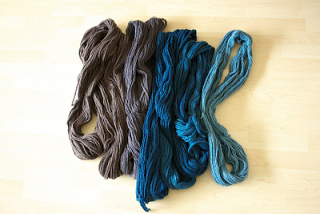
I have been ogling the pinwheel sweater (ravelry link) for a good while now, but I absolutely wanted a very nice, gradual colour change. With blues and greys, and maybe some teal. I had been thinking about using Kauni wool, but after knitting my legwarmers last autumn, I decided not to use Kauni ever again - my hand spinning on a bad day is less irregular than that skein I had.

Then I was pondering getting some top, dyed in a gradual colour change, and spin the yarn for the pinwheel. But I don't get to spin much, and the yarn would be very thin, or quite irregular and ugly, or plied from 4 to 5 singles, and I can't see myself finishing anything like that before I'm about 120 years old. Plus I am sort of unwilling to spin dyed top in large amounts. (I much prefer to spin historically prepared wool, nowadays.)

So... I splurged on an array of blues and greys, in really thick and deliciously soft yarn. And I wound the first two balls, on my day off after Freienfels. And started knitting.


Of course, it wouldn't be me knitting if there wouldn't be some modifications. Basic pattern is the pinwheel sweater, but with left-leaning increases instead of yarn-overs, and starting with four stitches from an I-cord "belly button" for a better and easier start.

And I am knitting with two yarns at one time, making "barberpole stripes" for that more or less gradual colour change; each of the two colours has four increases, so I don't have the alternating increase round and plain round, but always the same round (except for where the increases are). One of the yarns increases right before the green markers, the other right before the white markers; each double-round starts with the white-marked yarn. And I've made a bit of progress since taking these pictures - though it will take some time still until I can put in the armholes.

Hooray knitting!

(Update: Since my day off yesterday was partly spent knitting on this, I am by now just a little past the armhole line - so there's garishly red thread knitted in there, to take out later and knit the sleeves on.)
0
MAY
09
2

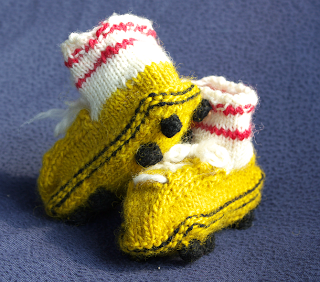
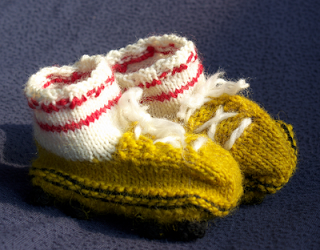
There they are. Soccer booties.

A few weeks ago, I wrote about a stealth baby knitting project. The item in question has, meanwhile, been finished, laughed about, gifted and has been favourably received by the mother-to-be.

And that means I can unveil them to you now...the soccer booties.
These soccer booties are based on a simple, basic bootie pattern with laces (Michelle Lo's "Sneaker Booties", free Ravelry pattern). The booties are worked cuff-down and in the round in the sock part, then the upper part of the shoe is worked in the flat. The sides of the shoe are worked in the round again, and the sole knitting closes off the bootie.
The booties were knit with different yarns, mostly about worsted weight, on 2.5 mm needles. I brought in colour changes and added bobbles to simulate the cleats on the sole. Working those in different, contrasting colours is what makes the finished item really pop – that, however, also means a lot of ends to weave in. You are duly warned.

Step 1:
Find out which colours to use. Do not skip this step – it is a safe bet that somebody who will be amused or delighted by these booties has a preference for a club. Clubs have their own colours. And choosing the wrong colours – that of the faved club’s main adversary, for example – will most probably lead to severe diminishment of both amusement and delight.

Step 2:
Decide on your colour scheme. You can work two colours in the socks or work the socks in one colour and the shoes in another (more or less neutral) colour. Modern soccer shoes are black, yellow, blue, red, white or brown; other colours are rather rare. The cleats come out best if they are knitted in a contrasting colour.

Instructions here are given for a two-colour sock (with two narrow stripes near the cuff) and two-coloured shoes. Photos are of the prototype; I tweaked the written pattern after that, which means it should come out a bit better now. Please let me know if you find mistakes!

Step 3:
Start knitting.
CO 36 sts in main sock colour. Join without twisting; place m to mark start of round.
Rd. 1-3: Work k2 p2 ribbing.
Rd. 4: k in sock contrast colour.
Rd. 5: sl 1st st, k in main sock colour.
Rd. 6-7: k in main sock colour.
Rd. 8: k in sock contrast colour.
Rd. 9: sl 1st st, k in main sock colour.
Rd. 10 – 15: k in main sock colour.
Rd. 16: k in main shoe colour.
Rd. 17: p in main shoe colour.
Rd. 18: sl 1st st, k to end.

Shoe upper starts now.
Setup row: k 18 sts, turn; purl 12 sts. Turn.
Row 1: (RS) k2, ssk, yo, p4, yo, k2tog, k2. If you prefer, you can slip the first st after turning in the shoe upper part; this can make picking up stitches easier.
Row 2: (WS) p4, k4, p4
Row 3: k4, p4, k4
Row 4: p4, k4, p4
Repeat R 1-4 two times more, then work R1 once.
Work 5 rows in stocking stitch (you end on a WS row). Turn.

Shoe sides start now.
Knit 12, do not turn. Pick up and knit 12 stitches along the edge; knit across live stitches; pick up and knit 12 stitches along the second edge. 60 st in total. Move m to current position (new start of round).
Rd 1-5: knit.
Rd. 6: purl.
Rd. 7: sl 1 st, p in shoe contrast colour.
Rd. 8: p 1st stitch in shoe contrast colour, change to shoe main colour, p to end of rd.

Sole starts now.
The sole is worked by knitting back and forth and knitting the last sole stitch together with the first live stitch from the shoe side rounds. You will work the basic rows (rs and ws), substituting a bobble row for the basic row in row 5, 11, 27 and 31.

Basic right-side row (odd numbers): k 11, ssk, turn.
Basic wrong-side row (even numbers): p 11, p2tog, turn.
Bobble row (work on r 5, 11, 27 and 31): k 2. Make bobble, k6, make bobble, k1, ssk, turn.

Make bobble: Bring in shoe contrast colour and work 7 st in next st by working the following: k, yo, k, yo, k, yo, k. (You can count the four knits to keep track.) Turn work, p 7. Turn, k 7. Turn, p 7. Sl 3 st to right needle, k 1, sl other st over this knit st, alternating between st from left and right needle. Take up main colour again and continue knitting with main colour. Snip off contrast colour, leaving a nice long tail.

When you have only 24 st left on your needles after R 36, graft the sole stitches together with the remaining live stitches from the shoe side rounds.

Finishing up:
Weave ends in securely. With the longer tail left after each cleat bobble, sew the bobble sides to the shoe sole for extra security. Block if desired, thread in laces.

Step 4: Laugh about the silly little soccer booties. Give to somebody-not-yet-walking to wear them. Enjoy.
0
APR
18
2

Oh the Tiny Fun.

I am sure that knitting for babies is something that oodles of other knitters have discovered for themselves during hundreds of years, and now it was finally my turn. Yes, that was not very long ago, but I think I can be excused for that - after all, I haven't been knitting for so long.

First of all, babies have one definitive asset for being knit for: They are small. Really small. And while knitting something small might be a tad fiddly, it is really fast work - after all, there's so many less stitches in a sock for a 3 months old than a 30 year old.

And secondly (and I think that's even more important), they don't want a say yet in what they will be wearing. As long as it fits (more or less) and is the proper warmth for the ambient temperature, it will be okay.
And they are not walking. Which is the go-ahead, the carte blanche, the glorious licence to do some really outrageous knitting. If the parents are amused by it and like it - that's what the wee one will wear (at least until he or she wiggles out of it).

So... I used part of the weekend for some tongue-in-cheek stealth knitting project. Which is not so far from being finished, though there's still a gazillion of ends to weave in and finishing touches to be done. Photos will follow after the real-life reveal, which will hopefully be soon.
0
FEB
14
0

Things, randomly written here.

Firstly, for all those of you who are planning to put in a visit to the V&A before they close down the textile study room, a heads-up: I have been sent additional information by two friends who went there and found that, without any further notice, the staff closed the study room at noon.

So they recommend that
any colleagues intending to make a special visit to the collection are *strongly* advised to contact the museum first to check that the room is likely to be open : they probably won't give any promises, citing the usual weasle phrase "lack of resources", but pointing out that the room will soon be closed anyway might help.
So please phone ahead if going to the V&A to save you a disappointment.

Secondly, there are more conferences coming up: The Braid Society meeting in 2012 and the Leeds Congress 11-14th of July 2011. I have made the mistake of looking at the preliminary programme up on the website, and now I'm totally lusting to go there. If only beaming were invented already!

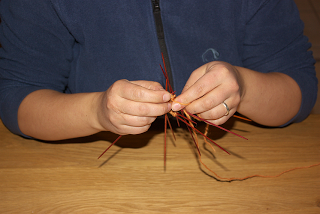
Thirdly, I spent part of the weekend having a load of fun with the new "in" sports discipline, Extreme Hedgehog Wrestling. Here's photo proof of it:


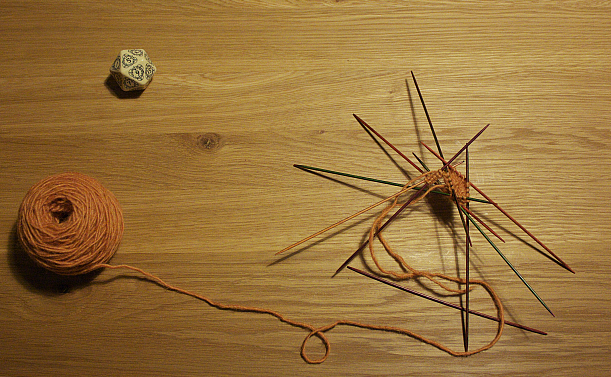
And this is the hedgehog in rest:


The thing lying around on the table in addition to the needles and yarn is a count-down d20* that I use for counting knitting rounds. (For those of you not enlightened by roleplaying friends sharing their dice and knowledge, countdown dice have the numbers arranged so you can easily find the next one in sequence - as opposed to normal dice where you have to hunt for the next number.)


It's a pattern that was published in Knitty a while ago**, and contrary to my usual approach, I actually did not change anything when knitting it. Well, except using dpns instead of the recommended two circs, and messing with the needle size : yarn thickness ratio to get the correct gauge. (Hint: My needles are, to a normal knitter's mind, way too small for the yarn.) After I broke one needle tip during the wrestling session start, I sort of tried to err on the side of caution in regards to the number of needles (and therefor reduced stress on the individual needle).Hedgehog Wrestling then is the natural side effect of this.

* A 20-sided die. Which is plenty for most knitting purposes and a very standard type for a lot of roleplaying games.
** I won't tell you what it is yet, because it's intended as a gift, and you never know who reads this blog. I'll show the finished thing once it's been received, though.
0

By accepting you will be accessing a service provided by a third-party external to https://pallia.net/

Contact