
Latest Comments

Guest - Katrin Sprang Discussion
18 September 2026
Hi Rachel, I have looked for more photos of you, but that was not very successful. I found a link on...
Guest - Beatrix Sprang Discussion
15 September 2026
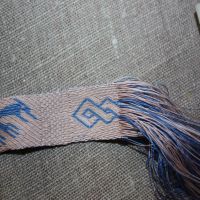
That lozenge pattern element is not a photograph, but a scan. So it should be to scale. But I pinned...
Guest - Katrin Sprang Discussion
15 September 2026
I was not referring to Rachel's reconstruction (is the reconstruction you refer to the one photograp...
Guest - Beatrix Sprang Discussion
14 September 2026
There is something Rachel did not mention. She told me: "Well, I worked with the measurements we too...
Guest - Katrin Sprang Discussion
14 September 2026
Well, this is certainly developing into an interesting discussion. Firstly, going from that lovely l...
FEB
22
0

Ponderings on Patterns.

From time to time, I get asked if I have a pattern for this or that piece of clothing - to which my usual answer is "No, because there were no patterns in the modern sense used in the Middle Ages". Exceptions may apply for items such as hoods, where it's easy to take the pattern from an archaeological find, and which fits a range of head, neck, and shoulder sizes, and not-really-fitted garments such as high medieval breeches, which are rather huge and don't need a lot of measuring.

For dresses and other fitted items of clothing, though, such as hose? In my opinion, it does not make any sense to offer a pattern in the modern sense for these - because their construction, as it can be reconstructed, did work completely different. To get a result close to what the original garments were, it makes much more sense to follow the procedure that was probably used for the originals than to try and use the industrial, post-19th-century approach to clothes, in graded sizes on paper patterns.

Generally speaking, for the historical construction of garments, you take some key measurements and transfer them to the fabric straight away. It's not even necessary to have a measuring tape for this, you can do it with a piece of string (measuring tapes are a rather late invention as well, at least I was not able to find any evidence for them from earlier than the 17th century). Your building bricks for the garments are geometrical shapes, which means they are easy to cut out of the fabric, and final tweaking takes place straight on the body. In case of the more involved, very tight-fitting garments used in the late Middle Ages, or in case of really expensive fabrics, this cut-then-fit approach can be done first on the lining, and then the lining fabric used as a template for the upper fabric.

The huge advantage of this approach (apart from being much closer to the original method, and thus much better suited to get results that look and fit more like the originals fit their original wearers)? Different body shapes pose a much smaller problem than when you have graded pre-made patterns. Human bodies are quite different from start, and they tend to take on even more different shapes if weight is put on, which is definitely an issue today (it would be interesting how many overweight people there were in the Middle Ages, but that's an entirely different topic and not really relevant for now and here). These very varied ways on where extra fat is stored is one of the reasons why it's much harder to find well-fitting garments for people that are overweight or adipose; some people carry most of the extra weight in the legs, some in the butt, some around the middle, and these differences make for very different shapes, so basic pattern grading will not work properly anymore.

So I'm always a bit to very sceptical when I see "patterns for medieval dresses" somewhere. In my personal experience, a lot of the patterns will not work properly, because - as explained above - the approach is just too different. It's especially, um, "interesting" if the pieces in question have not been published completely yet... as is the case with the Lengberg bra. Apparently this skirted bra has been turned into graded patterns which are now available at a site called Reconstructing History. Apart from the fact that if you use the search engine of your choice to look for reviews of patterns from this place, you'll find a lot of people telling you that they are badly documented, badly graded, and come with not-so-great instructions, I can tell you that the members of the Lengberg research team do not endorse this pattern. It was produced without their co-operation or consent, and they do emphasise that it was made without direct knowledge of the original garments or their patterning.

The Lengberg research team is working on a publication on the garments, and as far as I know, they are also going to make their reconstructions as accessible (and re-tailorable) as possible. I know that patience is hard... but it's probably very well worth it here.
0
JUN
29
0

A Closer Look at Fibres.

I'm back with my Bronze Age Fibre problem. Well, it's not just my problem... it's a pretty common one if you look at reproducing fabrics from that time. Let's take a look...

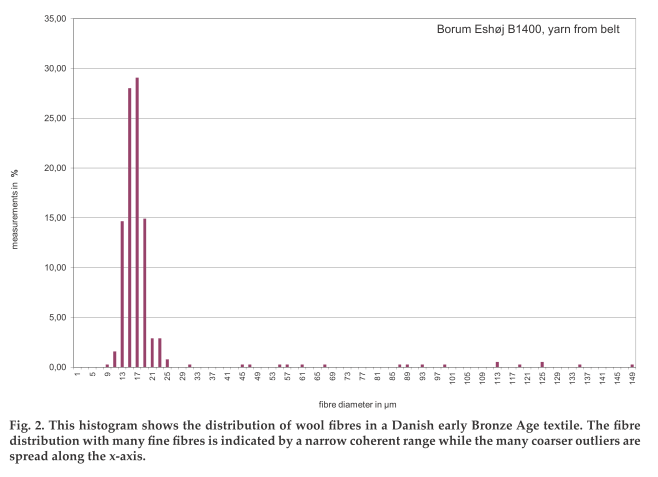
Modern Merino wool, which is seen as rather fine stuff, has - if of the fine kind - fibre thicknesses of around 20 micron. Sometimes you get extrafine, which is at about 17 micron.

Bronze age fibres were, mostly, around 17 micron. There's fluctuations, of course, but that's the main component of the textiles - really, really fine fibres. Then there's some few extra coarse ones thrown in, with 45-150 micron thickness. A diagram of fibre thicknesses counted was published in Skals, I., & Mannering, U. (2014). Investigating Wool Fibres from Danish Prehistoric Textiles. Archaeological Textiles Review56, 24-34, and thanks to the generousness of ATR, you can download the whole issue with the article included here. To save you the search, the histogram is on p 26, and it looks like this:


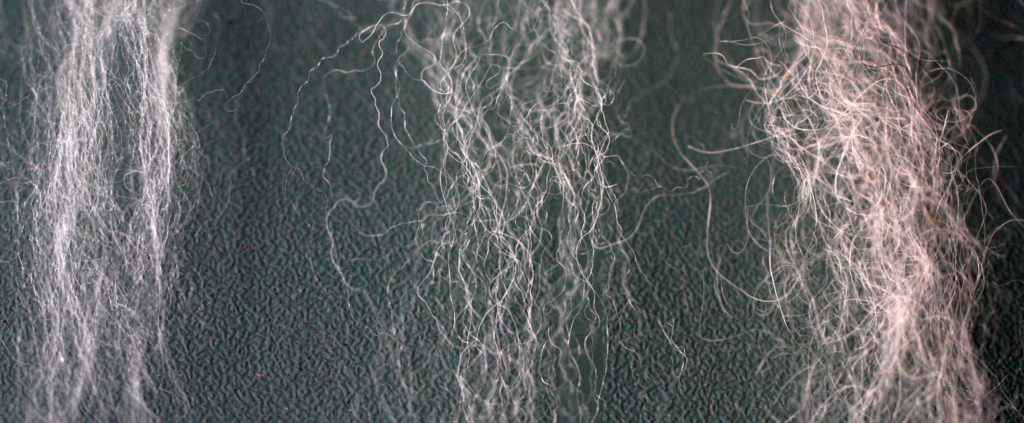
Getting this mix of fibres is difficult these days. I have gotten some superduperfine special wool now, with (according to my supplier) around 15 micron of fibre thickness. You can see it to the very left in this picture; next to it is a sample of my beloved Eider wool, and on the right Valais Blacknose wool.


Even though it's just a macro photograph, I think the difference is quite clear. The difference when you touch it is very clear as well - the superduperfine wool feels like silk, and it's supershiny (which is partly due to some post-shearing treatment), while the Eider and Valais are just normal shiny.

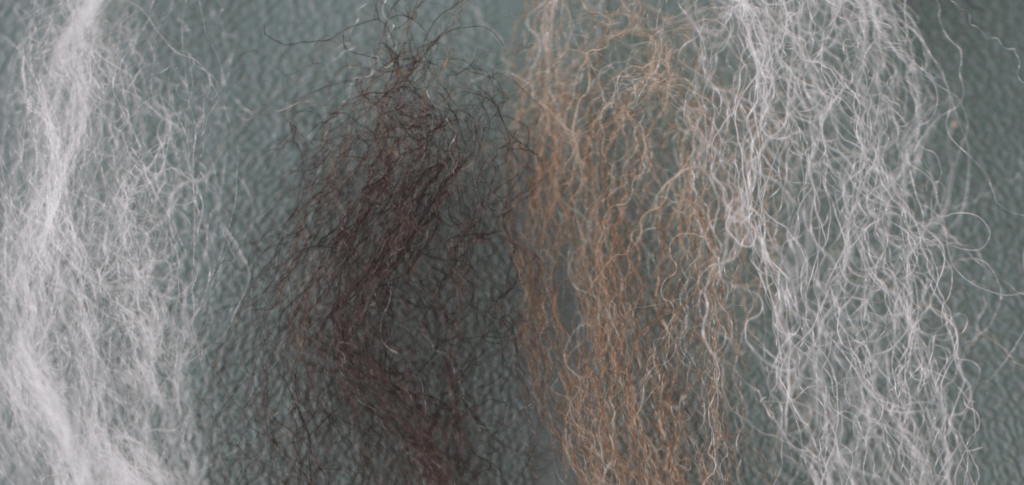
I've also compared it to the Manx Louaghtan, which is an old breed, and to another wool sample that I got for these comparison reasons:


Again the superfine is on the left, followed by my South American test candidate, then the Manx (which appears more saturated brown than in real life) and, for comparison, the Eider wool again. Both candidates are definitely finer than the Eider wool (which should have around 30-33 micron), but considerably coarser than the superduper benchmark.

And here you are. The Bronze Age Fibre Problem, in pictures. The superduperfine wool lacks the coarse fibres strewn in, and has been seriously processed to make it silky, smooth, and shiny. It also is very, very white, and BA fibres are mostly quite heavily pigmented. The two coloured wools have a mix of coarse and fine, but way too many coarse fibres strewn in to match the BA originals. They are, however, nicely pigmented.

So, like with many reconstruction projects, there's the choice between compromises. Use the very fine fibre although it has been heavily processed, dye it, and accept the fact that it lacks the coarse hairs? Try to blend some extra coarse fibres in (it would still need to be dyed)? Or use a wool that is naturally pigmented and not supertreated, but has too coarse fibres, or too many coarse fibres for the amount of fine ones?

Or... would someone please invent a time machine and fetch a handful of Bronze Age sheep? Pretty please?
0
APR
15
0

Livestream about the Lengberg Garment Reconstructions on Saturday!

Exciting news has reached me yesterday - on Saturday, April 17, there will be a live Q&A about the Lengberg garment reconstructions on Youtube, run by Marion McNealy, Rachel Case and Beatrix Nutz. I'm delighted that I heard about this in time!


So if you have no un-topple-able plans for Saturday evening, the livestream starts at 20:00 German time, and here is the link to the Youtube channel where it will take place.
0
NOV
24
0

Happening here.

Things currently happening here:

I'm writing a bit for a short little article about the Albecunde belt - it's more of just a better snippet, but it's still nice to revisit the thing again. It's a lovely piece of tablet weaving, and every time I look at the pictures I have of it, my fingers itch to sit down and make trials with different kinds of silk to find the perfect thread.

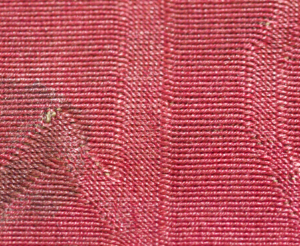
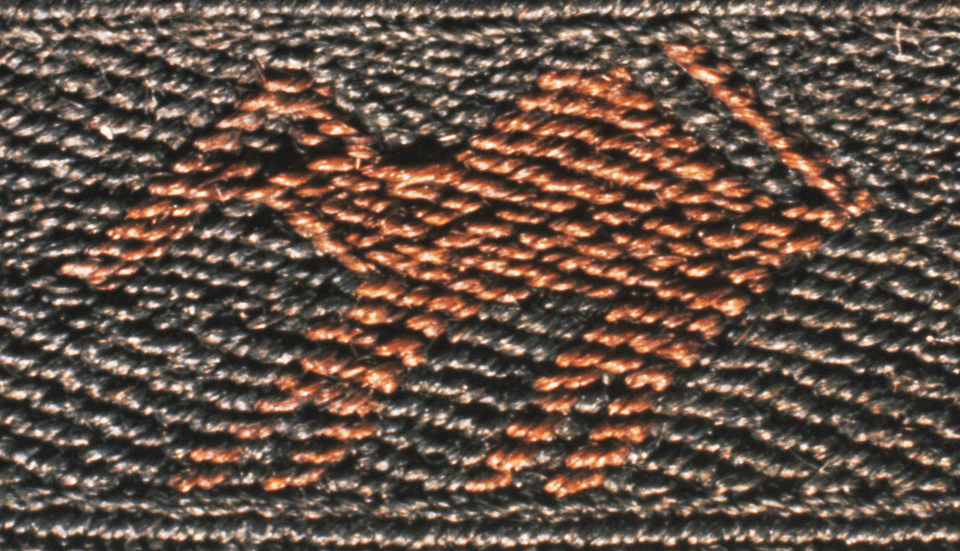
[caption id="attachment_5674" align="alignnone" width="300"] Detail from the "A(i)lbecunde" Belt from the Diözesanmuseum St. Ulrich & Afra, Augsburg. Tablet-woven from silk.


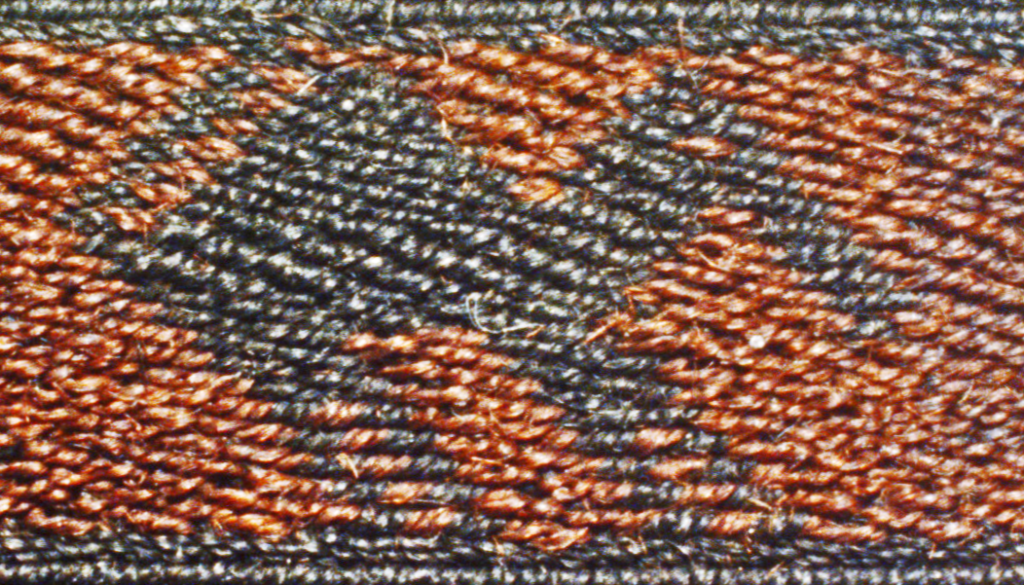
You can see in the picture that the angle of the individual cords in the weaving is very, very steep. There's also rather little difference iin apparent "looseness" in the looks of the cords twisted in S and twisted in Z direction - which points to very little, almost non-existant S-twist in the original threads.

The silk embroidery threads that I have already have too much of a twist in them, unfortunately. So I'd love to get my fingers on some gummy silk with almost indiscernable S-twist to give that a try, and that's certainly something that will be needed for the next stage of the project. (If you have a hint on where it's possible to get such silk, please do let me know!)

There's no time for that just now, though. The little piece needs to be written, and then there's some more prep to be done for a travelling exhibition organised under the wings of EXARC. That requires me to do two little snippets of a video, and this time I need a proper script, so I won't babble too much into the wrong directions.

Finally, more writing of some other kind - it's nearing the end of the month, which means, as usually, some newsletter writing. Before, you know, the month is over and I can't title it "November Newsletter" anymore...
0
OCT
28
1

Manuscripts as Textile Sources.

Textiles sometimes survive in the weirdest circumstances - the Viborg shirt was pulled from a posthole, where it had carbonised (thus the linen fabric has survived). There's textiles that were used as tarring brushes, textiles used as toilet "paper", or those used as wrapping for metal items; in all cases, the coating led to them being preserved better.

Even better when the fabrics are not coated or permeated with something... but are preserved in good conditions. Dry and away from light, and protected from moths and mice and other critters that might have a use for them. Like... pressed between the pages of a book. Such as manuscript curtains.

If you go "huh?" now, that is exactly what I did. A friend pointed this possible source of medieval textile knowledge out to me, as she had heard a talk on the topic in one of the (digital) conferences she attended. And here's one of the little bits of good things the pandemic brought: Because the conference was digital, the talk is available online, on Youtube, and you can get a glimpse of this fascinating practice and, even better, a glimpse of some of the preserved textiles!

0
AUG
06
0

Peacock Feathered Fabric!

If you're reading Middle High German texts, there's occasionally the mention of peacock feathers in clothing - quite often it's a "peacock hat", but sometimes there's also a reference to other garments in a kind of peacock-y style.

Nobody really knows what this kind of fabric was (or if there's several variations)... but I have now actually stumbled across a real piece of extant fabric that includes peacock feathers!

It was found in a relic case in St. Rumbold Cathedral, Mechelen, Belgium. The fabric has been radiocarbon dated to the 13th century, and it is a red cut velvet (silk pile on linen ground weave); applied across it, in a kind of cross-hatch pattern, are peacock feathers and gold threads (gilt silver around a silk core). Unfortunately the text doesn't say how exactly they were attached - but I'm utterly thrilled anyways.

It has been published in an article aptly named "A Box Full of Surprises" (available on academia.edu).

This is... way cool!
0
JUN
17
0

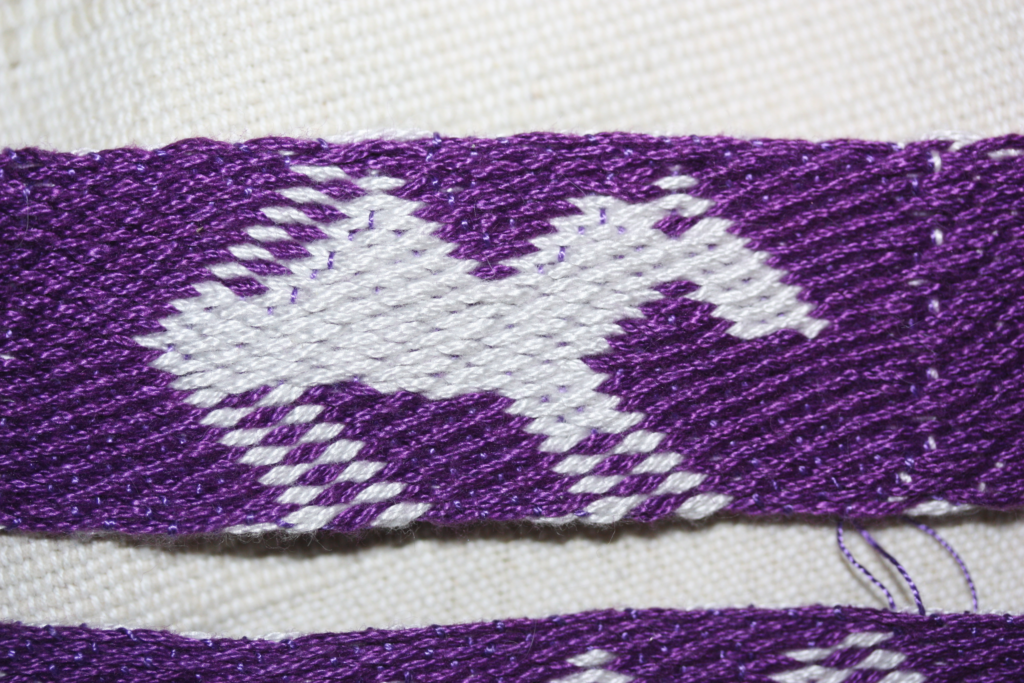
Looking the Dog in the Eye.

The eye, the nose, the neck. Ah well.


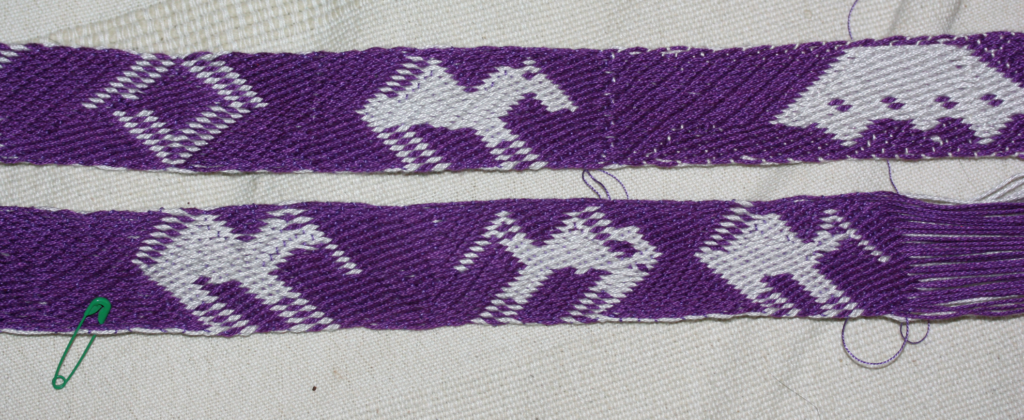
First, let me tell you about the main difference, for me, in weaving ass-first versus nose-first: When starting with the nose, I will very easily end up with a baboon ass on the dog because of getting the timing of leg slope start and back slope start not quite right. When starting with the tail, I have a high probability of ending up with a too-thick neck because of somehow fuddling things up in the middle, and then getting the timing for the neck not quite right. I suspect that if woven cleanly, the thick-neck-problem might evaporate. (It's on my list to manage that the next time.)

The nose area, however, is a different beast.

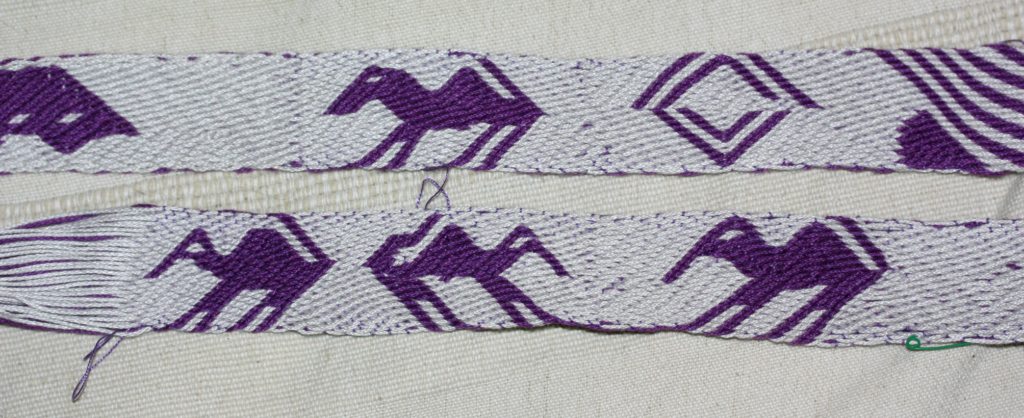
[caption id="attachment_5364" align="alignnone" width="328"] Photo from UNIMUS.no


[caption id="attachment_5365" align="alignnone" width="441"] Photo from UNIMUS.no


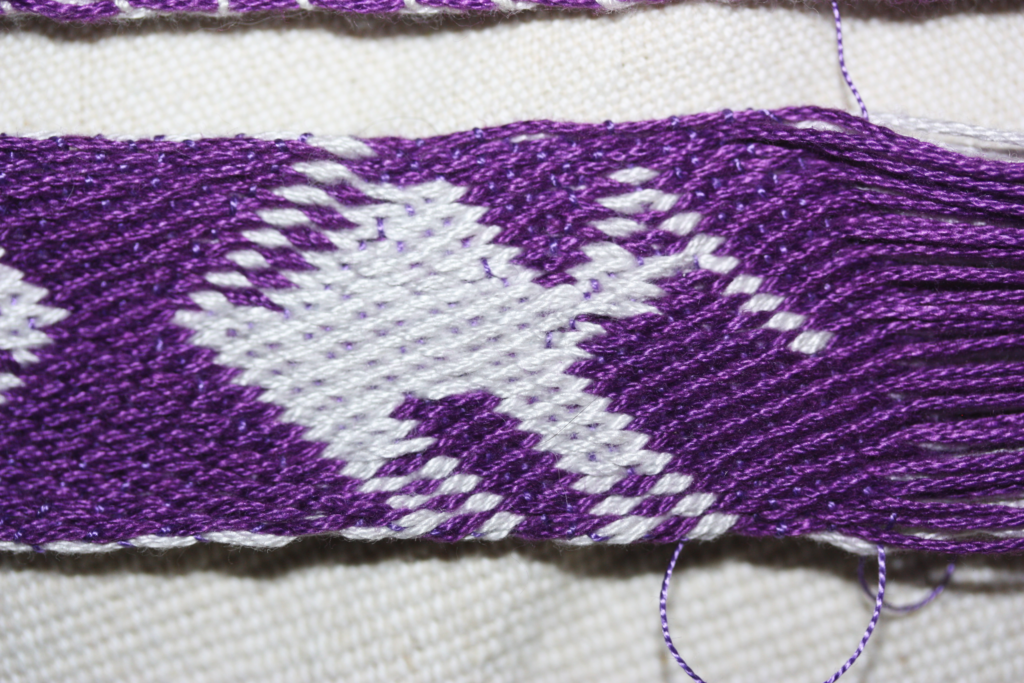
If you compare the look of the back of the band in the tail and leg region, you can see that there is a characteristic look of broken narrow lines - that's the back of the regular diagonals structure, which is exactly what we have on the front for a while: white, purple, white, purple.


The noses on my dogs are all one of these regular stripes as well - white, purple, white; a single (two-thread) line on top of the band, and the regular broken line on the back. Except in the very first dog, where I did a wide nose.


Now, the rules of normal twill dictate that a line you "draw" on the background is either one line (two thread's worth) wide, or three lines (in order to go out with a nice clean line again). Three lines because you have, in the diagonal base setup, a white line coming out of the twill, then your pattern dark line, a light line, a dark line, and then a white line going back into twill again. For a wider line, you cover up the light between the two dark lines by change of tablet turn direction, but you still have to weave into the regular dark line to get a clean shape. So. Two or six is the choice you have.

The original animal's nose is wider than a single line (of two threads) and much more narrow than a regular wide line, though, and that is technically not possible without doing Strange Things (TM).

I suspect the sneaky and ingenious use of some double-turns here, to get the effect. I'm not sure yet how and where they need to get started, though. This is one of the cases where I'll actually sit down with pen and paper and start drafting this to see where lines meet normally, and where lines have to start, or change, to get the desired effect.

And then I can see another dog-weaving stint in my future...

(By the way, in case it interests you: If I don't make silly mistakes and have to weave back, weaving a doggie takes me about one and a half hours. Do try this at home, but not late in the evening when tired, especially not late in the evening when tired plus distracted by other stuff going on in the room that you feel the need to participate in while making silly mistakes in your weaving.)
0

By accepting you will be accessing a service provided by a third-party external to https://pallia.net/

Contact