
Latest Comments

Guest - Katrin Sprang Discussion
18 September 2026
Hi Rachel, I have looked for more photos of you, but that was not very successful. I found a link on...
Guest - Beatrix Sprang Discussion
15 September 2026
That lozenge pattern element is not a photograph, but a scan. So it should be to scale. But I pinned...
Guest - Katrin Sprang Discussion
15 September 2026
I was not referring to Rachel's reconstruction (is the reconstruction you refer to the one photograp...
Guest - Beatrix Sprang Discussion
14 September 2026
There is something Rachel did not mention. She told me: "Well, I worked with the measurements we too...
Guest - Katrin Sprang Discussion
14 September 2026
Well, this is certainly developing into an interesting discussion. Firstly, going from that lovely l...
JAN
16
0

Rippenköper.

I've mentioned working on the fabric info thing - and one of the things I really want to include is lesser-known weaves. Well, weaves lesser known today, I should say, because back in their hey-day, things like samite and Rippenköper definitely were well-known.

Rippenköper is something that I wasn't really familiar with either; it only had a relatively short time where it was the Thing (or at least one of the things). It's a twill variation, made by changing over from 2/1 twill to 1/2 twill after a few wefts, which results in narrow stripes giving a pleated effect. Since this is a weave where you will see more of the warp or more of the weft depending on which side you're looking at, if you have warp and weft threads in different colours, it will also give you a colour stripe effect.

If you're curious about that weave now, Carolyn Priest-Dorman has written a blogpost about it a while ago, including a pretty picture of a Rippenköper she wove in the background of the page - you can go check it out here.
0
JAN
15
0

Links for your delectation.

More of the things-going-on-here info: I am sitting here working on an overview about fabrics in the Middle Ages. This is a large topic, and a complicated one, with many facets and many aspects and rather bad sources. Fortunately I'm "only" going for a two-hour talk, so the bad sources don't matter too much, as there's too little time anyways to go into detail of such a kind that I'd need much better sources. (Though, of course, things would be easier with better source material, which means a) more textile finds that are b) published in an easily accessible way...)

At the moment, I'm still in assembly mode. I usually start presentation outlines with a more or less rough idea of the things I want to cover, then gather all the necessary info for this, stick in a lot of pictures, think of even more things that are definitely relevant, thus stick in more stuff, then do a test run and discover I have to cut things down by about two thirds... which I then do and manage more or less, only to find things during that process that have to be added in for things to make sense, which usually makes things interesting again.

Right now, though, more things get added, and a bit later, I'll do a run-through where I babble to myself to find out how long the monster will take, to consequently enter the next stage. While I am working on that, here are two potentially time-consuming links for you - enjoy!

The Archaeological Textiles Newsletter (now the Archaeological Textiles Review) has been around for quite a while, and they have published a lot of very interesting articles, most of them short but informative.
Because the ATR people are very nice indeed, you can download the back issues up to issue 59 (which is from 2017) from their website, for free. Of course you can also subscribe to the Review, which will then bring you the more recent ones.

If that's not enough to keep you occupied, you can head over to the website of the Bamberger Staatsbibliothek and leaf your way through the digitised Bamberger Apokalypse, dating to the early 11th century. (If you're in the area, there will also be an exhibition, starting soon, about the manuscript.)

 
0
DEC
11
2

Textile Advent Calendar!

As every year, Amica and Maria, the two wonderful textile nerds (that is according to their own description, mind you) behind the blog Historical Textiles are making a textile advent calendar. As every year, I'm only catching on halfway, and then have to catch up.

Do pay them a visit - there's some wonderful photo of an old bit of fibery goodness every single day!
0
FEB
07
3

Links!

It's time for a link roundup again - here you go:

In German: Why a bicycle manufacturer sends his bicycles in cartons with a TV printed on them.

There's a knitting card game on Kickstarter - where you can knit (virtually, and thus much faster than in real life) objects based on actual existing patterns, with actual existing yarns. The video doesn't show much about how the game is played, but if you are into knitting and card games, it might be interesting for you.

Medieval Histories has an article about Viking dress, more specifically: about royal Viking dress.

BBC has an article about women explorers in the 19th century craze for getting mummies and related artefacts out of Egypt and into museums and collections... and modern researchers as well.

Anne Marie Decker has put her presentation about "Charting the Nalbinding of the Nile" online. If you're interested at all in nalbinding, do take a look at this - if only for the pictures!
0
DEC
15
0

Reduce, re-use, recycle.

At least re-use - that is, after all, what was done with the Bernuthsfeld tunic. Case in point?

triple_use

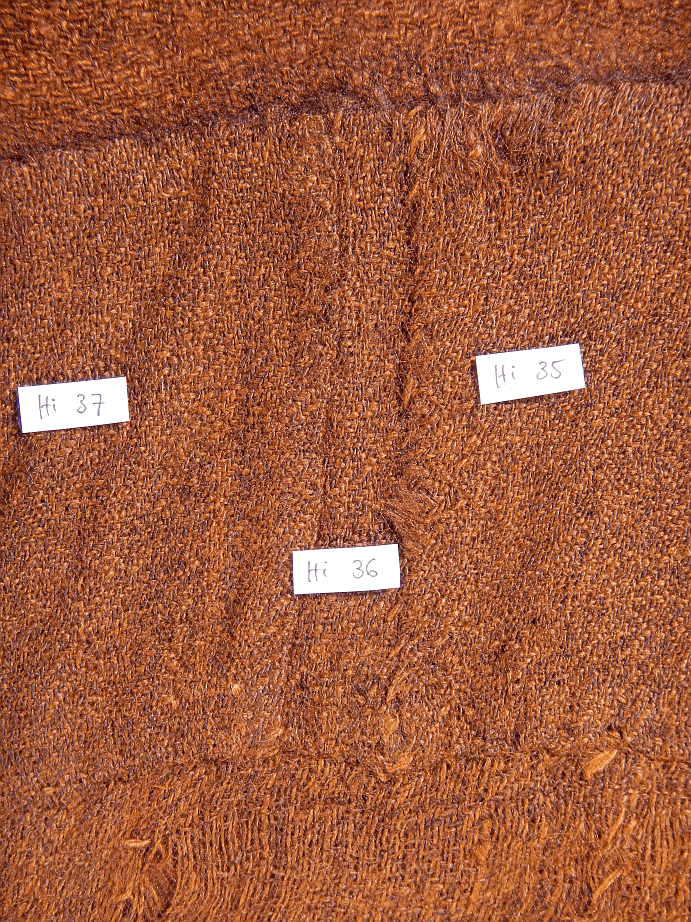
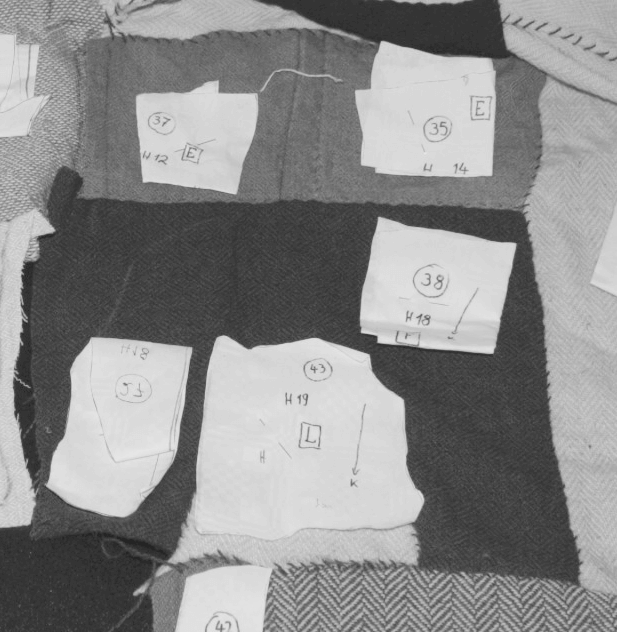
Patches 35-38, our numbering. (Did I mention we gave out new numbers for the patches, as not all of them are covered in the drawing that Hahne did?)

You can hopefully see that there is a light diamond twill fabric and a darker diamond twill fabric, and the lighter one has its own seams, done in a different hand than the main tunic makers' one (which is the rather clumsy overcast stitch around the patches). There is also a proper hem at the bottom of the light fabric, which in turn is stitched to the darker fabric, which has its own proper hem at its own bottom.

triple_use_original

So my interpretation is this one: The light diamond twill fabric was once a kind of garment, sporting said seams and hem. At some point, it was worn down so much or had gotten out of fashion so completely that it was taken apart, and the still-okay bits were used again, to make a new garment (maybe a child's tunic) out of the light fabric together with the darker fabric. The two are not the same, but rather similar, so they'd work nicely together.

The colour difference in the original today is not quite as pronounced as it is in our reconstruction, which is partly due to the difference in the base colour of the fibres in our fabrics being larger than in the original and partly due to our decision to make the fabrics a bit more different in order to clearly show that they are two different pieces with different history.

In any case, here we have a beautiful example of re-using fabric not once, not twice, but three times as part of a garment - first, the lighter fabric on its own, then together with the darker one in a garment, then as a big patch in the Bernuthsfeld tunic.

(Also it was really, really nice to sew the proper seams and hem in the light fabric, and an amazing contrast to do this sandwiched right inbetween doing some Bernuthsfeld overcast seams!)
0
NOV
23
1

Exhibition "Expedition Mittelalter"

As one of the programme points during the Textile Forum, we went on an excursion to see the special exhibition "Expedition Mittelalter" at the Schnütgen-Museum in Cologne. If you can arrange it, I heartily recommend going there, as you will get treated to a lot of beautiful things usually buried in the archives. This includes, obviously, textiles.

Among them: a puzzling (at least to me!) embroidery of a horse or unicorn on a black (yes, black) linen background, dated to the 15th century. An incredibly beautiful reliquiary bag embroidered with silk in counted stitch and with a flat gold strip (also puzzling, because I have no real idea on how that strip was stitched in, and oh what would I give to see the back of that thing!). Plus a plethora of other textiles. Oh, and the Anno chasuble - a samite cloth dyed with real mollusc purple, dating to about 1000.

As opposed to most special exhibitions in German museums, in this case all the objects are from the hosting museum's own archives, and so you are allowed to take photographs for private purposes (no flash and tripod, so come prepared with a steady hand).

The only downside is that there is no catalogue. There's a comic book that you can complete with a kind of treasure hunt during the exhibition, which is nice and fun in its own way, but nothing even remotely helpful if you're trying to learn more about the individual objects. But yes, that's the only downside, and the pieces themselves are really making a visit worth its while.

The exhibition will run until January 28, 2018, so there's still a bit of time to travel there.
0
OCT
23
1

More rants (not mine this time, though).

If you're interested in old textiles, you might have caught the thing with the Viking tablet-woven band that, according to Annika Larsson, spells "Allah".

The Guardian and Heritage Daily, among other places, covered this "staggering" find. Then up sprang the debate on whether it really was possible that the band has Arabic script on it, and spells "Allah" - one prominent voice against it was Stephennie Mulder, an associate professor for Medieval Islamic Art and Architecture. She did it on Twitter (of all places!), in a brilliant string of tweets you can see here. (Go look at that link for pictures of medieval tablet weaves with stunning patterns!)

Apart from the Square Kufic style being significantly younger than the textile and other script issues that are covered in that tweet string, Carolyn Priest-Dorman also has a few things to say about the pattern. Especially that the square-ish things at the side, shown in the images in the articles, are... not actually in the band itself.

The Guardian's article has since been updated to include the academic debate.

The Atlantic also covers this discussion, as does The Independent.

I'm not sure what brought Mrs Larsson to go forth and invent extra bits for a band just to read something Arabic into it, but I'm not happy about it.

I'm much happier about the fact that there were quick and well-founded counter-arguments for it. It's a beautiful band, it is a stunning piece of work, and it does deserve proper study, but it's not a prop for inventing an alternate history, thankyouverymuch.
0

By accepting you will be accessing a service provided by a third-party external to https://pallia.net/

Contact