Latest Comments

Guest - Katrin Sprang Discussion
18 September 2026
Hi Rachel, I have looked for more photos of you, but that was not very successful. I found a link on...
Guest - Beatrix Sprang Discussion
15 September 2026
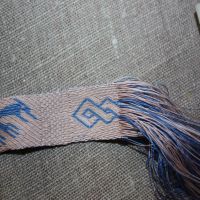
That lozenge pattern element is not a photograph, but a scan. So it should be to scale. But I pinned...
Guest - Katrin Sprang Discussion
15 September 2026
I was not referring to Rachel's reconstruction (is the reconstruction you refer to the one photograp...
Guest - Beatrix Sprang Discussion
14 September 2026
There is something Rachel did not mention. She told me: "Well, I worked with the measurements we too...
Guest - Katrin Sprang Discussion
14 September 2026
Well, this is certainly developing into an interesting discussion. Firstly, going from that lovely l...
FEB
29
0

Recent Textile Stuff.

Here's some textile-related stuff (finally, as promised) that has popped up during the last few days. Enjoy!

Tracy Hudson has an article up in the EXARC digital journal, looking at spinning experiments and how much they can tell us.

Another exciting thing, right at my doorstep: The Kaisermäntel ("emperor's cloaks) in Bamberg are getting some quality research time, and it already looks like the researchers will find exciting things, such as remains of pre-drawings on the fabric (link goes to a German article). There are six pieces counted as Kaisergewänder, and they are the oldest extant textiles of European rulers, dating back mostly to the 11th century. Only mostly, as the fine gold embroidery was cut out from the original ground cloth and transferred to new silk ground fabrics.

It was assumed until now that the original placement of the embroideries was preserved during that transfer, but current research will look into that. Art historian Dr. Tanja Kohwagner-Nikolai, who is working on these wonderful textiles, is doubting that the original arrangement has been preserved especially regarding the Sternenmantel, which is a cloak with embroideries of constellations. She suspects that the embroideries were purposefully arranged differently, with the intention of supporting a cult around the rulers Heinrich and Kunigunde.

The project will run for the next four years, looking into different questions around the pieces and their history from the 11th to the 15th century, up to their last conservation and restauration in mid-20th century. Research will be interdisciplinary, with material and technological analyses, historical and art historical methods combined.

This is a very exciting project - I do hope they will get a lot of good results from the analyses! If you'd like more information, here is the (German) page of Uni Bamberg about the project. If you are in the area, you can visit the Diözesanmuseum and see the garments for yourself (the museum is open Tue-Sun 10-17 o'clock).

Sarah Bendall has posted the next chapter on her effigy bodies reconstruction: Boning and Binding.

Finally, rather unrelated, but really interesting: Barbie dolls dressed up with hijabs.
0
FEB
19
0

World's Oldest Dress

A dress find from Egypt, called the Tarkhan Dress and housed in the Petrie Museum of Egyptian Archaeology in London, has been radiocarbon-dated - and the result: it's the oldest garment we know of, about 5000 years old. This makes the piece the oldest piece of evidence for something that was tailored from woven fabric - and with a V-neck, decorative pleats in the yoke area and long sleeves, this is definitely and beautifully tailored.

The National Geographic has a short article about this garment, and there's also a more in-depth article about the dating in Antiquity.

This is a really exciting garment, and it does show again how old clothing is - and how important it was for mankind...
0
FEB
15
0

Videos and Stitches.

Let me start this week by giving you two links to spend lots of time looking at stuff!

Firstly, Doug has posted a number of videos from Scotland's Community Heritage Conference in 2015. Topics range from community projects and landscape projects to surveying, and there's even a "minute of madness" short video.

Non-moving pictures, but lots of them, and lovely ones of sewing work are in Sarah A Bendall's post about her reconstruction of the Elizabeth I effigy bodies - cutting and sewing. If you like to look at hand-sewing, or are interested in early modern stays, or both, you should not miss that post!
0
JAN
21
1

Grand Challenges in Archaeology

Doug is running a blogging archaeology carnival again - asking about the Grand Challenges of Archaeology, and I promised him an article. So here you go: these are the Grand Challenges to my archaeology.

First, and biggest, challenge for me? Logistics. Since I'm a freelancer, I have limits to how much money and how much time I can spend on a project. Whether that is a reconstruction project, an experiment, or an article, my ressources are limited. When I am really lucky, I get paid to do some research on a specific topic (or at least paid for a reconstruction project so I can cover part of the research time from that payment), but usually, it's on my own time and bank account.

There is, technically, the possibility to apply for grants, but since I've had few positive experiences with grants yet, and it is usually much easier to get them when you have a network based on a Uni, museum, or similar institution, I haven't spent a lot of time on applications recently. It boils down to time again, here - sometimes I have to struggle to keep up with all the absolutely necessary things like sending out orders, keeping the shop pages updated and conforming to the legal shenanigans the EU likes to toss at us, blogging and then doing the work on current projects. With that, I might not have the time or the energy left for much more.

This is just me, however - it's not directly related to archaeological textiles. One of the Great Challenges there, generally, is that there is so little data available. Textiles are very perishable, and conserving, analysing and publishing them is quite expensive (as it takes a really, really long time to microclean an archaeological textile, and analyse it, and thus it is a pricey thing), which means that by far not all textiles that are preserved are actually analysed and published. With finds that are not frequent in the first place, this does seriously cut down on our possibilities - and skews our understanding of how textiles looked, because the things that do get published are obviously the spectacular pieces.

A second Great Challenge? Terminology. This is a veritable quagmire. We have pictures, we have medieval terms, we have (very few) surviving textiles and garments... but we have no possibility, usually, to firmly link one clothing term to a type found or shown in the pictures. In addition, costuming history has traditionally taken specific old terms and uses them to address certain types of clothes or textiles, though this might be misleading, or even wrong. There's a German term, "Sendelbinde", that has been used with the meaning of "hood" or "chaperon", but the term is not medieval - it originates in early costume history, in the 19th century, and was first used to mean a hat band. If you're looking at stitches in sewing, there's so much variation in modern terms (and so much inaccuracy) even within a single language. It gets even worse when you try to translate things. At least this problem can be solved easily, even if it looks a little awkward, by inserting a schematic drawing in the article or paper, showing which stitch is meant by what term. The other problem is harder; for me, I'm solving it by trying to use modern, general terms for specific types of garments.

These are, for me, the biggest issues - a third one is the fact that it is not easy to find all the (small) publications about clothes, garment fragments, or textile finds, as they are typically written in the language of the country they were found in, and often published in small, hard-to-find journals or books with a small print run. But if we could conquer the problem of money and the problem of terminology, so much of textile or garment research would be made easier.
0
DEC
18
0

I'm back home, and I have stuff for you.

You're getting a late blogpost today because I had slow internet today, and it even ate a half-written post... but you are getting one, and it is one with free stuff! (Very fitting for the season...)

First of all, as a reminder - free ebook in Aarhus Uni Press this month is Woven into the Earth. Go download it if you haven't done so yet, and tell your friends who are interested in archaeological textiles. This is a wonderful book, and it is definitely good to have.

You already downloaded it? You would like more books? Here you go.

On a completely different, and very much non-archaeological note - there is a free e-book about working with MS Word, "Microsoft Word for Publishing Professionals" by Jack M. Lyon. A few years ago, the author's newsletter "Editorium" helped me a lot when prodding my thesis text into shape, as well as later when I had typesetting to do. If you're working with Word (as so many people in the social/historical/archaeological sciences do), you might want to give it a look.

And now on to the juicy bits.

I had the opportunity to visit Estonia for a few days, and I didn't only meet lovely fellow textile people and fellow archaeologists and got to see exciting finds in several museums and a good number of the Estonian textile finds, I also brought home some books (about, who would have guessed it, Estonian textile finds). Two of them are about the finds from Siksälä, which is a burial site used continuously from the 11th to the 15th century - the Estonian Iron Age and Middle Ages. Siksälä has yielded exceptionally rich finds, including textiles wonderfully decorated with bronze spirals. There's a publication in two parts, a text part and a catalogue part; both are in Estonian*, but anyone can look at the pictures and construction drawings. And if I say anyone, I do mean it - both the first volume and the second volume are available online, free of charge, thanks to the University of Tartu.

Another absolutely amazing Estonian find is the craft box from Lohavere (which should be written with a little ~ sitting on top of the o), which comes from the hillfort of the same name, dated to the 12th and early 13th century. If you know the Mästermyr find and have always dreamt of something similar, but related to textiles? Here it is. The craft box, made from birch bark, contained textile remains, prefabricated and half-finished products, bronze ornaments and tools, some of them neatly stored in smaller boxes or little pouches. It is an absolutely fascinating find and gives so much information about how the spiral decorations were worked... and it, too, is published in a little book, and that, too, is available online free of charge.

These finds absolutely deserve to be better-known - so feel free to spread the word, and of course enjoy the publications of these gorgeous finds!

*Estonian is a language belonging to the Finno-Ugric group, and more or less related to Finnish. A few fun facts: Estonian has fourteen cases. Yes, fourteen - because there are no words to signal direction (like "into" or "from"), and a case is used instead. More fun facts? Estonian has no genders, so there's no problem with being politically correct. Because there were a lot of Germans in Estonia in the Middle Ages (Hanseatic League was a reason for that, for instance) there are quite a few German words still around, which makes not understanding most of the rest even more peculiar. Final fun fact for today: as I'm easily amused, it diverted me no end that the greeting "Tere" sounds much like the southern German colloquial "Dere" (which is very short for "Habe die Ehre", I have the honour). If you're intrigued now, here are a few useful Estonian phrases, and here is a very interesting pdf with facts about Estonian.
0
DEC
10
1

Musée des Tissus, Lyon - please help!

Just when I was starting to feel all seasonally-appropriately fuzzy and soft and warm inside, a Bad News (TM) email dropped into my inbox... the Musée des Tissus in Lyon is in danger of being closed.

This museum holds an immense collection of historical textiles from all over the world and is one of the most important, if not the most important textile museum that we have. (You can search a part of their collection online here. It's all in French, unfortunately, but you could try "tricot" for knitting (which includes a Coptic sock) or "laine" for wool or "soie" for silk or "broderie" for embroidery. Just to get an impression of what treasures they hold.)

You'd think that an important, large, critically-acclaimed museum would be safe from closure, right? However, things look truly dire. There's a long article (in French) here, and I'll try to give you the gist of it in English, but make sure to have a look at the article itself for the pictures. It's very long though, so the TL;DR: the Chamber of Commerce of Lyon, who ran the museum up to now, is undergoing budget cuts and restructures that prevent it from holding on to the museum. The city, the Louvre and the French state department of culture all want nothing to do with the museum, using a number of paltry excuses.

There's a petition on change.org to save the museum, started on Monday, and it's already collected a lot of signatures. Please help - sign the petition and spread the word wherever you can, however you can. This museum is huge for historical textiles, and its closure would be a real catastrophe.

-- (This is not a complete translation, just a rough one, shortened in places. Should you find a mistake, please let me know - my French has become very rusty and creaky over the years.)

The danger of closure of the museums des Tissus and the sister museum for decoreative arts in Lyon is not a new thing; it's been in the air for more than a year now. A bit of background: the two museums (which are in effect one museum only) are not very well known to the public, but it's essential to know a little about their history to understand how the current situation came about.

The museum goes back to the 19th century; it was established to show off the superiority of the silks produced in Lyon (which had not been appreciated enough at the first World Exhibition), so it was basically a marketing scheme. The museum opened its doors in 1864. The Chamber of Commerce ran an ambitious acquirement policy, with well-known experts as evaluators, and it resulted in several donations. The Chamber of Commerce funded the acquisitions. Since 1843, a mission was abroad in China to buy outstanding silks; as the commission consisted of real experts, they brought only actual masterpieces back to France.

The ambitious programme of acquisition of decorative arts objects was tuned back to favour textile acquisitions in the 1870s. In 1891, the museum became le musée historique des Tissus, and the decorative arts collections were placed in other museums or put into the archives. In 1925, the Musée des Arts décoratifs part of the museum was reinstated at the hôtel de Lacroix-Laval, right next to the hôtel de Villeroy where the Musée des Tissus is located.

Though the silks from Lyon are at the basis of the collection, the museum holds documentation of 4500 years of textile history, from Antiquity to today, and from all the continents - the only weak point being Black Africa. There are about 2.5 millions of pieces (though they are counting each textile sampler catalogue as one item only, even if they hold hundreds more fabrics each). It is the most important textile collection of the world, only rivalled by those from the Metropolitan Museum, the V&A and the Los Angeles County Museum of Art. Experts from museums and textile research institutions from all over the world are all in agreement that the collections in Lyon are incredible and incredibly important. For instance, Lesley Miller from the V&A in London says «The Musee des Tissus is one of the most important collections worldwide in terms of its size and range, geographical and chronological coverage. It is also unique in the scope of its holdings of products of the local silk industry, which was – and still is – international in its impact. It contributes to international scholarship through its reserve collections, library, permanent displays and temporary exhibitions.»

Apart from textiles, the museum holds fabric designs in the tens of thousands range. In 1999, the museum was offered the archives of the house Bianchini Ferrier, working for ten years with Raoul Dufy, so it has hundreds of designs made by that artist. The museum holds no less than 200 designs by Antoine Berjon, the world's biggest collection of velvets Grégoire, ... The Decorative Arts part also has about ten thousand designs of old masters, of which only a small part has been studied to this day. There are drawings from Rosso Fiorentino, Philippe de Champaigne, Inrges and many more. There are artworks from wood, ceramics, emaile, ivory, glass, ... and all this are only a few examples of the riches this museum holds.

So why does the Chamber of Commerce, so proud of their history, now happy to think about closing the museum today? It looks like the state is to blame. It has sucked the Chamber dry in two ways: between 2015 and 2017, they are going to lose about 40% of their income from taxes. And in 2015, the state has taken wway a lot of money from their short-term assets. In Lyon, that was a cheque of about 15 millions of Euros, cutting their capital down a lot and making functioning difficult. In January 2015, the staff has been cut down by 15%, which did not affect the museum yet. In 2016, a new plan is foreseen, and it can be understood very well why the Chamber of Commerce, when its core is heavily affected by the cuttings, cannot go on to protect the museum. In addition, there are restructurings going on in the CoC, as there are new regions being established, and Lyon is going to fusion with Roanne and Saint-Etienne on January 1, 2016. And if the Chamber of Lyon is very attached to its museum, there's no guarantee that the two other areas will appreciate the history and support the museum. The CoC Lyon wants to preserve the museum very much, and they are willing to transfer the custodianship of the museum, including the two houses where it is in, to prevent it from being closed. The only question is - to whom?

The city is not interested, and the mayor, Gérard Collomb, seems to not realise the importance of the topic. It does not look like the city is working on finding a solution, and the meetings that were held until now have not procured any results. It is true that it's not easy for the city of Lyon, as they are also having the Musée des Confluences and the Musée Gallo-Romain as a handicap, putting 15 millions into the budget of the Musée des Confluences. However, the numbers of the Musee des Tissus are infinitely more modest.

Contrary to what a report done on demand of the Inspection Generale des Affaires Cultures might make one think, the museums (Tissus & Arts) are not spending much money especially compared to their level of activity, and they are largely self-financed. Their financial status is rather healthy. The current budget (which is not enough, but allows the museums to survive) is about 2.7 millions of Euros. The museums make about 800 000 to 1 million euros per year themselves. That means they generate almost half of their budget themselves, which is very remarkable.

The two museums have an extraordinary level of activity. Since the arrival of Maximilien Durend as director five years ago, not less than 24 exhibitions have been organised. There is an acquisition policy, there have been important donations made, there are conferences and concerts. An example of the activity is the current exhibition le Génie de la Fabrique. In spite of a budget in 2015 of about zero for exhibitions, this is certainly one of the most beautiful and fascinating exhibitions that are currently available. It retraces the history of silk in Lyon, relying entirely on the collections of the museum. It was not possible to edit and print a paper catalogue, so there is a freely available online catalogue. A visit to this exhibition is recommendet to understand the richness of items in the museum. All the specialists from France and abroad that we interviewed have underlined the great competence of Maximilien Durand and his team. In short, we stand before a museum with collections of international importance, with a small but highly competent and motivated team. And it is not only a museum: since its creation in 1954, the CIETA (Centre International d’Étude des Textiles Anciens) is based at the museum in Lyon. The CIETA is an organisation that is working to regroup textile museums, bringing them together and establishing common terminologies and strategies to catalogue and research historical textiles. They are also teaching and training specialists, and evaluate the current research being done. This makes the museum at Lyon to a centre of studies, probably the most important one in Europe, that all the world knows and where all Europe goes.

To save the museum, the director Maximilien Durand has had a very genius idea, that the CoC does approve of. While several of the world's greatest museums have important textile collections (like the ones mentioned above), those of the Louvre are basically non-existant. The Louvre does stress its universal character, and thus the idea is to let the Louvre annex the two museums, with the Musee des Tissus forming a new department and its sister house joining a remarkable collection to the Louvre, complementing the pieces already in their possession. A first meeting looked like the Louvre was interested, but they pulled back quickly. The benefits for the Louvre, Lyon and the museum are very evident, however - the Louvre would gain a textiles collection, rendering it truly universal; Lyon would win prestige at having a satellite of the Louvre; the museum would be saved and get more international visibility. A win-win-situation. And that at a very low cost, with 1.5 million euros per year to survive, 2 millions for developing.

It seems like this is too intelligent a solution. But the Louvre does see this solution as a "dead end". Why? Because only a part of the collection is coherent with that of the Louvre, and the rest (the majority) is more an "industrial art approach" that is not in sync with the Louvre's vocation. There's also the excuse that they would need to spend 1.7+ millions per year on the new parts, and the Louvre says they cannot afford this... while their yearly budget in 2015 was 199 millions of euros.

This disinterest is not only visible in the Louvre, but also in its custodian, the Direction generale des patrimoines. Their director, Marie-Christine Labourdette, is not willing to understand that the Chamber of Commerce cannot go on to hold the museum. She also insists that because of the origins of the museums as a marketing stint, they have ties to the industry and thus it's an industrial art museum and not wihtin their scope, more or less. They propose to have a meeting with everyone to find a solution... but who is to take part in this? The city does not want to hear anything about it, the CoC is not able to hold the museum anymore and the region (being restructured) is not available. The situation is dire, time is pressing, but Labourdette seems to expect that all will turn out by itself into a solution eventually.

If the museum should close, the big question is what will happen? The staff will, of course, be dismissed, and the houses taken back by the CoC. And the collections? The decorative arts could go to the Arts museum in Lyon, where they will probably stay in the vaults and archives. The textile collections would have to be transferred to a museum or a collection where the massive amount of pieces can actually be accommodated, and that would only be possible at the Louvre. Transfer and housing would have to be financed half by the state due to law, and half by the owner (the CoC). A stint like this would cost several millions of euros - money that could be used to safeguard the collection in its present place, and keep the museum alive.

Or the museum could be turned into a national museum, which would be absolutely merited by the importance of its collections. There is no French national textile museum yet, so it would be a good addition; but the director Marie-Christine Labourdette don't want to talk about this.

--

Thanks for reading this far! I'm afraid I've run out of steam, and I'll skip the rest of this article. It's more about the financial situation, about a financial report that seems more than a little dodgy, and how the staff is afraid and becoming demoralised, and that something needs to be done to save the museum.

Here's the petition link again. Please help saving the museum by signing and spreading word about this issue!
0
DEC
04
1

Very Old Knitting, Part 5.

Slipping stitches is nice, and can be very helpful, but it takes time. Also, it tends to annoy me when I have to do an abundance of it... so I was thinking of alternative methods to get the new stitches to go through two previous ones, but without slipping stitches. I was thinking about just knitting into the row below in addition to the current row, or about having two needles parallel in the knitting... and, as we were hanging out together, I told the most patient husband of them all about this, and explained about the necessity to slip stitches with the other method because otherwise the stitch to discard won't go over the newer ones in the proper direction.

After mulling this over and thinking a minute about it, he asked "Why don't you just align them differently?" Brilliant man. So once I had yarn and needles handy again (this might have involved buying a set of simple metal needles to live in my handbag, because you can always find a use for metal sticks, and there was yarn in the bag already) I tried both my ideas (which did utterly not work, both of them, but it was interesting to see how spectacularly they failed to work) and then the different alignment.

So here you go, courtesy of the Most Patient of All Husbands, a second method to do compound knitting, with no slipping at all as long as you work in the round.

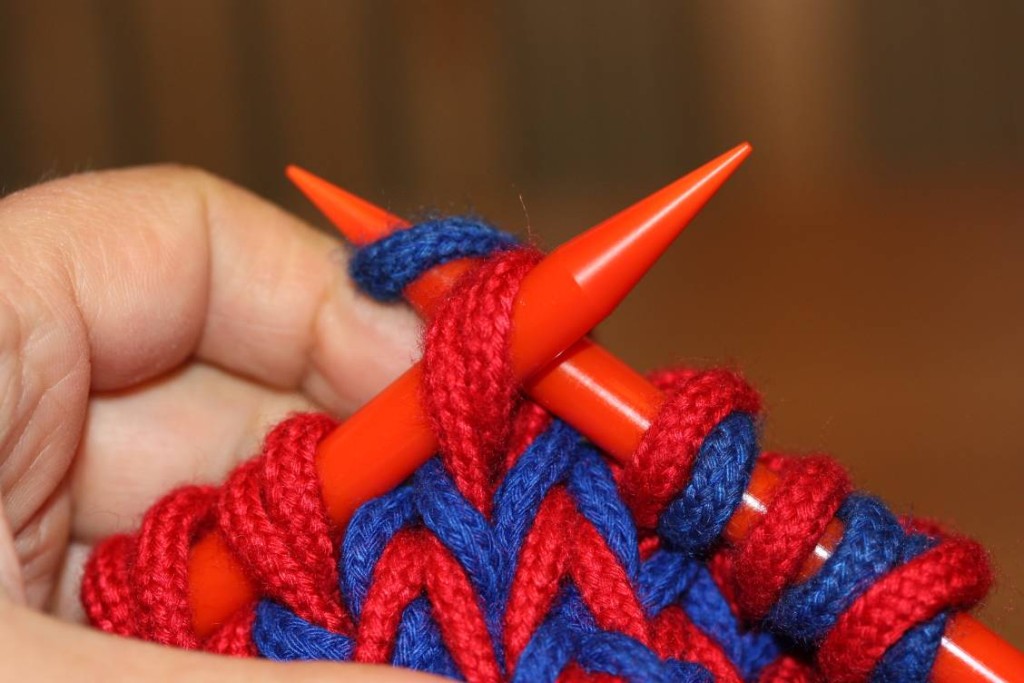
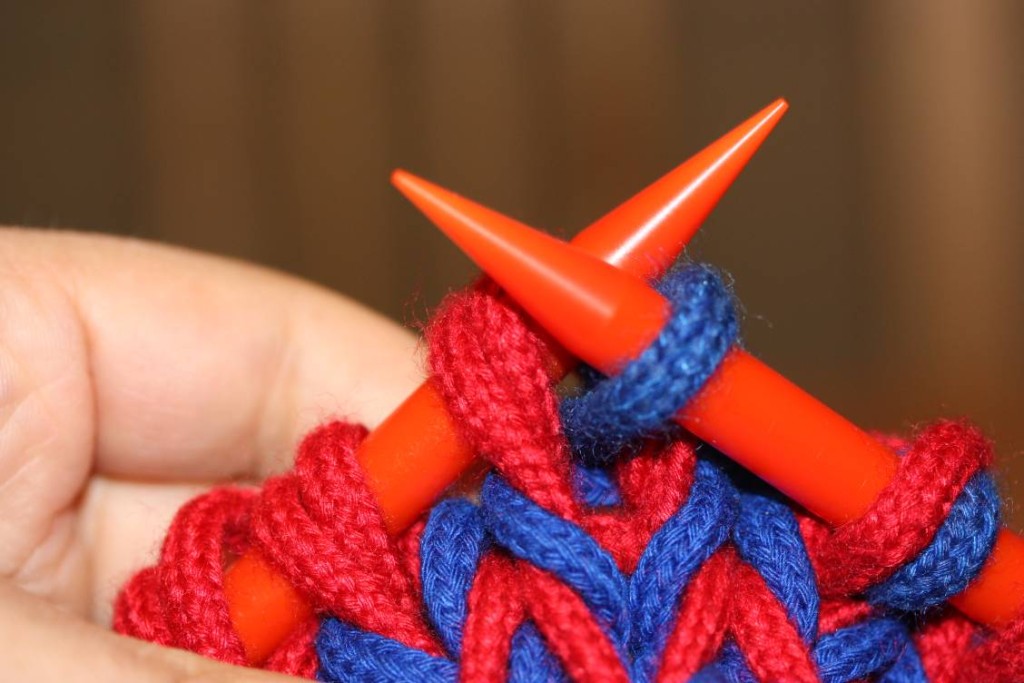
All stitches are aligned with the right leg behind the needle. The older stitch is now always on the left side, the newer stitch on the right side of the pair.

[caption id="attachment_2062" align="alignnone" width="640"]Insert right needle straight through both stitches on the left needle and wrap yarn from back to front (so the right leg of the new stitch will lie in the back)... Insert right needle straight through both stitches on the left needle and wrap yarn from back to front (so the right leg of the new stitch will lie in the back)...


[caption id="attachment_2061" align="alignnone" width="640"]...draw through both stitches on left needle... ...draw through both stitches on left needle...
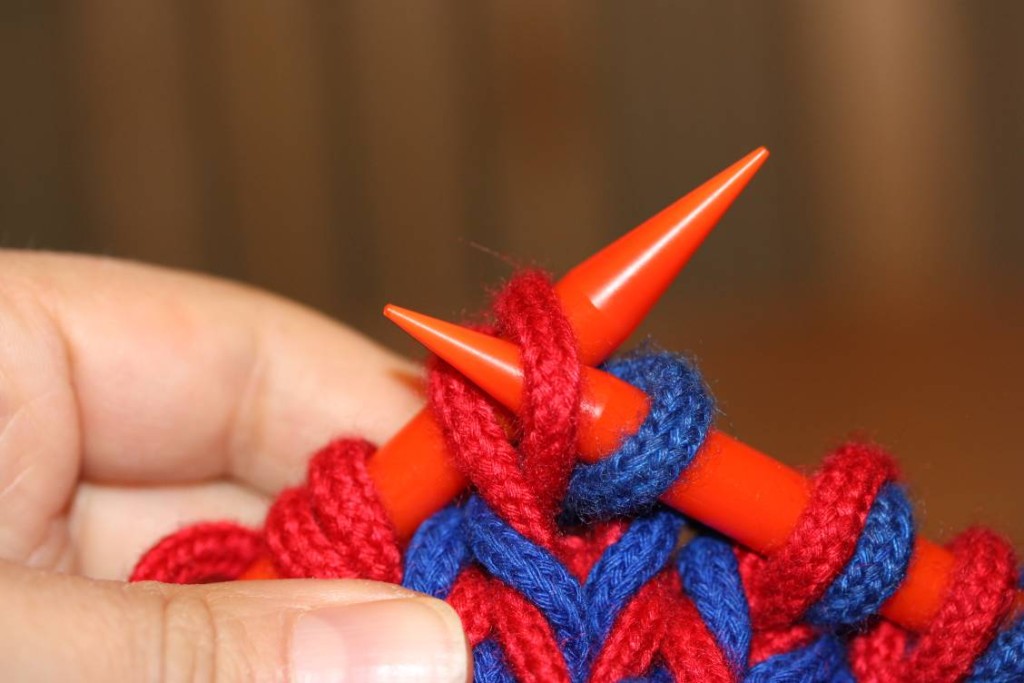

[caption id="attachment_2060" align="alignnone" width="640"]...and move the first stitch on the left needle over to the right. ...and move the first stitch on the left needle over to the right.
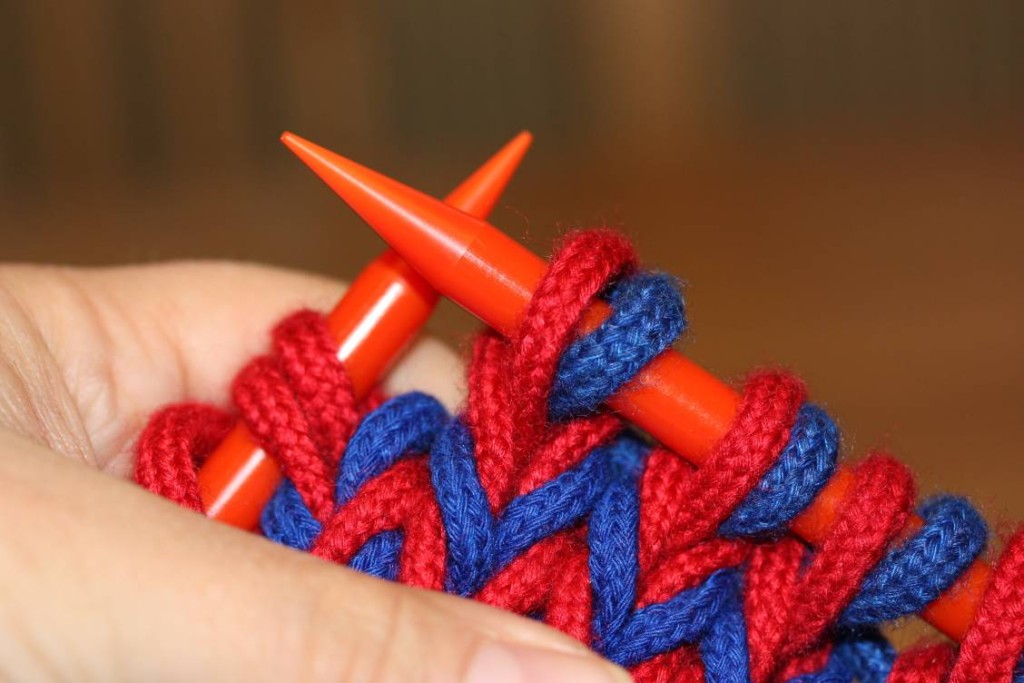

[caption id="attachment_2059" align="alignnone" width="640"]The new stitch lies on the right, the older stitch on the left. The new stitch lies on the right, the older stitch on the left.
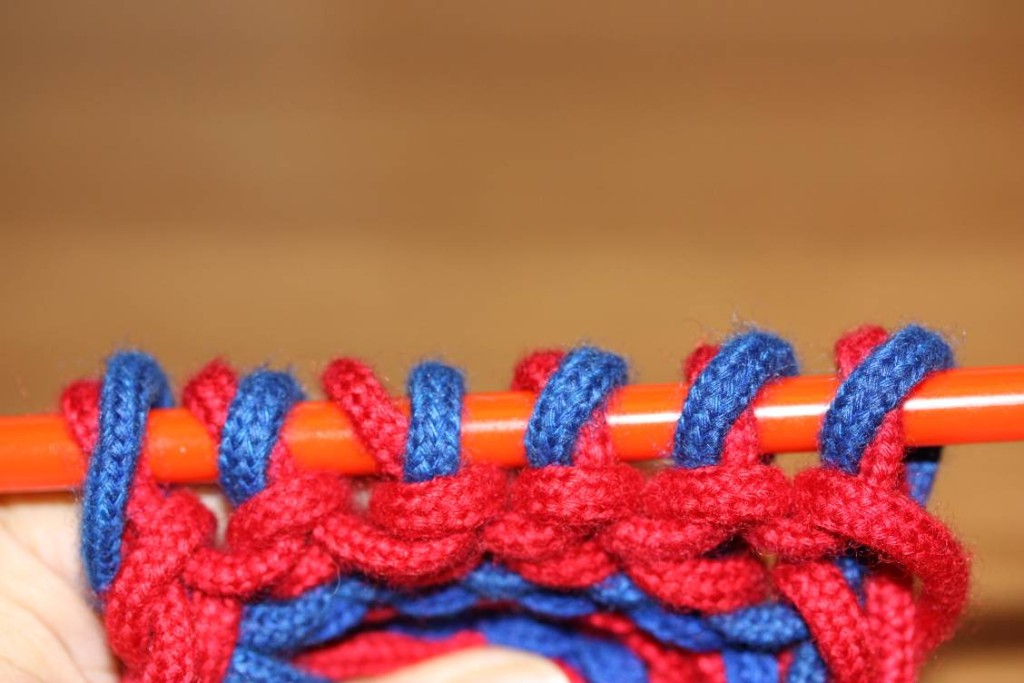

[caption id="attachment_2058" align="alignnone" width="640"]View from the back - you can see how the stitches sort of cross over each other on the needle. View from the back - you can see how the stitches sort of cross over each other on the needle.
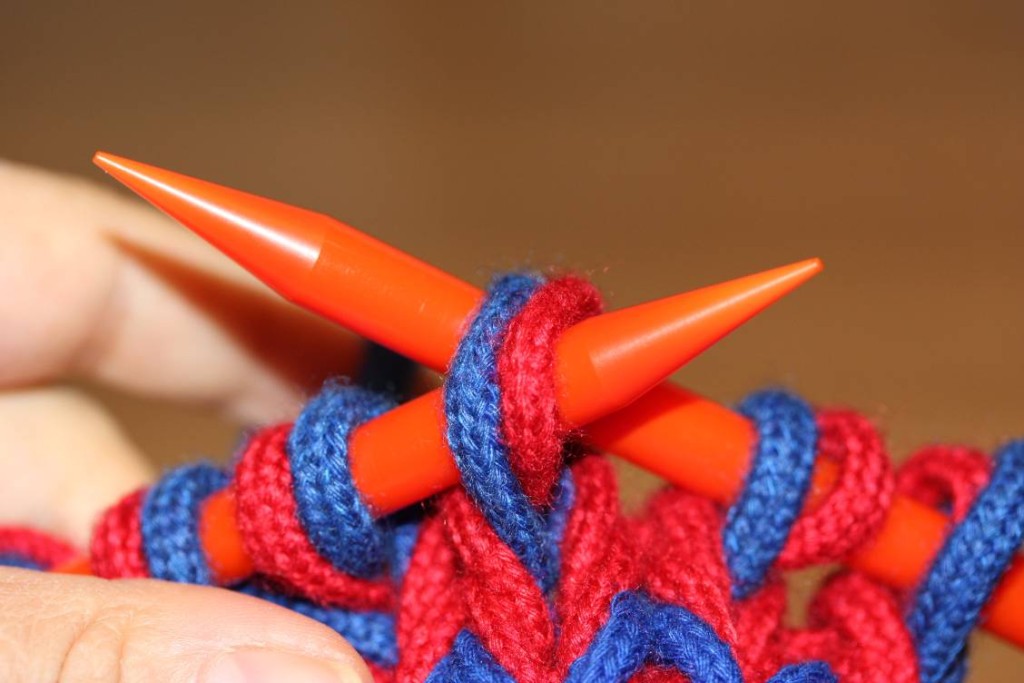

This is nice and relatively fast to work, and involves no slipping. There is a little danger of stitches swapping positions, though, especially in the first and last stitch of the row, mostly due to them being much looser. Knitting in the round eliminates that problem, and it also lets you work without having to deal with a return row, because that... well. That's an entirely different beast.

To get the stitches that have to be discarded to move over their new counterparts in the correct direction, there needs to be some slipping of stitches again. I tried doing a return row, similar in method to the original instructions, and lo and behold - there were twisted stitches again:

[caption id="attachment_2057" align="alignnone" width="640"]Insert left needle through both stitches on right needle. Insert left needle through both stitches on right needle.
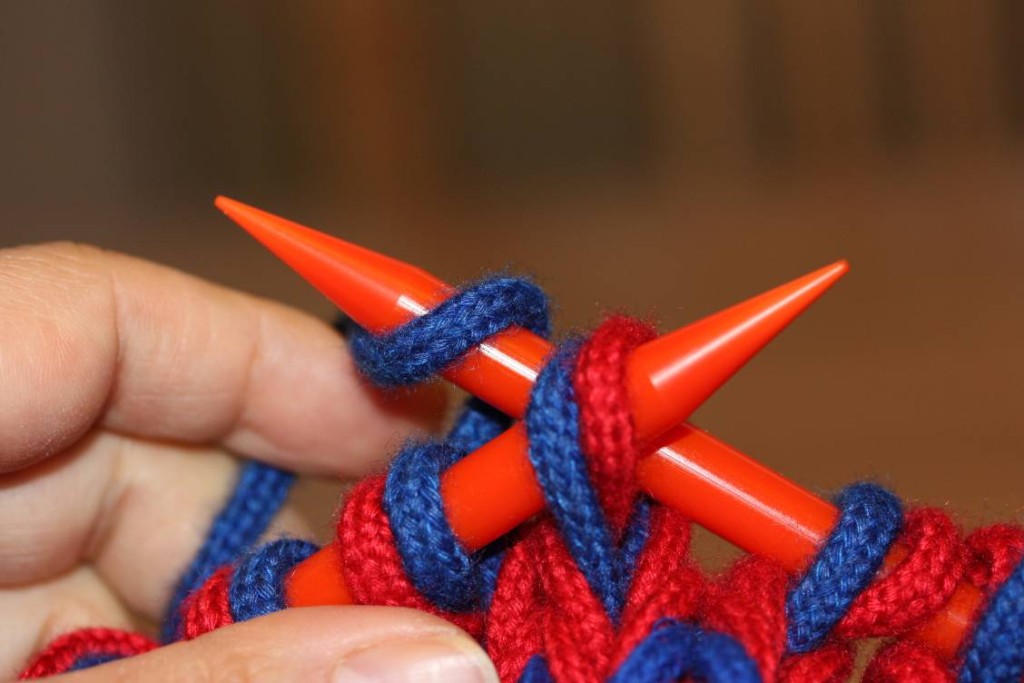

[caption id="attachment_2056" align="alignnone" width="640"]Wrap yarn from back to front around right needle, pull through both stitches... Wrap yarn from back to front around right needle, pull through both stitches...
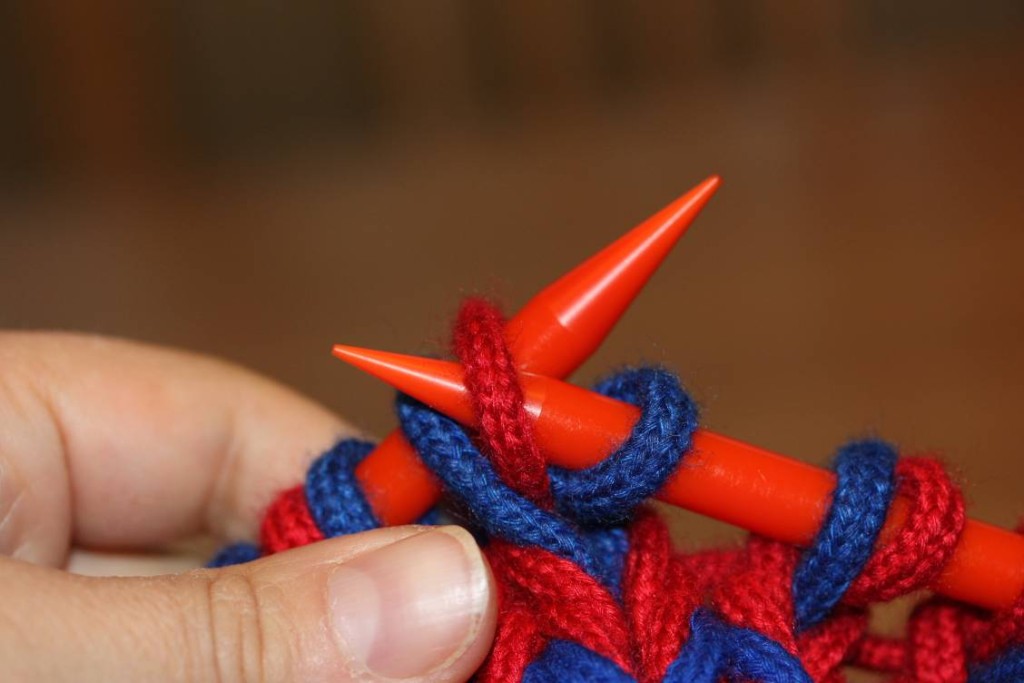

[caption id="attachment_2055" align="alignnone" width="640"]... and transfer first stitch on left needle to right, dropping the second stitch off the needles. ... and transfer first stitch on left needle to right, dropping the second stitch off the needles.
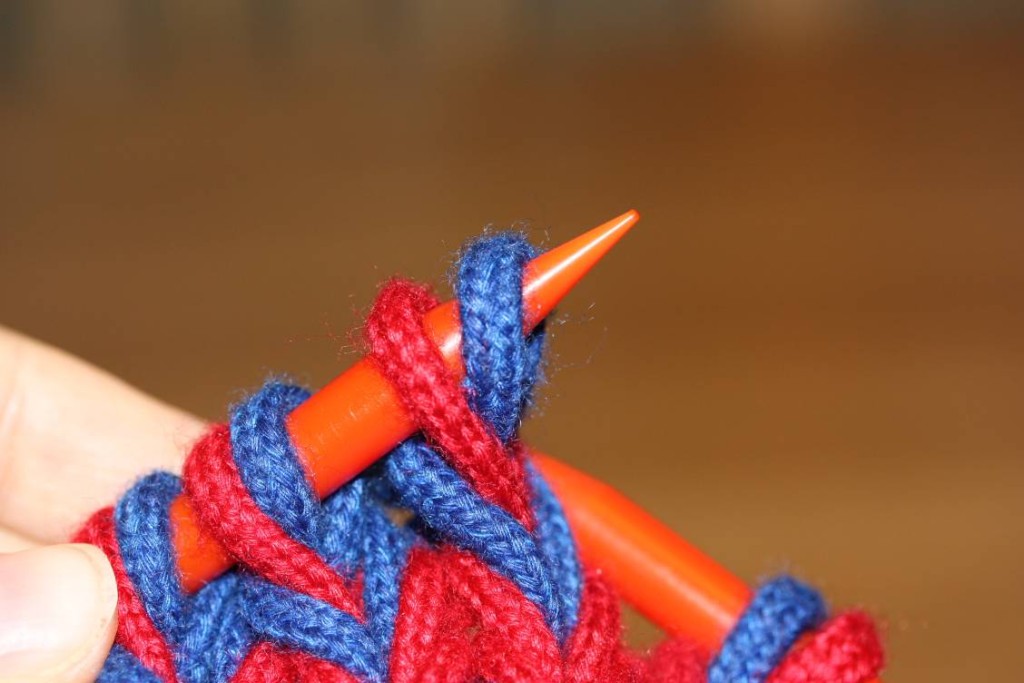

[caption id="attachment_2054" align="alignnone" width="640"]Then transfer both stitches to the left needle. Then transfer both stitches to the left needle.
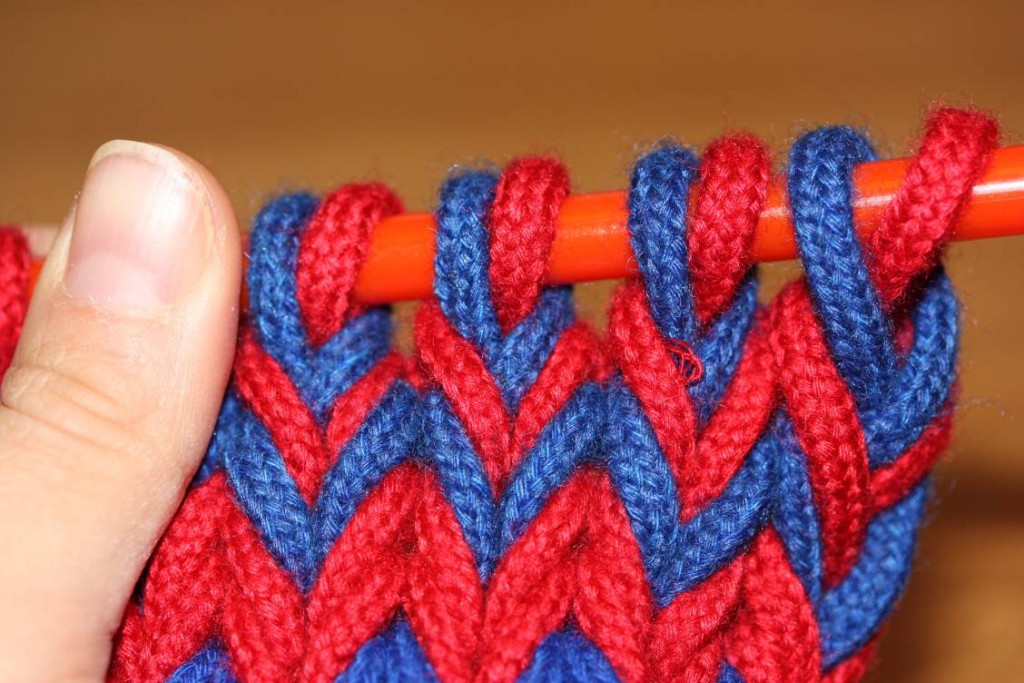

[caption id="attachment_2053" align="alignnone" width="640"]The result after one more regular row: after the return row, the stitches that were discarded are twisted... The result after one more regular row: after the return row, the stitches that were worked in the return row are twisted...


I'm quite sure that the twisted-stitch issue can be resolved by different alignment or some other shenanigans. There remains, however, an interesting fact: no matter which method, the original or this one, working in one direction only is much easier than turning around and working knitting in the flat. So knitting with stitches through two previous rows instead of just one seems to be much better suited to working in the round, not in the flat.

Which sort of fits into the picture of early knitting being done in the round only, as far as we can tell from our evidence. So maybe there was a point in time when flat knitting, going back and forth in rows, was developed and it didn't work so well with the stitches in double depth, leading to the development of the knitting through just one previous row? Who knows - but maybe, some day, we'll have a few more knitting finds to help with these questions.

I hope you enjoyed this series about knitting - and if you find a better method, or a good way of working the return row, please let the rest of us know in the comments!
0

By accepting you will be accessing a service provided by a third-party external to https://pallia.net/

Contact