



Latest Comments

Guest - Katrin Sprang Discussion
18 September 2026
Hi Rachel, I have looked for more photos of you, but that was not very successful. I found a link on...
Guest - Beatrix Sprang Discussion
15 September 2026
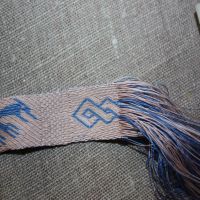
That lozenge pattern element is not a photograph, but a scan. So it should be to scale. But I pinned...
Guest - Katrin Sprang Discussion
15 September 2026
I was not referring to Rachel's reconstruction (is the reconstruction you refer to the one photograp...
Guest - Beatrix Sprang Discussion
14 September 2026
There is something Rachel did not mention. She told me: "Well, I worked with the measurements we too...
Guest - Katrin Sprang Discussion
14 September 2026
Well, this is certainly developing into an interesting discussion. Firstly, going from that lovely l...
APR
12
1

Netting pictures.

A good week ago, I received a comment/question on one of my netting posts regarding pictures of netting and the persons doing said technique (thanks Christina!).

As to who did netting - that is rather hard to answer. There is a bunch of netting finds from Sint-Truiden which might indicate it was done in a convent, but as usually, nothing is certain. There are not so many well-documented pictures of people doing netting either - which probably is partly due to it not actually being depicted, and partly to depictions being misinterpreted as another technique. I think I have seen netting labeled as "knitting" at least once.

That said, there are the usual sources to find pictures of netting ladies (it's mostly ladies, as far as I have seen yet). One good resource to turn to for a start, as always, is Larsdatter.

And then searching diverse picture and museum databases might yield things like this 15th century woman netting, actual nets like this one from Sint-Truiden, or pictures of nets used for fishing (very frequent due to the biblical stories around this) and hunting (like this one).

As usual, it is not too easy to find good pictures of someone doing the actual textile craft, and search terms "net" or "netting" will turn up lots of unhelpful pics as well. It may be worth a try to also look for "knitting" or "making garment" as well - there is a story about Jesus' tunic being seamless, and I know of at least one picture from the late Middle Ages where this garment is clearly made by netting.
0
APR
04
0

NESAT Call for Papers is out!

The next NESAT conference will be organised by a dear friend of mine (whom I got to know because she organised a conference that I attended, way back when).

It will be the 12th NESAT conference, and it's going to take place in Hallstatt, Austria - the place of the lovely, wonderful, and absolutely spectacular Bronze Age and Iron Age textile finds from the salt mines.

And now, since the preliminary organisation has all been done, it is time for the Call for Papers to go out:

Dear Colleagues,
 
The NESAT XII symposium will be organized by the Natural History Museum Vienna on 21st till 24th of May 2014 in Hallstatt, Austria.
 
Abstract submission deadline:         May, 31, 2013

You find more conference details, including details about handing in abstracts, on the conference homepage, www.nesat.de. The page is both German and English, the conference also has these two official languages. And there's a picture of Hallstatt and one of the textile finds from there right on the front page - so it's worth a look in any case.
0
NOV
15
0

Things are picking up.

Usually, for someone working with demonstrations and in connection with living history events, the late autumn and winter months are the slow season - the time to kick back and think about stuff for the next season to come. The time to pack away things, repair stuff, make new stuff (or plan to do it until it's time to frantically do at least a bit of all that work in the week before the new season, in time-honoured tradition and in tune with the old reenactor's joke "Winter is the week before the first event in the new season").

But this year around, I don't feel as if things were slowing down; on the other hand, there's plenty to do and some juicy projects and other things have reared their heads, promising interesting times and a chance of income.

So I am emailing and reading and writing and planning... while drinking coffee (always good) and eating highly motivating sweet substances (aka cookies and chocolate). After all, the brain needs sugars, right?

Link for today: Not a medieval dress, but a spectacular one - and it has been restored recently. It's the Victorian stage costume of actress Ellen Terry, and the article is brought to you by PastHorizons.
0
OCT
24
1

Yarn made this possible!

If you are interested in Vikings and Viking Archaeology, you probably know that there is L'Anse aux Meadows, a Norse or Viking settlement in Canada. This was the first, and up to now only, known proof for the arrival of the Norse in Vinland (that's how they seem to have called the fabled continent way, way over the sea).

Now I have stumbled over an article published in National Geographic, and there is a second settlement where finds very, very strongly indicate that it was not made by indigenous population. The finds are from Baffin Island, in Canada, far above the Arctic Circle and north of Hudson Bay. Archaeologist Patricia Sutherland looked at the finds, made in the 1980s by a missionary, in the archive of a museum in Quebec in 1999 - and found out that the yarn which was part of the finds is a match for thread finds from the Norse colony in Greenland. Since the indigenous people of Baffin Island did not spin, this is the first very strong hint it was a Norse colony.

Recent excavation in the place seem to corroborate this - they found whetstones. But isn't it nice that the yarn finds opened up the way?
0
AUG
20
1

The Manly Art.

A friend pointed me to the existence of a small book called "The Manly Art of Knitting", written by Dave Fougner. It seems to be available used only, and that to a steep price - 90+ USD from the Big River Store, at least.

However, for those of you just curious about the contents, like me, with no actual need to buy it, there's a very nice review on the Historic crafts blog. (They have since moved to a new location, here on blogspot, and it looks like a nice blog, but unfortunately with no new posts done during the last year.)

Anyways - manly art of knitting. The book appears to contain instructions on how to knit a hammock, among other things (I like that idea). A hammock would be just the thing to lie in during this summer heat we have here (though that would also mean we'd need two conveniently spaced trees... which are not to be had in our garden).

Other (not so manly) links - on Medieval Silkwork, there's a post about female undergarments in written sources.

And I should be working on my article now, the deadline is looming up...
0
AUG
17
3

Men's undies, medieval, and how to find them.

Cathy Raymond asked in a comment about my last Lengberg finds mention:

I blogged about that particular item awhile ago, pointing out its resemblance to the ancient Roman subligar which was worn by women, and an anonymous blogger commented that the Lengberg find had been identified as a man's garment. The blogger also claimed that a lot of 15th c German images show men wearing such garments.

The University of Innsbruck's web article on the finds agrees with my anonymous blogger--it identifies the item as a man's garment, and remarks, I believe, that it was found close to a wool fabric scrap believed to have come from a codpiece. Given that the Lengberg finds did not come from graves, I don't think that sort of association, in and of itself, is persuasive evidence. But there may be other evidence I don't know anything about that supports the identification of the garment as male.

Can you point me to any images confirming that men wore such garments? The English and French images with which I am familiar show men wearing briefs that look more like modern Fruit of the Loom briefs, but I'm not very familiar with 15th German miniatures or artwork.
These pictures are not very frequent, and most of the examples I have found are from crucifiction scenes where the two other guys are shown as well, or from similar martyr scenes. One example from a crucifiction scene, from end-of-15th-century Austria, is here in the IMAREAL. If you search for "Kreuzigung" with the timespan 1300-1600, there is at least one more example. When I'm specifically searching for those undies, I am thus looking for crucifiction scenes - though those only showing Christ will not suffice, since he's invariably shown with a cloth covering his nethers, no modern underwear.

Sometimes the corresponding undies are also shown in bed scenes or in "battle for the trousers" scenes. Those topics are usually searchable in most piccie databases, so I'd recommend them as search terms.

(Technically, you can also search for clothing - underwear or underpants on IMAREAL. However, the tagging is not always complete or correct, and that search will not necessarily find you all the instances. This is not intended to bash the IMAREAL tagging - I have a private, tagged, picture database and I do know how hard it is to do it consistently and correctly all the time.)

Oh, and regarding the male-or-female discussion: We have proof (picture proof) that these types of underpant were worn by men, but that does not exclude them being worn by women. We just have no picture (or other) proof for it yet. So personally, I would say that it's not very likely that a lot of women wore them, but that they might have been used by some, or in some circumstances as for controlling blood during menstruation, for example.

I hope that helps!
0
AUG
15
1

Lengberg Underwear

You have of course heard about the Lengberg Underwear finds - Beatrix Nutz is still very active publishing them, and a new article in French is in "Histoire et Images Medievales" published this month.

Meanwhile, others are putting their own experience together with the new finds, such as Isis Sturtevagen, who has a very interesting article about medieval underwear on her blog.

In non-bra news, the first Call for Papers for the 2013 UK Experimental Archaeology Conference to be held at Cardiff University and St Fagans National History Museum, Cardiff, on 11 – 12 January 2013, is out. Information and the usual other stuff ; ) can be found at the conference blog/website.

And finally, and something totally different: There's a new archaeological dissertation blog online, about “Sámi circular offering sites – a comparative archaeological analysis”. It is a PhD project in archaeology by Marte Spangen, Stockholm University.
I think it's very nice that more and more PhD folks blog about their work!
0

By accepting you will be accessing a service provided by a third-party external to https://pallia.net/

Contact