


Search the Blog
Latest Comments
Guest - Aislinn
Dyestuff Citizen Science.
09 October 2026
This is a great project. I look forward to the results. Thanks for letting us know.
Guest - Aislinn
Time for...
09 October 2026
Looks delicious!
Guest - Katrin
Sprang Discussion
18 September 2026
Hi Rachel, I have looked for more photos of you, but that was not very successful. I found a link on...
Guest - Beatrix
Sprang Discussion
15 September 2026
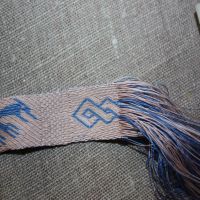
That lozenge pattern element is not a photograph, but a scan. So it should be to scale. But I pinned...
Guest - Katrin
Sprang Discussion
15 September 2026
I was not referring to Rachel's reconstruction (is the reconstruction you refer to the one photograp...
Embroidery!
I'm currently spending snatches of time here and there to sit down with some embroidery, all in preparation for the workshop in April. At the moment, I'm mostly trying to figure out whether there was a typical approach to work sequence and turning corners in the counted embroidery that I have in my books. And that means... stitching and comparing.
There are a few things I have already learned (or learned even better) about medieval embroidery. One of the first things, and one of the biggest problems, is the size of that stuff (pun intended). Medieval embroidery... it's tiny. Teeny-tiny. If you buy modern ground fabric for counted work, you'll often get about 12 to 13 threads per cm as "fine quality". Medieval fabrics? 19 or 20 threads per cm. That's about a third smaller, and fabric in that fineness and even weave is not easily available nowadays. (I'm working on it, by the way.)
Apart from those little problems, I'm vastly enjoying myself trying out different ways to make transitions from one row to the next, with differring success. I have not settled on one "best" technique yet, and I'm not sure there will be one for me... but my sample-and-try-out-things fat chicken currently looks like this:
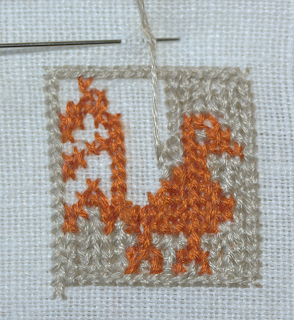
It is worked in "Zopfstich", a stitch giving sort of a braided appearance (Zopf = braid), and it's fun and easy to work. I did not get it totally like the original which is partly due to my being bad at counting and partly due to the different thread counts (I have to work over different counts of threads in different directions). As you can see, it's not perfect - but it does serve its purpose as a trying out slightly different techniques.
And plump chickens? I like them.
There are a few things I have already learned (or learned even better) about medieval embroidery. One of the first things, and one of the biggest problems, is the size of that stuff (pun intended). Medieval embroidery... it's tiny. Teeny-tiny. If you buy modern ground fabric for counted work, you'll often get about 12 to 13 threads per cm as "fine quality". Medieval fabrics? 19 or 20 threads per cm. That's about a third smaller, and fabric in that fineness and even weave is not easily available nowadays. (I'm working on it, by the way.)
Apart from those little problems, I'm vastly enjoying myself trying out different ways to make transitions from one row to the next, with differring success. I have not settled on one "best" technique yet, and I'm not sure there will be one for me... but my sample-and-try-out-things fat chicken currently looks like this:

It is worked in "Zopfstich", a stitch giving sort of a braided appearance (Zopf = braid), and it's fun and easy to work. I did not get it totally like the original which is partly due to my being bad at counting and partly due to the different thread counts (I have to work over different counts of threads in different directions). As you can see, it's not perfect - but it does serve its purpose as a trying out slightly different techniques.
And plump chickens? I like them.
Comments
No comments made yet. Be the first to submit a comment
By accepting you will be accessing a service provided by a third-party external to https://pallia.net/