



Search the Blog
Latest Comments
Guest - Katrin
Sprang Discussion
18 September 2026
Hi Rachel, I have looked for more photos of you, but that was not very successful. I found a link on...
Guest - Beatrix
Sprang Discussion
15 September 2026
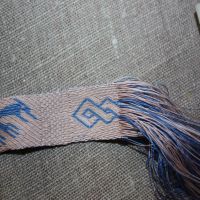
That lozenge pattern element is not a photograph, but a scan. So it should be to scale. But I pinned...
Guest - Katrin
Sprang Discussion
15 September 2026
I was not referring to Rachel's reconstruction (is the reconstruction you refer to the one photograp...
Guest - Beatrix
Sprang Discussion
14 September 2026
There is something Rachel did not mention. She told me: "Well, I worked with the measurements we too...
Guest - Katrin
Sprang Discussion
14 September 2026
Well, this is certainly developing into an interesting discussion.
Firstly, going from that lovely l...
Spinning with a Distaff
Thanks again for all you input on the headwear thread - and for the replies to the Spinning thread. I'll tackle the first two now.
If all this does not work, or if you feel too distracted by learning how to hold the distaff and learning how to draft with the new arrangement, you could also fix it to something else and stand or sit beside or in front of it until you are used to the new method.
If you have a tendency to break the fibres, maybe you are drafting too slowly with the new arrangement?
fiofiorina said...I have had better experience with the whorl not breaking if it was not firmly attached to the spindle, since it can then slide off the spindle when it drops - the stick takes most of the impact, and the whorl survives. But if the spindle drops, there's always some danger of the whorl taking damage, whether firmly attached to the stick or able to slip loose. Key with spinning with a whorl only slid onto the stick is to make sure it really sits firmly enough so it does not just slip off and fall down from the stick during spinning. (Though mine have done so frequently, too, and they did survive.)
I use a hand distaff when spinning "Roman" and a long one for medieval displays. I still sling the thread under the whorl, as it made the difference between whorl falling to the ground and breaking and spindle falling to the ground and whorl surviving. For modern spinning I prefer working with the short Roman distaff than holding the wool in my hand. But that's me.
Lady Lamb said...You have several different possibilities to use a distaff - hand-held if you use a short stick, tucked into the belt if you have a long one, or tucked under your arm. Have you tried to place the distaff in your armpit? If you let your arm hang down, it should fix the distaff firmly in place.I learn to spin for myself with the help of some books and YouTube. I don't need to pass the thread under the whorl, and in case it helps you can make a small opening at the tip of the spindle. At events I try to use a distaff but this is my problem. I'm not used to it. I try to support it on my belt so it won't fall and my left hand it's free to grab the fibers, but sometimes I find that difficult. Another problem is that with a distaff I have some tendency to break the fibers. I don't know if you can give me some tip, or maybe I just need to get used to the distaff.
If all this does not work, or if you feel too distracted by learning how to hold the distaff and learning how to draft with the new arrangement, you could also fix it to something else and stand or sit beside or in front of it until you are used to the new method.
If you have a tendency to break the fibres, maybe you are drafting too slowly with the new arrangement?
Comments 1

By accepting you will be accessing a service provided by a third-party external to https://pallia.net/