







Latest Comments

Guest - Harma Too Many Images Error.
27 November 2026
There have been weeks in November in which I would talke about 800 pictures. Proof of very interesti...
Guest - Max Mustermann The True Cost of Driving a Car.
06 November 2026
Great breakdown — the non-fuel costs are exactly the bit most people forget when they compare cars. ...
Guest - Harma Phew. Now it gets involved!
21 October 2026
Have fun at these events.
Guest - Aislinn Dyestuff Citizen Science.
09 October 2026
This is a great project. I look forward to the results. Thanks for letting us know.
Guest - Aislinn Time for...
09 October 2026
Looks delicious!
JUL
08
6

Darth Vader Cat.

If you've been following this blog for a while, you know that we have the privilege to be door-openers and can-openers for a little (though really not so little) cat. Things that you might not know about said little cat:

She came to live with us in 2012, when we fetched her out of an animal shelter. She'd been found, as her previous owners had set her out in the midst of winter, so her history is unknown. The shelter gave her a name (Madonna), sterilised her, had her chipped and her ears tattooed (these are standard shelter procedures in Germany, to help identify an animal if it gets lost), and gave her a general health checkup. She never felt at home living with other cats, and from what we gleaned from her behaviour, she was probably all on her own, and she definitely had no possibility to go outside in her former home.

After she'd been with us a bit, we realised she had weird coughing fits. A bit like coughing up a hairball, but never with any hair coming out... so we did a bit of research, and then we went to the vet, and we were told that yes, she has feline asthma. So we did some more research, and we found out that there's several ways to treat the asthma: Depot cortisone injections, cortisone pills, or inhaling cortisone with a special inhaler. The two first methods are systemic treatment, and daily doses of cortisone are, unfortunately, not without side effects. Inhaling, in contrast, puts the drug only there where it's needed: into the lungs.

So we got an inhaler, and cortisone spray, and started the rather long and tedious process of getting the cat used to inhaling. (She got pills during that time. That was even less fun than the inhaling training.) It took about three months, and it is daily ritual since, morning and evening. Usually, it's a very quick procedure - she gets a "bribe" treat, lies down, inhales, gets some more treats, we wipe her nose, even more treats (they are small ones), and then she's getting her food, or we open the door so she can go out and do Important Cat Things.

This process has fascinated quite a few people in our acquaintance, so in case you are curious now as well, here's a video of me doing the inhalation stuff with Madonna. The colours are a bit flat, but everything should be visible enough...
 
0
JUL
05
0

Conferences and Book Preorder Stuff.

If you're looking for things to go to, or something to read, here are possibilities:

The EXAR conference, which will take place in Vienna on September 26 to 29, has its programme online. Registration is possible via their website, with a reduced fee if you register before August 15. As there is still space in their poster session, you are also welcome to hand in an abstract for a poster.

There will be a conference "Craftsmen and Metalworking in medieval cities: 35 years later" in Paris on September 12-14. The programme of the symposium is finished, but not available online yet; you can contact the organising committee via their website, though. Registration is open until September 5 or until the limited number of places is taken.

If you are looking for even more conferences, check out the "Conference" section on the RMBLF.be website, where there is a long list of all kinds of them, or the EXARC webpage.

Finally, the book thing - Jane Malcolm-Davies and Ninya Mikhaila are publishing "The Typical Tudor", which will be delivered in May 2020. If you are interested in Tudor-era clothing, this might be an interesting book for you; read more about it on their website (where you can also pre-order).
0
JUL
04
1

I can't believe this.

First things first: I love the EU. I love what it makes possible, and that it slowly, slowly brings us all closer together. The Euro has made things a lot easier (though it was certainly bad for my currency conversion maths-in-my-head skills!), and I think it's the only way forward.

That said... the EU and its politicians do some really stupidly weird things. Such as moving the parliament once each month from Bruxelles to Strasbourg. For a week.

Here is a video (in German, sorry) about this insanity:

 
This is absolutely, utterly crazy. It's an insane waste of time, money, and resources that could better be spent in other ways. Such as helping people who had to "travel" without wanting it (aka refugees). Such as financing more sustainable technology for travel and energy. Or a hundred other things.

I'm really, really taken aback by this. How on earth can this still go on, while everyone in the EU parliament (hopefully) is aware of the climate change, and of the need to work on a more sustainable lifestyle for all of us? Why have the green parties in the parliament not protested this again, and again, and again, until it stops? Or, if that wasn't possible for them on their own, why isn't this made more public so more people (like me) can get really upset, and think about how to change it?

Aaaaaargh. Can we please, collectively, all have more brain power? To use for making the world better, instead of more crazy, more hateful, more fearful and more insane?
0
JUL
03
0

Kickstarter Collapsible Cutlery

One of the things that come with me whenever I am travelling, apart from the World's Best Thermos Mug, is a set of cutlery. We actually bought that for our camping travels, when obviously you need cutlery, and I tried to get the most lightweight version possible. While my husband went for a three-piece set made from titanium (because that's really nicely lightweight), I found a wooden set with four pieces (it includes a small spoon, and for some things, I just love using a small spoon). It was even lighter than the titanium one... but unfortunately, neither a wooden knife nor a wooden fork are really useful for many food items.

So after being annoyed with them for a while, tearing open breadrolls (or borrowing a real knife) and breaking apart instead of forking up things with the fork, I caved and bought a second set, this time in titanium as well, to replace the knife and fork. I kept the spoons, though. They are wonderful. When I'm travelling, the cutlery comes with me - in my travel bag or in my handbag, depending on whether the latter comes along or not. When I'm not travelling, though, it is stored with the rest of our camping gear. Consequently, sometimes it happens that I am somewhere and my handbag does not contain the cutlery... and I would need it.

I've now stumbled across a cutlery set from metal that is full-size, but will pack down as the individual pieces are screw-together, which sounds just like the thing to put into my handbag to live there, forever. It's called "Outlery", and it is currently running on Kickstarter for another two days. If that sounds interesting to you, too, here's the link!
0
JUL
02
0

Exciting, exciting.

It's fully feeling like summer here, I'm working on the lace chapes and on fiddling some more (and better) with metal stuff and doing some fun tablet weaving on the side and sending off orders... and there's the summer break coming up sort of soon, and before that, I need to get all the things done and prepared for Dublin.

Dublin! WorldCon! It's all very, very exciting - if everything goes according to plan, I might get to be in a bit of the programme, and I will (that is definite) have a table in the Dealer's Hall, and I'll be able to spend time with some wonderful friends, and get to stay in a room at Trinity College (which is exciting all by itself). There will be tea, and Irish food (and I'm so looking forward to that already, too) and I will have two huge suitcases to lug with me.

So, to be all honest, it's not only extremely exciting, it's also a little bit scary at some points. For instance, it meant registering for VAT in Ireland. It means lugging two huge suitcases into a train and into an airport and through Dublin (not too far there, though, fortunately). It also means I have to decide what to bring to my sales table... as not everything I have will fit into the suitcases, and there's a weight limit too, and you'd be surprised at how much some things weigh, and how bulky some other things are...

Anyway. Hasn't someone somewhere at some point said you should do at least one scary thing per day, because it's good for you? That's what I sort of tell myself now. That it's good for me.

And you know what? I actually do believe it. Plus I'm so looking forward to this weird wild sell-things-at-WorldCon-Shenanigan!
0
JUL
01
0

Lace Chapes, Continued.

Something that has happened to me time and again:

I look at some medieval Thing. I sort of try to figure out how it was made. I read up on more details of the Thing, and the Type of Things. I find out that there was quite some variation, and that some of the assumptions I made when seeing only Thing are not correct.

I read up more on Type of Things. I find something about it that sounds... weird. Like "how on Earth can that work" weird. "Whyever would you want to do that with this tool/material/method" weird.

I fiddle around some more with doing stuff. I try the weird-seeming tool, material, or method. I find it works brilliantly - much better than my own ideas that I used in my first tries.

I stand there, humbled, and realise again that living a couple of hundred years later does not make anyone automatically smarter, or better at doing something that was already successfully done, and developed to best efficiency, back then.

At least these days, I've been humbled often enough and learned enough about this that it does not take me very long to try out the original materials or (possible) methods... as opposed to when I was a teenager and getting started with Living History.

In the most recent case, by the way, the Things are the lace chapes, and the Weird Thing About Them was the indication that at least some chapes (possibly not all of them, but this is a tiny detail that may be hard to see or evaluate anyways, due to several different reasons) were riveted with an iron rivet.

Now, those chapes are tiny. (I mentioned that, right?) They are made from very thin brass sheeting, so once they are bent, they are a good bit stabler than the flat sheeting, but it's still a relatively soft material. Iron is much harder than brass... but I did find that using a soft iron wire to make the rivet does work better than using a dedicated brass rivet (yes, you can get them in so tiny).


So. I stand humbled, and corrected, and will happily go on pounding the heck out of soft iron when riveting. (Very carefully, though, rather softly, and with a very small hammer. I lovingly call it my "Mädchenhammer"... my girls's hammer.)

Now what is left to do is figure out how to offer these in the shop - which kinds of bands, which lengths of chapes, which lengths of bands. (Obviously, I'll be able to make specific lengths on demand, but setting up the shop attributes for that might not work...) If you do Living History, use laces with chapes (or laces without them) and have comments for me, they are very welcome!
0
JUN
28
2

Lace Chapes - Or: How To Tiny Metal.

I've been asked about proper, nice, authentic lace chapes again and again over the past years... so this has been on my list for ages now.

Lace chapes, for those of you not into medieval dress accessories, are like the plastic endcaps on shoelaces - they protect the lace from unraveling, and they make threading the lace through holes or eyelets much easier. Especially in the later Middle Ages, the style of dress for both women and men uses lots of laces to get things nice and tight-fitting on the body... and for all those laces, chapes are really handy.

The tiny problem is, though: The chapes you can usually buy today are way too large, and they are often cast, while the originals were made from sheet metal with use of a hammer and much smaller. How much smaller? Well. The modern ones I could find quickly when pretending to shop for some have a top diameter of about 5 mm. The medieval originals that I have nice documentation for have a top diameter of between 2 and 3 mm. That is... much smaller.

Most modern laces with chapes are also held together with a few stitches, while those original chapes that survived with lace in them are usually riveted to lock in the lace.

So recently, I have gotten some material to give this a try... then I played around some more. Then I bought some additional tools. Then I made some more tools. Fiddled around some more. Researched what was inside those chapes.

I'm getting there now. I can tell you, though: These things are tiny. TINY. And it's incredibly fiddly to set those infinitesitiny rivets without bashing the chape itself to pieces...


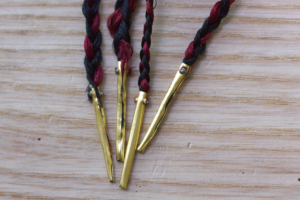
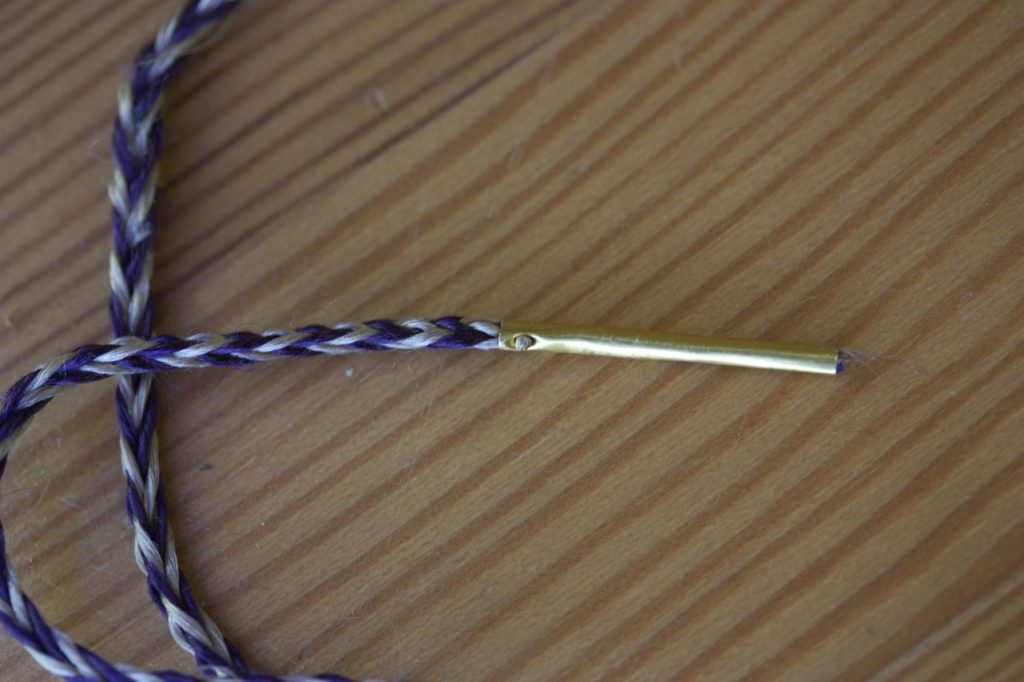
...but I'm getting there. This is one of the latest prototypes I've made, with 2 mm diameter at the top. And just so you get an idea of the size, here's a bigger one (with a good 3 mm diameter top) in my fingers:


I had originally planned to make these chapes and sell them, together with rivets, for customers to assemble with their band of choice. It looks to me, though, as if the originals were hammered close around the lace, then riveted for extra security. Even if you put this aside and assume it will be possible to stick enough of the lace into the closed chape, successfully setting a first rivet took me several tries, complete with totally bashed chapes. So I'll have to offer the chapes mounted on laces, all set and finished, to save everybody's nerves.

Which means I had to take a closer look at the laces involved...
0

By accepting you will be accessing a service provided by a third-party external to https://pallia.net/

Contact