Latest Comments

Guest - Harma Too Many Images Error.
27 November 2026
There have been weeks in November in which I would talke about 800 pictures. Proof of very interesti...
Guest - Max Mustermann The True Cost of Driving a Car.
06 November 2026
Great breakdown — the non-fuel costs are exactly the bit most people forget when they compare cars. ...
Guest - Harma Phew. Now it gets involved!
21 October 2026
Have fun at these events.
Guest - Aislinn Dyestuff Citizen Science.
09 October 2026
This is a great project. I look forward to the results. Thanks for letting us know.
Guest - Aislinn Time for...
09 October 2026
Looks delicious!
FEB
13
0

More about Lightfastness Tests (part 1)

There's been comments about the lightfastness test setup which, in most cases for hobby and smallscale professional dyers, consists of picking a south-facing window and sticking stuff in there for a given amount of time... which is very obviously not a scientific way for evaluating lightfastness.

First of all, though - let's take a closer look at the things that happen when light hits that textile. I've brushed up my knowledge a little bit, but please note that I'm not an expert, and I'm going to put what happens, as I understood it, into very simple terms. If you want the nitty gritty details, you can check out "Chemical Principles of Textile Conservation" by Agnes Timar-Balazsy and Dinah Eastop (published 1998), where pages 88-92 and 225-232 will bring you many insights.
Basically, what happens is that the light hitting the fabric inserts energy, and this energy can cause chemical reactions on molecular levels. One of these processes is photolysis, where bonds in the dye molecules are destroyed, leading to a different chemical structre and thus a change or loss of colour.

The second process, and even more important than straight photolysis, is photo-oxidation. When this happens, a carbonyl group in the dye molecule changes to  carboxyl group, leading to a shortening of the dye molecule and thus a colour fade. This process is usually slower if humidity is very low, and can also be slowed down by an atmosphere with less oxygen (though some colours may fade faster in a vacuum - so you can't be sure if that is good or not). Metals including iron and copper, as well as their compounds, can aid photo-oxydation. Even nastier about this process is that it can result in active radicals such as hydrogen peroxide, which is a bleaching agent, speeding up the fading of the textile.

Different dye molecules are more or less prone to these reactions to light, which explains the varying lightfastness levels of dyes. Both UV light and visible light provide energy for these reactions, but the wavelengths do make a difference.

So... now that we all know, more or less precisely, what happens when the dyes fade, we can get back to testing.
0
FEB
12
2

Lightfastness Tests!

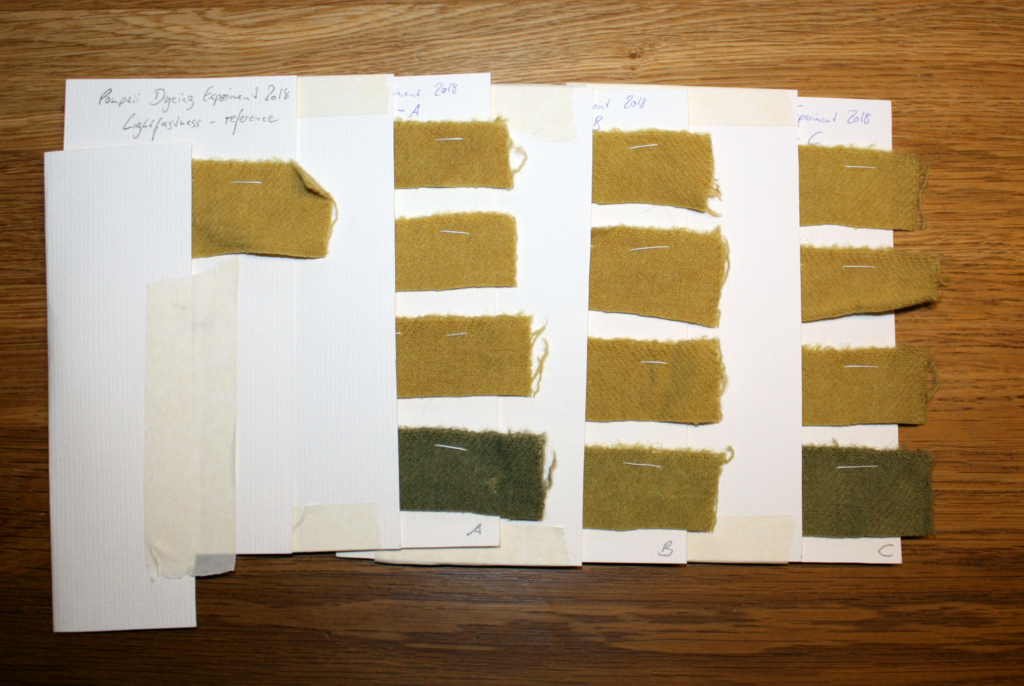
Well, it's a bit to wait until the prime season for lightfastness tests (three months in a south-facing window in summer, I've been told, would be the perfect thing), but the fabrics from the Dyeing Experiment are all set and prepped... and I might hang them into a window a bit earlier than full summer:


I'm really, really curious to see how well these will hold up, and if there is any difference between the metals that have not made very obvious changes to the colour, and the reference.

So. Summer. I'm ready for you.
0
FEB
11
0

Need to procrastinate?

There's a lot of nice ways to procrastinate. Not that I would ever do this, right? Well.

Just in case you have some extra time to spend, or need something to make you spend some extra time that you don't actually have, here's a link to the Cenobium project, which has wonderful images of Romanesque capitals. The project name stands for "Cultural Electronic Network Online: Binding up Interoperably Usable Multimedia" and the website features a multimedia presentation of Romanesque cloister capitals from the Mediterranean region with high-resolution digital photographs, 3-D models, and panoramas.

Or are you looking for something more substantial than digital images? In that case, you might prefer to procrastibake. Apparently this is not only a thing, but even has its own hashtag on Twitter. So - some really cool baking if you are both a language nerd, history lover and friend of mathematics is this cuneiform tablet with a mathematical equation. In gingerbread.

Hm. Now I wonder if there's a nice kind of non-gingerbread cookie dough that would be a good cuneiform base...

 
0
FEB
08
1

Knitting Stuff.

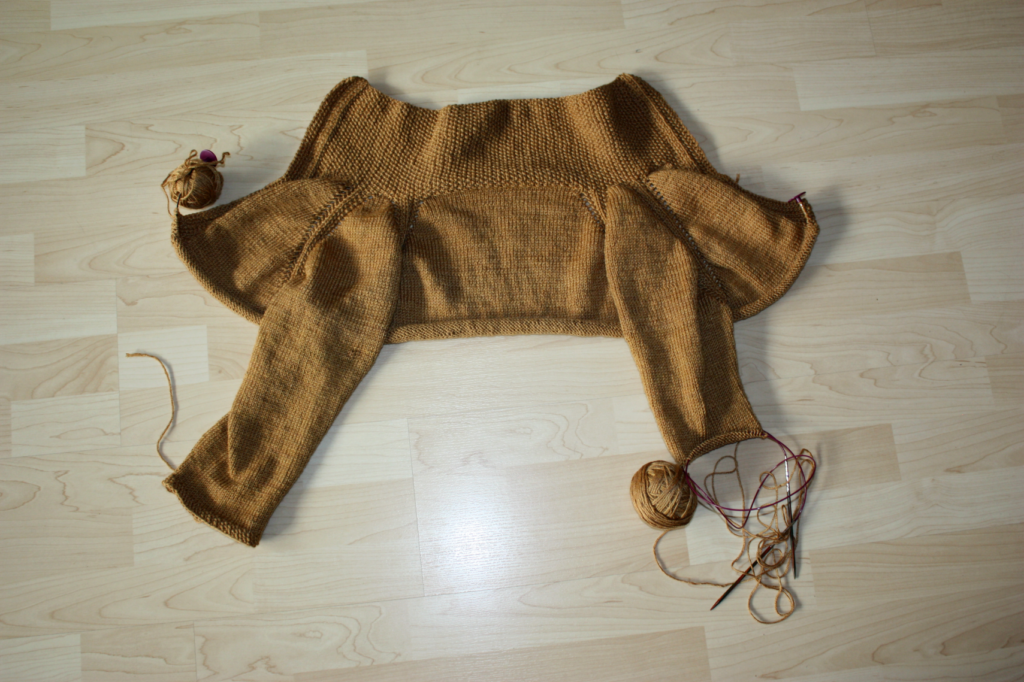
There has been a bit more knitting going on here - some on the train, some in the café, and some at home... which means my current project #1, Vodka Lemonade, does have almost two sleeves now:


I've opted to do the sleeves earlier than the pattern states (which, as usual, lets you knit the sleeves once the body is finished), as I was so annoyed about having the large, heavy rest of the thing hanging around when I was knitting the sleeves on Moyen Age. There's still a bit of residual annoyance with this now, but it's not as bad by far - and I'll find out how much the sleeves will annoy me when I knit the rest of the body.

The brioche stitch travel knitting needs some loving attention with an awake brain at the moment, as I have managed to drop a stitch and now need to figure out how to get it back up into line again... which is not as straightforward in two-colour brioche as it is in normal knitting.

While we're at the topic of knitting, here's the record of train delays as documented in a scarf by a woman commuting in Germany.
0
FEB
07
3

Links!

It's time for a link roundup again - here you go:

In German: Why a bicycle manufacturer sends his bicycles in cartons with a TV printed on them.

There's a knitting card game on Kickstarter - where you can knit (virtually, and thus much faster than in real life) objects based on actual existing patterns, with actual existing yarns. The video doesn't show much about how the game is played, but if you are into knitting and card games, it might be interesting for you.

Medieval Histories has an article about Viking dress, more specifically: about royal Viking dress.

BBC has an article about women explorers in the 19th century craze for getting mummies and related artefacts out of Egypt and into museums and collections... and modern researchers as well.

Anne Marie Decker has put her presentation about "Charting the Nalbinding of the Nile" online. If you're interested at all in nalbinding, do take a look at this - if only for the pictures!
0
FEB
06
0

Weaving.

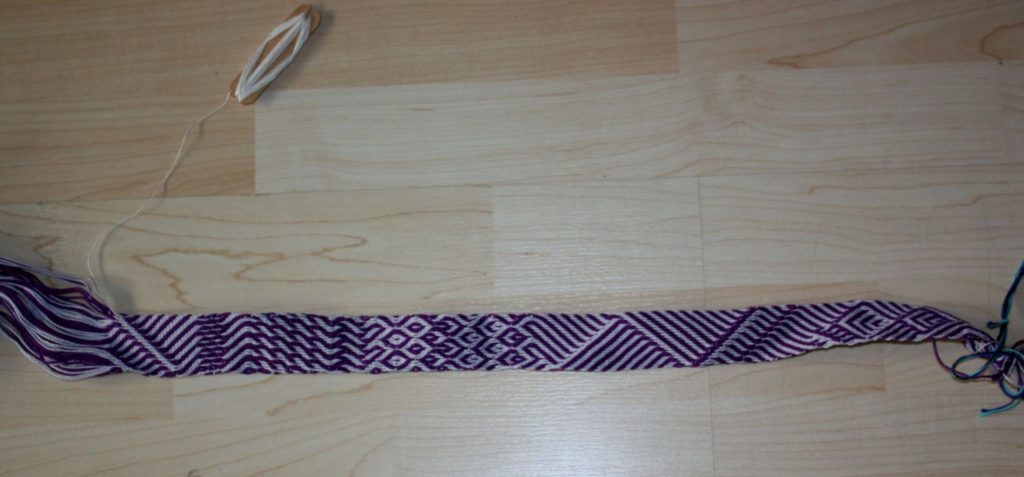
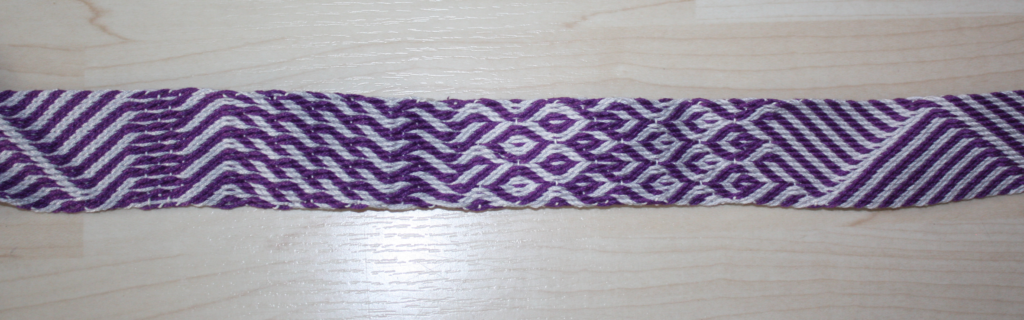
With the bonus warp, I've done some playing around - one thing I wanted to test was using a warp spreader (also known, in this testing instance, as "common comb") and see how this would work for me. Another thing on my list of stuff I'm itching to do was to play around with diagonals - when the ladies in the weekend weaving workshop in Belgium were in the diagonals stage, this desire suddenly jumped into my brain, and there it stayed.

So I spent a little time just fooling around - and I have some more ideas for the next bits.


I'm half pleased with some of the patterns and quite pleased with some others - and the overall impression would probably have been nicer with a purple weft thread instead of the white one, but ah, well, there's a few more metres to come...


... so I can fiddle with these eyes and peacock eyes and slanty bits some more.
0
FEB
05
0

Getting back to normal. Again.

Today is earmarked for finally, finally sitting down and getting the book-keeping up to date. Tax day is coming up, and I'm woefully behind with the keeping of the bureaucratic side of things, so it's paying bills today, marking bills with little numbers, matching the little numbers in my software, and then (with a very happy sigh) putting away a stack of paper at the end, sending off the tax report and after it, sending money to the Finanzamt (who kindly expects to hear something from me every quarter of the year, plus twice more for the main taxes and for the final version of my VAT balances).

To my great surprise, it actually feels good to sit and do this stuff - a job I usually don't like very much. I'm still not over the moon about it, because it always means some amount of searching for this receipt or that email, and checking stuff, and occasionally doing some research on the 'net on how and where to book something, and much of this feels like a waste of time. However, I've had so many other (and time-critical) things to do and prepare in the last weeks that this time around, sitting down for this calculated waste of time means that all these nice, exciting, but also exhausting things are over for now, and I can get back to breathing calmly and get into "normal mode" again... which also, hopefully, means I get to whittle down the to-do-list some, and get re-started on a bunch of projects which had to fall off the list for a while.

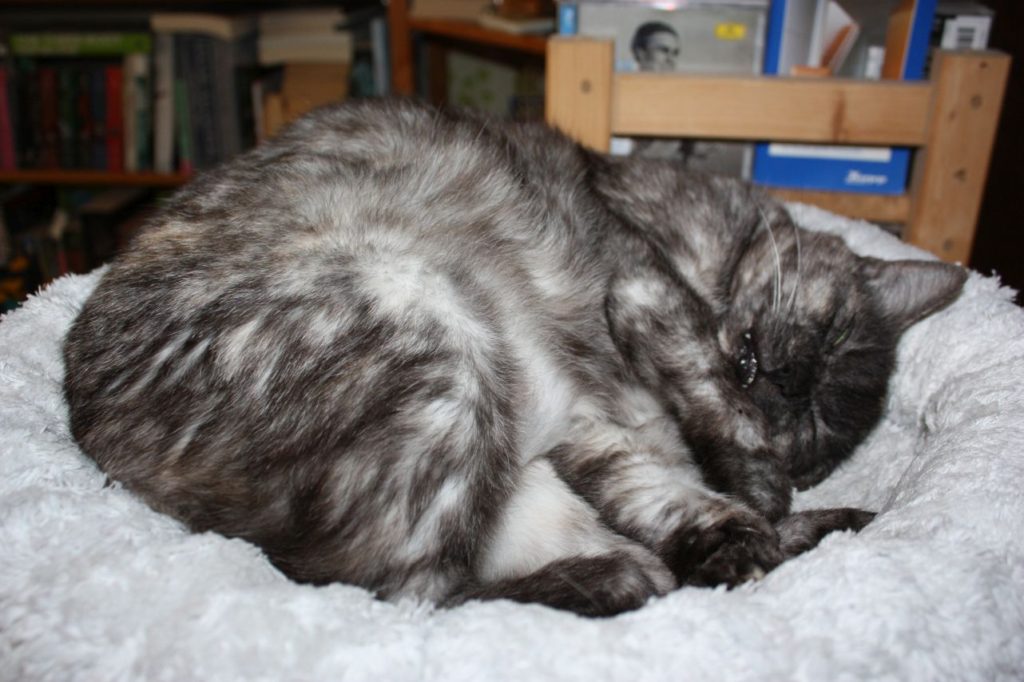
Other inhabitants of this lair here, of course, have never left normal mode:


Which, in this case, means a lot of napping, especially now that there is quite a bit of snow on the ground - which Madame does not appreciate a lot...
0

By accepting you will be accessing a service provided by a third-party external to https://pallia.net/

Contact