Latest Comments

Guest - Harma Too Many Images Error.
27 November 2026
There have been weeks in November in which I would talke about 800 pictures. Proof of very interesti...
Guest - Max Mustermann The True Cost of Driving a Car.
06 November 2026
Great breakdown — the non-fuel costs are exactly the bit most people forget when they compare cars. ...
Guest - Harma Phew. Now it gets involved!
21 October 2026
Have fun at these events.
Guest - Aislinn Dyestuff Citizen Science.
09 October 2026
This is a great project. I look forward to the results. Thanks for letting us know.
Guest - Aislinn Time for...
09 October 2026
Looks delicious!
OCT
21
0

Themes in Archaeology

Routledge Publishing is doing a "Themes in Archaeology" thing, and they have finished setting up their themes now. To celebrate, the articles under these groups are free to read until April 30, 2017 -you can find the theme collection here.

In unrelated news, I'm working on the outline of an experiment we will do at the Forum, about how well dye penetrates a finished fabric. This is all very, very exciting, as whether something was dyed in the piece, in the yarn or in the fleece is quite a big difference regarding workflow and craft procedures - and after our experiment, we might have a tiny bit more knowledge about whether white spots could be expected in a piece-dyed fabric or not.

My typing is a little slower today, though - because the little cat is again hanging out on my desk, and I don't have the heart to set her down... she's having a few tough days, as she hurt one of her legs. As a result, she is to take pills (which she hates), painkiller (which she loves, it seems to taste like heaven) and, worst of it all, she is not allowed to go outside, to keep her from overworking her leg. So here I am, with one sad, bored, unhappy cat who needs a lot of cuddling and attention. Sooooo bored. Poor kitty.
0
OCT
20
0

Threads, really close-up.

I'm into preparations for the Textile Forum up to my ears and beyond - there's spinning to be done, and planning for experiments, and things to be organised. So while I am squinting at my hand-spun yarns, making sure it has enough twist, you can look at these glorious microscope photos from the Getty, showing metal threads in an early modern tapestry named "The Triumph of Bacchus":

Art under the Microscope: Threads.
0
OCT
19
0

Upgrading my Knitting Counters.

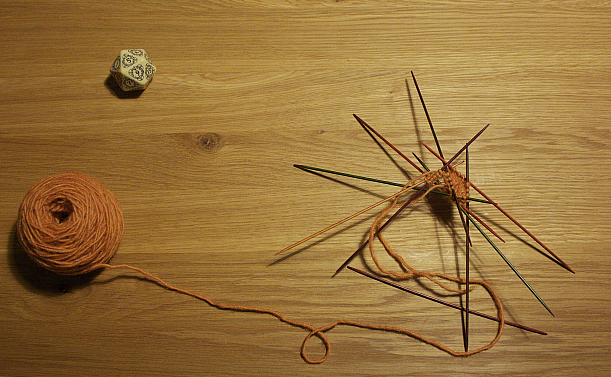
Occasionally, I am knitting things that require some row-counting. I'm usually not in a state of mind to go down a list of rows without some aid to help me keep track of which one I'm in, so I have been using dice to keep count for me.

IMG_55241
Usually this was a special die, though - it's a countdown die, which means the numbers are arranged in a way that you can easily find the next one in sequence. (It also has 20 sides, which is enough for most sequences.) Normal dice have the numbers arranged differently, and I was using a normal D10 (a ten-sided die, for those of you not familiar with this) which always meant some searching for the next face to move up.

Recently, though, there was the Spiel fair in Essen. And, as usually, I went there and had a glorious time and looked at lots and lots of games and game-related things... which includes stuff meant for roleplaying.

Now when you are roleplaying, it can happen that your character gets into a fight. You throw some dice, someone else throws some dice, and suddenly, your character gets hurt and you need to keep track of its health points... and while you can do so with a sheet of paper and a pen, or some other way of counting, there's a new gadget around for this: a life-counter ring.

As in: something you can wear on your finger and use to easily and conveniently keep track of which number you are at.

Are you thinking the same thing I was thinking?

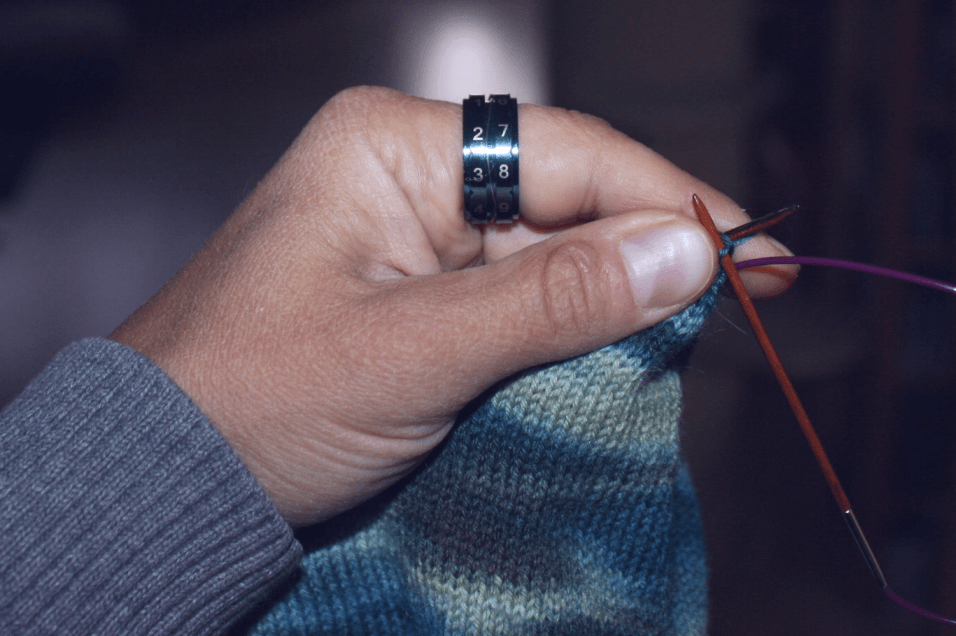
[caption id="attachment_2685" align="alignnone" width="640"]counterring This knitting action is obviously missing the hand I need to hold the camera. Also, the ring should be turned to another spot - it has a clearly marked area for the current numbers somewhere behind my index finger.


Right. New counting thingummy for knitting. I haven't used it in earnest yet (my current knitting project is not in the row-counting part yet), but have tested it, and it works fabulously. There's a little spring wire between the two numbered rings that makes sure the count only changes when you want it. For that, you gently press the ring towards the middle and then turn it. It's made from stainless steel, about one cm wide, and comes in blue (my colour), rainbow, gold, or black. It will also count up to 99, which should be plenty for all knitting purposes.

If you want to have one, too, the company making it is called CritSuccess, and they do ship worldwide. They also have a lifetime exchange policy - if your ring gets damaged, doesn't fit anymore, or you have any other issues with it, you can exchange it for a new one.

Now if I didn't have such a heap of work waiting to be done, I could go do some knitting...
0
OCT
18
2

Misconceptions.

There are a lot of misconceptions about, regarding medieval stuff. Not only about textiles and clothing (the old brown sack, anyone?) but also about crafts, housing, hygiene, and fighting.

These misconceptions are hard to battle sometimes, as they keep being reinforced through many channels - TV and cinema being just two of them. However, media can also be a powerful tool to show research results and helü deconstruct the misconceptions. This is just what the film here is trying to do:


A medieval knight's gear is, weight-wise, about the same as a modern soldier's full kit, or the gear of a modern fire-fighter. So in the film, you can see three men run an obstacle course in their respective kit. It's an impressive display of the agility still possible in a 15th century armour - and also really interesting to see how close the three people are in their results.

This is a really nifty thing!
0
OCT
17
2

Weaving Preparation: Wool yarn testing.

One of the things in frantic preparation right now are the experiments for the Textile Forum this year. We'll be having a rather experiment-heavy Forum, and all three planned things involve dyeing - one of the experiments will be a repeat of the Pompeii dyeing experiment exploring the influence of kettle metals, one will be a test about linen mordants with protein, and one will be looking at dye penetration in woven fabrics of different densities.

The lattermost requires appropriate yarns, and I will get to spinning tonight - a few hundred metres of yarn need to be done for weaving several samples. The weaving will take place at the Forum, and since the weaver lives in the Netherlands and I live in Germany, she will only see the yarns right before having to use them.

Most modern weavers use machine-spun, plied yarns, at least for the warp, because they are (usually) stronger than singles. Of course a plied yarn is stronger than just one of its singles, and modern yarns are often soft-spun, which means they are not very strong. So modern weavers tend to be a little nervous about using singles in the warp.

Just to make sure that the yarn is suitable for weaving - as in "strong enough" - I was sent instructions for testing, taken from "Inventive Weaving on a Little Loom: Discover the Full Potential of the Rigid-Heddle Loom, for Beginners and Beyond by Syne Mitchell (Storey Publishing 2015)". The two tests are the snap test and the drift test. For the snap test, you take the yarn between your hands so that about 10 cm are slack and then "snap your hands apart sharply"; for the drift test, you apply even, slow tension.

The instructions in the book say that if the yarn survives the snap test and "stretches and then stops" in the drift test, it's suitable as warp yarn. Can you guess my problem?

"Sharply" is not a very quantifyable thing. So if I take my yarn and pull my hands apart sharply, it will break. The same is true if I take a four-ply Regia sock wool yarn. In the drift test, my yarn will stretch and stretch and stretch and eventually snap... so according to these instructions, it would not be suitable for weaving.

I think the problem here is that you'd need to be a weaver and know the amounts of tension or snappiness in your own weaving process to really make these tests helpful. For non-weavers like me? Or for "remote testing" yarns? It needs to be more quantifyable.

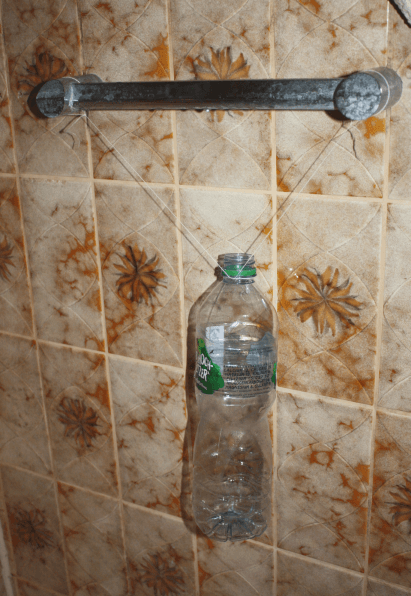
So here's my equivalent to the drift test: Tie an empty plastic water bottle in the middle of a piece of the yarn to be tested, then tie the two ends somewhere so that the bottle hangs in a suitable way to be filled. (Hint: A shower or bathtub, or someplace outside that can take a splash of water would be good places.)

[caption id="attachment_2677" align="alignnone" width="319"]Setup for the drift test. Please do admire the typically Germany-in-the-Seventies tiling in the background. Setup for the drift test. Please do admire the typical "bathroom-in-Germany-in-the-Seventies" tiling in the background. The white spots on the handgrip also tell you that we have really hard water here.


Measure out a certain amount of water, such as one litre, which will be one kilogram. Then, slowly and with as evenly a stream as possible, pour water into your bottle until the yarn snaps. The difference between the amount of water you filled into your pouring container and the amount still left is the weight the yarn could take - in my case, about 880 g.

Now the equivalent to the snap test: Tie a weight to one end of your yarn to be tested, then measure out one metre of yarn plus a bit to hold, starting above the weight. Take the end of the yarn securely in one hand, the weight in the other, hold them side by side high enough, then drop the weight. If the yarn bounces back, it has survived the test. If you are not sure on how much weight is necessary for the thread to pass the weaver's requirements, add more weight until it snaps. (Obviously, the smaller the increments of added weights are, the smaller your squishiness factor will be. My yarn snaps somewhere between about 60 and 100 g of weight.)
0
OCT
03
0

Taking a Breather.

Things have been somehow hectic around here, and before the Nobilitas-Akademie and the Textile Forum eat up all my brain and time - first the planning and preparing, then actually being there - I am taking a little breather, and a break from the blog. (The breather includes a few days of holiday travelling with the Most Patient Husband of Them All, which I'm utterly looking forward to.)

I'll be back blogging on October 17!
0
SEP
30
0

Gratuitous Cat Pic.

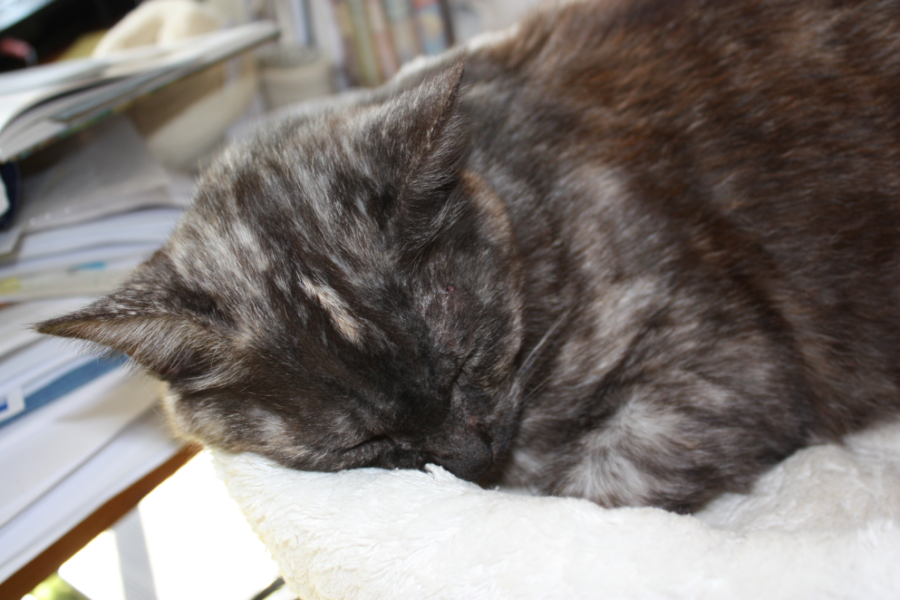
It's Friday, and what better day is there to post a gratuitous cat picture? So here you go:

sleepycat
Madam, snoozing happily, while other folks have to work...
0

By accepting you will be accessing a service provided by a third-party external to https://pallia.net/

Contact