Latest Comments

Guest - Harma Too Many Images Error.
27 November 2026
There have been weeks in November in which I would talke about 800 pictures. Proof of very interesti...
Guest - Max Mustermann The True Cost of Driving a Car.
06 November 2026
Great breakdown — the non-fuel costs are exactly the bit most people forget when they compare cars. ...
Guest - Harma Phew. Now it gets involved!
21 October 2026
Have fun at these events.
Guest - Aislinn Dyestuff Citizen Science.
09 October 2026
This is a great project. I look forward to the results. Thanks for letting us know.
Guest - Aislinn Time for...
09 October 2026
Looks delicious!
SEP
20
0

Have an old embroidery book.

The next few events are drawing nearer - the European Textile Forum and the Nobilitas-Akademie, so I'm rather busy preparing for these. While the cat, helpful as ever, is sleeping in her cat bed beside my desk, making small adorable sleepy cat noises... that are more an incentive to cuddle her or curl up for a nap than to be as busy as I should be. Oh well.

Since I'm working on the presentation for the Akademie right now, I'm looking at embroidery-related stuff... and I have stumbled across a very early Italian pattern book that is freely available on the net: Alessandro Paganino's book "Il Burato". The book was published in 1518 and contains lots of patterns, plus the famous picture on how to transfer patterns to the fabric.

While you're at the website of the Textile Research Centre in Leiden, to get that pdf, do have a bit more of a look around - there is a lot of content, embroidery- and other textile craft-related, that is really worth exploring!

 
0
SEP
19
0

Archaeology Things (once more)

Here you go, actual archaeology-related content:

The next Experimental Archaeology Conference (the tenth!) will take place in Leiden, Netherlands, Thursday, 20 April, 2017 to Saturday, 22 April, 2017. The Call for Papers is currently up, so if you'd like to submit something or just want more information, you can go here.

This is not your cup of tea? Or your loaf of cheese? Well, maybe this is: A bronze age ceramic pot found in Denmark contains residue of animal fat that might be from an attempt to make cheese.

Still not interesting? Maybe I can get you with this, then - Means of Exchange: Dealing with Silver in the Viking Age is the current free e-book of the month from Aarhus University.
0
SEP
16
0

Testing... complete.

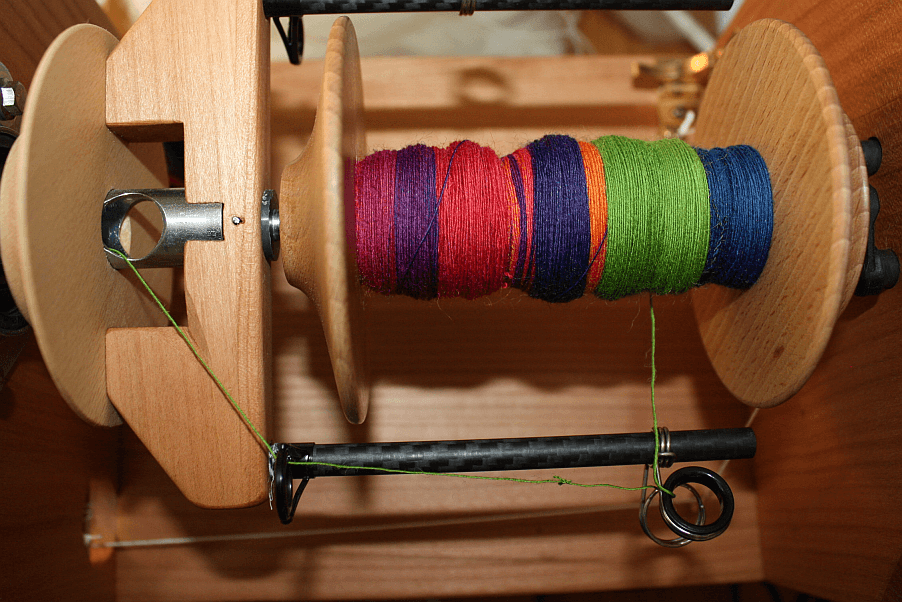
I've finished my test run with the e-spinner, and the result is 745 m of two-ply yarn.

The things I learned... they are many.

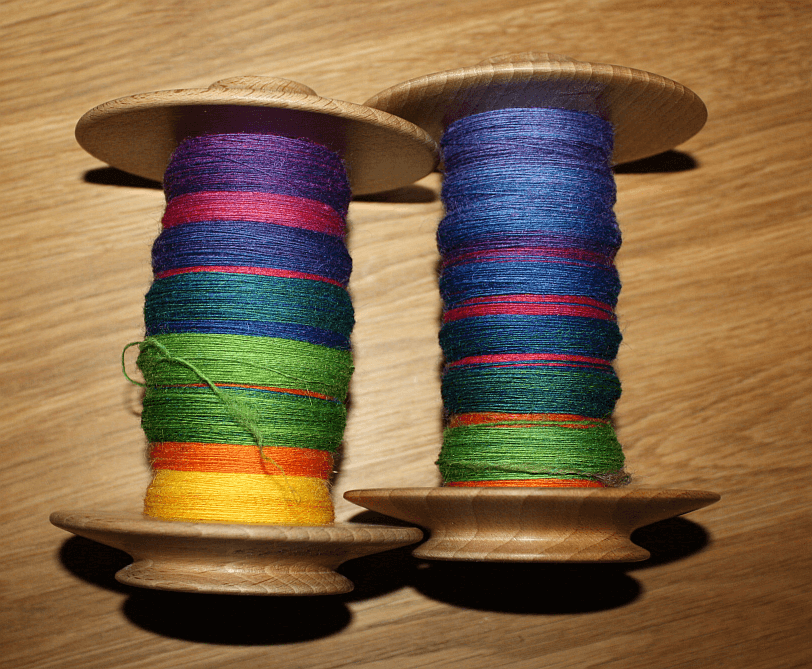
I am a sucker for slow colour gradients in yarns. Always have been - so I had a lot of fun spinning, and I was delighted with the result:

two_bobbins
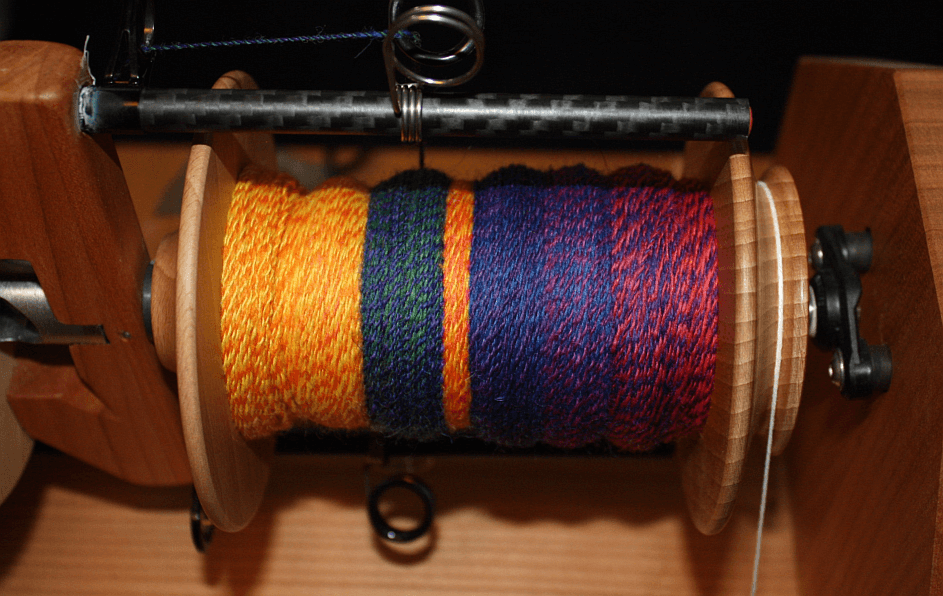
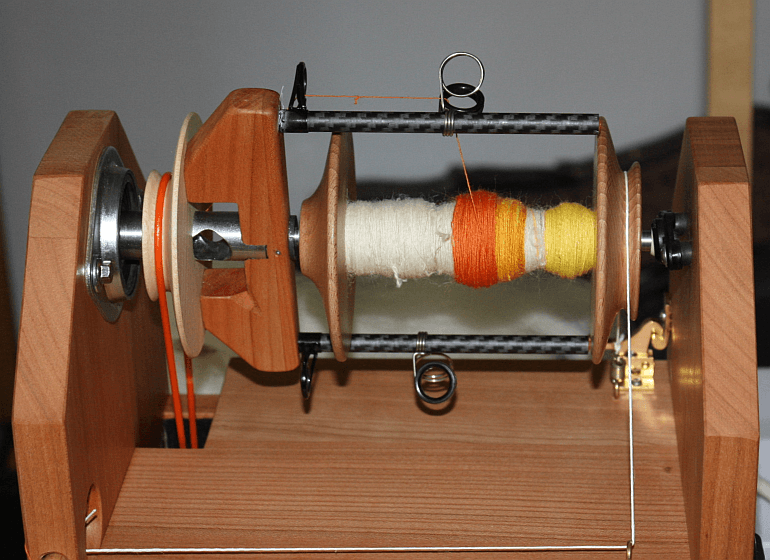
What I'm not as fond of, though, is when the slow colour gradient doesn't match up properly. Which was, unfortunately, the case from about the middle of the two batches. Where there should have been a lot of bright, clear yellow, there was a lot of overlap between yellow and orange instead, and the other colours followed suit.

twoply_in-progress
I'm especially not fond of the mix of very light and rather dark, like the mix of purple and salmon on the very right end of the bobbin. But there was nothing to do but persevere, and finish the plying.

I'm not the queen of plying, by the way. I can spin alright, but I'm not plying often enough to have a lot of practice, so there are more places than I like that are badly plied.

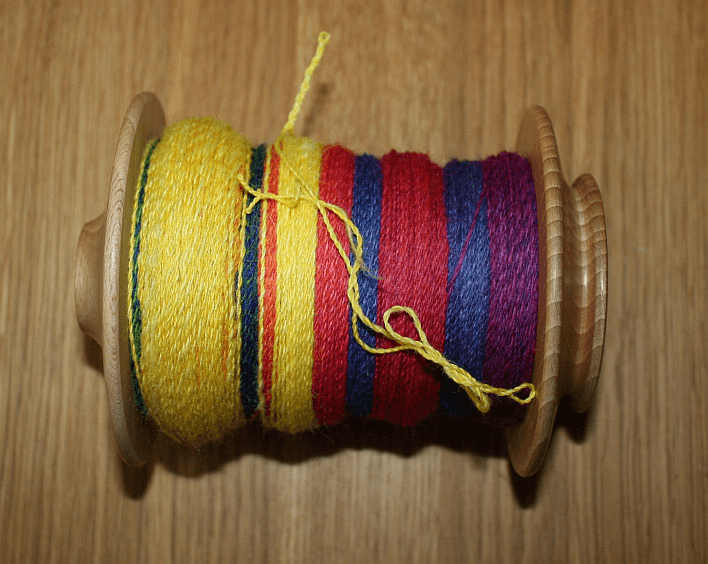
The bobbin was finished in spite of my unhappiness with the colour match:

twoply_done
and at least at the end, the colours did match up better again. I guess I'll find out how it looks when I figure out what to do with 745 m of fine two-ply yarn. Knitting, probably. (Suggestions for patterns are welcome.)

Next step was measuring out the length - that means skeining. Next thing I learned was a two-fer: The plying differences did not even out even though I had a long stretch of the yarn between bobbin and skeiner; and my skeiner is not up to the strain a large amount of wool places on its arms... so I definitely need a new one now, and have to repair the old one. Good thing my length measurement is done via a separate tool and not through counting turns on the skeiner!

Once the measuring was done, I soaked the skein in water, and now it hangs for drying. There are, as mentioned, ample spots where the plying work is not perfect. There are also quite a few places where I could have done a better job spinning. But since the aim of the whole project was to gain experience with the new tool and to get a speed benchmark, that I can live with... especially as I found out that I can spin rather quickly. So now I can calculate for spinning medieval-style yarns on the e-spinner for reconstruction projects. Plus I have some nice colourful yarn to play with. Hooray!
0
SEP
15
6

Done. Finished. Goal attained. Happy.

Remember, back in January, when I wrote about my weight issues in a long, rambling post? When I started losing weight back then, I set a goal weight number as the finishing line.

It took a good while to reach that number. I was planning to be finished in summer, and though I broke through the border to normal weight according to BMI charts in mid July, the last few kilos to the goal weight I'd set took much, much longer than expected, due to a number of things (among them two weeks of vacation, where I did not eat at a deficit). Basically, I've been more or less finished, as in "weight and body fat percentage are in a healthy area now", for... a good two months? So I've started to gradually eat more again, to prepare for maintenance mode and figure out how much I actually need now to stay where I am... still very slowly going down, waiting for the magical number to appear.

This morning, I have seen that number. I am now officially done with the weight loss, and entering maintenance mode, so to say. This little fact has not made it to my brain just yet - I've been juuust slightly above the goal number for four weeks now (water retention is nasty!), and it still has to sink in that it is now there.

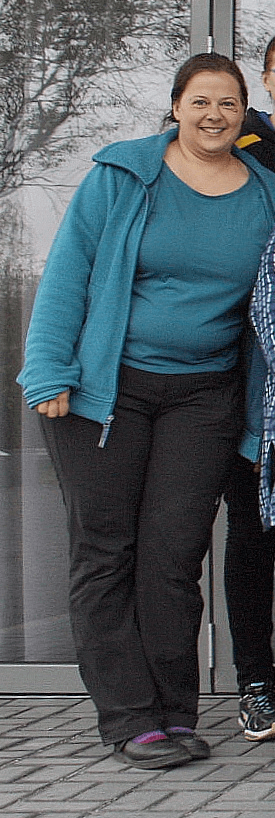
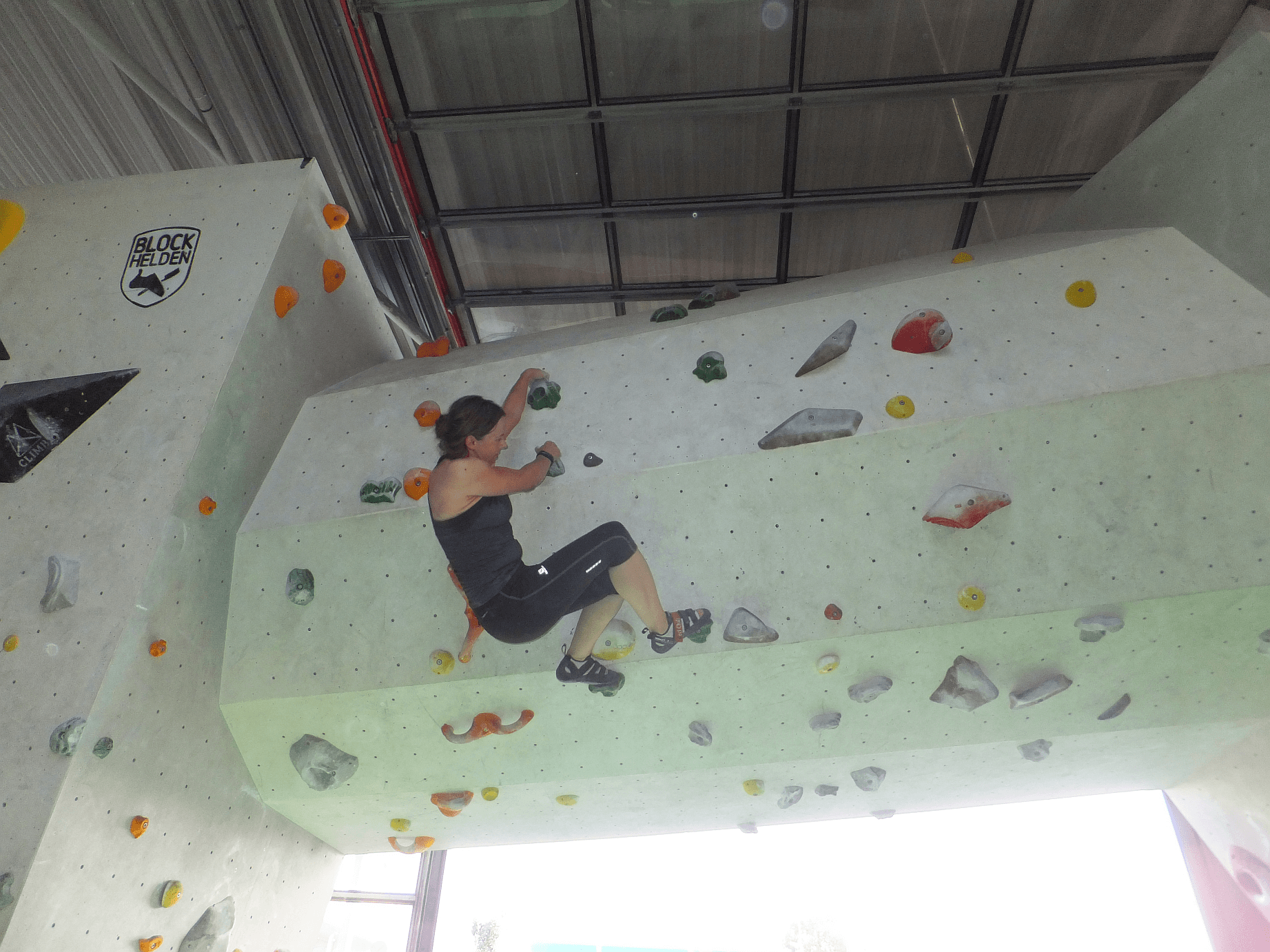
And now, I guess, it is time for the obligatory before-and-after-pics. So on the left, you see how I looked last winter, before I got going. On the right, you see how I look now, and what I did on Tuesday evening - a friend has infected us with the Boulder Virus a while ago, and we're now going up the walls about once a week. (Yes, I know, they are not proper before-and-after pics, where you have the same posture and the same clothes and stuff. But I guess you will get the gist.)

november_lookkletterkati


So. I did it. It was really simple: count all calories (including every little bit of food and every drink), eat less than you burn, get enough protein, do a bit of sports to keep as much of the muscle mass as possible, and that's it.  Simple doesn't mean easy, though, and it was hard sometimes - but it was worth every little bit of effort! Life is much, much better now that I have lost the excess weight. Also... I have a wardrobe full of new clothes (the old ones didn't fit anymore, apart from a few very old ones that were always tight before).  I have a new hobby (climbing or bouldering are just not as much fun with too much weight to hoist up)... and I even made a new friend in connection with the book that helped me so much - Fettlogik überwinden.

And I'm very, very happy about all this!

 
0
SEP
14
0

Archaeology Stuff.

Archaeologists are the only group of scientists who actually destroy their sources when they do research. Really, we do - because you can only dig a site once, and then... it's gone. That is the main reason why we try to leave things in the ground unless a dig becomes really necessary - if it has kept well in its place for a couple of hundred years, it will keep for another fifty or so, and with all the progress in imaging technology, conservation technology and other technology, we'll be able to get much more information out of the site in a few more years than right now.

The fact remains, though, that archaeologists are a destructive bunch of folks. Sometimes even if we cannot dig. Case in point? See the blog "A Life in Fragments", where Matt writes about his studies on the destruction of Bronze Age metalwork.

Less destructive: The Winter Issue of Fornvännen is out (thank you Aardvarchaeology for listing the contents up so nicely!) and it's online, for free. Articles are partly in Swedish and partly in English.
0
SEP
13
2

What I've been up to.

Things I've been up to:

Working on the European Textile Forum programme. (Should be a step further soon, and I'm really looking forward to getting the updated programme online.)

Doing my homework from the last fair - which includes things like re-organising stuff in the transport boxes, correcting the numbers in my inventory list, and similar (usually not very exciting, but necessary) shenanigans.

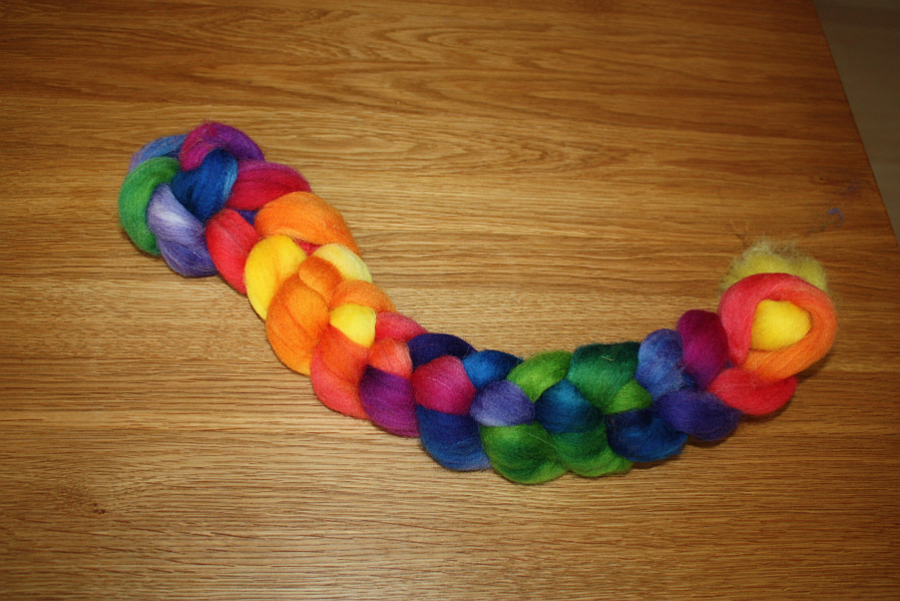
Wrestling with The Gnome. Well, wrestling is too hard a word - it's been going rather smoothly. I used the excuse that I need to get to know my new tool to finally start spinning rainbow-coloured wool I bought ages ago:

rainbowwool
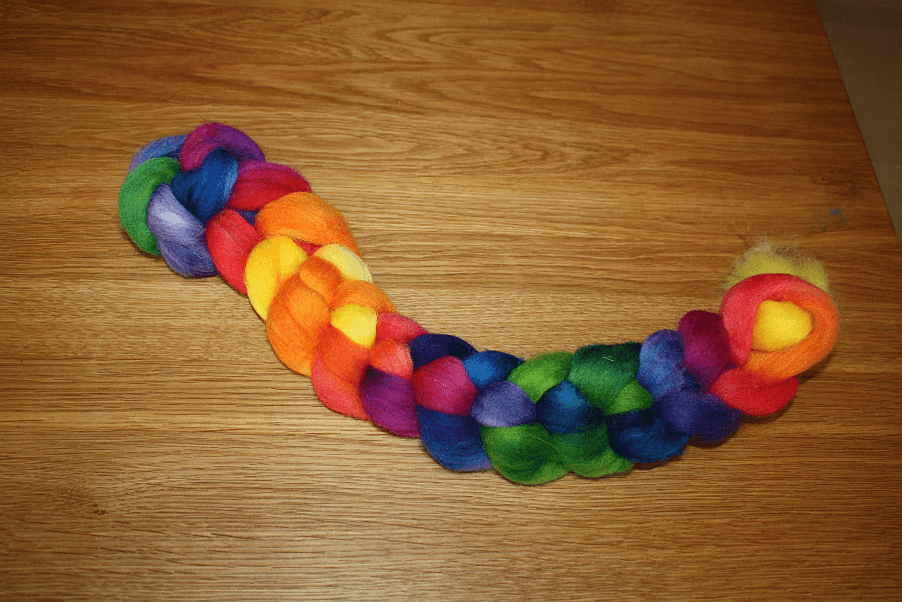
That is half the wool; the top was symmetrically dyed, so I unraveled it, split it in the middle, and now I'm spinning the two bits individually to hopefully get a wonderful rainbow-coloured two-ply in the end, with long colour runs. I have no idea yet what I will make with it, though. It will be about 150 g of yarn when all is done, so it should be enough for a good-sized shawl - but whether I really need another shawl is another question.

Anyway, it spins up nicely:

gnome1
and quickly:

gnome2
I can see a bit more spinning in my future, though - that is about one quarter of the first braid done. Lots more to go!
0
SEP
12
1

New tool joy!

It is a truth universally acknowledged by every spinner, weaver, knitter or other textile craftsperson that any tools needed for the craft are herd animals.

As of today, I have a new addition to my personal herd of spinning tools. Never mind that over the years I have accumulated more spindle sticks than I can shake a stick at (quite a few of the sticks intended for sale made it into my personal tool stash). Never mind that I already have two wheels (four, if you count the two not-really-functional ones).

The two functional wheels I do own already are good ones... for their purpose. The reconstruction of the medieval Great Wheel is a wonderful wheel that is suitable for serious production of woolen yarns. It may be slightly wonky, due to the fact it needs to be completely taken apart for travel, but that doesn't make it less productive. It will only do for woolen yarn, though, and it takes up a lot of space, and the yarn (as I have not practiced enough) tends to be a bit uneven. The other one is a small one - my first wheel ever, and it is rather... slow. These days, it is mostly used to wind off portions of thread for selling them, so it still earns its keep, even though not through making yarn.

Once in a while, though, I get a request from a museum regarding yarns that will be as close as possible to the historical originals. For many textiles, especially high medieval or earlier ones, that means thin, very high-twist worsted yarns. Spinning these on a spindle is technically no problem, but even if I do spin quite quickly these days, wind-up time always means that spinning takes a long time. The wheels I own are also not suitable for making yarns of this type - it is technically possible, but takes about the same time as spindle spinning does. I tried to re-vamp one wheel (that is one of the not-really-functional ones), but there were serious problems with the friction necessary to drive the very small whorls. So I can offer historical threads, yes, but as it takes very long to spin them, they are very pricey indeed.

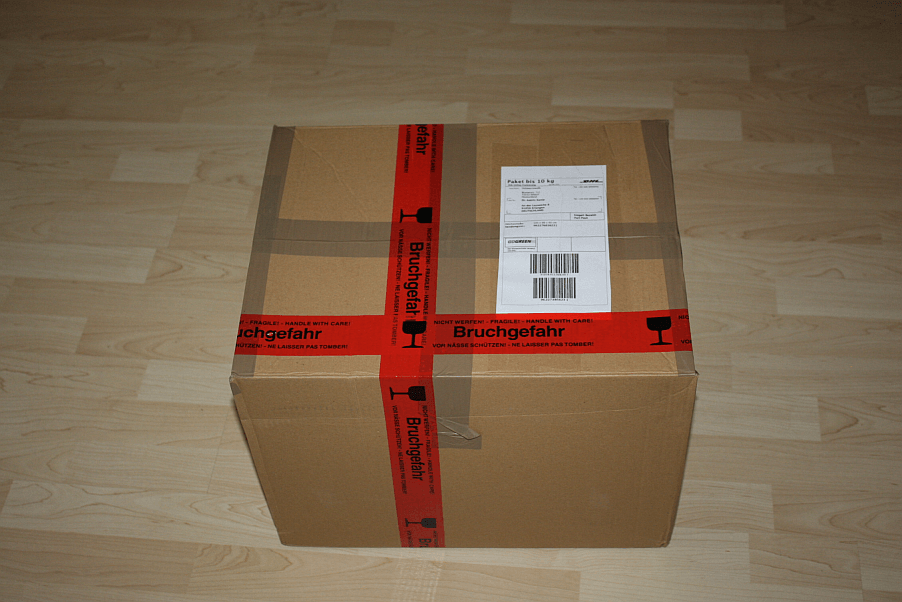
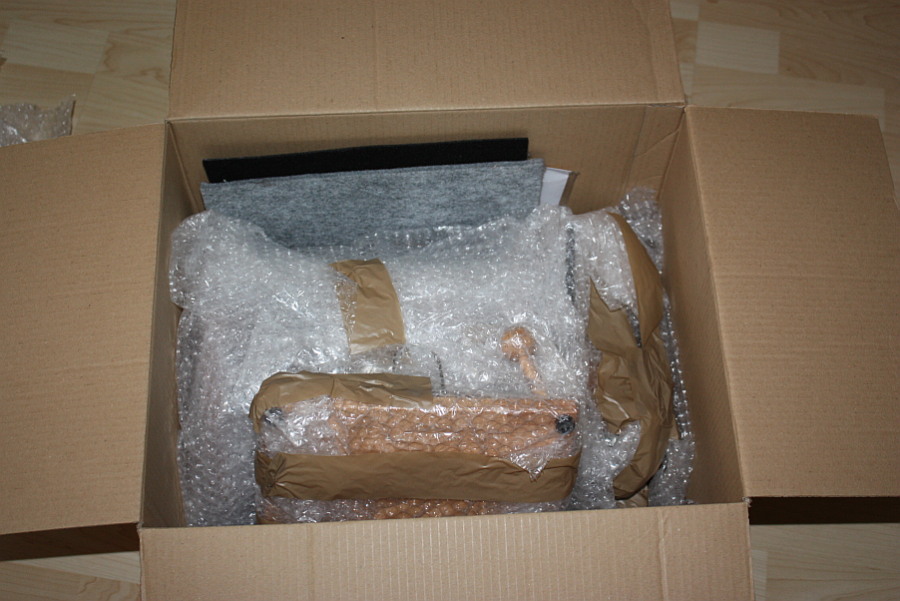
When I was at Wackershofen the weekend before last, though, I finally got the opportunity to try out an e-spinner and see if it could be persuaded to deliver the ratio of twist and yarn intake that I need. Long story short - it did, and today this package arrived here:
zwerg1
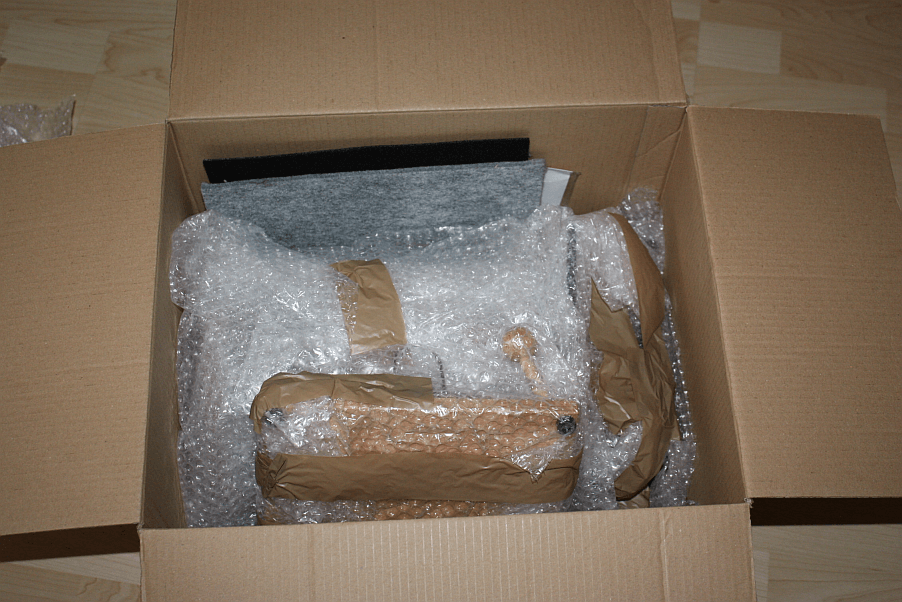
Inside, nested in copious amounts of bubble-wrap, is the Zwirnzwerg (literally: plying gnome):
zwerg2
It doesn't come on its own, though (herd animals, remember?) - it is accompanied by a Lazy Kate and two extra bobbins (for a total of three) and a foot pedal and some spare bits (the brake cord, for instance).

The Zwirnzwerg (and how could I not fall for something called a plying gnome...) is produced in Germany, and is relatively new to the market. With all the accessories, and the maker's willingness to cater to special wishes, it is sold for a very, very fair price. The manufacturer's page is German only, but there are some pics, and google translate does a decent enough job to turn it into semi-readable English. I did ask him when we met at the Ravelry fair, and yes, he does ship internationally.

And here it is, my very own helpful gnome:
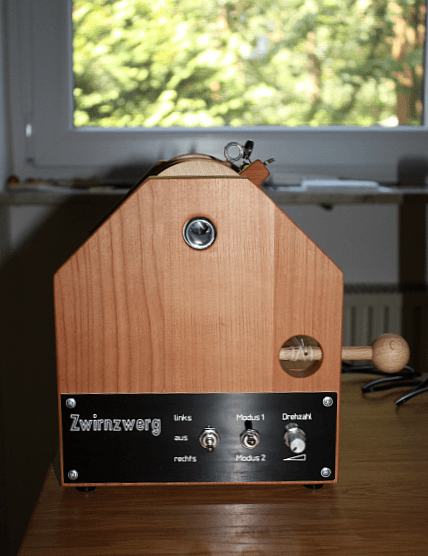
zwerg3
We will now have to get to know each other, and I will have to get a feel for spinning the yarns I want with it. Obviously, I had to give it a go straight away. The result?
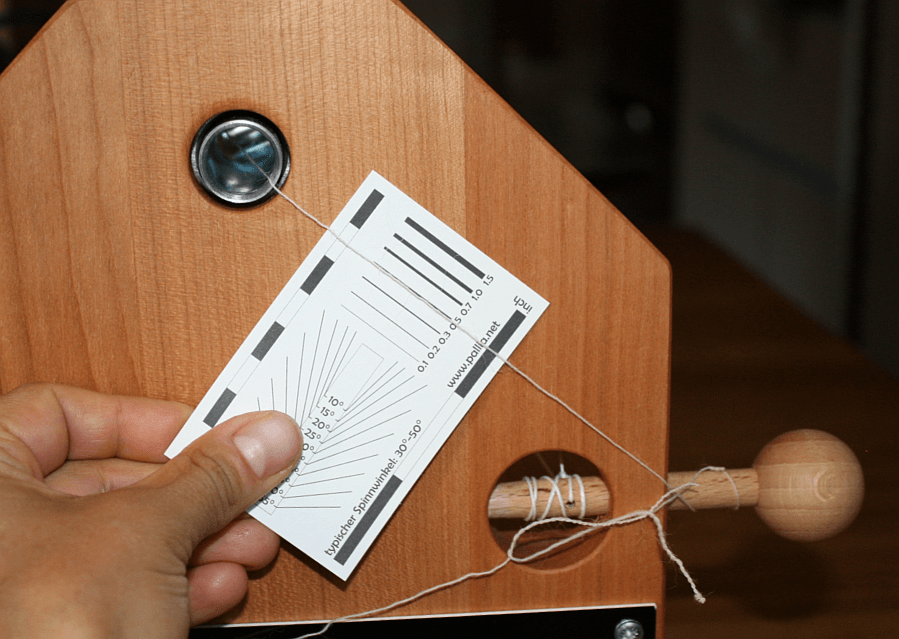
zwerg4
About 0.5 mm in diameter, and with a twist angle of 35-45°.

Or, to stay with the Austen references: I am quite delighted!
0

By accepting you will be accessing a service provided by a third-party external to https://pallia.net/

Contact