







Latest Comments

Guest - Max Mustermann The True Cost of Driving a Car.
06 November 2026
Great breakdown — the non-fuel costs are exactly the bit most people forget when they compare cars. ...
Guest - Harma Phew. Now it gets involved!
21 October 2026
Have fun at these events.
Guest - Aislinn Dyestuff Citizen Science.
09 October 2026
This is a great project. I look forward to the results. Thanks for letting us know.
Guest - Aislinn Time for...
09 October 2026
Looks delicious!
Guest - Katrin Sprang Discussion
18 September 2026
Hi Rachel, I have looked for more photos of you, but that was not very successful. I found a link on...
NOV
11
5

Knitting history

Ah, I should have known that a single post about knitting will draw more people out of the woodwork and get comments than all the other techniques. And actually, I wonder why - is it because more people can relate to knitting stuff, doing the technique themselves?

Comments yesterday made clear that there is huge interest in the history of knitting. When I was writing my thesis, of course knitting was one of the textile techniques to be mentioned, so I did some reading on that topic. And found (again) that knitting is a very, very hard technique to trace - about as nigh impossible as felting, if for different reasons.

Felting has no regular internal structure and thus is prone to fall apart into single hairs in adverse conditions - and adverse conditions for felt even include those that are generally good for organic material. With knitting, the problem lies elsewhere. Knitting can be unraveled so easily - and partly or completely "frogging" the work, if modern knitting blogs are any indication, is quite usual for things not living up to expectance. (Please tell me, do you frog knitted things that you don't wear anymore as well? Or only new stuff that doesn't fit or please well enough?)

If we assume that yarn was a valuable thing, and especially fine, colourful silk yarns, I can very well imagine that the yarns were unraveled and stored for another use - which would greatly reduce the number of knitted finds. Recycling and re-using (or remaking) of standard, sewn-from-fabric garments can be frequently seen in the archaeological evidence: Small, cut-off bits with seams in them, obviously the bits that could not be salvaged and used in a re-make because they were too crooked, too small or too oddly formed, or bits that were too worn. Now imagine somebody frogging a piece of knitting to re-knit. All that will be left might be a snippet of yarn - which, unfortunately, doesn't carry a sign telling the textile researcher "hey, I was part of knitting once!". And this makes knitting research a huge problem.

From what I could find in sources that were recent enough to already factor in the discussion of nalbinding against sprang, there was no evidence for true knitting before the start of the 12th century. There's a little more in the 13th, and more and more in the late middle ages and early modern age, but nothing earlier. The early datings usually come from the "coptic socks", and those I will consider as all nalbinding until somebody can prove the opposite by re-evaluation of the actual finds.

To round this off, for those of you hungry for references: Here's my list of things about knitting, taken from my bib database. I have not read all of those, so I can't guarantee that they will be good or insightful - if you know any of them, comments are very welcome!

CARDON, DOMINIQUE: Fils renoués. Trésors textiles du Moyen Âge en Languedoc-Rousillon. Carcassonne 1993.

GREINER, SYLVIA: Kulturphänomen Stricken. Grunbach 2002.

KJELLBERG, ANNE: "Knitting and the use of knitted goods in Norway before 1700. From archaeological finds to documentary evidence." In NOCKERT, MARGARETA und ESTHAM, INGER (Hrsg.), Opera Textilia Variorum Temporum. To honour Agnes Geijer on her ninetieth birthday 26th October 1988. Stockholm 1988. 145-152.

TURNAU, IRENA: "The Diffusion of Knitting in Mediaeval Europe." In HARTE, N.B. und PONTING, K.G (Hrsg.), Cloth and Clothing in Mediaeval Europe. Essays in Memory of Professor E. M. Carus-Wilson. London 1983. 368-389.

WYSS, ROBERT L.: "Die Handarbeiten der Maria. Eine ikonographische Studie unter Berücksichtigung der textilen Technik." In STETTLER, MICHAEL und LEMBERG, MECHTHILD (Hrsg.), Artes Minores. Dank an Werner Abegg. Bern 1973. 113-188.
0
NOV
10
0

Speed Knitting!

So what is the fascination of knitting for me?

First of all, you can make useful things with this - like socks. (Did I mention I like knit socks?) And if you have a penchant for making your life more difficult, then you can take very fine needles and very fine yarn and make a myriad of tiny stitches for some early modern stockings. Or go and buy a "tsock kit" from the Tsarina of Tsocks, who makes artwork kits disguised as sock kits. (And I will definitely need some of these crazy socks some time in the future.)

Then, knitting still is all over the place - thousands of people do it, and probably everybody alive knows at least one knitter. And it is easy to learn even if you are on your own, because there are so many websites and, even better, so many videos that show you how to cast on, work in the round, knit and purl, English, Continental or Oriental style. Just search youtube (or generally search) for "knitting tutorial", and there's enough to keep you occupied for hours.

But for me, there's another fascinating thing to knitting: The possibility of speed. A good while ago, I wrote a Google Penance for the search term "tricks to faster hand sewing", with the bottom line that with sewing as with most other craft processes, there's a limit to how fast you can go - and it just won't get faster. Knitting sort of has an exceptional position here, because knitting can be sped up oh, so much.

To give you a taste of what is possible in the extreme, here's a video of Miriam Tegels knitting - she's the holder of the Guinness World Record in speed knitting, with 118 stitches in one minute.


Isn't that really incredibly fast? And doesn't that make me think of the knit stockings in early modern age and wondering how long it took a professional knitter to make one?
0
NOV
09
11

Knitting, anyone?

For years now, I have successfully been a non-knitter. I just never did it. I had not learned in school how to knit (they only taught us crocheting), and I had only made one short and unsuccessful try to learn it back years ago, when I was still caught in puberty. The technique somehow never appealed to me enough to fiddle my way through it, and I could remember from my one try that it was really difficult to catch those pesky loops of the stitches and that I didn't know what to do when one of them slipped.

And then, when I started out in the textile archaeology field, knitting was said not to come up before the later middle ages, and not properly before early modern ages, when it somehow becomes all the rage and Knitter's Guilds form and those guildmembers knit amazing things. So I had a perfect excuse for not knitting: a, there are more than enough people around who know how to knit and do it (and teach it), so there's no danger of the technique dying out; and b, I had more than enough other techniques that were less modern and less well known already. And c, I didn't want to do things in techniques that can fall apart so easily just by pulling on the working thread (yes, you have to take out all the needles before that too, I know).

But. But. Knitting has actually been found dating back to the 13th century (in a German well, of all places). Knitting is a problem for the textile archaeologist because it can be unraveled so easily. The wherefrom and why of the development of knitting is still not known to historians. I like a good scientific unknown - it always reeks of challenge for me. And then there are the socks, which I admit I love. Hand-knitted, nicely patterned, woolen socks... aah.

And then there was the Textile Forum, where a lot of truly awesome knitting went on inbetween all the other things. Fine woolen yarns! Intricate patterning! Really really thin "knitting needles" that were sold to the knitter as "a bit of copper alloy wire"! This all smelled like a challenge and a fascinating opportunity for some full-scale madness much too much for me to resist.

So I have finally given in and learned how to knit. And I have discovered some of the fascination of knitting for myself...
0
NOV
06
1

Photos from Finds in Norwegian Museums

Life is so much nicer with pictures! And life is getting nicer and nicer these days, with more and more databases and pictures from museums coming up online. Here's another one that came to my attention very recently: The Universitetsmuseenes fotoportal, with pictures of finds from four different museums. The pictures include some shots of the Oseberg findings, and there's some textile there too (of course).

You can search over all four museums by using the little search box - just remember that it's Norwegian, so make sure to type "tekstil" if you are looking for fibery things. I would love to link a good English-Norwegian online dictionary here to help with the search terms, but I haven't found one yet - the few I tested did not even know how to translate "textile" into Norwegian. Instead, if you need a German-Norwegian translation (or if you know the search term you want in German but not Norwegian), I can point you to trusty Heinzelnisse, where you can even play vocabulary games to improve your language skills...
0
NOV
05
3

Setting up...

Today, the two knights for the exhibition at Hartenstein will be placed into their final spots and installed securely (so they don't gallop off in the night or, even worse, fall onto an unsuspecting visitor).

Setting up for an exhibition, for me, it's always a very exciting thing and surely a cocktail of emotions. There's a little anxiety (did I bring everything? will it all fit?), a little stress (oh my goodness I hope it doesn't all take so long to set up as this item), an amount of fun (after all, things are finally coming together as they are supposed to do), a generous measure of pleasant anticipation and hope (ah, this looks really nice here, that will be splendid once we open, I hope everybody else likes it as much) and, of course, a dash of "oh no!" (oh no, a badly done tiny spot/a little fault/a scratch already!) to spice it all up.

And altogether, I like this cocktail very much... so I am really looking forward to today's session.
0
NOV
04
0

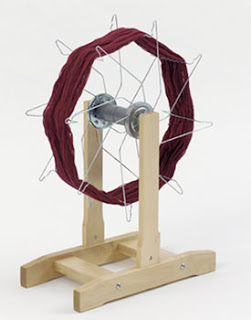
Tool Talk - Schacht Company: Goko Swift

Not a book review, but a tool review this time - the Goko swift, made by Schacht in a traditional japanese design (and sold more or less only in the US).

I first found mention of this swift when looking for some better way to wind the very thin silk that Sabine dyed onto spools for storage and for sale. I have a normal, four-armed "umbrella" swift, but that just didn't work properly, even not when tuning it with an additional cardboard support strip for the silk to lie on. Unskeining these fine threads was not possible in a humane (and sensible) amount of time, and I was looking for alternatives. There was only one swift to be found on the Internet that was supposedly very well suited for fine, delicate threads - the Goko.


Now this swift is not the cheapest one to buy (around 130 USD), and shipping fees to Germany range between steep and outrageously expensive for such an item. But I was in luck - a travelling colleague brought one back to me, saving me the shipping costs. I unpacked and tested it yesterday, and here's what I think.

The swift consists of a wooden stand and a metal wheel with eight supports for the yarns, making it roundish instead of square as most swifts are. The wood part is quite solid, with a glossy varnish as finish, and marked with the Schacht company emblem. The two vertical support beams are slitted on top to take up the axle of the wheel.
The wheel, in contrast to the wood parts, does not have a good finish or solid feel. On my Goko, the "flanged core" was only half assembled, with one of the flanges off and quite bent. I do not know when or why this happened, due to the mode of shipping via "colleague-mail" meaning this went through several pairs of hands, but I had expected a more solid and better finished piece - the holes for the arms and the edges of the flange were not deburred, and I was not thrilled. Some gentle taps with a hammer soon took care of the bend in the second flange, and both the flange and the arms of the swift then were easy to install. However, the arms were not really perpendicular to the core, but instead seemed to be bent a little out of shape - making the whole wheel look slightly lopsided. I now had some doubts if buying the swift really had been a good move - so I proceeded to test it.

I took out a slightly mangled skein of very thin silk threads (why test with something easy, after all?) and put it on the swift. There was the next surprise in stock for me: The skein was too large, probably due to working with it on the previous swift, which might have lead to some stretching. I put it on anyway - since nothing can get caught in moving parts on that swift - and decided to give it a try.

And what shall I say? It worked beautifully. I unskeined the remaining silk with a few stops to untangle a bit, but compared to before, this was incredibly quick and easy. After all, I had stopped working with that skein before because it was almost impossible to unwind in a humane amount of time. The huge difference that the additional four arms of the swift and the wide support for the skein make is hard to describe and still make believable. The too-large skein, by the way, had quickly shrunk to Goko size without additional tangling. I tested it on a second silk skein, and it worked just as well again - so now I am convinced that for my uses, this swift was worth every penny. I had no yarn breakage due to sudden stops in spooling (with a spinning wheel set up for spooling with very light tension on the drive, so it slips with very little resistance), because both the wheel and the swift stopped at once whereas before, my wheel would stop but the swift would break the yarn.

That also is the upside of the very light quality of the metal parts: They are very light - so the actual working part of the swift seems to weigh almost nothing and turns very, very easily and with little resistance to abrupt stops (for example because there's a tangle in the skein). This swift really is very well suited for fine, fiddly yarns that are difficult to unskein. I haven't tested it with wool or other material yet, but I am quite sure it will work nicely as well.

So if you frequently wind yarns or threads that are on the thin and delicate side and give you trouble turning the corners of a normal umbrella swift, you might want to consider the Goko. It is not cheap, and it is not finished to craftspersons' delight in every last bit, but that does not take away from its functionality - and that, for fine threads, really is awesome. Proving again the old fact that good tools are important, and special tasks may need special tools to make success possible.
0
NOV
03
0

Connecting Grad Students

Through a mail from my old Uni, I have just stumbled upon "Gradnet", an association that wants to make life a little easier for grad students by hosting an interdisciplinary and international conference, an opportunity for productive and critical exchange.

I haven't heard about them before (that's a small wonder and has much to do with both my topic and my work style, and little to do with them), but the programme of the next conference is online, and it looks quite large and quite nice.

The next conference takes place in Erlangen, from 20 to 22 November - so pretty soon - and you can check out their programme on the Gradnet website www.gradnet.de.

I probably won't be able to hop over there due to the move coming up on the next weekend, but I'd love to hear about it, so should you go there, please drop me a comment!
0

By accepting you will be accessing a service provided by a third-party external to https://pallia.net/

Contact