







Latest Comments

Guest - Max Mustermann The True Cost of Driving a Car.
06 November 2026
Great breakdown — the non-fuel costs are exactly the bit most people forget when they compare cars. ...
Guest - Harma Phew. Now it gets involved!
21 October 2026
Have fun at these events.
Guest - Aislinn Dyestuff Citizen Science.
09 October 2026
This is a great project. I look forward to the results. Thanks for letting us know.
Guest - Aislinn Time for...
09 October 2026
Looks delicious!
Guest - Katrin Sprang Discussion
18 September 2026
Hi Rachel, I have looked for more photos of you, but that was not very successful. I found a link on...
SEP
23
5

Market Stall Organisation

While working on the real wood-and-cloth market stall, thinking about the selection and presentation of goods and working simultaneously on the "market stall" website, I'm pondering how to sort and how to present the goods on the website - and what and how much information to provide with each piece.

I carry a few replicas - like the spindle sticks, the netting needles, naturally dyed silk threads, and so on. However, I don't have "perfect" replicas for sale in the sense of the original material is used for the replicas (the correct metal, the correct wood) and that they are made using only medieval tools and methods (and that would be really pricey). In addition, I carry some goods that are part or complete conjecture - I have pincushions to keep pins and needles safe, I have parchment tablets for weaving. And finally, there are some things that are first seen later than the middle ages, like the "Nähsteine", where I'm actually not sure whether they were not used before the 17th or 18th century or whether usage was just so normal/unspectacular that they are not shown on the few pictures that we have from medieval sewing work.

When people come to me on the market to buy real-life, they can just ask and I can explain and discuss things with them. In the internet - not so easy. It is of course possible to mail or phone, but takes significantly more effort to do so.
So the big question is: Do I need to write the story behind each of the objects on the market stall webpage? Or would nobody care? Do you, as buyer of things as LH equipment want to know exactly what, where, when, why? (Personally, I would.) Comments and input, anyone?
0
SEP
22
2

Work style

My usual style of working slightly resembles a multi-front war: Tackling several items from the list at the same time, which means that I work a bit here and then switch to another thing on the list, and maybe later to a third one. This is partially due to necessary waiting between steps on single projects, partially because sometimes I think it's faster to answer an e-mail and do the corresponding bit of work on a project at once rather than mark the mail and get back to it later on, and partially because I like some variation.

This has, as everything in life, its upsides and downsides. An upside is that I get to work on the project that currently tickles my fancy rather than stick to "Plan A", and that I am very flexible - if some grand idea occurs for one thing, I'm used to switching and will continue with the grand idea and the things it brings with it. The downside is that of course time and energy is lost in translation from one project to the next - and even if the loss is small, it will be there.

In the past months, I have often wondered whether it would be worth trying to finish one thing with absolute priority first and then go down on the list - and frankly, I'm not sure I am willing to try this. Once a deadline approaches for one of the projects, I know I'm perfectly capable of putting that project up front, and everything else does take a back seat, but I don't know if that style of work would suit me and the rather big variety of topics and projects I have in planning, under way or in postprocessing at any given point in time. So for the moment - until I get an inspiration what to change and how, or any grand hints by you, dear readers - I will probably just go on like I'm used to, working on more projects more or less parallel. Which also means that I will have my usual seemingly slow progress with things.

Speaking of progress: There actually is some for several things - planning for the new market stall has done a quite big leap, and this project is now ready for the scissors, needle and thread phase. I have done enough progress on my new (very thin silk thread) hairnet to actually see the proper mesh and for better demonstration - the very first rows are somewhat unspectacular for the viewer. So my weekend was rather productive, and this feels very good.
0
SEP
21
0

Early Textiles Study Group conference

I have received a call for papers (on the usual labyrinthine ways these things take) for next year's Early Textiles Study Group conference that will be held in the UK. The theme will be colour and the organisers are aiming for an even contribution of technical and sartorial papers.

So since the organiser in her original mail asked to pass this on to interested parties, for all the dyers and colour people out there, you can find the full CfP as a .pdf behind this link.
0
SEP
18
3

Normal life has me back.

Now, slowly, I remember the things that I was planning to tackle before the Forum took over completely - smaller things as well as medium to big things (like the website relaunch, finishing an instructional video for netting and finding out how much fabric is needed for the new small market stall).

Yesterday, though, was mostly spent with the experiment dataset. I'm still looking at and photographing each spinner's individual output and playing around with the weights spun to see if there are general tendencies. And there are, and yet not. While for example spinner A made a totally predictable yarn only influenced by the fibres - with one fibre smoother, thinner yarn than the other - other participants have two sorts of yarn, quite thin and very thick, and they have no obvious connection to either spindle or fibre. It does need a seriously wacky spinning instrument to throw them out of their usual yarn type and thickness range, though, and sometimes not even the wackiest of spindles will do that. So this is a very intriguing start, and I hope I will find some more connections or possible connections.
0
SEP
17
0

Brain Test

During the Forum week, we of course chatted about all kinds of things (though most of them fibre-related), and of course there were requests to share this or that link or site.

So here's the Brain Test, my part - let's see if I can remember what I was supposed to.

First of all, of course, there's Phiala's String Page (where I made my first braiding steps many years ago) and where the now-famed and coveted pdf about tablet weave structures may be found. The accompanying talk lit quite a few lightbulbs in tablet weavers' heads!

There's a video on Youtube I talked about - no, wait, there's more. First there are the two wonderful and calming videos showing short-draw and long-draw spinning by Ruth MacGregor that I linked already here. (At the Forum, I had the joy of getting taught long-draw by Ruth herself. I can now spin thick and fluffy yarn, hooray and huzzah! And Ruth in person is even more calm and friendly than her videos suggest.) Then there's the incredibly speedy weaving on an inkle loom, to be found here.

Then there was mention of the Tsarina of Tsocks. If anyone can tempt me to add knitting to my stash of textile techniques, it is her with her incredibly beautiful socks! There's also a blog where she writes about tsocks (who would have guessed?)

Another thing I frequently mentioned to several persons (mainly day-guests and visitors, though) is Therèse de Dillmont's book. If you have not yet found out about it, go visit the webpage where the whole book (in the English version) is available for free!


Oh, and I am also supposed to put up pictures of the event (and the spinning) on the Textilforum website, send around the list of adresses of the participants and analyse and evaluate the data from the experiment. Which will all happen, and soon.
0
SEP
16
0

Sleep deficiencies back to normal (almost)

I took the day off yesterday (well, mostly) and had a wonderfully relaxing time just reading, snacking, relaxing and napping, so now my wakefulness-levels are almost normal again.

Now that I'm in the quiet of my own little study again (crammed full with the boxes of the experiment), I really start to miss the chatter and bad jokes and friendly banter and "string talk" of last week. And slowly I realise that the Textilforum has indeed taken place, that we really did it, that the experiment was really wildly successful, and that I have a heap of things to remember the wonderful week by, including my first ever badge for making a fire without more than two matches (heehee! All that training was worth it!), the most ugly cardboard-piggybank ever made by man or woman (and a very well-fed one at that, thanks to the generous people at the Forum) and the now-famed cat timer that usually resides on my workdesk but had taken a venture out and did some important work in the spinning experiment.

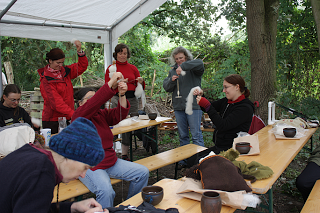
There are already some pictures online at Phiala's blog, summing up nicely all the things that went on, including the silliness. Here's a random picture taken during the spinning experiment (they are not sorted yet, of course...):

0
SEP
15
3

Back home from Textilforum

I arrived back home from Eindhoven yesterday evening, after a week of all things good and fibrey (or stringy). More than a hundred of spindles were spun upon, masses of tablets turned, waffles and chocolate eaten, large quantities of coffee and tea consumed, and laughter and fun abounded.

The Textilforum was everything I had hoped and wished for: A meeting place for craftspeople and scientists, a place to chat and exchange knowledge and personal experiences with different historical techniques, to network and have fun together, a place to do some shopping for textile-crafts-related things and tools that cannot be found just everywhere, and an opportunity to have some nice, juicy bits of science that requires more than just one or two skilled craftspersons. So overall, a complete success, and I am sure that every visitor to the Forum also went home with something new and delightful learned.

For the experiment, I had the joy and privilege of working together with fifteen wonderful spinners to generate a really large dataset that will help a lot for researching spinning and spindle whorls in the future. This dataset and lots of number-crunching from it will probably keep me on my toes for the next few days and weeks, but the data already looks very, very promising. The first results were already presented to the spinners and lecture audience on Saturday evening, and more results are the topic of my talk at the liveARCH conference in Hungary in October. A good reason to set to work on all the cops of yarn and questionnaires!
0

By accepting you will be accessing a service provided by a third-party external to https://pallia.net/

Contact