Latest Comments

Guest - Katrin Sprang Discussion
18 September 2026
Hi Rachel, I have looked for more photos of you, but that was not very successful. I found a link on...
Guest - Beatrix Sprang Discussion
15 September 2026
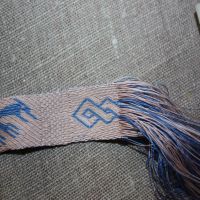
That lozenge pattern element is not a photograph, but a scan. So it should be to scale. But I pinned...
Guest - Katrin Sprang Discussion
15 September 2026
I was not referring to Rachel's reconstruction (is the reconstruction you refer to the one photograp...
Guest - Beatrix Sprang Discussion
14 September 2026
There is something Rachel did not mention. She told me: "Well, I worked with the measurements we too...
Guest - Katrin Sprang Discussion
14 September 2026
Well, this is certainly developing into an interesting discussion. Firstly, going from that lovely l...
JAN
22
2

Finally - a new date for the Textilforum!

It has taken us longer than we hoped to find a new date, but at last, the search was successful. Now we don't have a too tight schedule or an overlap with the planned dates of either of the two conflicting conferences, the EXAR conference 2009 in Hungary and the Conference for Archaeological Dyes and Dyeing.

The new date is even a bit earlier in the year, which hopefully means warmer and overall slightly better weather. The Textilforum will take place in the beautiful Open Air Museum in Eindhoven, Netherlands, from the 8th to 13th of September. If you are interested in historical textile crafts, this might be the place for you!

You can find more information at the forum website www.textilforum.org, where you can also subscribe for the forum newsletter, bringing you news and notice of updates of the site. Or contact me if you have questions.
0
JAN
22
0

A stitch in time has been linked to.

Thank you, Dr. Richard Scott Nokes from Unlocked Wordhoard.
If you don't know that blog, go have a look - it is one of my regular reads. And if you like to read medieval-themed or medievalist blogs, the Wordhoard features a huge list of blogs that might entice you to spend hours and hours reading...
0
JAN
21
10

Skjoldehamn neck flap

At last I found the time to check back to the lively discussion about the closure of the Skjoldehamn shirt on pearl's livejournal. The discussion already made another webmaster put up more and larger pictures, so it is high time I post my promised photo.

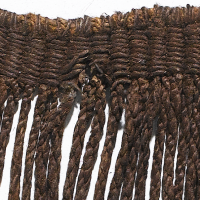
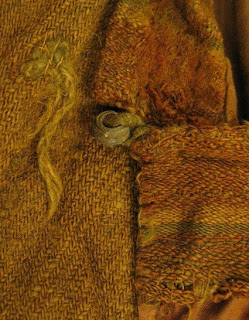
Here you have the neck flap, in colour, with the bead as closure and the broken loop of wool thread that probably served to hold the bead:


If I remember correctly, the bead is made from metal. Here's an even closer closeup, where you can see that it is not a leather thong, but a woolen braid or something similar that holds the bead to the flap.


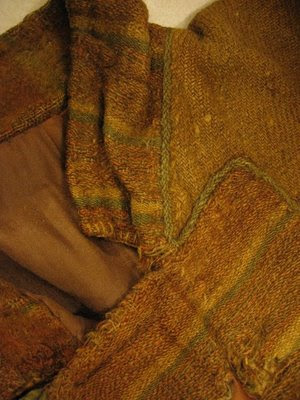
And finally, in the last picture, you can see the upper left part of the flap, with the braiding running along the edge. The stripes can be seen clearly here.


I took the photos myself; please respect copyright rules when linking to or using them.
0
JAN
20
0

Working my way through the list

Another day has raced past, and I only just remembered that I am still due a blog post. I have a good excuse, though, since I spent the day on the telephone (work-related) and preparing several pieces of written stuff. There is still a huge list on my blackboard, but at least I'm not feeling all overwhelmed anymore.

Somehow, having too many things to do will not result in frantic activity but in a state of mind (and body) rather like paralysis. Sometimes I wonder why that is so. There were times when I thought it was only me, and a sign of not being up to this or that, but I have found out since that it is a rather common thing. So at least I am not alone.

Overcoming this paralysis can be hard, though - especially when working on one's own in a cosy little study, with the internet and books and telephone and whatever else right there to distract and eat up time badly needed for work. Beginning might seem hard, but once the first task is done, the rest does get easier. But then, sometimes, it is better to take half a day off to sort through things in the mind, even if matters seem pressing.

For now, my list is adequately diminished for one day's work. There are a few things that I want to have finished by the end of the current week, even if I'm not sure this is possible, but I'll try my very best. And I have the good feeling of overwhelm overcome.
0
JAN
19
0

Advertising Material

After finally designing (and getting printed) a new business card last year, now it is time to get some more promotional material. So these days see me surfing the web to catch up on the do's and don'ts for flyer and brochure design - like the Flyer Tutorials on allgraphicdesign.

I know that for a lot of small-scale freelancers, doing all the things needed for a business (even a tiny business) is exhausting and unnerving. For me, that is not so, and I count myself very lucky for that. While I don't actually enjoy bookkeeping and writing invoices and haggling for money, I know that it is part of the whole package, and I do it for me. Other things, like design work for advertisement or typography for texts? I love them. And it just adds to the beauty of the job, in my eyes, that I get to do something new and refreshing from time to time.

I have the basic concept ready, now I need to write the advertisement texts and spice it up with some pretty pictures. Both text and pictures will probably take a good bit of time, but fortunately it is not pressing yet. I want the flyers to be ready by end of February, so there is still some time to mull over the design in between other work - just the way I like to do these things.
0
JAN
19
3

Why sewing by hand?

HandsewnZM6 or machine sewn? For normal modern people, that is no question - a machine is faster and will almost guarantee you even, smooth stitches. When going into the living history field, things are different - machine sewn garments are then a sacrifice to modern style, to laziness, or to the fact that nobody has enough time for all those enticing projects and all the clothes needed. Or is that so?

When I started sewing for living history events, I was seventeen years old and had just gotten into the "medieval market" scene. My first piece was a hood - what else? It took me ages to stitch together the two halves of a hood (cut after a pattern drawing in a journal, not after an archaeological find). Even worse, the cloth was a mix of wool and polyester. But I had my first deep experience with hand-sewn clothing then, and I found that it really makes a difference.

Unlike modern patterns for clothing, medieval patterns are not designed with a sewing machine in mind. On the other hand, sewing technique is such an important thing in medieval tailoring that fabric, sewing thread and seam type were carefully matched together to get best results - this can be seen when comparing the extant medieval garments.

Choosing the right fabric for a pattern, and the right seamtypes for that fabric, is an essential part of historical tailoring and sewing. Which already answers part of the question that I hear regularly: Why do you sew by hand?

Historical patterns are not designed for sewing with a machine. Many stitches cannot be reproduced with a common household sewing machine at all (and not even a high-end one). In addition to that, hand stitches are much more versatile than machine stitches, and the beauty and functionality of good hand stitching are astonishing. On the Viborg Shirt*, up to eight layers of fabric are stitched together into a join that will lie absolutely flat - and this is even possible with thick, homewoven old linen. A hand-sewn seam will always look, fall and drape differently than a machine seam. And last but never least, it is much sturdier - as everyone who has ever picked a hand-seam apart will know.

Sewing by hand does of course take much longer than just running it through the machine. For an authentic presentation, however, handsewing is essential, and I can promise each hopeful beginner that he or she will have a wholly different attitude towards the hand-sewn garments, compared to something quickly machined together.

Here's a picture to whet your appetite for hand-sewn garments: It is one of my reproductions of St. Elisabeth's dress, sewn with linen thread from medium-thick wool twill. The hem is finished with a double row of running stitches and overcast stitching with inlaid wool yarn. Isn't this a nice thing to behold?
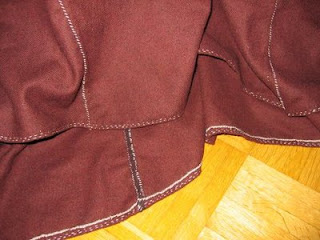


* There is a very thorough article on the shirt by Mytte Fentz, "En hørskjorte fra 1000-årenes Viborg" in KUML 1987; Årbog for Jysk Arkælogisk Selskab
0
JAN
16
0

Oh, those To-Do-Lists!

I have a huge To-Do-List today, looming beside me on my blackboard. I hope the amount of chalk white will be reduced significantly by tonight.

At least I have made good progress during the last two days, with finally an idea for a catchy advertisement phrase (that will go on the flyer/brochure thing) and an amount of writing done. Furthermore, I had the pleasure of reading a very old print (from 1573) in the library, which is always something special.

Word count in Current Writing Project today is 5.021 words. I wrote a bit more yesterday, but most of that is lying in a different file, as notes, and waiting to be edited into text and transferred. Rest of yesterday's work was mostly reading and thinking. The outline and the thoughts relevant to it are finished, and I have a pretty good idea what can be achieved with this book and where it can go.
0

By accepting you will be accessing a service provided by a third-party external to https://pallia.net/

Contact