

Latest Comments

Guest - Katrin Sprang Discussion
18 September 2026
Hi Rachel, I have looked for more photos of you, but that was not very successful. I found a link on...
Guest - Beatrix Sprang Discussion
15 September 2026
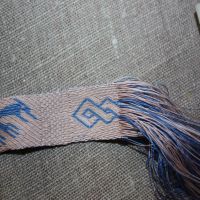
That lozenge pattern element is not a photograph, but a scan. So it should be to scale. But I pinned...
Guest - Katrin Sprang Discussion
15 September 2026
I was not referring to Rachel's reconstruction (is the reconstruction you refer to the one photograp...
Guest - Beatrix Sprang Discussion
14 September 2026
There is something Rachel did not mention. She told me: "Well, I worked with the measurements we too...
Guest - Katrin Sprang Discussion
14 September 2026
Well, this is certainly developing into an interesting discussion. Firstly, going from that lovely l...
JAN
14
0

Libraries

I love libraries. Especially those where you can keep the books for a long time.

Having studied in Bamberg, I grew used to the wonderful library there, with very friendly librarians, good light, lots of tables (and in the archaeologists' library building, with a wonderful view included) and very kind and fast service. There's the "book of wishes", for example: If you miss a book in the catalogue and think that the library should have it, you write it into the book, and most of the times, it gets ordered. (And then you get that wonderful book with a slip of paper between the pages, saying "Your Name" and "Erstausleihe" (first loan).) Thank you, TB 5 in Bamberg!

The library in Erlangen, on the other hand, has not too many books for my research. And those they have are all scattered across town, standing in smaller library rooms with often reduced opening times. A lot of those books can't be checked out. There's only one Erlangen feature I miss in Bamberg: You get an automatic email notification once your book is nearing the end of checkout time. Nevertheless, this wonderful feature won't help anything if the book can't be checked out.

And that is the main reason I'm still going to Bamberg now and again: The wonderful library. (I don't mind at all that it also gives me the chance to have coffee and a chat with friends and colleagues there, too, during much-needed library breaks.) And today is library day, so I'm on my way to the car, lugging along a stack of books that need to be returned (or, in some cases, checked out again). And I'll come back home with even more books.

0
JAN
14
0

Paperwork buildup

Somehow, that nasty paperwork stuff has a tendency to agglomerate on my desk. I have a stack of urgent, semi-urgent and non-urgent paperwork stuff to occupy myself with, and I really feel like I should tackle it today. If not yesterday.

Well, usually I am glad about any pronounced drive to do paperwork. The problem is that I have dedicated this week to work on Current Writing Project, and I want to stick with that decision. I have given myself an incentive to get a chunk of work done, shaping the project and doing the groundwork, and that is what I want and need to do. Current Writing Project is coming along nicely, by the way, sporting 3412 words at the moment.

Still, those urgent paperwork things nag me and nibble at the back of my conscience daily. Do you know that situation? Do you have a fail-safe, fool-proof, wonderful way of dealing with that? If so, please tell me about it!
0
JAN
13
0

Kruseler and Hairdos, Part I

Since my kruseler is finally finished, I have started to play around with it. It is not as voluminous as the one worn by the lady on the left, but the appropriate size and form to try things out. As a result, I feel like I'm finally getting the knack of putting up the hair and then putting on the veil so it looks like the medieval pictures show.

When wearing a kruseler, it depends mostly on the hairdo worn underneath whether it will sit nicely or not. I am sure that form and type of the hairdo will also decide whether the finished thing looks more angular or more rounded.

The updo I'm mostly using for trying things is the "logroll", one of my staples for wearing my hair. I will try to make a proper description with photos during the next days, since that is much easier than trying to describe.

The importance of the hairdo, in turn, means that putting up the hair in the appropriate (and symmetrical) way will make or break the kruseler reconstruction. Fortunately, I have long enough hair to play around with all kinds of different braided and non-braided updos, though I still have problems to fix the buns at the temples. With braids, it is a little easier to put up the hair - unfortunately, I especially like the smooth unbraided hairdo that can be seen on the Arnolfini Portrait. I have not managed yet to replicate it properly, but I'm working on it...
0
JAN
12
0

Garment Production

After a phase of almost no sewing work, things have advanced during the last two or three weeks.
I have finally finished a kruseler that is now waiting to be tried out with the appropriate hairdo underneath, and a woolen sideless surcote is finished apart from the hem. The upper area of the surcote is lined with rabbit fur for extra warmth, and I am looking forward to testing this garment, though proper wearing will have to wait some months.

While working with fur, I have also decided to sew myself fur mittens. I get very cold fingers very fast, and I have rabbit furs and wool, so why not make fur-lined woolen mittens to keep my hands warm? I wanted to make non-modern ones (of course) so I can also use them on medieval events during winter time (or in severely cold spots). For medieval handwear, both gloves and mittens are known, and in the 14th and 15th century, even "lobster mittens" (two compartments for two fingers each, and the thumb) can be found on pictures. I opted for the earlier (and warmer) classic mitten type, though.

There are not many finds of fur garments, and cut and shape are usually impossible to tell from pictures. But the bookshelf, again, comes to the rescue with Rainer Atzbach's wonderful thesis about the finds from Kempten in Southern Germany. The Mühlbach-Ensemble in Kempten is a complex of a few buildings that sported hollow spaces between floor layers and between rooms. Those were filled with remnants of daily life - fragments of clothes, wood pieces, dust, straw, coins, paper scraps, and so on. Because there was no soil environment, and because it was all kept dry all the time, vegetable fibres and furs have kept well.

Fur usually degenerates in the soil, due to the tanning process (with alum) that does not result in leather as resilient as oak-tanned (or similarly tanned) leather. Thus, tannin-tanned leather might still be found in digs with good conditions, while furs or alum-tanned leathers will have disappeared. And this is why the Kempten finds are so important: It is the largest known find of furs from medieval times. If you can read German, Rainer's book "Leder und Pelz am Ende des Mittelalters und zu Beginn der Neuzeit: Die Funde aus den Gebäudehohlräumen des Mühlberg-Ensembles in Kempten (Allgäu)" is definitely worth a look. It is not only a documentation of the finds from Mühlberg, but he also gives very well-researched, concise histories of leather and fur garments. If you need to know something about shoes and fur garments, the book is a good start to delve deeper into the topic.

By the way, the first mitten fur lining is finished already, and the second one is coming along nicely. I hope to finish both mittens, including the woolen layer, on Friday.
0
JAN
09
0

Freezing cold!

It's about 10°C below zero outside, the coldest it has been in this otherwise mild region for ages. There's snow outside, covering most of the bike paths and some of the streets, and for once it has not turned to mud and slush. People are bundled up in thick, warm jackets, wearing gloves and scarves and hats; bicyclists slow down while their wheels dig forward through the snow.

I'm sitting in my cosily heated study again and pondering the near future. Two of my projects have ground to a halt, one lying on ice for the next four months, the other tagged with "take it easy, go slowly, evaluate thoroughly" and thus not on speed either. So this is the time to occupy myself with number three, going on with building the concept and figuring out things - mostly reading and brainstorming work. And with that phase come the worries - is it enough? is it too much? is the concept good? how long will it take? how much good, useful material can I get?

So the next week will see me stockpiling books from the library, reading, researching and brainstorming. I am confident that by the end of next week, I will have a nice concept and a better overview over the topic, since I have already done some preliminary work on this a few months ago. And probably I'll be all excited about it again and raring to write. While the phase of doubts and worries can be stressful, I'm still glad about it - after all, it is a good thing to re-evaluate and re-think a concept after a while. And a little doubt can help a lot at the right place and time.
0
JAN
08
1

Connecting Textile Researchers

Things always come up in bunches - like when you are going to a flea market, and there are lots of stalls selling, say, pots? (Probably when you are not looking for a pot, that is.) And the next time, about everybody sells plates? Somehow, there seems to be something in the air that will instigate the same thing happening at several places.

With research, it seems to be the same thing. There are several things on the Skjoldehamn garments that have cropped up over the last years, and I have just realised that I'm way behind on this topic. Those garments are still extraordinary (there are only two proper trousers from the whole European middle ages that I know of, and one comes from Skjoldehamn), and I'm sure they will stay special forever. And I am very glad that they are getting re-evaluated and reconsidered, because they are absolutely worth it.

And now, connecting textile people seems to be in the air as well. I have received a very nice e-mail from Beth Matney with information about a duo of lists, started to help us all keeping up with the goings-on in the historical textile world:

As you know, it is a bit difficult to keep up with the literature, conferences, symposia, etc. in the field of textiles and clothing from the post-Roman through the early modern periods (500-1600CE). It is a field spanning many disciplines in many languages with the indexing of the journals quite scattered (if indexed at all) and many titles not well publicized or easily available. Well, in an informal discussion after a DISTAFF session at the last International Medieval Congress (Kalamazoo 2008) several of us (Dr. Carole Collier Frick, Dr. Gale Owen-Crocker, Robin Netherton and Beth Matney) bemoaned this and it was decided that an elist might be useful. So I have created two Medieval Textiles and Clothing groups:

A discussion list (restricted membership), MEDTC-DISCUSS: http://groups.yahoo.com/group/MEDTC-DISCUSS/

and a newsletter list for announcements of titles, etc. : MEDTC-RESOURCES: http://groups.yahoo.com/group/MEDTC-RESOURCES/

Though MEDTC-RESOURCES will include the titles and announcements from MEDTC-DISCUSS, it will not include any of the discussion of them and only in MEDTC-DISCUSS will you be able to post directly.These lists are academic in focus and scholarly in tone. Please see the full descriptions at the links above.
(Text Beth Matney)

So for all of you interested in historical textile stuff, maybe one of these lists would be a good idea!
0
JAN
07
0

Spinning Threads

Over the holidays, I have finally found the time to pick up my hand spindle and do some spinning.

I like to spin, I just never get around to doing it - there are so many other textile things that beg for my attention or that lie around half-finished. And so my spinning implements lie dormant most of the time. Since there was not much space at the lodgings where we spent the days around New Year, and since I was not up to complicated work anyway, I sat down and spun on the hand spindle. The output of the two hours timed spinning - normal thin thread and thicker thread, for one hour each - is still on the spindle stick, waiting for evaluation. It will be useful for preparation of the spinning experiment, one part of the Textilforum that I am very excited about: An experiment to find out more about the influence of the spindle and the spinner on the thread produced. If that has piqued your curiosity, you find the whole outline for the experiment on the forum pages, here.

The date for the Textilforum is not yet fixed (and thus not up on the website) - we are working on it, though, and hope to have it nailed down and ready for publication by the end of the week. Unfortunately, it is not too easy to find five days where we can have most of a museum and not get a date cross-over with one of the other textile or experimental archaeology events taking place in autumn - so if you have some fingers unoccupied, please keep them crossed for us!
0

By accepting you will be accessing a service provided by a third-party external to https://pallia.net/

Contact