Latest Comments

Guest - Harma Too Many Images Error.
27 November 2026
There have been weeks in November in which I would talke about 800 pictures. Proof of very interesti...
Guest - Max Mustermann The True Cost of Driving a Car.
06 November 2026
Great breakdown — the non-fuel costs are exactly the bit most people forget when they compare cars. ...
Guest - Harma Phew. Now it gets involved!
21 October 2026
Have fun at these events.
Guest - Aislinn Dyestuff Citizen Science.
09 October 2026
This is a great project. I look forward to the results. Thanks for letting us know.
Guest - Aislinn Time for...
09 October 2026
Looks delicious!
JUN
11
0

Double CTR Lectures Tomorrow!

There are two hybrid lectures hosted by the CTR tomorrow:

Textile Research in the Pre-digital Age AND Vindolanda, Berenike, Qasr Ibrim: Securing Textile Records for the Future.
Lectures by Lise Bender Jørgensen, Emeritus Professor of Nordic Archaeology at the Norwegian University of Science & Technology, Dept. of Historical Studies and John-Peter and Felicity Wild.

Time: 12 June 2024, 14:00-14:45
Place: South Campus, room 11B-1-05 and on Zoom
Organizer: Centre for Textile Research (CTR)

Abstracts:
Textile Research in the Pre-digital Age
This talk will present Bender Jørgensen' work on archaeological textiles during the 1970s and 1980s, which included visiting museums in most of Northern Europe at the time of the Iron Curtain, followed by field work in Egypt during the 1990s.

Vindolanda, Berenike, Qasr Ibrim: Securing Textile Records for the Future
Detailed records of archaeological textiles, written, drawn and photographed in the field, are vulnerable, particularly when they are not digital and have no secure home. Total digitization is a partial solution. In this discussion we present and comment on the (incomplete) digital archives for three key Roman sites, copies of which are being deposited with CTR for long-term curation, and use.

You can join the Zoom Meeting with this link, or use the Meeting ID: 629 5654 6156 and Passcode: 468241.

And if you're interested in more events and lectures by the CTR, check out their website! 

0
JUN
10
1

Presentation Ponderings.

I'm currently working on translating (and shortening...) our NESAT presentation for an upcoming conference in German, and this, together with some other things, has made me ponder how presentations at NESAT, but also other conferences, have changed during the past years. Or maybe I should really say decades, but that makes me feel old.

Back when I started out in Uni, standard was still having slides, and one of the guidelines that a tutoring archaeologist gave us was two slides (shown in parallel) per minute when you are planning your presentation. 

Then came the advent of PowerPoint, and the utter freedom to have as much text, and as many pictures, as you wanted. In as quick a sequence as you wished to, because you're doing the clicking yourself and don't have to say "weiter" (or knock) so your helper puts in the next slide.

At the last NESAT, we had one old-style paper presentation (with powerpoint, but the rest of how it was designed was really more like back when slides were the usual thing), and the rest of them were all "modern style". The big difference, for me, was that the old-style presentation was slow enough in both text and images that you had enough time to jot down the key points and you could even have made a quick sketch of the key parts of the images. With the modern style presentations, you stand no chance. Information density and slide speed is so high that you cannot write fast enough for all the key points, let alone try and sketch something. Very few exceptions apply, but for me, the way to get the most out of the papers in modern style is to write down the things I find important or interesting that the speaker says, but that are not written as bullet points on the corresponding slide - and I make a photo of the slide in addition to that. 

Thinking back, this has changed over the past years too, I remember being able to write down more of the content that was presented. I don't think I have gotten that much slower in writing; my impression really is that the papers have become more densely packed with information all the time. (I do confess guilty of trying to fit as much into my presentations as possible, so I have definitely played my part in this development. Case in point - our NESAT presentation had 47 slides in total, for a run time of max 20 minutes. That's about 25.5 seconds per slide if you distribute the time equally.)

Looking at it like this, it's a small wonder we were all so tired after the conference days! It also seems to be quite different in other disciplines... which I also find very interesting. Maybe I should venture out to more neighbouring discipline conferences in the near future, to compare. 

0
JUN
07
0

Textiles from Prague Castle - Book

 I found out at NESAT that I had completely missed a new book coming out last year - about the archaeological textile finds from Prague Castle! The book is written completely bilingual in Czech and English and spans textiles from the 10th to the 18th century. 

You can order it directly from the publisher's webshop here, or through your friendly book-dealer of choice. With almost a thousand pages, it's definitely a larger book, and I'm very much looking forward to it! 

0
JUN
06
0

Colour Measurements...

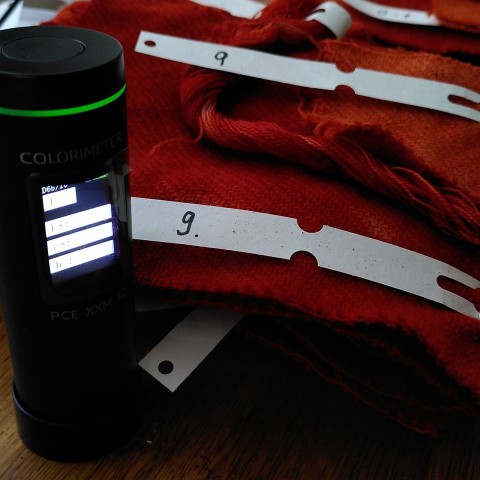
So after finding out about how difficult it is to judge, compare, and describe (or colour-list-match) colours by eye, I'm now trying to see if a colour checking tool is helpful in this regard. Which means... hearing a lot of beeps.

Because every time this thing here takes a measurement: 

...there's a little beep.

I'm going for averages, since the samples are not all completely evenly dyed, some more than others. So I've been taking 20+ measurements of each sample so far, and now I have enough to go and see if the data looks useful, or not.

For today I've definitely heard enough beeps!  

0
JUN
05
0

Citizen Science Project "Deep Time"

A citizen science project called "Deep Time" has led to the discovery of a large number of archaeological sites. The project was made in collaboration with the National Trust, and was a large-scale analysis of LiDar scans.

You can read an article about the project on the Guardian's website here, or visit the digventure site to learn more about this and other projects.

0
JUN
04
0

Refashioning the Renaissance.

There's new exciting projects popping up... and sometimes it takes me a few years to find out about them. Like the "Refashioning the Renaissance" project, a large research venture about everyday clothing and fashion in the Renaissance. It's based in Finland, but the website is in English.

The project encompasses quite a lot of different research bits and pieces, such as the re-making of a silk stocking, dyeing tests, and more - you can read about those on the project blog. The project will still continue for a while, and I hope they will get to do a lot more fascinating things!

0
JUN
03
0

Medical Shenanigans Part 2, or: What I Learned.

I did learn a great deal during my week-and-a-bit in the clinic. One thing that's rather easy to learn if you're lucky like me, and go through your procedure and recovery with very little trouble, is - humility. There's a lot of luck involved in the diagnosis and treatment of any disease, and when you hang out in a clinic, you will usually see quite a lot of people that have it much worse. 

I also gained a much deeper appreciation, and a lot more respect, for the people working in the care industry. Everyone on my ward was always calm and friendly, even if there was a lot to do. They were going back and forth all the time, and put in some extra time before their shift and some extra time afterwards to make sure the hand-over was complete, and their colleagues were informed about everything. Whenever there was an issue, they'd be there, happy to help. Any questions were answered if possible, or if it was a question for a doctor, that was stated clearly and then the doctor would be asked about it. Once I was woken up for the night-shift checks, and the lady apologised for having to wake me - even though it was her job to do so, and I knew when I went to bed rather early that this would happen. 

Working a care job is a very hard job, but seeing the people on this team, you'd never suspect it. They were, one and all, really wonderful and I can't praise them enough.

Another thing I have learned? How to administer an anti-thrombosis injection to myself. Because of side issues of Cushing's Disease like a less effective immune system and a higher risk of thrombosis, I got extra antibiotics plus extra anti-thrombosis injections for a full 5 days, 3 times a day. That was a lot of injections... and I was offered, straight from the start, that I could do them myself if I wanted to. After a few of them, and after one of the ladies managed to accidentally hit a spot where it actually hurt, I did decide to try it. The trick is to pinch a fold of muscle in your thigh (or belly, but I went for the thigh), insert the needle, then let go of the pinch and slowly press in the injection. It did not hurt at all that way. (It got a little uncomfortable and stung afterwards, as the liquid moved through the tissues, but that can't be changed. You also inevitably get a "blauer Fleck" around the point, proof that the anticoagulation stuff is working!) 

When you get surgery like mine, you also get to do fun things for a while. Such as dragging an infusion stand around with you; I quickly dubbed him Hans-Georg. Though, admittedly, we had a lot of fun together, the nurse's declaration that he would be my new best friend was not completely correct. I was quite glad to officially break up with him on Tuesday night! 

I also learned that I tend to drink a lot if there's tea available right outside my door, and I have nothing to do all day. Except, well, hang around and sip tea, especially as that also seemed to help my nose to get less congested. And sniffing the tea was a nice way to try and wake up the sense of smell.

Finally, I got told (before surgery) to ask for pain medication afterwards as soon as I'd realise the pain was coming back, or increasing. Both the surgeon and my roommate at that point made it very clear that trying to just endure the pain would be a very bad idea. The explanation? Traumatic pain like you have after a surgery is harder to dampen down the higher it was able to rise, and there's a kind of memory mechanism that will kick in over a certain threshold. You do not want to have pain memory. So, basically, waiting too long before asking for more pain meds after a surgery will mean that they take longer to take effect, and that you will need more and possibly stronger ones to work. Since I was not planning on having more pain than absolutely necessary, I asked for some more drugs straight away when I noticed the pain coming in - and that did work wonderfully.

Fun side story: When I first came to again after surgery in the wake-up ward, I had some pain in my nose (which was to be expected) and in my left ankle (which was utterly unexpected). The pain meds made the nose pain go away, but the ankle persisted in being really painful. I told the nurses about it, and there was nothing visible, no swelling... and then they removed the foot part of the surgical hose, and a minute later, the pain was gone. There must have been a tiny fold pressing on a weird spot!

0

By accepting you will be accessing a service provided by a third-party external to https://pallia.net/

Contact