Latest Comments

Guest - Harma Too Many Images Error.
27 November 2026
There have been weeks in November in which I would talke about 800 pictures. Proof of very interesti...
Guest - Max Mustermann The True Cost of Driving a Car.
06 November 2026
Great breakdown — the non-fuel costs are exactly the bit most people forget when they compare cars. ...
Guest - Harma Phew. Now it gets involved!
21 October 2026
Have fun at these events.
Guest - Aislinn Dyestuff Citizen Science.
09 October 2026
This is a great project. I look forward to the results. Thanks for letting us know.
Guest - Aislinn Time for...
09 October 2026
Looks delicious!
MAY
28
0

Medical Shenanigans.

So... I am back from my time off, and back from a wonderful NESAT. The health stuff has been taken care of at the start of May, and it was definitely an experience.

I could have gone on living very well without being medically interesting, but in things like that, well, you don't always get a choice. I was very, very lucky overall, however.

What I had goes by the lovely name of Cushing's Disease - and if a condition has "disease" in its name, usually that is not a good thing to have. My diagnosis happened more or less by a chance discovery of abnormally high DHEA-S levels, so I did not have any real, noticeable symptoms yet. Cushing's Disease is a rather rare condition; most people, however, have heard of Cushing's Syndrome, which has similar symptoms and is much more common. 

Both conditions are characterised by an excess of cortisone in the system. Cortisone is a good thing to have, in general (you need it for the flight reflex, for instance, or to handle other stressful situations both physical and psychological), but too much of it for too long is very much not-so-good. In Cushing's Syndrome, the excess cortisone can come from anywhere, for instance from a therapy with cortisone. In C's Disease,  it's all home-made stuff. In my case (which is the most common variety of CD), it was a little adenoma (a benign tumour) on the pituitary gland. That tiny booger had nothing better to do than sit there and secrete ACTH, which is the signal stuff telling the adrenal glands to get going on making some more cortisone. Because, well, the booger thinks it's a good idea. (If it thinks. Anyways.)

There's only one good way to fix this, and that's to cut out the adenoma. How this is done is fairly straightforward, literally - you go in through the nose, then make your way through the sphenoid bone, open up the bottom of the sella turcica where the pituitary gland sits in, cut out the adenoma, and that's it. (Well, you place the insides of the nose back where they belong on your way out, of course. The septum gets temporarily pushed to the side, which means two small incisions inside the nose, but they can't really be seen from outside.) Going for the brain through the nose is not a new idea either, as the old Egyptians did that already. (They may not have been so specific and precise with what they took out, though. I was quite determined to only do this kind of reenactment in a very much modernised and very watered-down version.)

So. First bit of real good luck: Diagnosis before the onset of any noticeable symptoms. Second bit of real good luck: One of the best clinics in Germany for this kind of surgery is in Erlangen. Third bit of real good luck: Everything went very well, without complications, and I had the best team, best nursing staff, and best roommates imaginable in the clinic for my recovery.

Now I have a lot of high-res images of my brain, with and without the booger in. There will be another check in about three months where I get to lie down on the really expensive wellness lounger again. (Pro tip: If you have to go for an MRI, bring a blanket or ask for one. I almost turned into an icicle my first time; the bed itself is heated, so you're warm from the bottom, but there's a cold air flow inside the machine, and that does mean business. I was afraid that I'd start shivering and would ruin the images! Second time I asked for a blanket and it was really nice and comfy.) 

I will also get the questionable treat of a lot more visits to the doctor in the future than I was used to, as hormone levels of all kinds need to be checked regularly for now. Time will tell whether my pituitary gland will take up its job again to produce ACTH - as it has been on pause for a good while, it might be a little miffed and not willing to do the work just now. (The surgeon said that for them, it's nicest if the gland never starts up again, as that means the tumour is gone and has not come back. Once production starts again, checks have to be made to see if it's legit and done by the gland, or if something has grown back.) So for a while, I'm now depending on meds to keep me going. That is a little scary, actually... but I'll get used to it for a bit, and I do hope I will be able to wean myself off the pills at some point. I can report that there was no problem at all with my dosage even hopping through Warsaw for the NESAT conference, which I was able to attend without problems. The only thing that happened was that I got very tired rather quickly in the evening, and a bit earlier than usual, but then, everyone was tired after the very intense days of the conference.

(Side note: It was a very good thing that I prefer the train to the plane and had arranged for a night train trip to Warsaw and back - you're not allowed to fly for three months after a surgery that goes inside your skull. So I was very, very pleased to have travel plans compatible with after-surgery guidelines!)


0
APR
29
1

Blog Break .

The month of May will be full of different appointments for me, including one for a surgical procedure, which also means that I will unfortunately not be able to go to the Nadelwelt in Karlsruhe. Because I'll be off to NESAT following that, I'm putting the shop on hold for a while, and orders coming in will be sent off after May 28, when I will be back.

I'll also be having a blog break during that time, so I can take all the time necessary for recovering and don't need to squeeze in blogging between coming back home and going off to NESAT. 

So I will leave you with this image of my test weave for the fabric reconstruction:

The lower part is the one that's the best fit to what we are going for. The little test piece was done weaver-tensioned, and my selvedges are still, well, let's phrase it kindly and say they are offering a lot of room for improvement. But it's doing okay for what it was intended for, which is answering the questions "how will it look, approximately" and "will we get into the right range of thread density" and "does the amount of twist in the threads look about right". 

And then, just like with knitting swatches... you go for the big thing, and you hope. Which is what will happen while I'm off the grid, or a bit afterwards, depending on how things go, timing-wise. Keep your fingers crossed all goes well!

0
APR
26
2

Sizing.

Because I have to wet and stretch the skeins anyways, the plan for the warp yarns this time was that I add some sizing in that process, saving Silvia (who will do the weaving) from that extra prep step.

As it's here and available already, we settled on animal glue for the sizing. The idea behind sizing is to strengthen the threads against friction and abrasion on the loom, making it easier to weave and giving a better end result. So I dissolved some animal glue in warm water, bathed the skeins in their hot bath to set the twist, pressed out as much excess water as possible and gave them a good long soak (about half an hour) in the gluey liquid. 

All this was followed by the usual draining of the skeins, then stretching them and hanging them with a weight to dry. In this case, I made sure to move them frequently, especially at first, to prevent them from sticking to the drying rods.
All five skeins are almost dry by now, so they will get packed and sent off soon, and then we'll see how things go...
0
APR
25
0

Prototypes!

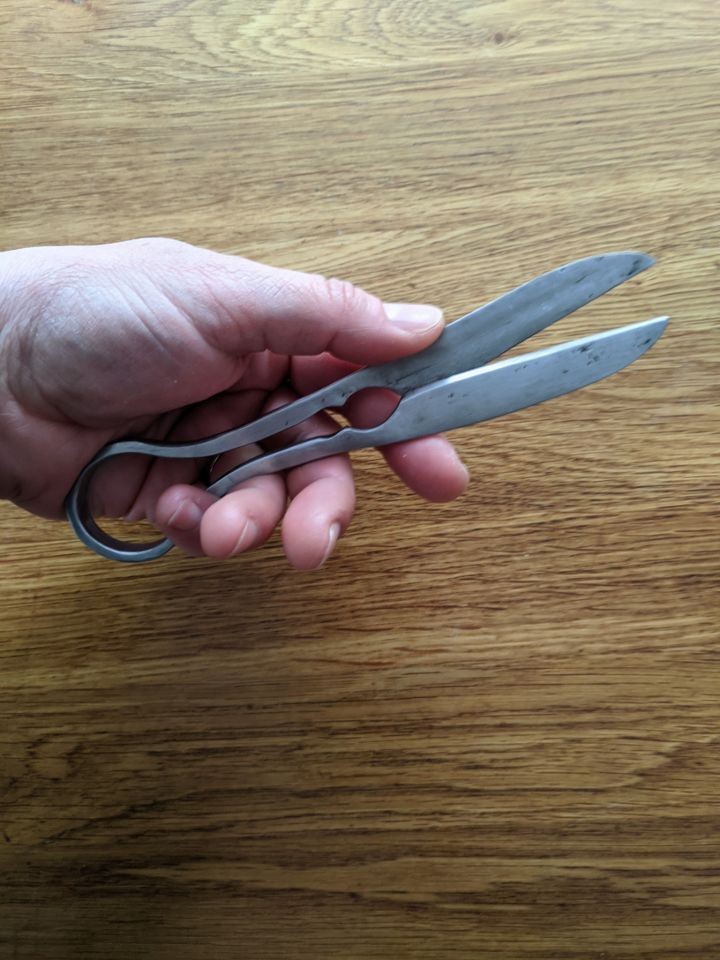
I'm very, very happy about two wonderful prototypes... of shears!

Shears were more common than scissors for most of the Middle Ages, at least according to archaeological evidence. They are still in use for some things today, so you can relatively easily get simple shears in either a fairly large or a very small size - for shearing sheep, pruning plants, or snipping threads.

The medium-sized shears, though, they are hard to come by if at all. And if you're going for historically correct shapes of the blade and the overall form, well, here's none of them that will pass scrutiny. So for years, I have searched for someone willing to accept the challenge and make shears for me to sell.

Finally, I found someone. These shears are made just like the originals were: With steel cutting edges, welded onto the iron body, in the shape and size they should be (around 14 cm in length). A nice, rounded bow at the end, and a bit of decorative waves just before the blades start. They are sharp enough and well enough aligned that they will cut fabric nicely and cleanly. 

There will be a little bit of fine-tuning to make them softer to press together, as cutting at the moment requires a little more strength than is comfortable for doing more than just short bits, and then they will turn up in the shop at some point. And I am thrilled they will!  

0
APR
24
0

Exhibition Opening!

 There's an exhibition opening this weekend - in Lauterbach, about the everyday life on Burg Wartenberg. The exhibition includes some finds that have never been shown before and are not published anywhere as images, plus some finds that have been newly evaluated.

Alas, I won't be able to go there, as I will be in Kamenz demonstrating spinning - but I do hope I'll be able to see the exhibition at some point! 

0
APR
23
2

Experiment!

And now for something completely different... I found this very amusing, and I hope you do, too! 

0
APR
22
0

Spinning Speed Ponderings, Part 6.

And because I arrived at the conclusion that it might be interesting for you to watch, here's a video showing... spinning. Or, to be more precise, drafting. That's me production spinning for the current project, and the bobbin that I made this video on averaged out at a little more than 160 m per hour. (Personal best.) All you will see is my drafting motion, and I found it very, very boring to look at, but then I've looked at this from a slightly different angle for a lot of hours by now, and it's much more interesting if you're actually doing it. (Still of limited interest though. A hundred times a very little will still not be much...)

Again, this is possible because the wool is very easy to spin and the thread is in my absolute comfort zone, thickness-wise. I need to concentrate more than I have to do at slower speeds, and stopping the spinner for adjusting the winding lead on the flyer has to be done slowly and with care, otherwise there will be a lot of slack thread. Similarly, starting up again should be done slowly.

Both hands are working here, by the way, though the front hand (my left hand, I'm strongly left-handed) does most of the moving. The other, though, subtly presses down on the fibre a way back or lets go, which helps me to draft evenly, and turns the end of the top to help catch the fibres that I want to catch.

The spinner can do a max speed of about 1650 rpm, and it's set to a little less than 3/4 max, so it's probably runnning somewhere around 1000 to 1200 rpm. I have about 1.5 bobbins to go for finishing the warp, that's a bit more than 1.2 kilometers. And then... the proof of the pudding is in the eating, and the proof of the yarn is in the weaving (and then wearing). 

0

By accepting you will be accessing a service provided by a third-party external to https://pallia.net/

Contact