








It's a holiday here today, so you're getting this stream from a webcam watching ospreys instead of a proper blog post:


It's a holiday here today, so you're getting this stream from a webcam watching ospreys instead of a proper blog post:
If you're a textile archaeologist, there's one highlight, conference-wise, that comes up every three years: the NESAT. Short for Northern European Symposium for Archaeological Textiles, this started as a very small thing to make a few lone textile researchers a little less lonesome - and now it has grewn into something relatively large, and absolutely awesome. My first NESAT was the one in Copenhagen, Number ten (and I still have the t-shirt, literally).
Now the Call for Papers for NESAT 15 is out. It will take place in 2024 in Warsaw, Poland; the CfP is open until the end of October this year. Find out more, if you're interested, on the official conference page here.
A long, long time ago, I stumbled across EscapePod - the weekly science fiction podcast. I don't remember exactly how, or why, but listening to the episodes became a wonderful way to keep me entertained during long hours of textile work, or long hours of driving in the car. I managed to listen my way all through the whole back catalogue, and there were very, very few episodes that I didn't like.
So at one point, liking it so much, I got myself listed in the Escape Artist narrator database... thinking that I might, at some point, get sent a nice story for EscapePod, and read it, and that would be very cool.
Well. I did get narration requests - but not from the 'Pod, but from Cast of Wonders. And apparently it wasn't completely horrible, because I did get more (very occasionally, but that's totally fine with me - it does take a chunk of time to do the recordings and the primary editing). The most recent one has come out in May, and if you're curious, you can listen to it here.

A few years ago, we stopped mowing our lawn - which, back then, was consisting to about equal parts of grass, wild thyme, and moss. It still has these three components, but now a lot of flowers are blooming in the ex-lawn. Most prominent are scabiosa flowers, with their distinctive pink pollen - and we know our neighbour's bees come to visit them a lot, as he tells us they come home with pink pants.
The flowers are not only making the bees happy, though. There's also some flower heads that are lacking their half-ripe seeds, and some of the stems of these flowers are broken. And here's one of the reasons:

There's a pair of these, and they stop by quite often. They are very shy, though, making it hard to get a decent picture of them even with a tele lens...
I'm absolutely delighted every time I find a new manuscript fully digitised and freely accessible online - it makes research so much easier, and really helps to get a better overview of what was used and available in the Middle Ages.
Yes, not every book has illuminations, and of course not everything is shown in manuscripts, and also of course one needs to take what is shown with a grain of salt, or sometimes maybe even a teaspoon of salt. But still - the more different images you get to look at, the more chances you have at seeing something for the first time, or seeing something way clearer than before.
That all said, here's one of the richly illuminated books, online for your pleasure: St. Elisabeth's Psalter, made around 1201-1208. Click on the eye on the book at the right edge to leaf through the book.
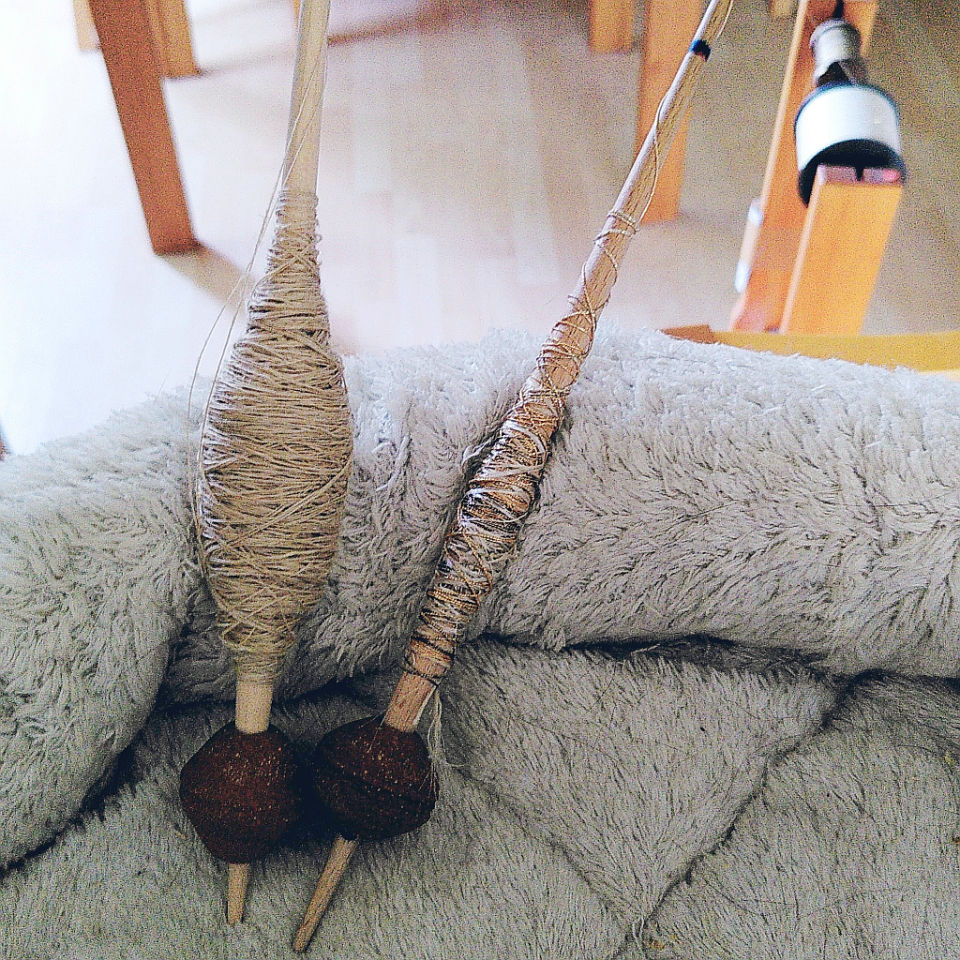
If you're following me on Instagram, you may have seen some pictures of this on-going project already. It is, so to say, a left-over from last year's European Textile Forum, where we tried to explore the making of membrane gold threads.
Membrane gold threads are the cheaper version of real gold threads - it's a gilt animal membrane wrapped around a fibrous core. In our case, we built on the analysis results of some Italian threads that Cristina Scibé is researching.
There's a lot of unknowns or insecure things in the reconstruction of the process, and we were (and mostly still are) unfamiliar with most of the materials involved, so there was a really steep learning curve and there were plenty of "d'oh" moments.
But we have arrived at a process that is working, and that would be plausible also for production.

The photo shows the two spindles I am working with for wrapping strips of stuff around the core - one with the two linen single yarns, and the other with the wrapped yarns. These are not membrane strips, but modern metal and metallised plastic strips, done for practise purposes, as the membrane is a little too much work and too much of a resource to use as training material.
It's an utterly fascinating project... and I will give a little presentation about it on the EAA in Belfast this year. I'm already very excited about that!
One of the goals of EuroWeb is making it easier to research textile heritage, and one of the steps for this was the development of a Digital Atlas. This has been launched recently, and you can now take a look at the Atlas here.
It's of course a work in progress - and contributions are welcome.
And here is the launch, as the recording of the livestream:
By accepting you will be accessing a service provided by a third-party external to https://pallia.net/