








It's a holiday today, so you get this picture of a sleepy cat:




Staying with the topic of membrane threads - one of the steps is, of course, to apply leaf metal to the organic substrate. In the original finds, this was very often gilt silver leaf, making the layer of gold even thinner and thus the whole thing even cheaper.
There's several different methods for gilding, and we used a modified form of water gilding for most of our tests. And because that is a very interesting thing unto itself, here's a nice video from the V&A about how water gilding is done:
I came across this video looking for the English version of some gilding terms, as I only knew the German ones - and I learned that for the last step, the application of the gold leaf, different liquids are used. I learned to do it with a mix of alcohol and water (and the German term for that is "Netze"), but I've found instructions now mentioning fish glue and just pure water.
The methods to transfer the gold leaf to the cushion vary as well. It's really, really fascinating!
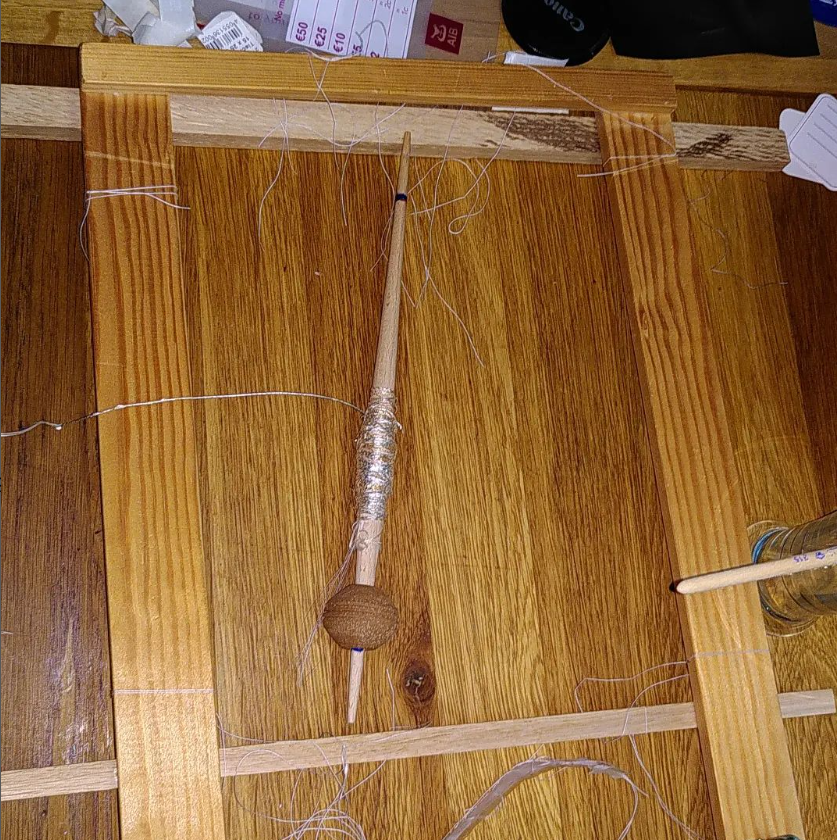
There's a bit of research happening here right now - not only for some work projects, but also for a little bit of extra. There was, you see, this project at the last Textile Forum to try and find out about how membrane threads were made.
Membrane threads are, to explain it very quickly, the cheap version of gold (or silver) threads. Instead of wrapping a strip of gold or gilt silver around a fibrous core, organic material is gilded or silvered with leaf metal and then cut into strips and wound around a core. Usually, that core is made of cheaper material as well, and not of silk like usual for the proper gold threads.
In our case, we used bovine gut membrane and linen thread as core, plus leaf silver for the silvering. There was a stack of questions when we started the project, and then there were more and more questions, and now there is still a lot, but also mostly new ones - which is nice, as it means we found answers for many of the questions from the first batch.
I will present our results in August at the EAA conference, and I'm already looking forward to that a lot. The next steps will be a comparison between the originals and our results (where one of the outcomes will, very obviously, be that ours are not very well crafted...) and then we will know more about how our process compares with the original one.
For now, though, I am very happy with what we did.

Even though we lack proficiency in all the relevant steps (mixing the appropriate glue, gilding the membrane, cutting it and winding it around the core), we have arrived at a workable solution for all the process steps that feels like it would be suitable for actual production. It's still a complex, time-consuming process, but then that's the case with so many texile-related tasks that it fits right in.
And I can't tell you how nice and satisfying it felt to actually produce silver thread in our last go at this reconstruction process!
Advertisement is an art unto itself - you want to be visible, and you want people to hear about your things, but you don't want to get on their nerves too much. (At least I don't, as I feel annoyed sometimes by too much explanations of how good something is... and I don't want to be that seller.)
Ads can be an art themselves, too, and especially older ads are quite interesting to look at. They do reflect the time they were made in, and sometimes they look weird and funny to our eyes, with different backgrounds and different lifestyles. And, in some cases, a bit more knowledge about what might be a good idea and what might not be one. (Radioactive potions, anyone?)
In case you, like me, enjoy looking at old ads once in a while, the Internet Archive has you covered. Here's their selection of advertising art from magazines. Enjoy!

Even though this was a sort-of-shortened week, I'm feeling more than ready for the weekend... which will include some work as well, as there's some membrane thread work scheduled to happen.
Before I go to have a coffee and a little break, though, here's a few more pictures for you, from the recent trip to Lisboa (more or less):

This here is very obviously, to any textile person who has looked at Roman textiles, an ice cream inspired by tunics woven with clavi. Very, very obviously.
I pointed this out to several colleagues who all agreed, and one of them was even inspired to have one. The guy who designed the packaging obviously had no clue whatsoever, since it shows a pirate... but yes. Clavi.

I've told you about visiting the Museo Arqueologico de Carmo - this is how it looks on the inside. Well, the half-inside - it's inside the museum and technically inside the old church building, but as you can plainly see, something happened to the church (an earthquake, followed by a fire, if you want to know) and the roof never got rebuilt.

And finally... some knitting happened! I have an unfinished hat that is brioche and more or less inspired by my Arabian Nights shawl, but it tends to spit out the needles when transported, so it's not exactly good travel knitting. Which means I had to start something new to take along, and I had to say goodbye to a pair of socks recently, and so I decided to start a new pair.
These are the Semki socks (the pattern is available for free on ravelry), and the yarn is sock yarn from Alte Künste, dyed naturally. It might not be the perfect choice for the pattern, but I am suitably amused by it, and I quite like the combination of colours and pattern, and think it's visible enough.
(Also today is obviously a day for long runaway sentences...)

At last year's Textile Forum, one of our topics was exploring how membrane gold threads may have been made. That is, in theory, a simple process - you take bovine membrane, gild it with silver-gilt leaf metal, then wind it around a fibrous core consisting of two spun vegetable fibre threads.
Simple, right? Well. As was to be expected, it's of course not so simple. First of all, how is the leaf metal attached to the membrane? There are a number of possibilities to do so. We tried using both oil and gelatin glue, and both worked. None of us was very proficient at gilding, but well, it was good enough for our purposes.
Next step: Cutting the silvered skin into strips. The original strips were less than one millimetre wide, and that caused problems as well - both with the cutting (which could be done with scissors, or with knives, we don't really know) and with the strips afterwards. Because it turned out that if you cut very thin strips, they start to curl up. Which is not very helpful for the following steps. There's also the question of how long the strips were... and there are no analyses that I know of which look at the length of the strips used to wind around cores. Or, in the case of flat strips, the length of these.

We found it much, much easier to wind a very long strip around the core than to use shorter ones, as the start and end always caused us problems. So we tried glueing the individual strips together... which basically worked very well, but we had issues with the glue: it was too brittle once dried.
So one of our next steps will be to try a different glue. There's also the possibility to modify animal glues with different additives to change their properties, including their elasticity, but we lack recipes for that, so we'll probably go with just the pure glues for now. (If you happen to know of any good, reliable recipes for making parchment glue or modifying it... they'd be very welcome!)
Things like that are the main reason why it's so important to do tests, and experiments, and try to recreate or reconstruct the actual working processes. Even if you're the best of researchers, it's just impossible to find out about all these small pitfalls by reconstructing a process on paper only. I'd never have considered how important the right choice of glue might be, or that the glue might be a crucial factor in how the membrane behaves - even though I've worked with glues a lot through my hobby bookbinding, and know from there that things will happen if you use the wrong glues, or too much or too little of them, or cover something on one side only. Which means I should have known, and as soon as the problem popped up, I went "oh yes, of course, that's an influence factor" - but before that... well. There's just too many things going on in any complex process (and most craft processes are complex processes) to consider them all without having the actual feedback from actual things being done.
And that all said, I will return to my preparation of some more tests in the project. It's guaranteed we will find some more questions, but I am hoping that we will find a few more answers too!
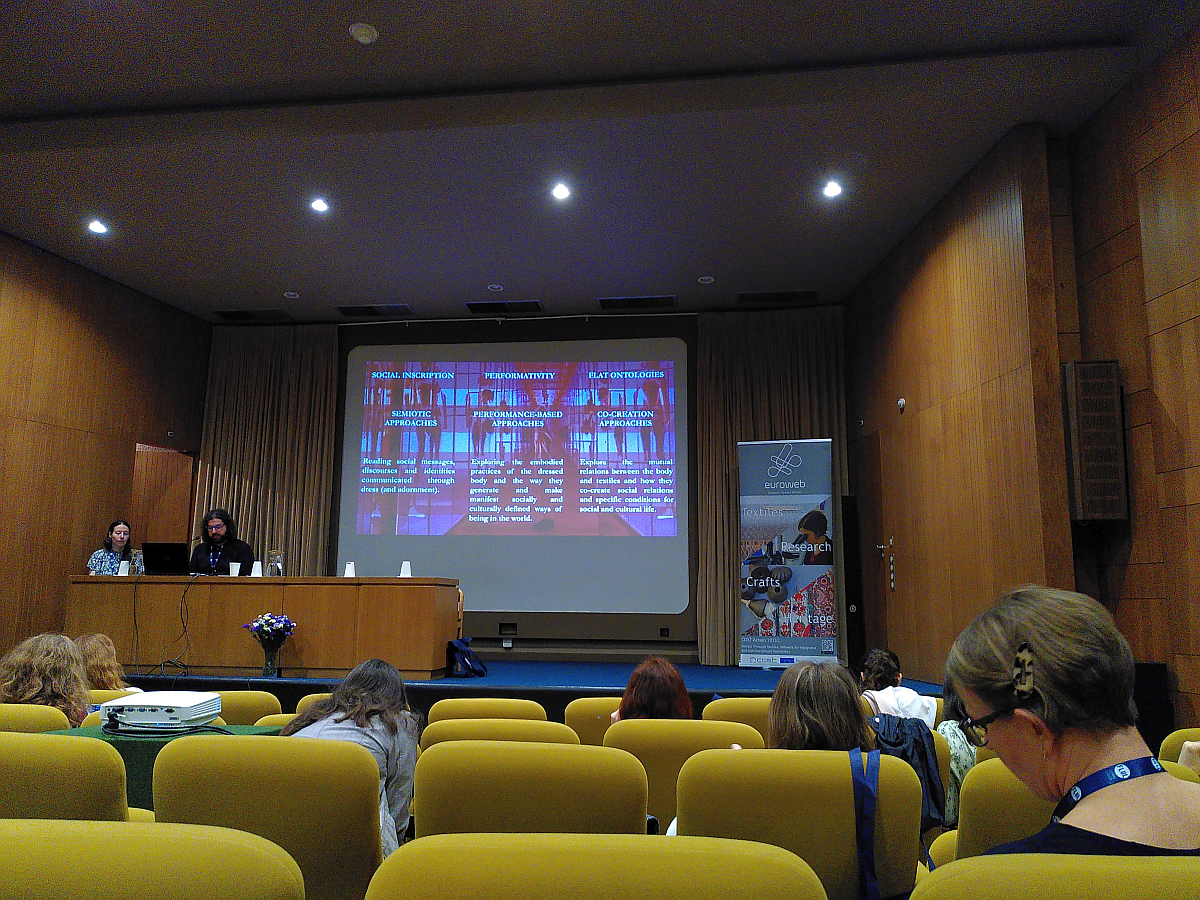
I'm back home from a wonderful workshop - and the title "Making, Wearing, Displaying: Textiles and the Body" really fit all the contents of the workshop.
We had a lovely mixture of papers and practical sessions, one of them involving modeling of various reconstructions of old garments. There was Iron Age and Bronze Age things, there were a few galloroman garments, and pieces from Xianjing - of which I got to model one. It was the earliest piece, put together from a lot of fabric that was mostly uncut, and a very interesting experience to wear. The two other garments from the same project were much more tailored and looked elegant from the get-go, while my gown felt more like hanging out on the couch and have chocolate and watch Netflix. (Or read a book, maybe.) While I've worn a good number of historical garments and garment reconstruction over the years, and most of them not just for half an hour or an hour, but for actual working and living in them, it was the first time I had something as loose-fitting and flowy, with no body shaping whatsoever. Very curious feeling for me.
There was also a workshop on Greek dancing (ancient Greek, of course), in the wonderfully warm sun, so it felt quite fitting. And then, of course, lots of papers about a huge number of aspects regarding textile and the body - from dental abrasions probably caused by textile work to a project looking at brain activity when doing textile work. The programme was really long and packed, but the organisers did an absolutely splendid job in how they arranged papers, breaks, and practical sessions to make it still easy to follow along and take in all the information.
We also got treated to a tour of the Ethnographical Museum in Lisboa, who graciously hosted us for the first two days, and to copious amounts of typical food and sweets (coffee breaks!) plus, of course, coffee.
Portuguese coffee is lovely, and I probably had too much of it - but did I mention it was delicious?

After the conference, I had a bit of time left to explore the city. I spent most of the two days I had walking up and down the streets, looking at things at a flea market, seeing the loom weights (and the museum mascot cat) in the Museo Archqueologico do Carmo, plus the Natural Science Museum and the Botanical Gardens as well as many, many streets in different quarters. There would have been much more to explore, but there's only so much you can do in two days, especially if you also have to take breaks to sample the local delicacies. There had to be an adequate sample size for determining coffee quality, for instance, and since there is not only the signature "pastel de nata", but a plethora of sweet baked goods in Portugal, these had to be sampled too.
Finally there were visits to a few supermarkets, because I always find it very interesting to see how goods differ from country to country, and on Sunday I spent some time doing what a lot of the locals did: Hang out in one of the parks, sitting on the grass and enjoying the day (in my case, with a bit of knitting).
And then it was already time to go home... with a few delays along the way, which meant I arrived a bit later than planned, but not castastrophically late. Now it's time to get back to work - with new insights about displaying dress and the body.
By accepting you will be accessing a service provided by a third-party external to https://pallia.net/