Latest Comments

Guest - Harma Too Many Images Error.
27 November 2026
There have been weeks in November in which I would talke about 800 pictures. Proof of very interesti...
Guest - Max Mustermann The True Cost of Driving a Car.
06 November 2026
Great breakdown — the non-fuel costs are exactly the bit most people forget when they compare cars. ...
Guest - Harma Phew. Now it gets involved!
21 October 2026
Have fun at these events.
Guest - Aislinn Dyestuff Citizen Science.
09 October 2026
This is a great project. I look forward to the results. Thanks for letting us know.
Guest - Aislinn Time for...
09 October 2026
Looks delicious!
JUN
02
0

More Bronze Age Stuff.

There is still some Bronze Age stuff going on - stitching, to be precise.

Because, well, after the Egtved things have been all wrapped up (and literally wrapped up and sent off to the museum), work went on with the men's garments, modeled after the find from Trindhøj. 

One of the pieces is a cloak, shaped like a half-oval. That, by itself, does not sound very spectacular. However, what makes it spectacular is both the size of the woven fabric. The cloak is approximately 126 cm long and 243 cm wide, and it's cut out, so the minimum size of the woven fabric must have been larger still.

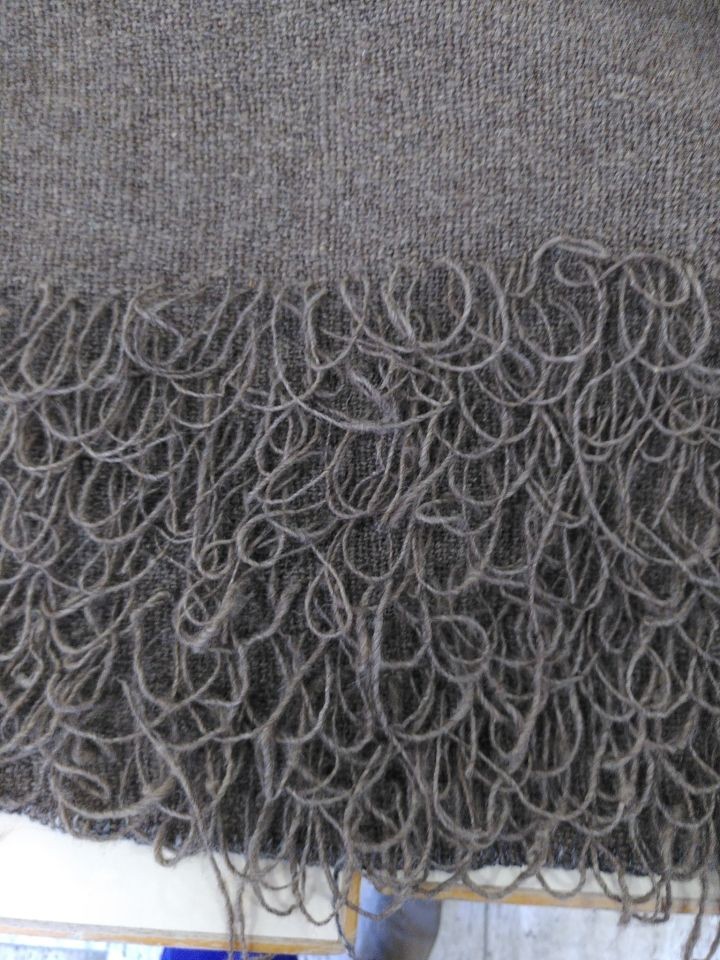
The other thing making it special and rather spectacular? It was finished with a sewn-on pile made from yarns. And this is what I'm working on right now:

It's rather pleasant work and each stitch does not take very long, but it's a large piece, and I am not yet at the thirdway point, according to my estimates. So... more stitching to do.

Also, there's several things that itch me in this: Because there's not much left of the pile, it's hard to tell how dense it was, how long the individual pile threads were, and if they were loops or cut open after being sewn on. There's also no good documentation or analysis of the stitch used to apply them that I could find. Which means I'm sort of making it up as I go along - or, in other words, I've tried around a bit after orienting myself after the reconstruction attempts done before, and analysis of another stitch used for pile, and found a process that feels good to me. Which I'm now sticking with.

All this is, again, a nice example of how one may have the impression that everything is known about a given textile... but once you start to re-create it, all the small and large gaps in our knowledge emerge. It's fascinating, and it's humbling, and it's always, always the case.

0
JUN
01
3

Just Because I Can.

Sometimes, you do things just because you can - and because it's (hopefully) fun. 

For two decades now, I've been part of a group of friends that meets once a year to do some book-binding, or related crafting. Each has their own stuff and tools and materials, and each has their own specialities and favourite tasks, and there's exchange of materials and ideas, and lending of tools (and sometimes hands), and a lot of friendly banter.

My typical agenda for each of these meetings is to make (at least) one document wallet, and (at least) one box. I like to make these, they are practical, and they also make very nice presents for deserving people. (There's quite a bit of work going into them, so they are not small presents, and I only give them to folks that I know will appreciate them.) 

One of the box types I like to make is a simple sort-of-brick-shaped one that can be scaled rather easily, and the cutting pattern I've worked out is handy to use up smaller bits of cardboard. You measure the width of your piece, divide that by 3 to get your magic number X, and if the length of the cardboard piece is 4X or more, you're good, and X will be your basis for cutting all the cardboard parts and all the cover papers.

Well. Sometimes the bits of cardboard that are left over are small. Quite small. So I made some tiny boxes the last years... and this time, I sort of wanted to know how low you can go, so to say.

The result? I've come to the conclusion that this is about it. My X, which equals the height of the pieces cut to form the box, and the width of the smaller side, was 7.7 mm. The cardboard was 1.5 mm in thickness - that's why the box looks higher in relation to its size than others made after the same pattern, but in a more sensible size.

I made it just like a proper large one, with outer covers, inner covers, and a nice lid with an inset so it will sit firmly on the box. It will accommodate a large grain of rice (several, in fact, if you stack them on top of each other) or a not-too-large dead fly (which was the running joke, as I called the larger version I made last time the fly sarcophagus).

I've had fun making this, and now I have a delightfully useless tiny little box. Ideas on what to do with it are very welcome!

0
MAY
30
0

I'm back, and it was wonderful.

I'm back from my gallivanting across the countryside, all the way down to the boot heel of Italy, and it was glorious.

I hadn't realised how much I had missed meeting up with colleagues for a conference and working together until I went to Vienna for a EuroWeb workshop and now to Italy. It was a three-day workshop about embroidery, and two days of travelling there and back each, and almost every minute of it was pure bliss.

Travelling took a while since I was not going to fly if avoidable at all, and it was avoidable by using a night train. As the direct flight connections to Brindisi or Bari were not convincing for her as well, I joined up with a friend in Munich and we travelled together, which just added to the fun. We had a night train from Munich to Rome, and then it's several hours again to get to Lecce and then Muro Leccese, where our workshop took place.

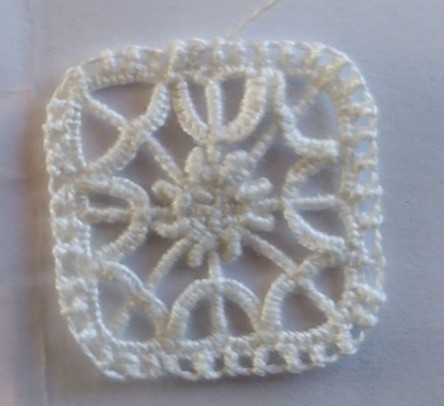
We had wonderful warm and sunny weather, delightfully delicious food, lots of Italian coffee, and incredibly nice people. There was a workshop on filet netting and embroidery, an exploration of Bronze Age embroidery stitches, an introduction to Punto Maglie (which is a kind of needle lace, which is something I'd wanted to do for ages and had never gotten around to), a number of presentations about embroidery-related research projects, many chats and discussions with colleagues, and oh, did I mention the food? I was in food heaven. 

I also worked on my appreciation of coffee without milk, or with very small amounts of milk - as I didn't want to be one of the touristy Germans who order cappuccino after breakfast. (When, on the last day, I discovered there was hot milk with the coffee break supplies, though, I did have a cup of coffee with lots of milk. And then a second one straight away. Due to remaining little bits of sense left in my brain, I didn't have a third one, though...)

Punto Maglie, taught to us by two lovely Italian ladies. In Italian, which added to both the fun and the learning experience. (I found out that I don't speak Italian, but can mostly understand Stitch Italian...)

I also learned a great deal and finally got to meet, in person, a few of the people I had met over Zoom beforehand, plus some new people. 

All things taken together, and the great hospitality of the local conference team (which even organised a little evening sightseeing trip to Otranto for us) added up to utter bliss for several days in a row. Utter, extreme, perfect bliss.

That was, by the way, the first time I've been to Italy. (I've been to South Tyrol before, but as both Italians and people from South Tyrol will tell you, that does not count as Italy. It's basically an extension of Austria where you can speak Italian, if you so wish, but German is spoken and understood about everywhere too.) I couldn't have wished for a better place to fall in love with the country.

My only problem now? My new favourite café is very, very far away from home...

0
MAY
24
0

Kestrels Breeding.

I like birds of prey - all of them. Which means I was delighted to find out that there's a webcam installed in a place in Germany... inside a nesting box used by a pair of kestrels.

The NABU (a German organisation for the protection of nature) has the livestream on their site, and you can find it here.  Breeding already started on May 12, so the chicks are expected for mid-June... not very long now!

0
MAY
13
0

Off To New Adventures!

Sorry for the blog silence yesterday - I had a very full day, and then I managed to eat something that did not agree with my inner plumbings at all. I'm still recovering, so it's taking it easy for the rest of today (the little cat being a very good model on how to nap inbetween).

Tomorrow I'll be off to a workshop on embroidery, organised by the wonderful people of EuroWeb - Europe Through Textiles.  The week after that has already been scheduled for some time off, as there's a public holiday on Thursday, making it predestined for an extra-long weekend.

So I'll be back on the blog on Monday, May 30. If you're looking for something to watch in that time, you might want to check out the conference recording from EuroWeb - Clothing Identities, here on their Youtube channel.

0
MAY
11
0

Stuff for the Germans.

Stuff for the Germans - I hope you'll enjoy this!

If you're in the Munich area from tomorrow to the weekend, you might want to have a peek into the Eisernes Haus, where there's an exhibition of modern artisan wares, including textiles from Sylvia Wiechmann's Damasthandweberei. Vernissage is from 17:00 on Thursday, May 12.

 The Germanisches Nationalmuseum has a very nice article (in German) about pictures in museums, their use on social media, and other aspects of taking photos in museums. You find it here on their blog.

If you've come across the phenomenon of people feeling "triggered" by apparently small things, and have sometimes wondered if there's a general trend to being more sensitive, or complain more about things, you might be interested in this article from the Süddeutsche.

That's three tabs less that are open in my browser ;) 

0
MAY
10
0

Finally Fully Degummed.

A while ago I wrote about dyeing silk and different outcomes, depending on whether it had been degummed or not. My degumming try that I referenced back in that post ended up being not completely successful, as some of the gum had still stayed in. 

I finally got around to doing it again, with a fresh sample, and this time I made sure to steep it to death, or something very close - it stayed in the hot soapy bath for a full hour, and I used de-ionised water to avoid any hindrance by our rather hard tap water. 

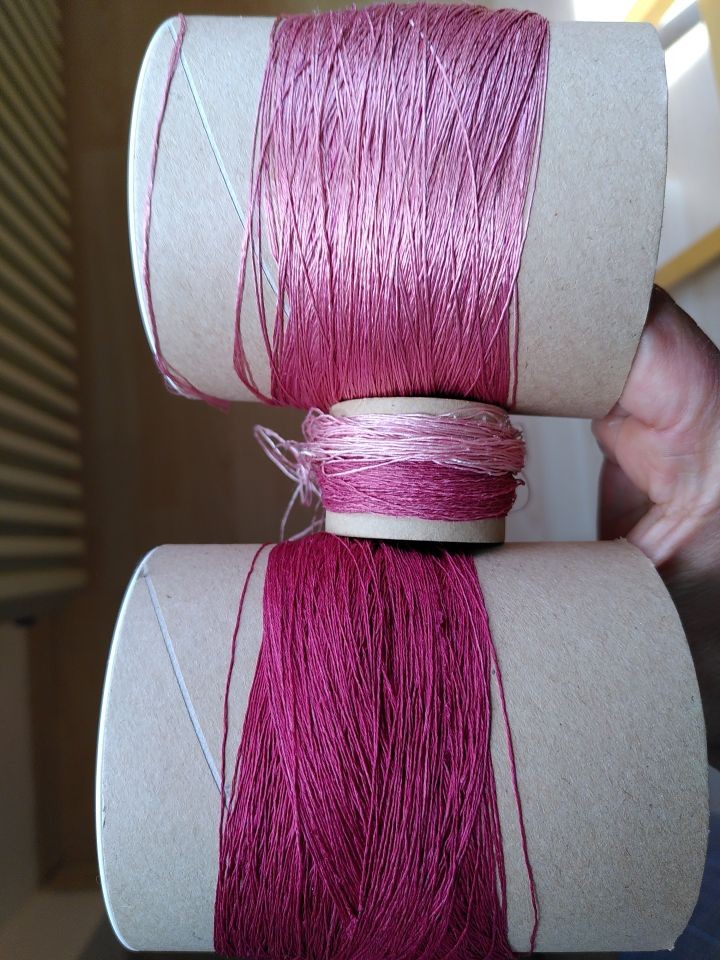
And here's the result:

As you can see, there's four samples now. The one on the bottom is the silk dyed in the gum, the one on top is untwisted degummed embroidery silk dyed together with the gummy silk. On the small roll in the middle, the bottom one is the outcome of my last trial, partly degummed, and on top is the completely degummed silk. 

It's become very light in colour, even lighter than the silk that was degummed before dyeing. I had expected something like that - either a bit lighter, or somewhere around the colour of the embroidery silk. 

There is definitely more shine now, but it is also much more delicate; I've had several snaggy bits even though it's a twisted silk. 

So my current conclusions are:

If you want to work with silk that has next to no twist at all, leaving it gummy or partly gummy might be a good idea to up the stability. The sericin also seems to take natural dyes much better, so if you want to have really deep, vivid colours... leaving it gummy or partly gummy is, again, your friend. In case you want it to be utterly shiny, though, degumming is the way to go.

Though I had the impression that the thin strands of gummy silk, with about 20 den, are also looking quite shiny. More exploration might be necessary...

0

By accepting you will be accessing a service provided by a third-party external to https://pallia.net/

Contact