







Latest Comments

Guest - Harma Too Many Images Error.
27 November 2026
There have been weeks in November in which I would talke about 800 pictures. Proof of very interesti...
Guest - Max Mustermann The True Cost of Driving a Car.
06 November 2026
Great breakdown — the non-fuel costs are exactly the bit most people forget when they compare cars. ...
Guest - Harma Phew. Now it gets involved!
21 October 2026
Have fun at these events.
Guest - Aislinn Dyestuff Citizen Science.
09 October 2026
This is a great project. I look forward to the results. Thanks for letting us know.
Guest - Aislinn Time for...
09 October 2026
Looks delicious!
MAR
30
0

Links (again).

I've made the mistake of doing a bit too much doom-scrolling in the past few days, including this morning. There's still war in the Ukraine, there's still really high Covid numbers in Germany, and there's still a lot of bullshitty stuff happening regarding energy and preservation of nature and sustainability here as well. It makes me feel sad, and helpless, and more sad, and that is not a very good thing. 

The little cat, however, is determined to brighten up my day by snuggling up to me on the desk, purring loudly, and I have the Vienna trip and presentation to look forward to. There's hot tea sent by a friend (well, not in its hot brewed state, obviously, but the tea bags), and finally a little light rain outside. While sunshine is nice too, the rain is much needed and appreciated, even if it means there will be fewer bees and bumblebees around today. 

I hope you have your own doom-scrolling under control, and enough nice things to brighten up your day. Maybe some links can also help? Here you go.

  • A German company is developing something like a cross between a pedelec bike and a tiny car - it seats up to two people, no driving license needed, and it has solar panels on the roof to help with battery capacity. Here's an article on Heise, and here's the manufacturer's website (both in German only).
  • The virtual convention "Flights of Foundry" is taking place on April 8-10. You can join in from anywhere in the world, for free.
  • It's a well-known fact that some plants thrive next to each other, and one of the prime examples are the Three Sisters. I tried a sort-of-doing-this last year, planting beans next to sunflowers (though with rather limited success - neither beans nor sunflowers usually thrive here, due to the rather poor soil in the garden bed I put them in). Here's an article about current projects on this on The Conversation.
  • In case I have not linked that before - the world's oldest pants were found a while ago, and have been analysed, and there's a nice article (with pictures) about them here.


And now I will return to getting something resembling work done...
0
MAR
28
1

Birds!

Today was birds-in-the-wintergarden day... it started off with a pair of black tits in the morning. When it's sunny outside, I open up at least one of the glass doors to the wintergarden, so that a) the plants get some unfiltered sunlight and b) the place does not overheat too badly. Sometimes, that means that a bird gets in and has a bit of a hard time to get out again, because it tries to fly through one of the closed doors, or one of the non-opening glass panels. 

That is not a huge problem unless Madame the Cat is on the premises - then it sometimes ends with a dead bird. Today, though, all the birds got lucky. 

The first of the black tits found its way out again straight away, while the second, smartly, sat down on a high rafter for a while. That was out of sight enough for Madame to lose some of her interest, and I could coax her inside (to visit her food bowl instead of looking for a feathery snack she won't eat anyways). After a while, the bird, now much calmer, went to explore the place in search of a way out, and was successful.

A few hours later, there was fluttering in the wintergarden again, and when I went in to take a look, two robins were trying to bore their way through one of the non-opening panes. Madame was outside on some important cat business at that time; I went and found the two birds to be surprisingly chilled. One was, in fact, so chilled that I could just grab it and carry it outside, where it refused to leave my hand and arm for a few minutes. I tried to transfer it to a nice place to sit on, but it hopped back onto my hand several times, and fluttered off only after it had shat on my arm. I've never had a robin on my finger before, and I can tell you that the grasp of these small, delicate bird feet is surprisingly strong, and that the leg length is astonishing.

I'd have loved to take a photo, but all the photo-taking implements were inside, and I didn't want to take the bird in there... 

Some minutes later, our cat returned from her important business elsewhere. Good timing, I'd say.

0
MAR
25
9

Crossdressing! Well, Sort Of.

There's currently a challenge going on in Instagram for Women's History Month: IG 14 from Austria has set out a list with a keyword for each day in March, and ask people to post something Living History or women's history related.  

Today's topic was "gender", and, well... here's a picture of me crossdressing, sort of:

I made that dress after Herjolfsnaes 42 (in Norlund's counting) way back, a long time ago. A good while later, having looked at more surviving garments, I realised that middle gores are a men's thing, and not to be found in women's dresses.

Why? You need middle gores in the front and back to keep a riding slit closed when not in use (and there are no riding slits without gores in any archaeological find). This changes the silhouette of the garment. That change, and the status associated with the riding slit, may be the reason why there are also men's tunics without a riding slit that still sport a middle gore, such as the tunic found in the Bocksten bog in Sweden.⁠ That, to me, makes a lot of sense. The dresses without a middle gore, by the way, make a slimmer seeming silhouette, and slenderness was - as we know from medieval epics - one of the aesthetic ideals for women.⁠ So this, too, does fit the picture nicely.

The dress, by the way, is very comfy and nice to wear, but would be the same without the middle gores. They don't really add anything (apart from some width...) 

0
MAR
24
0

Biased Much?

Sometimes, we fall into the trap of being human - there's certain things that we all just tend to do, and while they do make sense, usually, in an evolutionary context, it might lead to less than welcome outcomes in our modern world. Being human, and having these cognitive biases that we all have is, for instance, something that makes us vulnerable to con artists. Or to just acting stupidly all on our own.

One of the biases is the sunk cost fallacy - you've invested time, money, or both in something, and although reason tells you that it is a dead end and you should cut your losses, it is extremely hard to do so. I have definitely been a victim of that more than once! Confirmation bias is another very common one: favouring things that confirm what you already believe instead of staying objective and looking at your data in a more neutral way. Guilty, Your Honour.

Then there's also logical fallacies, such as using personal experience to dismiss statistics, or looking for patterns to fit a presumption (which sort of ties in with the confirmation bias). Recently, conversation between the Most Patient Husband of Them All and me has meandered to logical fallacies, and he has consequently presented me with a link to a very nice website, with lovely posters listing both biases and fallacies, which I now pass on to you for your delectation. You find them, and more, at www.yourfallacy.is and www.yourbias.is. Enjoy!

0
MAR
23
0

Online Workshop "Reconstructing Textiles" on Friday!

There's an online workshop on Friday titled "RECONSTRUCTING TEXTILES AND THEIR HISTORY: Egyptian Fabrics from the 1st Millennium AD at the National Museum of Denmark". It starts at 11:00 Copenhagen time, and there's a number of interesting topics covered - including some nalbinding, which is how I heard of it: Anne Marie Decker is giving a presentation there.

The workshop is open to the public, but you will need to register today or, at the latest, tomorrow in order to join in. You can do so via an email form that Anne has set up. She also posts the programme on her blog, and some additional information about both the workshop and its background. Go to her post at nalbound.com to find out more, and register if you'd like to do so, and I hope you have a lot of fun!

0
MAR
22
0

Guter Stoff!

"Guter Stoff" in German does not just mean a good (quality) fabric, it can also be used figuratively - either for something good to write about, or "Stoff" is also a slang word for drugs. Which means that guter Stoff is also a good drug.

If you know about these extra figurative meanings, it makes it sound much funnier when the Hansemuseum, in preparation for their next exhibition "Guter Stoff" is asking "Gebt uns euren Stoff" - give us your fabric. (Or share your drugs with us.) They are looking for items of clothing (or other fabric pieces) that have a history - or, to put it another way, that provide "guten Stoff" to write about. One piece will be chosen to be part of the exhibition itself, in the section about sustainability, and other items and their story will be shown on the website.

If you have an old item of clothing in your closets, and would like to participate, you can find the email to send your photo and story here on the museum website - the section is in German only, but sending your mail in English will be no problem for the team.

0
MAR
21
2

Springtime! Seedling time!

It's springtime for real now, or so it feels - getting warmer, more and more flowers opening up, and I sort of feel the slight pressure to get some of the spring gardening things done, such as planting peas.

I'm also sorting through the seed stock, as there are a few packets of seeds that are probably too old to be viable anymore. Some of them I've seeded out of curiosity to see if anything will still come of it (though I'm not expecting any luck with 10 year old tomato seeds), some I've scattered in the garden (either they sprout, or get eaten by something, either way it's fine) and some are not sorted into either category yet. There were some tomato seeds that had no year with them, so I've seeded those, too. 

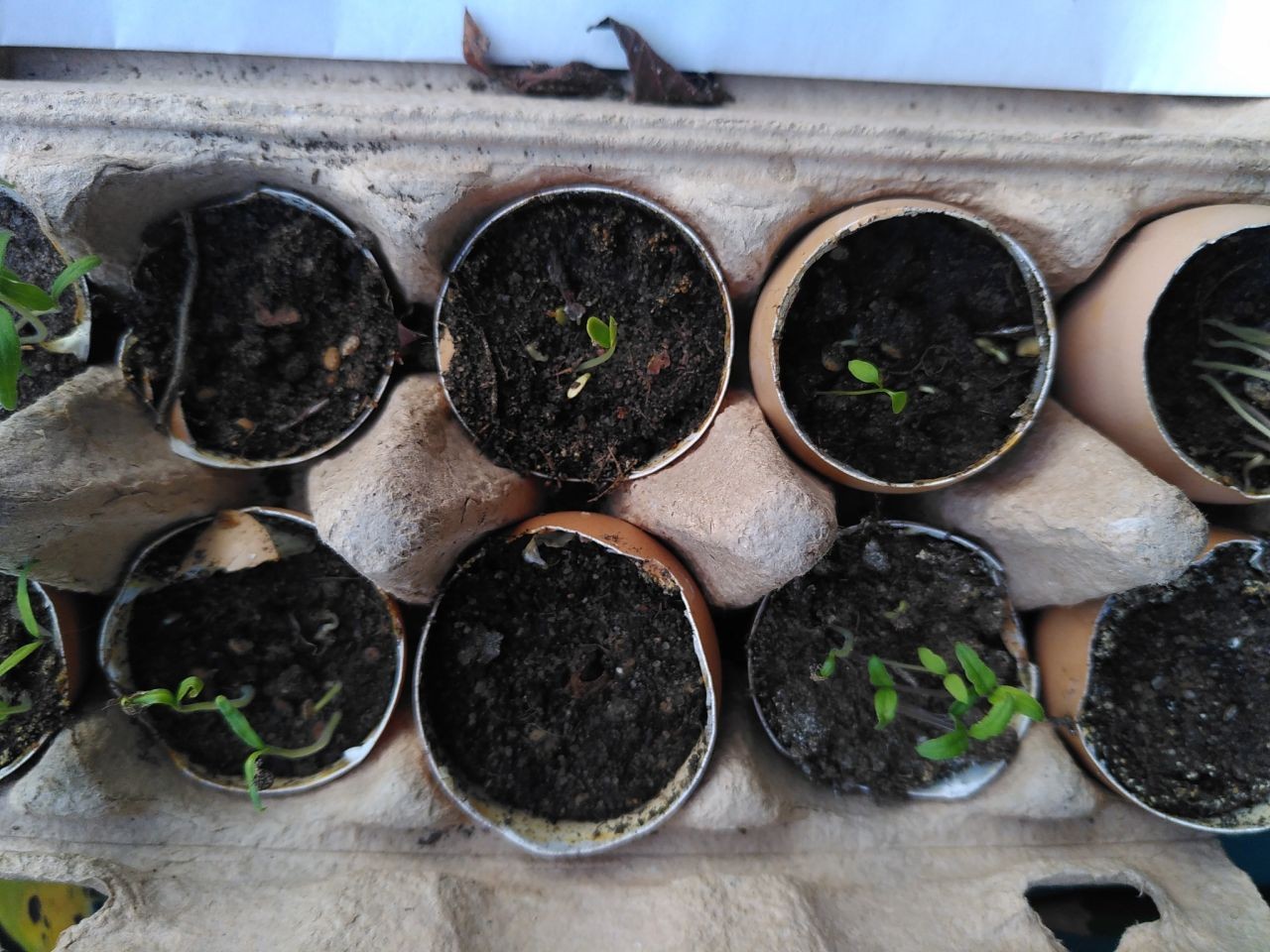
I've also tried something new this year, seedling-wise: 

I've used trays in the past, but they only worked semi-well; this way, I can have an eggshell for each variety and put them somewhere else if necessary (like out into the wintergarden once they have germinated, so they won't grow too tall and lanky for lack of light in too much warmth - which they need to get started). If you're thinking of trying it too, I found that the shells should be a minimum size to work nicely. We usually have L eggs, and the shell should really be split in the middle or above; if it's less than half the egg height, it's a little to shallow for me to feel comfortable. (I always think that it will dry out too quickly then.)

0

By accepting you will be accessing a service provided by a third-party external to https://pallia.net/

Contact
