Latest Comments

Guest - Harma Too Many Images Error.
27 November 2026
There have been weeks in November in which I would talke about 800 pictures. Proof of very interesti...
Guest - Max Mustermann The True Cost of Driving a Car.
06 November 2026
Great breakdown — the non-fuel costs are exactly the bit most people forget when they compare cars. ...
Guest - Harma Phew. Now it gets involved!
21 October 2026
Have fun at these events.
Guest - Aislinn Dyestuff Citizen Science.
09 October 2026
This is a great project. I look forward to the results. Thanks for letting us know.
Guest - Aislinn Time for...
09 October 2026
Looks delicious!
FEB
15
2

Ouch. Open Access, yes, but...

I had originally planned to share a Call for Submissions with you here today - for a special issue of a magazine about digital cultural heritage.

Information about this came to me via an e-mail, and so I clicked the link for the "learn more" (even though the mail seemed to have listed everything), and then I scrolled down a bit, and then I found this small note about the APC. That's the "article processing fee". Which, in that case, is the utter pittance of approximately, converted, 1550 Euro.

Ouch.

So. Here's what I think: I'm all for open access and free access to knowledge, research, and research articles. I also know that there's some things that can be done for free, and some things that can't be done for free. I do firmly believe that if someone is spending their workdays doing work, the money that comes out of said work should be enough to live on. So yes, paying for work done on editing, layouting, and (if it's a physical thing) printing and the paper - that is something that has to happen.

However... a lot of the academic journals will ask a really hefty price for reading them, which in a lot of cases can (or will) only be paid by institutions. If I'm charged 30+ € for a 30-year-old article (to download the pdf, mind you, not a physical copy) my understanding of the pricing is somewhat challenged. I would have more understanding if I knew that the paper authors and the peer reviewers would actually see some of that money... but nope. Academic articles, and academic review work, is entirely unpaid.

Some journals have started to offer Open Access publishing in the past few years. The money, in those cases, is then asked from the authors of the papers - called "open access fee" or "article processing fee" or something along those lines. Yes, there are costs to publishing, even if it's only online and there are no printing costs... but really? I'm not able, nor willing, to pay more than a thousand Euros to publish an article.

There's so much public money wasted on so many stupid things. Sigh. Some of it would be well spent on making research more accessible to everyone...
0
FEB
14
0

Today: Spinning.

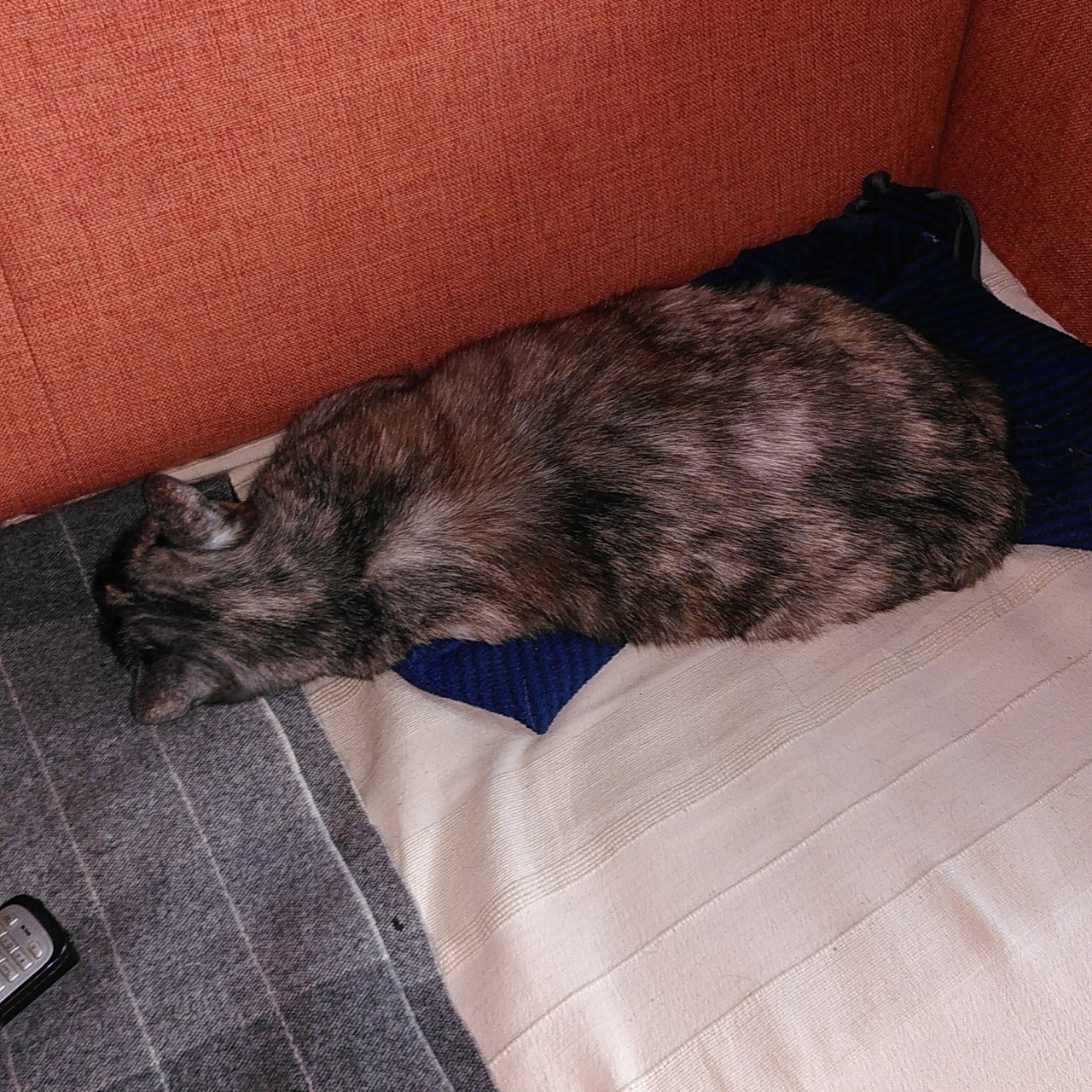
Today was mostly spent spinning - the Egtved blouse yarns want to be finished. I had, as was fitting, "help" from the little cat, who snuggled herself behind my back and snoozed.


That was comfy, and nice, and the only downside was that I had to get another sweater out of the closet afterwards, as the one I had planned to put on again was now lying underneath the cat... and no, I did not want to wake her by pulling the sweater out from under her furry butt.
0
FEB
11
2

De-gumming Results.

So, here we are - de-gumming results:

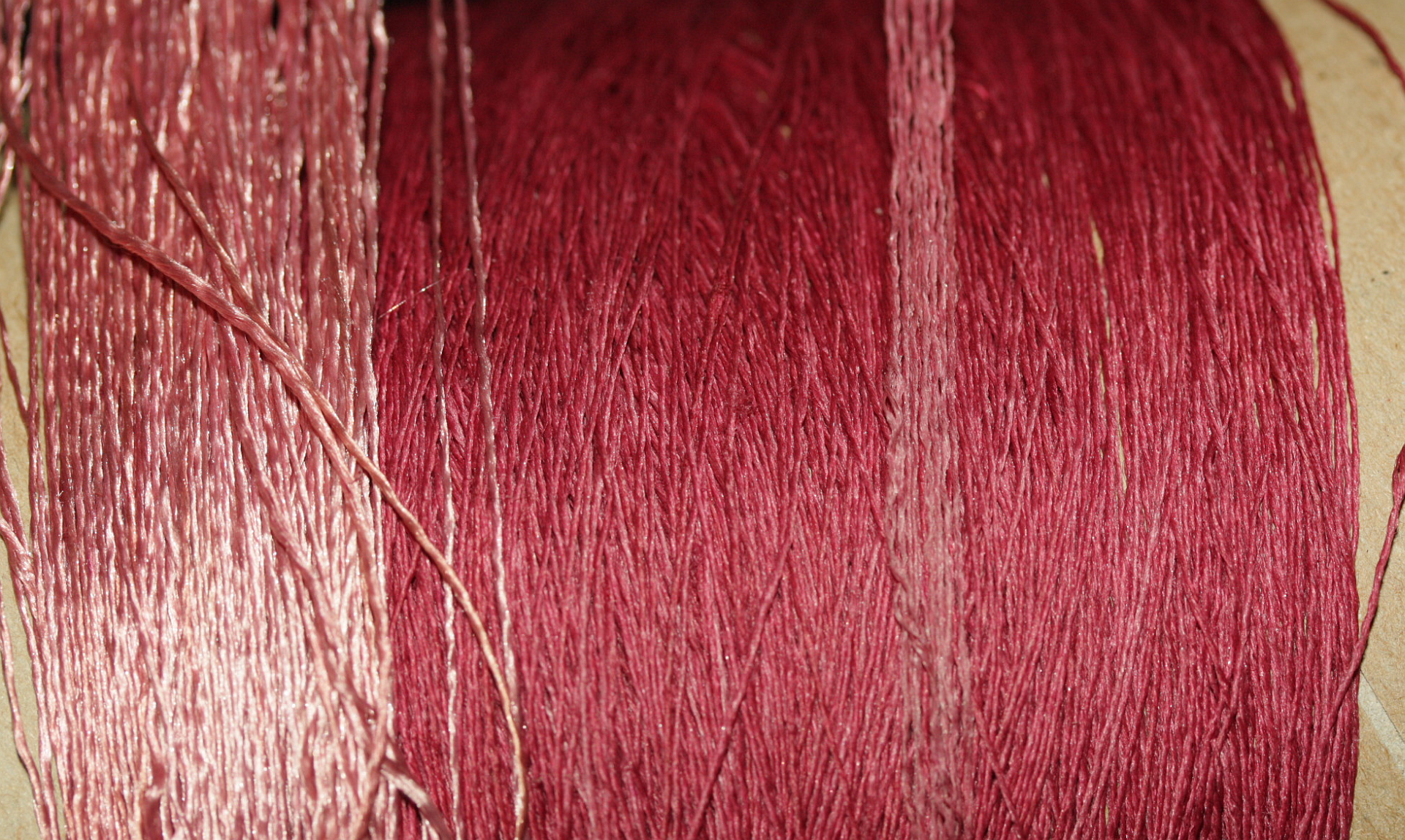
The procedure I did yesterday resulted in colour loss and definitely loss of some, but not all sericin - the silk still has a rather firm hand and is stiffer than I'd expect it to be if completely de-gummed.


You can see the narrow band of lighter silk on the gummy original silk, and the completely de-gummed and then dyed silk on the left side. Maybe I should take another small sample of the gummy silk and try to get all the gum out by boiling it within an inch of its life? See what happens then?

In other news, I've been busy in the background working on the website re-launch. As usual, it eats up all the time it can and then some, and there's other things to take care of and work on (such as the Egtved Project, for which you're also due an update), too, so it's actually feeling a little like a wonder that I have made as much progress as I have. The learning curve is also rather steep - in the past few days, I've successfully dabbled in CSS, altered php scripts (do not leave an extra . in or you will get a lovely error), edited sql tables by adding columns, written an sql update thingummy to replace values in a column (it's called Abfrage in German and I don't know the English term), and used a regular expression for a search-and-replace routine. I've also cursed the inconsistency of things when an installation went wrong and pondered the pros and cons of starting over or not. (Verdict? I'll try, and if it goes wrong, I'll go with the semi-clean install that seems to work okay for now.) At least I cannot complain about lack of challenges in all kinds of fields!

 
0
FEB
10
2

Gummy Silk - The Adventure Goes On.

Well, I definitely got your attention with the gummy silk thing yesterday!

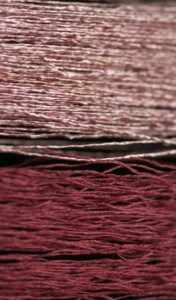
First of all, here's a better picture of the two silks side by side:


Now to the answers to all the comments yesterday...

Jessica's comment was:

That's really interesting! And it probably explains the deep colours we see in medieval embroidery. And how they were able to do couching over padding with a relatively thin thread and still being able to force the gold threads into place and keep them there. How does this partly gummed silk compare to modern Chinese flat silk? That's my go-to silk for medieval projects as it produces embroidery with a slight wavey texture as seen in medieval embroidery.
The gummy silk is quite a bit stiffer than the de-gummed one. The flat silk that I know is much more prone to snagging on anything that looks like it might be rough, but I haven't been able to do a proper comparison with similar silks yet. The gummy sample was a bit of the Texel stocking silk, which is a four-ply silk with slightly twisted singles, the de-gummed was flat silk (my embroidery silk). I have flat gummy silk here, but it's much thinner than the embroidery silk. On my list is trying to make a thicker thread from it, similar in size to the embroidery silk, and see how that compares. That will involve some winding first, though, and fortunately-unfortunately I'm a bit too swamped with other things right now to sit down and do that.
My guess would be that the textures the gummy silk will result in will be a bit different from the degummed one, but how much? That would need some investigation...
Beatrix wrote:

I wrote an article a while ago where I came upon twisted medieval silk. This is from my article:
Lisa Monnas and Roberta Orsi Landini wrote on S-twisted silk threads: ´fourteenth-century velvets usually have Z-spun main ends…but from the late 1420s their [i.e. Italian velvets] main warp threads were generally S-twisted. In contrast Ottoman velvets of the late 15th and 16th centuries generally have Z-twisted main warp threads´ (Monnas 2012, 15); ‘the finest silk thread was used for the warp: strong shiny silk organzine, generally made up of 2 S-twisted ends’ (Orsi Landini 2017, 15-16).
Monnas, L. (2012) Renaissance velvets. London: V&A Publishing.
Orsi Landini, R. (2017) The velvets in the collection of the Costume Gallery in Florence / I velluti nella collezione della Galleria del costume di Firenze. Riggisberg and Florence: Edizioni Polistampa.
So even reeled silk seems to have been twisted - at least a bit.
There's definitely silk with twist - sorry if my post sounded like there was only the untwisted version. Organzine, which is a 2-ply from more or less twisted singles, is also still used today as fine silk for weaving. It's much less prone to snagging than untwisted single, and still has a very nice shine to it.
The silk with very little or almost no twist is an exception, usually there's at least a bit of twist in there. Some is already added (or can be added) when reeling it off the cocoons. Usually, that small amount of twist makes no difference whatsoever - unless you're doing something like the Albecunde belt, where there will be an optical difference between the two tablet turn directions. That belt only works as wonderfully well as it does. Embroideries also usually seem to use really flat silk with no appreciable twist, though a little bit of twist there will not have too much of an impact, at least according to my experiences - plus you can always twist the needle to add or remove twist if it does.

Finally, Florence asked:
How does one de-gum silk?
There's several different ways to do it; you can read more about how the process works here (where different methods used in the industry are given).

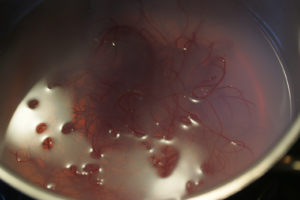
The classical method is to boil it off with soap, typically Marseille soap, which is based on olive oil. Which is also what I used for the de-gumming test I did today with a bit of the Texel silk.

[caption id="attachment_6739" align="alignnone" width="300"] During the de-gumming process - it's starting to lose some of the colour to the soap soup.
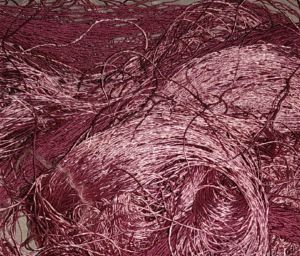

It's hanging out to dry right now, so proper colour comparison may only come later. I'm just as curious as you are!

0
FEB
09
11

Gummy or Not Gummy...

Sometimes, some detail in research pops up, and then it keeps haunting you, and occupying you, just a tiny bit. It's not growing into a big project, but it is always there, and occasionally, things touch it and then you try and fit the new thoughts into the current theories.

Well, that was probably a bit cryptic. So. Let me explain. About... silk.

As you probably know, most silk used in the Middle Ages was reeled, not spun - the long filaments from several cocoons wound off said cocoons together to get you a thread of silk. The more cocoons, the thicker your thread.

When the silkworm makes the cocoons, they're for its protection - so they are pretty hard. That's caused by sericin, or silk gum, which is more or less a protein-based glue sticking the filaments together and hardening them into a nice, protective shell. Hot water softens the sericin so the cocoons can be reeled off (it also kills the silkworm). The glue stays on, though, getting you... gummy silk, or raw silk.

This raw silk is stiff and can feel like a stiff nylon thread, very un-like the soft silk that we know today... because modern silk is usually completely de-gummed.

The thing about de-gummed silk? If you don't twist it, it is very fragile and prone to snagging. It's hard to handle altogether (though yes, very soft and shiny). Since talking to a conservator friend years ago who told me that usually, medieval silks have a much firmer structure than modern ones, I've been wondering about the use of gummy or partially gummy silk in history. The more recent research about the Albecund band is making me more and more convinced that gummy silk would be the solution to a few of the issues with weaving such a band.

One of the questions in that regard was - how does dyeing gummy silk work? Will it dye well? And will the dye be fast? (Side question - what happens if you de-gum it after dyeing?)

Well, I've gotten back two skeins that were test- dyed together, as in both mordanted and dyed together.


The gummy silk took on the colour much, much better... isn't that fascinating?

 
0
FEB
08
0

Nalbinders Wanted!

Do you do nalbinding? If yes, you could help a fellow crafter and researcher with her thesis project - Nele Nuutinen is writing about nalbinding instruction books, and is running a survey about nalbinding instructions used to learn the technique.

You can find the survey here - it is open until March 2. Please feel free to share the link with other nalbinders, too!

 
0
FEB
07
0

Uh oh.

Well. Do you know that feeling when you're waiting for some replacement of a rickety thing, desperately hoping that the old one will keep up until the new thing has arrived, or is finished?

That's how it feels with this website for me right now. Somehow, there were issues logging into the blog today. Which makes me a tiny little bit, um, anxious. There's still a chunk of things to do on the new website, including the shop setup... but I sort of feel the pressure now.

So maybe today is website-trying-to-wrap-up-as-many-things-as-possible day? It would certainly be very nice to finally get to the moving over to the new site part. (I'm also aware that there needs to be testing done before that can happen. And that there is never enough testing to catch everything...)

 
0

By accepting you will be accessing a service provided by a third-party external to https://pallia.net/

Contact