Latest Comments

Guest - Harma Too Many Images Error.
27 November 2026
There have been weeks in November in which I would talke about 800 pictures. Proof of very interesti...
Guest - Max Mustermann The True Cost of Driving a Car.
06 November 2026
Great breakdown — the non-fuel costs are exactly the bit most people forget when they compare cars. ...
Guest - Harma Phew. Now it gets involved!
21 October 2026
Have fun at these events.
Guest - Aislinn Dyestuff Citizen Science.
09 October 2026
This is a great project. I look forward to the results. Thanks for letting us know.
Guest - Aislinn Time for...
09 October 2026
Looks delicious!
JUN
28
0

More Bronze Age Textile Stuff.

Bronze Age! Yes, that's a bit before my usual time span, but I'm getting more and more fascinated by these very early textiles. First of all, I wonder how much of a difference the fibre makes - would you be able to tell, from the touch of the finished cloth, whether the fibre has 15 micron 0r 22, or 30?

I'm also fascinated by an oddness in the weaving technique. The surviving blankets were huge - the one from Egtved was 190 by 258 cm. That is a width that would be hard to handle for a single weaver. Add to that the fact that there are weft crossings in the fabric - there's just one weft per shed, but it's not the same one all the way through. Weft A comes from the left, weft B from the right, and at some point roughly in the middle, both go to the surface of the fabric and cross each other. Then weft A continues its journey to the right in the next shed, while weft b goes to the left, and they turn normally at the selvedge. This sometimes occurs with three weft threads instead of two.

Thanks to the wonderful image database of the Danish National Museum, you can have a look at this weft crossing thing in the Trindhoj blanket here. There's some crossings in the area left of the hole - you can download the image and then go hunting for these oddities with your image viewer of choice.

My suspicion is that two (or even three) weavers worked together on these superwide fabrics, and the crossings are where the spools or sticks or whatever they used changed hands from one weaver to the other.

This is really fascinating, and I'd love to try this out. The only tiny issue is that this requires a superwide loom (with the corresponding large number of weights, and large amounts of yarn), and some other people willing to have a go at weaving... Though a bit of testing might be possible with a loom and fabric with less width, to get an idea of the method, at least.
 
0
JUN
25
2

Transcription Desires?

Yay Friday! I'm looking forward to the weekend, even though there might be some work necessary this time - we're nearing the end of the month, and lamentably, I still have not finished my tax paperwork. Sigh. (I think there's not much left to do, but it's been a while since I did the prop work I already did, and thus I need to catch up on the status and do the rest of it.)

If you are looking for something to fall into during the weekend, not tax-related, you could try... Folgerpedia's digital resources. Folger is the world's largest Shakespeare collection, and you can explore a lot of related topics there as well. And from Shakespeare, you can venture off into the world of manuscripts, and early prints...

There's also EMMO - Early Modern Manuscripts Online - where you can browse all kinds of different transcribed books, for instance. These have been transcribed by volunteers, and you can actually become one, too. That's your opportunity to learn early modern scripts... and get a glimpse into letters from back when. Or recipes. Or... well.

 
0
JUN
24
2

Things Going On.

Things going on here? All of them.

Planning for the Textile Forum is going on, and our programme is about finished. Prep for NESAT is the next step.

I've also done some research on Bronze Age fabrics for a possible museum project (yay!) and learned that these fabrics are wildly different from the usual medieval stuff. There's fewer threads per cm, for one thing; then the usual warp and weft spinning direction is just the opposite of what you usually get in medieval cloth; there can be several wefts in one shed, and they cross over each other at some point... and the fabrics are quite wide. Quite, quite wide...

One of the problematic points for recreation of these really old fabrics is the fibre, though. Bronze Age sheep were different animals from what we have today, so the wool is mostly underwool, with around 17 micron thickness - with the occasional thick hair thrown in. Now, modern really fine-wooled Merino sheep have about 17 micron fibre thickness... but there's, of course, no coarse hair in their wool.

Which means I've been looking around, and am trying to find good sources for fibre that is at least sort of close to the original. Soay sheep might be an option, but there's not so many of them around, and getting their fibre might be a challenge.

This, by the way, is a rather common problem when trying to reproduce old things - the available material today can be so different from the original that trouble ensues. For instance if you need cattle metapodia, or cattle thigh joint heads, for a certain object... but the modern cow is much, much larger than the Roman era cow was, so your object will have the wrong size, or the wrong proportions.

There we go, then - looking for compromises, or good solutions to the problem...
0
JUN
23
1

I have never been so happy to have been stabbed with a needle.

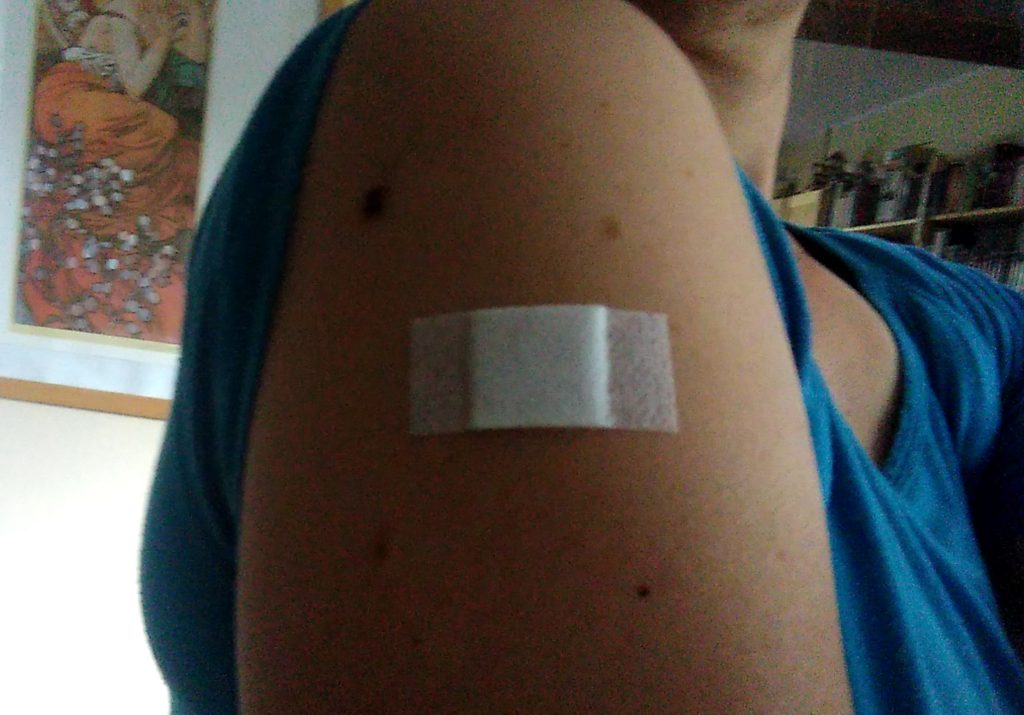
To my very great delight and rather considerable relief, my right upper arm is currently looking like this:


A very friendly doctor stabbed a needle into the muscle this morning and then pressed some of the good juice in. She also did it so gently and carefully that I felt about... nothing. I've actually felt more when grasses rubbed my skin with their prickly ends - not to speak at all about a midge bite, or scratchy madder plants, which both have been able to draw blood.

So... I will gladly forego bouldering for the next two days due to this (no sports for two days, she said). The second shot will be in six weeks' time, which means it's just in time for the full protection to be in place for the Textile Forum.

Whew.
0
JUN
22
0

Textile Dimensions Conference - This Weekend!

There's a conference about early archaeological textiles this weekend, hosted by the Institute for Christian Archaeology of the Uni Bonn - the timespan goes from Neolithic to Early Medieval textile finds, with a wide range of topics and geographical areas.

If that sounds interesting to you, you can find more information, including the programme, on the Institute's website. Because of the pandemic, the conference is mostly online - which means you can join in and attend via Zoom. If you wish to do so, email Petra Linscheid (her email address is on the conference programme pdf).

 
0
JUN
21
2

A Gorgeous Tablet-Woven Belt.

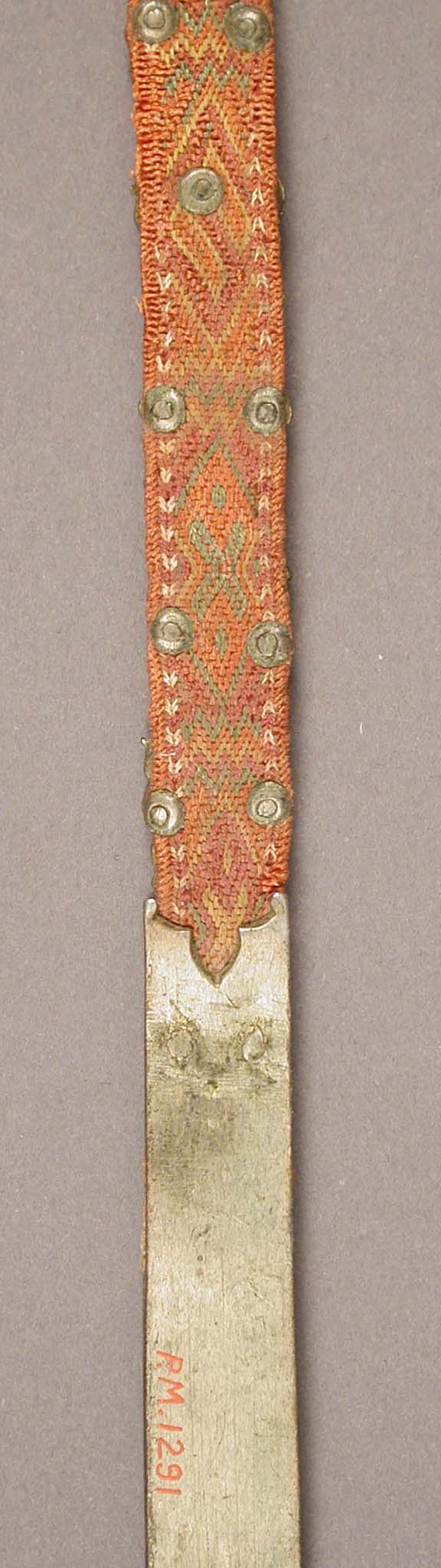
If you need some eyecandy on this Monday evening, you could go to the site of the Met Museum and take a look at this Italian belt from the second half of the 14th century - with lots and lots of beautiful metal ornaments. Lots and lots and lots; so many, in fact, that the beautiful tablet-weave is almost completely hidden.

Fortunately, though, the makers of the Met's digital catalogue also took a photo of the back of the band, at least of one part, and there you can see the weave.

Stunning, isn't it?

 
0
JUN
18
0

The Cameras.

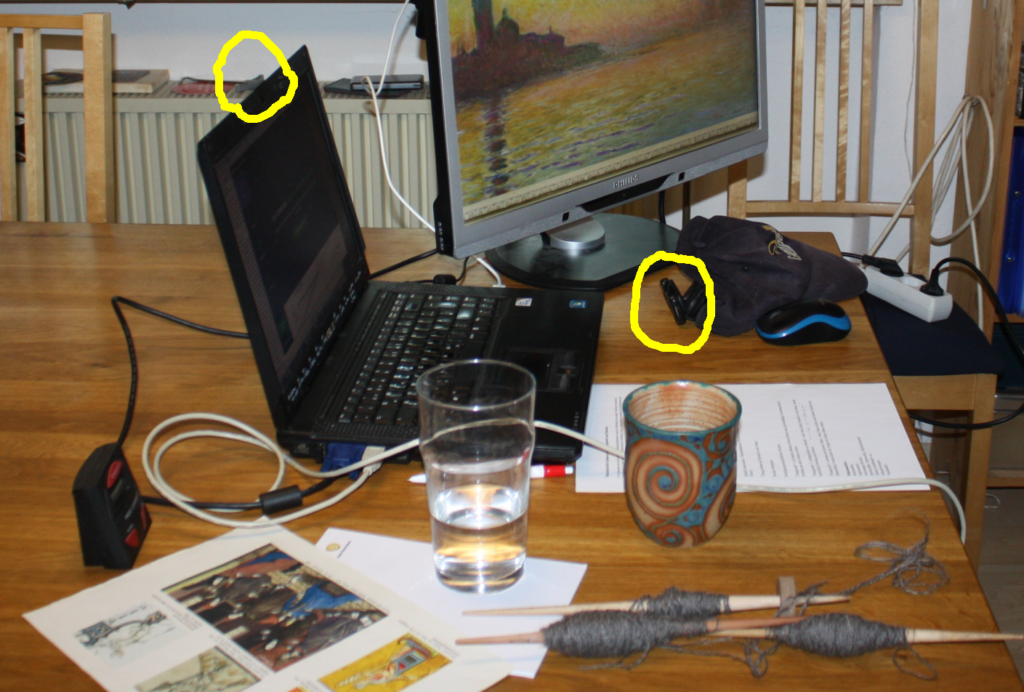
So... here's the solution to the camera question:

One is, yes, above the screen on my laptop, as would be expected - marked with a yellow circle. One is outside the shot, on a tripod and looking over the upper edge of the extra monitor. The third one is also marked with a yellow circle, and it's fixed to a cap.

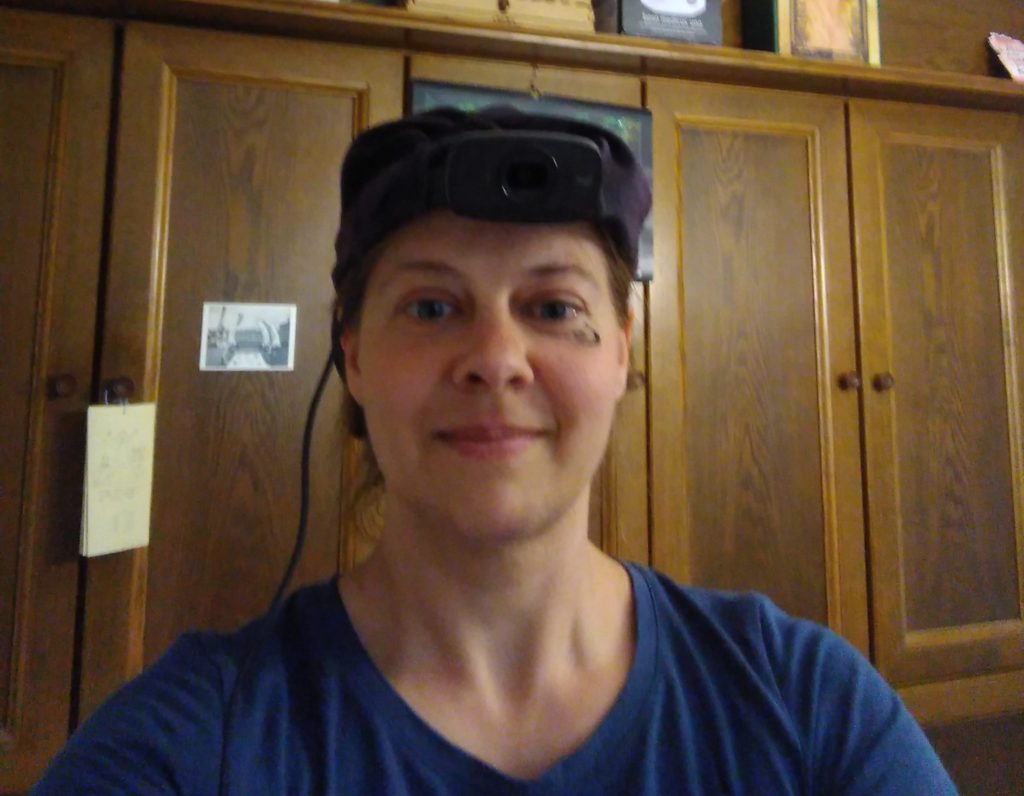
Which I wear. Well, not in that picture, there it's just hanging out on the table. When I do wear it, it looks slightly odd:


However... it means I can show my workshop participants exactly what I am seeing when I am doing things. Which is exactly what they should be seeing when they are doing the same things. And I am really amazed at the difference it makes to explain stuff! Well worth looking a little daft, with a cap with a long USB cable dangling from it...
0

By accepting you will be accessing a service provided by a third-party external to https://pallia.net/

Contact