Latest Comments

Guest - Harma Too Many Images Error.
27 November 2026
There have been weeks in November in which I would talke about 800 pictures. Proof of very interesti...
Guest - Max Mustermann The True Cost of Driving a Car.
06 November 2026
Great breakdown — the non-fuel costs are exactly the bit most people forget when they compare cars. ...
Guest - Harma Phew. Now it gets involved!
21 October 2026
Have fun at these events.
Guest - Aislinn Dyestuff Citizen Science.
09 October 2026
This is a great project. I look forward to the results. Thanks for letting us know.
Guest - Aislinn Time for...
09 October 2026
Looks delicious!
JUN
08
1

Tutankhamun's Collar.

One of the lovely things about doing the Textile Forum organisation is that I'm always learning new things, and getting to know more from other, quite far-away bits of the textile world. Case in point? This article about Tutankhamun's Collar.

I wasn't aware of the fact that a lot of textiles were found in Tutankhamun's grave - though I will mention right now that Ancient Egypt is quite a bit away from the European Middle Ages, which are my main field. The article about the reconstruction shows very, very nicely some of the many different methods that can be used to re-create or re-construct something, for different purposes. It also shows that it is well worth to repeat a process, after comparing the outcome of the work with the original and maybe looking at some additional sources again.

Also: What an ingenious piece of weaving! I'm already looking forward to seeing more of this at the Textile Forum!
0
JUN
07
0

Purple Dye Production

If you're interested in learning more about purple mollusc dye but missed the webinar a while ago - the recording of the session is available in the video archive of the American School of Classical Studies, and you can find it here.

There's a lot more things in the archive as well, sorted by category, so if you're into Classical studies, it's probably worth a look and a browse.

In not-so-classical news, I've been very busy sending out distaffs and spindles in preparation for the next online classes, and I'm already looking forward to the next one. If you'd like to join in for the English language one on June 30, there's still a few days left to book: I've set the deadline to June 10 to make sure that the parcel with the kit will definitely arrive in time within Europe. So don't miss it!
0
JUN
04
0

CTR Anniversary Conference

There's an online conference to celebrate the anniversary of the CTR, the Centre for Textile Research in Copenhagen. This was the place where my first NESAT took place, and I have very fond memories of the conference, the centre, and all the lovely people I met there and the wonderful times we had.

Now the CTR is celebrating their 15th anniversary, and what could be better for that than a conference? You can learn more about the online event, taking place June 14-17, on this website - and you can also register there.

Speaking of both online conferences and NESAT: Sadly, there's still too much insecurity about how things will look in August, so the NESAT which was postponed to this year from the last will, in the end, only take place online. I can see the sense in this, but I'm still really, really sad about it. I had been looking forward so hard to the trip and the stay in Finland and meeting all my colleagues again after four years. Sigh.

If you would like to register for the online edition of NESAT, you can do so on their website.
0
JUN
02
1

Gender Stuff Happening!

Bias is a thing. It always is, and always will be - we're all prone to it. It is human nature to put things into boxes, and to have assumptions and preconceptions. They might be cultural influence, or they might be due to personal experiences, but we all have them.

Gender bias is one of these things, and something that is being discussed a lot. Yes, men and women are different. Some of these differences may be nurture, but there's quite a bit of nature too... and I think that's important to know, and take into consideration.

Men, overall, have a different muscle structure - and accordingly are typically a good bit stronger than women. When I grew up, I was given the impression that women can do everything just as well as men. The intention behind this was, I'm quite sure, to not let me (and the other girls in my age cohort) form the impression that we're in any way inferior to the boys. It had the side effect, though, that I believed for many years that I should be just as proficient at everything as men are or can be... including carrying things or heavy lifting. Ah well. I have carried a lot of heavy boxes over the years, and I can't say that I regret it. However, I've also put a lot of pressure on myself to carry just as much, or perform just as well at hard physical tasks, as the male colleagues, and that is indeed something that I could have done without, in retrospective.

Bouldering actually was the thing that finally made me realise: there are anatomical differences, and I will never be as physically strong as my husband if we're in similar good health. That's just nature.

There may also be (I'd say there probably are) differences in how men and women think. There is, however, no proper reason that there should be so many more men in high positions in companies, and so few women. There's also no proper reason why women candidates for something like the post of Kanzler in Germany should be asked about their children and family, and who will take care of them, and men are not. That is just ridiculous.

Good news, though: These days, that inequal treatment is at least seen, and pointed out, by quite a few people. More good news: Germany is getting a law for a gender quota in larger companies, so that at least one woman will be present in the future if there's more than three people in the top management tier. That definitely is a start.

And to round this all off: Here's an article about gender bias, and how reducing the bias during the selection process has led to a significant change of the gender distribution in orchestras. Including a link to a website where you can test your own implicit biases... which is quite interesting!

 
0
JUN
01
0

Jewish Craftspeople Conference

Back in March, the Goldstein-Goren Diaspora Research Centre hosted an online conference about Jewish Craftspeople in the Middle Ages - and I only learned about it while it was already running, and then had a little timezone conversion issue, so I ended up not catching most of what I would have liked to see (for instance the paper including silk dyers on the second day).

To my great delight, though, that can be remedied. The conference papers were recorded, and they are now online on the Centre's Youtube channel for everyone to see. There's three videos, one for each of the days of the conference.

Enjoy!
0
MAY
31
0

Test Run: Successful.

Today was a little test run for the camera setup for the online courses - and I'm delighted to say that it was successful. It includes my putting on a slightly daft-looking hat with a camera installed on it to give the workshop participants the maker's perspective... definitely something that you can only do with an online course.

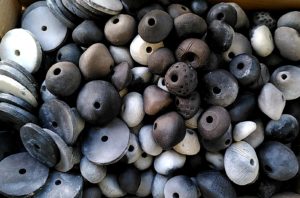
And because delightful things might well be accompanied by other delightful things, here's a picture of the cleaned, dried, not-yet-sorted fresh spindle whorls for you:


0
MAY
28
0

Fire in the Bowl.

My hair still smells a bit like wood fire... a nice smell, if you ask me. It reminds me of many, many different activities, and lovely times with friends and colleagues, in many different settings.

Yesterday's fire was a true work-fire, though - and since I had a lot of other things to do as well, I didn't get to sit down, relax, and enjoy watching the flames this time around. I didn't even make coffee on top of the spindle whorls, that would have been fun, and it's definitely on my list for the next time!

Firing whorls, the way I do it, is a kind of simulated pit firing. Instead of digging a hole in the garden and filling it with wood and the things to fire, I use a clay fire bowl (which is also the bowl that travels to Living History events with me). The bowl keeps the warmth of the fire nicely as opposed to the metal fire bowls, thus making cooking much more efficient in terms of fuel use. And for firing whorls, it is quite good at simulating the dugout pit.

In pit firing, generally, there's a high percentage of reduction firing (most of the whorls will turn out at least partly black). Temperature control is possible only in a limited way, by choosing how you build up your fire/pit, and what kinds of wood you use, and how long you let the fire burn. In my case, the firing temperature is not very high to quite low, and there is also always some loss of whorls if they get heated too quickly, or too unevenly.

But you want pictures, right? Here you go.

It all starts with filling the bowl with wood, wood shavings and, of course, whorls. It's a bit like whorl lasagna.
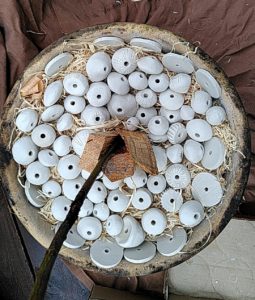


I start the fire on top of the whole thing then, trying to heat it up as slowly as possible. When that does not work out as well as intended, I get to hear cracking sounds... which means exploding whorls.
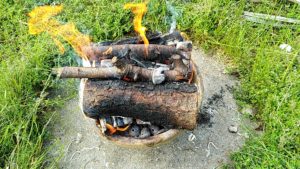


That is not a good sound - but there is some loss, that's just how it is.

Firing then goes on, with me putting more bits of wood on, and trying to have it burn nice and hot all the time:
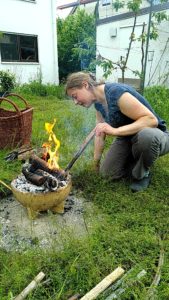


That takes a few hours. It would definitely be enough time to make coffee on top of the whorls!
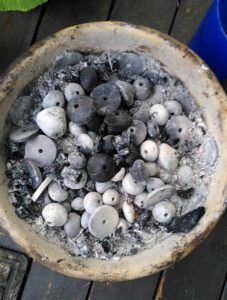


Once the firing is done, the bowl has to cool off a bit before I can take out the whorls. Usually I have a hard time waiting long enough, but I don't want to risk more damaged whorls because of taking them out too quickly. Then, once they're completely cold, the ashes and soot have to be wiped off or washed off, and once the whorls are completely dried again, I can weigh and sort them.

Here's the dead ones from yesterday's pit:
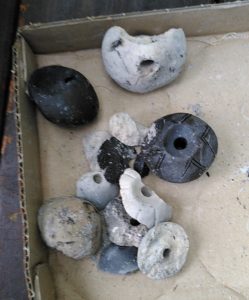


About ten whorls that did not make it, approximately. Not too bad - though I've done better in the past!
0

By accepting you will be accessing a service provided by a third-party external to https://pallia.net/

Contact