
Latest Comments

Guest - Katrin Sprang Discussion
18 September 2026
Hi Rachel, I have looked for more photos of you, but that was not very successful. I found a link on...
Guest - Beatrix Sprang Discussion
15 September 2026
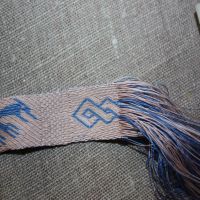
That lozenge pattern element is not a photograph, but a scan. So it should be to scale. But I pinned...
Guest - Katrin Sprang Discussion
15 September 2026
I was not referring to Rachel's reconstruction (is the reconstruction you refer to the one photograp...
Guest - Beatrix Sprang Discussion
14 September 2026
There is something Rachel did not mention. She told me: "Well, I worked with the measurements we too...
Guest - Katrin Sprang Discussion
14 September 2026
Well, this is certainly developing into an interesting discussion. Firstly, going from that lovely l...
JAN
16
2

More Distaff Questions.


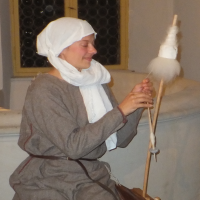
As requested in one of yesterday's comments, here is a follow-up post with a little more stuff about the distaff... for the basic explanation about the reconstructed medieval spinning, see also this post.
I am guessing that one takes fibre from the distaff and somehow moves it to the spindle, but I can't tell from this part if you are taking it randomly from any part of cousin It, or if you intend to take it sequentially, in the same order it was placed on the band, or what...
You draft from the distaff, and the flow more or less occurs naturally. I try to work my way along around the distaff, turning it a bit from time to time, so that I don't use up all the fibre on one side first. Otherwise, I don't much care where my fibre supply flows from, as long as it flows easily and evenly.

I am also curious to know how much time this distaff dressing process takes, and how much spinning time one gets from it. I gather from other posts of yours that it used to be that "everyone" used a distaff, but for modern spinners it is not so common to use one (though becoming more common again as more historical reenactors experiment with them?)
I can tell you exactly how long it took me for dressing this one: I snapped the first blurry pic at 13:56 and finished with the Portrait of Cousin Itt at 14:04. That's eight minutes, and I guess that at least three of these minutes were photo time. So in textile work terms, dressing a distaff this way does not take any time at all.
The spinning time you get from it, on the other hand, totally depends on how fast you are spinning and how much fibre you are using up per make (i.e. how thick you are spinning), so I can't tell you. Me, I go a long way with 42 g of fibre.

Modern spinners don't use a distaff, for the most part, because their spinning technique does not technically require them to do so. For the medieval style, however, the distaff is essential and you cannot physically spin without it.
Is there a savings in total time when using a distaff? (e.g. while dressing the distaff takes time, the spinning part goes enough faster as a result of having done so to make it worth it) Is there an improvement in the quality of the spinning (I am guessing "yes", since I imagine that it would be easier to be consistent as to how much fiber is added per second to the spun yarn).
Since spinning in the reconstructed style is not possible otherwise, you might argue that yes, yarn quality is improved ; )
Joking aside, what really does take time and has a big influence on yarn quality and ease of spinning is the fibre preparation. The five minutes (even if it were fifteen minutes, same applies) for dressing a distaff are really next to nothing compared to the time needed for spinning a substantial amount of medium-fine to fine yarn, and preparing the fibre to accommodate this. Spinning quality hangs on the quality of the fibre prep and the spinner's skill. If you muck up in dressing the distaff by wrapping it too firmly, for example, or too loosely, this is easily and quickly remedied, and there is quite a bit of leeway in how it needs to be; you just need enough friction between the held fibres to make drafting possible.
If you had mucked up in prepping your fibre, though, not the best distaff-dressing in the world will make that better.


The distaff is, essentially, your third hand for spinning - the one holding your fibre and helping you draft. And just like a real hand, if it holds only crap... it will give you that same stuff it holds. You have a say in how firmly it holds on to its stuff, though, depending how you dress it.

Any more distaff-related questions, folks?

0
NOV
29
0

More Manesse, and barbette-and-fillet thoughts.

Yesterday's post brought up a question in the comments regarding whether the fillet with the pie-crust edge was closed on top or not... good question.

Personally, I tend to see all of the fillets as open on top unless I can clearly see otherwise. That is possibly due just to a personal quirk, but my reasoning is: You don't really need it closed on top for stability (stiff linen holds up just fine even without an inlay of leather, or felt, or whatnot), and it's easier to adjust in size if you don't close it. So you can have a strip of linen that you tack together or even just hold together with a needle in the back, and if your hair changes or your hairstyle changes or you have a thicker barbette... adjusting the size is no big deal. Also it saves material.

There is one non-typical fillet in the codex Manesse that shows, very clearly, a non-closed version:

(fol. 11v, or page 18)

I have also tended to see the little darker area on top of this fillet as the top of the head peeking through:

(fol. 32v)

The only closed headdress find I know is one from Villach-Judendorf; that one has, however, no pie crust and consists instead of gold-brocaded narrow ware. Beautiful - but quite different from the Manesse versions.

Finally, while there is no picture of b-and-f in the Manesse clearly showing the top of the head peeking through, there is also none clearly showing a fabric top. And there are quite a few pictures clearly showing the fillet as just a strip, such as this one:

(pic out of HÄGERMANN, D. (Ed.) (2001) Das Mittelalter. Die Welt der Bauern, Bürger, Ritter und Mönche., RM Buch und Medien.; late 13th c, England).


That's my thoughts about the question hat or band as fillet - I'd be happy to hear your opinion, and the reasons for your arriving there!
0
NOV
27
3

The Manesse thing.

If you have looked at late-medieval pictures from Germany, chances are high that you have seen some from the Manesse Codex (completely online here, courtesy of Uni Heidelberg).

There's an iconic version of the female headdress of the barbette-and-fillet type in there, showing a wavy upper part. Like this:

(That's from fol. 32 v. Lots more to be found in the manuscript.)

I have heard about many different ways for a possible reconstruction of this wavy upper edge, and have seen a lot of interpretations - ranging from textiles woven with a ruffled edge, sewn-on ruches and ruffles to bands folded down and pleated, to an attached cord. It's perfectly possible that all these kinds of achieving a wavy edge were in use back then, but personally I have never seen a version that really convinced me.

Recently, I have added another interpretation to the mix - this one:


It's all linen (though it would be possible to make it with a stiff enough silk fabric), and the ruffled edge is made from the same fabric as the main part of the fillet. I think it might be possible to tickle it into even more similarity with the Manesse depiction, but for now, I am not unhappy with the visual impression...
0
AUG
26
1

Dear Internets...

Dear Internets,

a goodly while ago, I was a very happy woman because I found a picture. Those of you who have been researching stuff and looked for helpful pictorial sources will know exactly what I mean with that. (For those of you who don't: Imagine finding a winning lottery ticket that buys you a lovely evening out with your loved ones.)

I found a picture of a textile-related contraption. It was perfect bliss.

And then I did the Stupidest Thing Ever to do with sources just found. Those of you who have been researching stuff will probably know exactly what that is. The STE is the following thought: "Oh wow, finally! This is very good. And now I know where to find this source. I WILL BE ABLE TO REMEMBER WHERE IT IS." followed by the corresponding action, as in not writing down in at least one place where one can reliably find the info again where it was. Or marking the book. Or both. Plus, maybe, adding a few hundred more notes in other places.

I did one little test run with something cobbled together very vaguely resembling the basic concepts of that contraption. It seemed to work. I put it away to do some more research and test driving and planning to eventually do a reconstruction.
Then, things happened just like they tend to do: Stuff came up, stuff had to be dealt with, stuff was dealt with, more stuff came up, the projects in the drawer stayed in the drawer.

All that must have been more than a year ago in the meantime, and I cannot find that picture again. So it's time for me to bleg for some help - maybe you have seen the picture (or a similar one).

The contraption was for weaving tape (ribbon, band, narrow-wares) with a rigid heddle. It was basically a board lying on a table, the rigid heddle firmly set onto that board at about the front, and behind it with some space between them was a short upright round piece of wood. The warp was wound around that upright dowel and ran through the heddle; the woman weaving held the band (obviously moving it up and down to change shed) in one hand and shuttle and/or other tools in the other hand. I think the already finished band was also wound around a dowel that she held in her hand.
That's what I really remember (or am quite sure about). The rest of it? I think she was blonde, sitting with mostly her back turned toward the viewer, in the foreground of the picture, and I think she was wearing a green dress. It's having a late-medieval feel in my memory, and it may or may not have been a depiction of Mary.

So, dear Internets, I would be so, so happy if you could help me find that piccie. Because you know, yesterday I set down and fiddled with something prototype-like, and it totally works and is lovely to work with... and I'd so love to compare with the picture before I do a final version.
0
JUN
28
4

Hairnets.

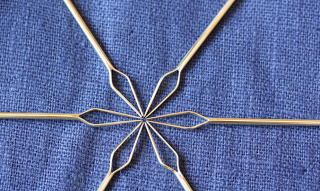
For years now, one of the almost forgotten techniques that are dear to my heart is (filet) netting. If you've seen one of those dainty, almost-nonexistent hairnets in the medieval part of a museum exhibition? Those are made by netting.

Contrary to what some people think (and some write), this is not the knot and the technique used for making fishnets. It's a different tool, a different method, and a different result - fine, small-meshed nets that can be used as hairnets as is or embellished with embroidery.

To keep the technique from dying out, I've tried to do my part - I sell the filet needles (replicas after a find from 14th century London), I demonstrate netting, and I teach the technique. Since many visitors do not know what that peculiar double-eyed needle is for, I usually place a finished hairnet close to the netting needle in my stall.

And occasionally, I will get The Question. The Question is a variation of "Do you make these for sale?" or "How much is such a net?" and is hard to answer - because most of my demonstration hairnets are ones that I used to try out a new technique, or material, or embellishment (like the ones with the pearls). Some of the work time was also clocked during demonstrations or at events, and you never work full speed on events, due to all kinds of distractions. That means that even though I recorded the time needed, it's not the realistic time for making one simple full net with suitable material, in the surroundings of the home workshop.


Netting needle eyes.

This has happened more often lately, so I have set out to do exactly that: Make a reference net of sturdy, white silk thread, in 4 mm mesh, aiming for the finished measurements of the late 13th century hairnet from London. I have started out yesterday, and I've about finished the crown part - next will be the interesting bit of doubling the number of mesh. (This, together with the start, is one of the fiddly bits in making a hairnet in the round.)

The clock is running. A hairnet, let me tell you, is not a thing made in an hour or so... it takes its sweet chunk of time. I'm not sure on whether it will be saleable, as it is - I have been pondering some alternatives to making it completely by hand, in order to offer a more affordable variation, but that will need some more planning.

If you have considered getting a hairnet, or have made one yourself, I would be happy to hear your input - such as how much you would be willing to pay for a (completely handmade) net, or how long it took you to make yours. Cheers!
0
JUN
26
0

Food, Games, Old Norse, and Daleks.

First of all, food: There's a new transcribed recipe on Medieval Cookery, so if you've always wondered how you should cook your Bruet of Almayne - here are several options.

Good food is one of the ingredients for a nice evening of games with friends - if you are looking for a nice medieval-style game board for backgammon and nine men's morris, take a look at Niklas' latest blogpost (in German, but there are pics).

If you're rather looking for a more intellectual pastime, maybe you would prefer to learn the language of the Vikings? There's a new book out there to teach you Old Norse and Runes, with a second volume for deepening your knowledge and reading skills forthcoming soon. (You can also look at samples from the book here.)

Speaking of books and Vikings, Marianne Vedeler has a new book coming out titled "Silk for the Vikings". It's available for pre-order at Oxbow books.

And if this has totally stressed you out now, and you need to relax, the Daleks will help you:


0
JUN
19
0

Fashion stuff.

Fashion, anyone? Here are a few links for those of you who are in the mood for some more-or-less modern clothing (hey, it was all the rage just a few hundred years ago!)

Some Icelandic clothing, including a collar (modern-ish) and a hood (medieval-ish).

Anyone who has been looking at early modern clothes or fashion in Germany will be familiar with the Trachtenbuch of Matthäus Schwarz. There has been some work done with it recently, including the recreation of some of the items - there's a BBC article here and a blog post, with a video about the making of one of the outfits. There's more links in the blog post, too.

A prehistoric fashion show will be part of the Humanities Festival in London. (Here's the official press piece about that, with two pics - but no mention of a date.)
0

By accepting you will be accessing a service provided by a third-party external to https://pallia.net/

Contact