

Latest Comments

Guest - Katrin Sprang Discussion
18 September 2026
Hi Rachel, I have looked for more photos of you, but that was not very successful. I found a link on...
Guest - Beatrix Sprang Discussion
15 September 2026
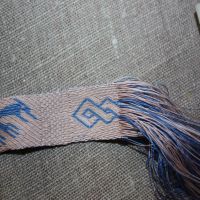
That lozenge pattern element is not a photograph, but a scan. So it should be to scale. But I pinned...
Guest - Katrin Sprang Discussion
15 September 2026
I was not referring to Rachel's reconstruction (is the reconstruction you refer to the one photograp...
Guest - Beatrix Sprang Discussion
14 September 2026
There is something Rachel did not mention. She told me: "Well, I worked with the measurements we too...
Guest - Katrin Sprang Discussion
14 September 2026
Well, this is certainly developing into an interesting discussion. Firstly, going from that lovely l...
DEC
05
1

Things you learn.

There are things in life that you learn because someone (or something) teaches them to you (whether you want that or not). Then there are things you learn because you want to learn them. And then there are things that you just... pick up.

One thing that I picked up from my mum is keeping a small stash of things suitable for presents. These are usually smallish things with a limited price that we see sometime, somewhere, during the year and think "that would make a perfect present for X!"

So we buy it. And then we put it into the stash... and when we are thinking about what to give to X as a present the next time a birthday or Xmas comes around, we check the stash.

It's too late to help anyone this year, but that's a practice I can really, really recommend. It makes finding presents fun, it spreads the spending a little more (though we don't give expensive presents, as a rule, in our circle; it's more giving something small but picked with thought, or if it's a larger thing, we give it as a group), and it saves a lot of headaches and stress when an occasion comes up. Plus you have a fallback for short-notice presents that might be needed.
0
NOV
23
2

RIP Anne McCaffrey

Anne McCaffrey, sf writer, died of a stroke on Monday. Locus online has an obituary, and I found out about it via ADM's blog post.

Anne McCaffrey was the writer that first made me really realise how different it is to read an English novel in the original from reading its German translation. I bought my first McCaffrey book - one from the Brain/Brawn series - on a bicycle holiday with my parents, and I loved it. With another of her books, I found that the German translation had lost all the appeal that came with her style of writing... and that convinced me to read books by English-language authors in the original, no matter what.


Then, for a while, she was my favourite author. I was in my teens, and her stories were just what I wanted: tales of love and conflict and glorious partnerships (between humans and dragons, humans and human-ish starships, humans and a living planet, and humans and humans). And all of them with a sort of happy ending guarantee. That was back in the days when it was not so easy to get your hands onto English language books in Germany, and I ordered them in via our local bookshop. With a considerable markup on the cover price in that procedure, I left quite a bit of money there.

Over the following years, my tastes gradually changed and evolved, and other authors took first place in my personal ranking. I stopped buying new books she wrote, instead turning to other tales - not so much guarantee for happy endings, not so many obvious storylines, and vastly different styles. Today, I usually tell people they are "Badewannenbücher" (bathtub books) - books that usually have more appeal to females than to males, a kind of story that you take into the bathtub with you for comfort reading when you are feeling down, with a non-taxing storyline and non-taxing style of writing, and something you don't mind too much if a splash of bath water gets onto it. (And there's nothing wrong with bathtub books - life would be much, much poorer without them.)

My sizeable stack of Anne McCaffrey books is still something I look at and remember my teenage days, my discovery of novels written in English. Even though I don't read them often anymore, they will stay - for the occasional day where I need to get into the tub with a book, or a friend does. And because Anne McCaffrey's books are an important part of my own history as a reader.

Rest in peace, Anne McCaffrey - and thank you for your books.
0
NOV
18
3

Please help.

If you are interested in medieval material culture, you will surely have heard about the IMAREAL - an Austrian institute that did a lot of research and made a lot of publications about that topic. The IMAREAL also includes several helpful databases, among them the picture database REAL online - which you probably also know. (If not, you should. It's huge and immensely helpful.)

All this institute is part of a larger organisation, the Österreichische Akademie der Wissenschaften (Austrian Academy of Sciences). This is a rather large Academy - in fact it's the largest non-university establishment for research in Austria - and it's an important employer for scientists in social and historical fields as well. 905 people* including admin staff work there, and I have at least two friends who are employed by them.

However, this is about to change. There has been a "Performance Agreement" (that never bodes well, does it?) between the ÖAW and the Ministry for Science and Research in Austria, signed on November 4.
This agreement paves the way for a large budget reduction and, consequently, for the loss or closure of many demonstrably excellent and internationally acclaimed research organisations. With these, up to 300 full-time staff members may have to go between 2012 and 2014.

That's about one third of employees! Such drastic employee cuts are unprecedented in Austrian
history since 1945.  The current economic climate does not serve to justify this severity, and cuts on this scale have not been made in any other areas.
Since third-party funding totaling approx. 22 Mio. Euro was acquired by employees, who now stand to lose their jobs, further negative impacts are foreseeable.  This amounts to a sustainable destruction of knowledge and infrastructure. 

There is a petition online to protest against these budget cuts and the subsequent loss of jobs. The petition page linked is in German, but there is a full English translation available on the page as well, with a translation of the field names and confirmation email you will get (link opens .pdf file). It is even possible to sign anonymously, if you do not wish your name to appear. If you want to go directly to the signing page, just click the red button below.


Please help by signing and passing on the information about this petition - it will only run for 54 more days. If everyone who uses the REAL online database signs, they might be in for a surprise...

* This may not sound much if you have large businesses at the back of your mind - but for social or historical sciences, it's oodles.
0
NOV
03
2

Praised be the Internets.

Internet is good. Well, since you read this blog, you will know that I think the internet is good. But sometimes, it comes back to me just how good it is - and then I have to say it again.

The internet helps me to connect with my friends. To find out when favourite musicians play somewhere I can go. It enables me to buy strange and useful things, like my new spinning wheel (yes, I have a new one). It continuously provides me with new programmes that are good to use and totally free for most private purposes (like Anti-Twin, a wonderful tool to find duplicate files, or Sequoia View, a programme that shows you how big a file is on your hard disk). It is a wonderful place to do research for writing and working.*

And it makes it possible to collaborate with people who live on the other side of the planet. All the way around, with no delay whatsoever, I can send things and messages and pictures, and we can discuss what is good and what is okay and what is not so good. And that, I think, is absolutely amazing.


*And yes, it also provides me with endless opportunities to get side-tracked, procrastinate, and waste time and money. But hey, that's the Internet for everybody, right?
0
OCT
31
1

Literature managing.

Books are just like pictures. They are lovely to have, wonderful to peruse, and a pain to organise. And it's immensely helpful to organise them - having keywords and tags to search pictures, and having keywords and notes to check whether a book was helpful or not. Plus a bibliography programme can help with citations - and save a major pain when writing.

There are several programmes on the market, the two best-known of which are probably Zotero (a free plug-in for Firefox) and Endnote (a commercial stand-alone programme).

Just recently, I have re-assessed Zotero as a possible alternative to my usual bibliography programme (which is Endnote). There are pros and cons for each of these two programmes, but one of the best comparisons I have found yet is this one from profhacker. So, even though my version of Endnote is quite a few years old now already - from how everything in Endnote is integrated in my workflow, I'll stay with it.

If you do not have a bibliography programme yet or are not totally content with yours, though, you might want to check out Zotero. After all, it's free - so it can't hurt to try.
0
MAY
27
0

Ah. Whew.

Of course the tax stuff was not finished without one or two revisions and double-checkings, and of course that took longer than expected.

And getting the book-keeping up to its current state also took a while - but I have finally found a few web resources that really helped me to understand some of the stuff I had just muddled through before. So, for those of you who are German and need to get some basic knowledge about how to do the books, I can recommend the introduction into bookkeeping offered by Collmex (which is software to do the stuff - not the software I use, but the booking processes are the same regardless of programme) and, for any additional questions, there's a forum called Rechnungswesenforum, where a lot of knowledgeable people hang out and are willing to help.

So while I did (of course) not get all of the stuff done that I wanted to get done yesterday, I learned a few things about the book wrangling that were really helpful - and will probably make life (and bookkeeping) easier in the future. Whew.
0
MAY
17
3

ATN friends wants you!

I've finished the current extra-urgent bit of work that was on my list yesterday night, and now I only have to wait for the piece to dry and bring it to the post office. And the rest of today? I'm taking it off. Yay.

But since I promised you more info from NESAT, I will at least tell you about the ATN meeting.
For those of you who have never heard of ATN, it is short for "Archaeological Textiles Newsletter". This has been an institution for quite a few years now, started way back on somebody's kitchen table and sent out as a biannual newsletter.

Nowadays, the ATN is put together, edited and sent out by a small group of people, and it used to be printed at the university press in Copenhagen. However, this printing possibility seems to have ended; the university wants to close its publishing department. And that in turn means the ATN has to make some changes for the future. It is planned to change it to an annual double volume instead of two volumes per year, and of course a new print shop has to be found. Plus a name change has been discussed - from "Archaeological Textiles Newsletter" to "Archaeological Textiles Review", since it seems that something called a newsletter is not worthy for external funding, while something called a review is.

These changes mean that the ATN (or ATR) will need a few more members to survive - so if you are not a subscriber yet, but interested in textile archaeology, please join the "Friends of ATN" (which is a subscription for one year, called membership because of some other bureaucratic issues) and help it survive! 
Anyone can join, you don't need to be affiliated with any university or research institute. And it is really worth it - there are always interesting articles in the newsletter, and the ATN regularly sees the first (or even the first and only) publication of a smaller textile find, or a preliminary results note about a work in progress. Subscribing is easily done via the secure webshop of ATN, and it's not expensive either - the one-year membership costs 20 Euro.


Oh, and of course you are welcome to spread the word...
 
0

By accepting you will be accessing a service provided by a third-party external to https://pallia.net/

Contact