Latest Comments

Guest - Katrin Sprang Discussion
18 September 2026
Hi Rachel, I have looked for more photos of you, but that was not very successful. I found a link on...
Guest - Beatrix Sprang Discussion
15 September 2026
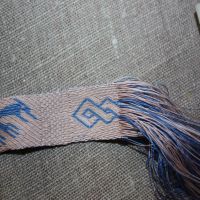
That lozenge pattern element is not a photograph, but a scan. So it should be to scale. But I pinned...
Guest - Katrin Sprang Discussion
15 September 2026
I was not referring to Rachel's reconstruction (is the reconstruction you refer to the one photograp...
Guest - Beatrix Sprang Discussion
14 September 2026
There is something Rachel did not mention. She told me: "Well, I worked with the measurements we too...
Guest - Katrin Sprang Discussion
14 September 2026
Well, this is certainly developing into an interesting discussion. Firstly, going from that lovely l...
MAR
25
0

...more recording time...

I have a new (upgraded, yay!) recording setup that now needs testing, as there's another podcast chat session planned for tomorrow, again with Kaptorga. (We didn't get around to all the things last time, so here's to another try.) 

Which means... I will now drag stuff to the closet, and see how much Madame the Cat will have to say when I'm doing test runs. Wish me luck! 

0
MAR
24
0

Knitting for Statues.

Knitting has had its moments throughout history - both regarding technology and, well, current politics. Knitting was used for codes to transmit information hidden in innocent pieces of clothing in war times. Now, there is another thing that happened because of knitting: in Denmark, new statues reminding of women who were influential personalities are being planned, all because some knitters decided they'd guerilla knit dress some of the naked female statues.

There's an article in the NYT about it, and you can read it here

0
MAR
23
0

Lovely People.

I am, as you probably know if you are reading this, a one-person enterprise. Which means I do about all my stuff all by myself, from website design and maintenance to tax filing, from writing texts to selling stuff. And then there's workshops, conferences, and museum employments.

Unfortunately for my planning, sometimes these things tend to... clump together. Also unfortunately I have not yet really mastered the art of bilocation, and usually the things that are going to clump together are just too nice and too delicious-sounding to decline. So from time to time, things sort of... derail themselves a bit, and I get horribly behind, and it takes a while for me to catch up. Yes, this is entirely my own fault for mis-estimating things, and I do feel bad about it when it means delays in answers, or in posting orders.

Which is exactly what had happened with my recent stint of abroad adventures, which were wonderful and made me happy, but also ate up more time in the prep, the afterprep and during the events themselves that I did less than I had planned for in that time.

So, very understandably, I got some mails asking about a delay in shipping, and all I can say is that I feel very happy, and very lucky, to have customers like this. Both enquired kindly, one with the explicit mention of their understanding that a one-person show can sometimes lag behind, and the other one asking if I was okay.

This is so, so nice, and it really made me happy and feel all warm and tingly inside. I do try hard to send thing off in a timely manner, but it's just great to be treated like this when it was not possible to keep up.

So, thank you to all the people that do things like that - you are making the world a better place. 

0
MAR
20
0

CTR zoom lectures

In case you are like me and, while you know that there are lectures organised by the CTR in Denmark and that they are available via zoom as well (so you don't need to go to Copenhagen, though the city is definitely worth a journey) but then completely forget to check their lecture calendar, here's your reminder that you might to do so. Especially since there is a lecture coming up about colour terms and how they changed over time - something that is quite good to know!

0
MAR
19
0

More Cotton Research...

If you're interested in the fabrics that were the reason for the spinning workshop that brought me to England, there's an article freshly out - and it is open access, so you can enjoy it without having to pay (or jump through hoops).

You can find the paper "A Visual Method to Compare the Quality and Complexity of Archaological Textiles: The Cotton Mantas of Pre-Hispanic Colombia" here.

0
MAR
18
0

Bronze Age Loom Evidence.

As you will probably know, finding and identifying textile tools in the archaeological record can be tricky - especially things that are not as blatant as spindle whorls or maybe a rigid heddle. 

So it's rather a sensational find that remains of a Bronze Age loom could be identified - including some carbonised wood. Wood, people! Of a loom, and clearly belonging to the loom as it was found right next to an assembly of loom weights.

I will say no more, but send you on to the open access article itself, so you can get it straight from the horse's mouth: 

Evidence of a warp-weighted loom in the Bronze Age settlement of Cabezo Redondo (south-east Spain), published online by Cambridge University Press

0
MAR
17
0

I am back!

I'm back home from a whirlwind two weeks - first a little journey to South Tyrol where I got to meet the people from the Archaeoparc and do some wool prep and spinning sessions together with them, and then it was back home to repack and go to Cambridge for more spinning - this time including cotton, and involving the replicas of some Colombian spindles that were used about 600 or 700 years ago. One of the questions was which spinning technique might have worked with them - but in addition to this, we were also exchanging spinning and fibre preparation knowledge with two lovely indigenous women from northern Colombia. There were a few eye-opening moments for everybody, and there was oh, so much fun and laughter.

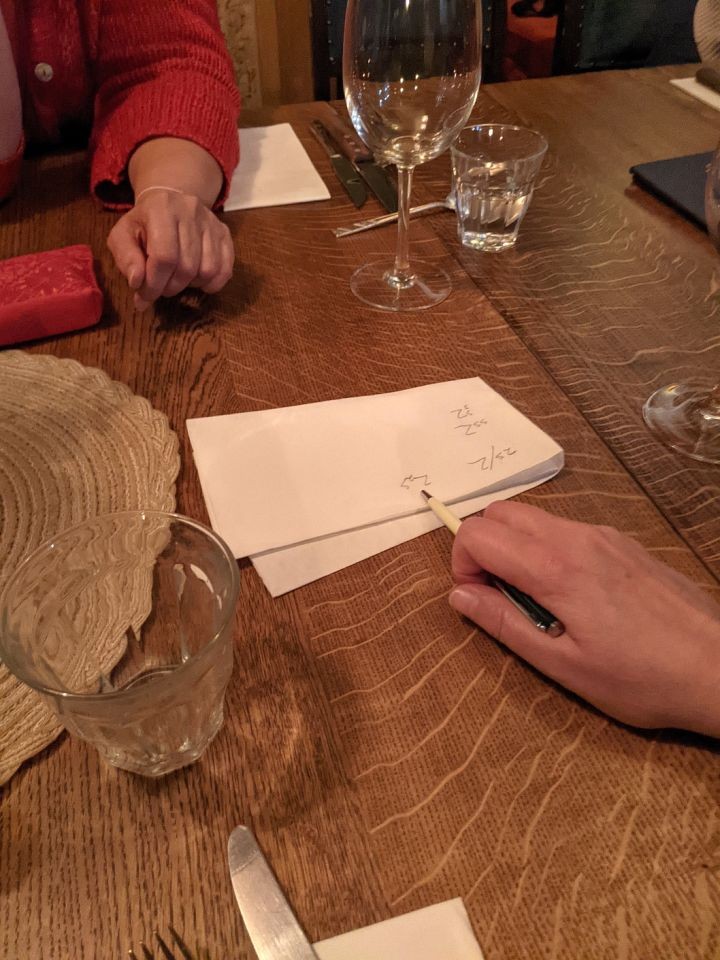
There was also some table accessories collateral damage. It turns out you can use extra straws very well to explain and demonstrate some cotton fibre properties, and some harm was done to a few paper napkins (which found themselves torn into strips and used to show twist effects, or solve questions about twist issues that turned up at one point).

These were by far not the first napkins* that I've seen repurposed for explaining textile stuff. I've seen them used to make impromptu threads or bast strips, to be torn into garment shape to explain draping, or to be torn into bits to show how garment construction works. They have proven so useful and versatile over the years that I am actually considering now to make one or two of them part of my teaching kit. Just in case, you know.

An explanatory napkin used in some other way - because you might just need to draw some stuff. Right there and now. Yes, that includes the dinner on the last evening, when everybody really was very tired already.

There was also a lot of splicing in some ways, and some stitching (the traditional bags are made in a variant of nalbinding and fitted with a braided strap). I have understood a lot more about cotton spinning now, and am much, much better at turning spindles into my previous non-favourite counter-clockwise direction. (Still not good at this clockwise and counterclockwise direction thing, though.

Now it's back to all the things that have assembled here to make me go back to the desk and catch up. I also need to go on a diet, we were fed very well and I have a hard time not eating all the delicious food that you get in Britain, but not in Germany... so it feels like I've eaten half the island now. 

I do hope though that there will be some sort of follow-up thing of this workshop at some time - not because of the food, but because of the amazing experience of meeting other textile people and seeing so many different approaches to one thing, and being able to learn from each other. It really was fantastic.


* I actually associate hearing "would you hand me that napkin, please" from any textile people so much with that poor napkin now being either drawn on or ripped up in some way that I was sort of shocked when I heard that phrase, handed a napkin over, and then found out it was to be used as a tissue. 

0

By accepting you will be accessing a service provided by a third-party external to https://pallia.net/

Contact