

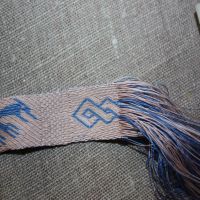
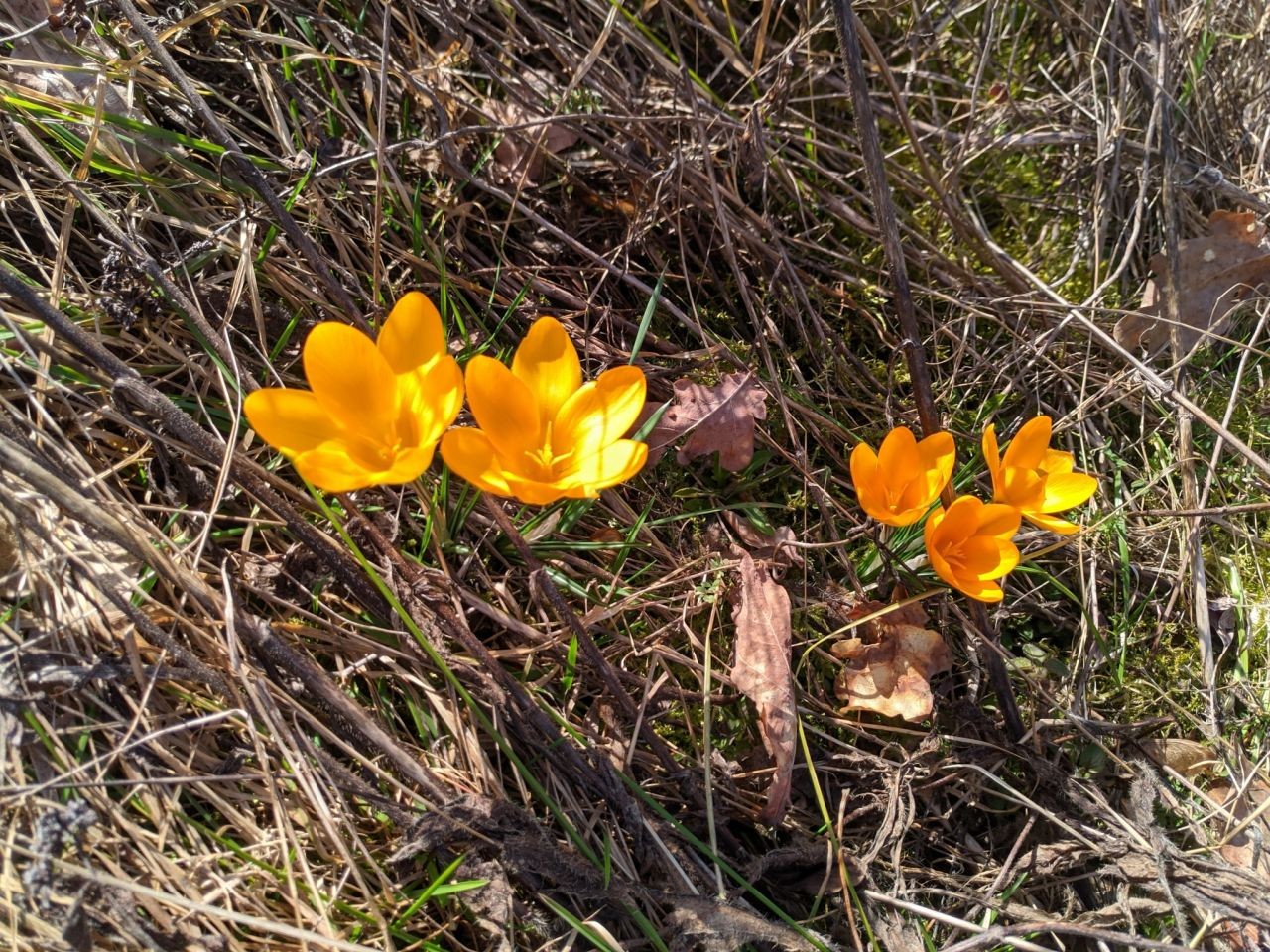
I am off to do things - which means that I will be off the blog until March 16. Until then, I will leave you with these harbingers of spring:

...and hope that you will have a good time and enjoy some lovely weather!

I am off to do things - which means that I will be off the blog until March 16. Until then, I will leave you with these harbingers of spring:
...and hope that you will have a good time and enjoy some lovely weather!

I've gotten the information that there's a new open access book out, about - natural dyes! The book is the result of an EU project to help revive natural dyeing, but is mainly geared towards educational and artistic users.
You can download the pdf for free from this website. I hope you enjoy it (and thank you Mari for the information!)
I spent today in an online conference, which was fabulous, but a little short on break time - so my brain feels rather mushy now. Nothing a little bit of fresh air and some food won't fix, hopefully, as there's the weekend packing to be done...
Tomorrow is another conference day, with the same rather enthusiastic schedule, and tired or not right now, I am already looking forward to it a lot!
I've stumbled across links to two alternative search engines recently. One of them is Marginalia Search, which, sadly, does not refer to marginalia in medieval manuscripts, but rather to the margins of the Internet.
The other is called WiBy and dubs itself "the search engine for the classic internet". You know, the Internet as it used to be when it was geocities and lots of personal websites, or at least that's the vibe I got from it.
It does indeed seem to me like searching the 'Net gets harder these days, with more and more AI-generated stuff flooding everything. Only a few days ago, I got to see a "crochet pattern" showing cat's faces. It looked lovely, and quite life-like, but more like needle-lace than crochet, and though the "pattern" looked hand-written, the whole thing was, you guessed it, AI. All this added to the fact that some terms are harder to find things anyway than others, and unfortunately textiles have a lot of these terms... well.
So I've taken a look at the two alternatives, and I think they're not my solution. They are both giving out links to sites that might not be up on top of the Duck's list (I usually use duckduckgo as search engine), but nothing that looked really interesting to me and that I hadn't seen before. There might be more amusing or enlightening outcomes for other searches than "hand spinning" and "medieval textiles", but those are the two that I tested.
No glorious alternative for me, thus. Which means I will stick to the duck for now, with the addition of searching via academic portals and the Google Scholar page - which is, actually, quite good, much as I try to limit my use of Google stuff.
Sometimes, when you're researching something, it seems like there are funny gaps in what we know, or what we have, or both. For instance, there seems to be a funny gap for textiles from around the year 1000. There's also a funny gap regarding spindle whorls that date to the High Middle Ages. (Granted, there's a funny gap regarding spindle whorls, period, at least if you are looking for publications with a focus on them... but that is an entirely different story. Just like the fact that it might just be perception, as you never have enough information about the current focus topic, no matter what it is.)
I have Slavic whorls that are decently published, Early Medieval ones, Viking period ones (Birka, we are grateful for you), and there's collections of Late Medieval and Early Modern ones, but the High Middle Ages? Meh.
Or at least I haven't found much. There's the occasional mention of one being found somewhere, but they are rarely published properly, with the weight, measurements, and a drawing.
So in case you have good examples, or know of good publications with them... I'm all ear.
Thanks to my lovely textile colleague Sarah Goslee, I've been pointed to the DOAB - the Directory of Open Access Books. And yes, it does contain quite a number of textile-related books!
You will probably have to filter down if you only search for "textile", as there's a lot about modern speciality textiles and modern textile manufacture in the list, but fortunately an "archeology" filter exists, as do several others.
You can find the main directory at https://www.doabooks.org/en. I hope it will be helpful for you!
I have been dabbling a bit more with the Lengberg cap sprang - on and off, though mostly off in the last months, and now it's more on again. (I am on row 48 or so of almost 200, and I realised that I will need the frame for the Sprang workshop in June, which gave me a nice bit of extra motivation to finish before then.)
While I did make the pattern for the hands-on piece for an exhibition about women's networks by marriage, due to start in May, the piece was done with slightly thicker threads and ran much longer than the original for the same amount of rows. Our solution was for me to make fewer rows - it's enough so you can still get a nice impression of the pattern, but it also was a good compromise for the museum budget. In this case, being a bit "off" from the original was thus not really bad.
It still irked me a little, especially after taking more looks at images of the original and realising how incredibly dense it was. So I made another set-up (with probably way too long threads, but I wanted to have room to manipulate at the end still), with slightly thinner threads, and made it my main task to get the fabric really, really, really, really dense.
By now I am far enough to see how well it worked - and I am actually not too far off the original this time!
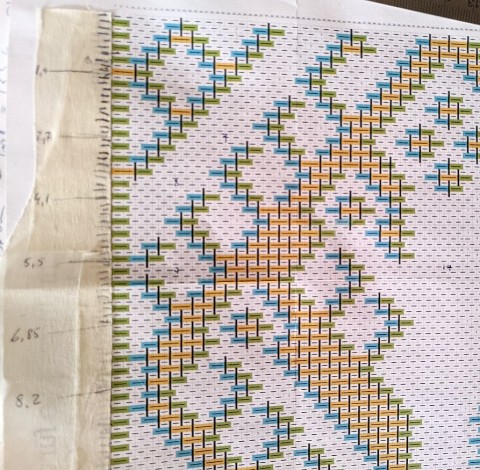
This image shows you part of the pattern chart written by Carol James, with my marks of "done" rows and, more importantly, small numbers giving the length in centimeters at that place on the original, calculated from the amount of overall rows and the full length of the original piece. It's a guideline, thus, nothing more - but I find it very helpful.

As you can see (more or less well), I should be at about 6.85 cm of length now. I am at...
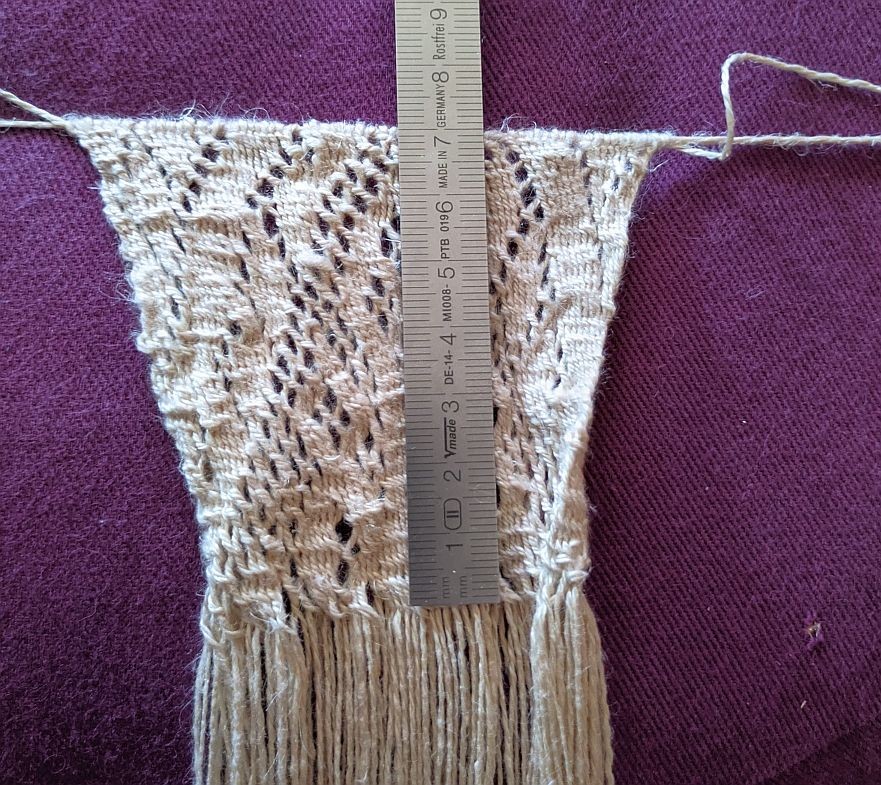
...about 7 cm. That is not too bad! The bottom piece is a little more irregular, and I measure something between 7 and 7.3 cm there, but I still have hope that it might even out again some more.
The trick to getting there was, apart from having the right thickness of threads, working with very little tension and pressing the new row in very, very, very hard. That includes pulling the threads against the weaving sword in small bunches, and repeating it across the width several times. It doesn't take quite as long as the braiding row itself, but it feels almost like it!
So this is how the frame looks, and yes, that is my working "tension".
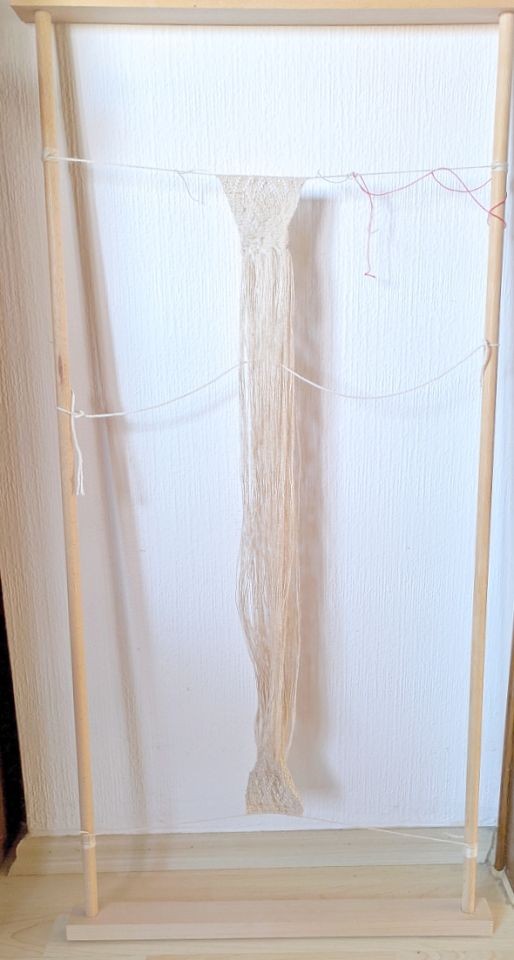
It does work, though! And I can have a little more working tension when doing the manipulation, too, as I am working close to the top fell. Now only about 150 rows to go, and I will be done!
By accepting you will be accessing a service provided by a third-party external to https://pallia.net/